a sermon for Easter Day, picking up on the turn made by Mary Magdalen. The readings for the day are Acts 10:34-43 and John 20:1-18
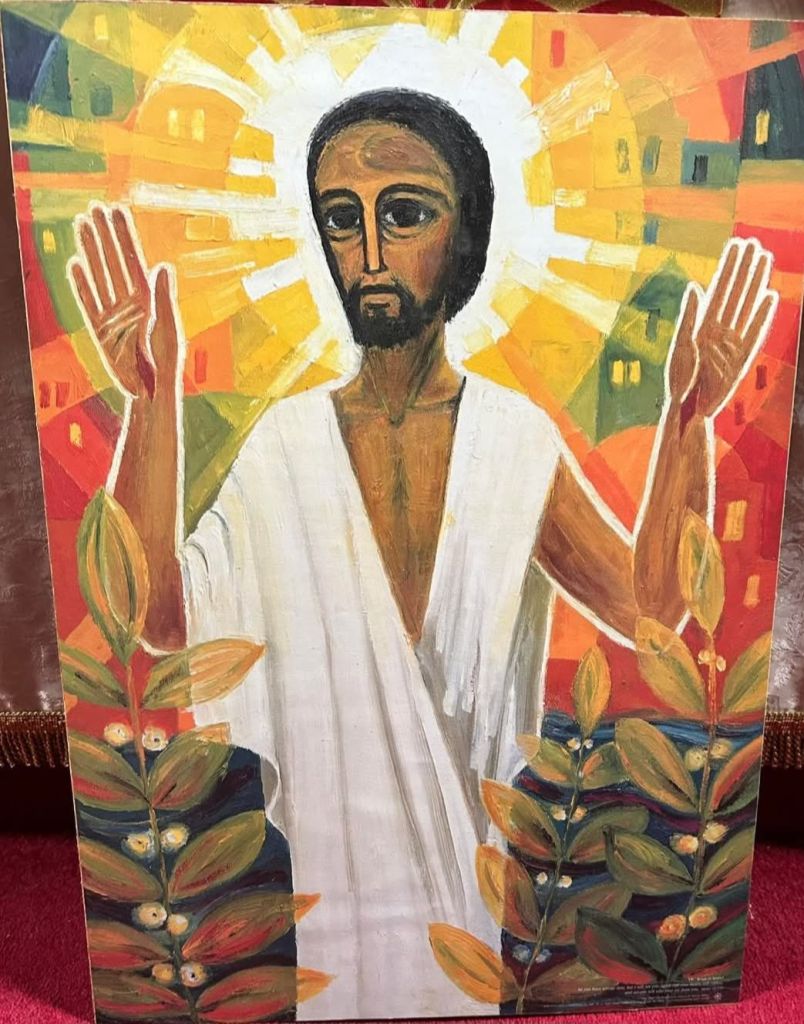
I love preaching that brings scripture to life. I love preaching that brings scripture back to life – back to the life, the often bitter experiences through which the word of God has been heard.
This morning, I want to highlight two moments in John’s Easter story. The first is about time. The second is about a turn.
So the time.
It was early.
It was the first day of the week.
It was still dark.
We set our clock by that sentence.
We gather as early as we can on the first day of the week.
And we do that because of what was found that morning.
Our whole body clock is set to the rhythm of resurrection.
We don’t live by Greenwich Meantime.
We live according to Resurrection time.
Early on the first day of the week, while it was still dark …..
It’s always dark in John’s gospel.
Taking his cue from the very first verses of our scriptures, from Genesis, John begins his gospel with the words In the beginning was the Word, and the Word was with God and the Word was God.
For John, Jesus was always the Word.
In him was life, and that life was the light of the world. The light shines in the darkness and the darkness has not overcome it.
In John’s gospel there is always darkness, from first to last.
Even on this morning of resurrection, John writes, it was still dark.
His context was that his community faced a hostile environment.
The persecution they suffered cast a long shadow over them.
They were persecuted by their fellow Jews who rejected their beliefs about Jesus and mocked them as Nazarenes.
Eventually they were excluded from their synagogues and became outcasts.
So, it was still dark when John wrote his gospel.
I suspect most of us would recognise the usefulness of darkness as a metaphor for our own times.
It is still dark because our lives are overshadowed by all sorts of crises of carelessness and cruelty, and because of the suffering we inflict on one another because of what we can get away with under the cover of darkness. We walk through the valley of the shadow of death.
We all have known dark times in our lives.
Every generation says the same.
It is still dark.
We can’t wait for the clocks to change. For lighter nights.
With darkness comes despair.
Our fears and anxieties come alive in our darkness.
It is still dark and there are those with the upper hand who want to keep us in the dark.
There are those who profit by keeping us in the dark—not just politically, but emotionally and spiritually.
The algorithms of social media don’t care about truth—they care about our despair. Despair keeps people scrolling down, microdosing us with reasons for despair till we turn against ourselves and one another.
Our teachers are saying that there is a national emergency as they see the damaging effects of dangerous influencers on our children. They report a rise in misogyny and racism flooding our schools as pupils ape the behaviour of figures such as Donald Trump and Andrew Tate.
One teacher said, “I have had boys refuse to speak to me, and speak to a male teaching assistant instead, because I am a woman and they follow Andrew Tate and think he is amazing with all his cars and women and how women should be treated. These were 10 year olds.”
This is a black hole our children are falling down.
The challenge for all of us is how we build resilience for our children and ourselves to prevent our doomscrolling and to build our resistance to those who have a vested interest in keeping us in the dark, despairing at the way things are.
And what’s all this got to do with Easter?
Well, Jesus is the light that shines in the darkness.
it’s still dark.
In 2025, it’s still dark – very dark for many.
As it was in the beginning when, in the words of the first verses of our scriptures, darkness was over the whole world (Gen 1:2) so it is now, for our children and for ourselves.
Wherever we look there are things we can’t see and things we can’t understand.
It is still too dark to see.
And that’s how it is in our gospel this morning. It was still dark, and there was a woman by a tomb, one of the disciples Jesus loved and who loved him. She is weeping her heart out because the body she wanted to see was nowhere to be seen. She is overcome by grief and despair. It was very dark for her that morning. The only light she could see was the light of two angels who asked her what the matter was?
And she turns.
She turns in her grief and sees Jesus standing there. She didn’t know it was Jesus. She thought he was the gardener.
The first question the church asks us when we are baptised is “Do you turn to Christ?”.
The whole movement of Mary Magdalen is loaded into that question.
We turn with her.
John, the evangelist takes us deep into the heart of darkness in the details of Jesus’ death and crucifixion and then turns us round.
Instead of being fascinated by the tomb and death, he turns us round to see Jesus.
There’s a turning we all need to keep making.
It’s a turning called repentance.
Resisting darkness, despair and all the fears of the night means turning our heads, our minds our hearts and our whole selves round.
It’s such a simple movement John describes.
He wants us who share the same darkness to notice her turn.
She turns.
He wants us to turn round with her to see what she sees.
While it was still dark and she was weeping she turns around.
She turns round to see a stranger.
At first she doesn’t see.
She thinks he is the gardener who might have carried Jesus’ body away.
She is like the blind man Jesus healed in Mark’s gospel.
He needed a second touch from Jesus.
At first he could only see people looking like trees walking, but then “he saw everything clearly” (Mark 8:22-26).
So it is with Mary Magdalen. When she first turned she did not know what she saw. She knew him in the intimacy of his call. Mary.
This is how Easter people are formed.
It’s our turn now
from despair to hope
from darkness to light
from hatred to love
from the dead ends
of selfish dominions
to life that is eternal.
It is to see a different way
and look in a new direction
that we join Mary of Magdala
the disciple Jesus loved
and called in the whisper of her name.
She became the first apostle, not by understanding, but by turning – and then being sent. Resurrection begins with a turn, in the dark. Let us follow her intentional movement. First, to turn, then to see, and then to go.
Do you turn to Christ while it is still dark?

 Grits and Grains