Thy Kingdom Come

Today is the 7th Sunday of Easter, the 7th Sunday of the 50 day season of joy.

I just mention that because we always have to watch out for the number 7.
It is, if you like, our lucky number.
It is the number of completion and fulfilment.
It’s the days of the week,
the measure of our time,
the time of creation,
the span from start to finish.
It’s the number written into our rhythm of life –
the six day week, the day of rest, the gift of God.

So, we’ve had 7 Sundays inhabiting the Easter message,
letting the hope of resurrection work in our hearts and minds.

But the season isn’t quite over.
We are left with a question.
It is a question asked of the apostles, and by the apostles.
And it’s been left hanging for all who have followed them.

They gathered round Jesus and asked him:
“Lord, are you at this time going to restore the kingdom to Israel?”

As far as we can see, they don’t get an answer.
They were asking him – are you the Messiah we were expecting?
Are you the one to restore the fortunes of Israel?

There is no answer because it’s the wrong question they’re asking.

The question is a reflection of one of the great temptations of human nature –
the tendency towards nostalgia and restoration.

The temptation is still with us.

We long for restoration.
We dream of returning to some imagined greatness,
some remembered certainty,
some lost golden age.

Nations do it.
Churches do it.
We do it ourselves.

There are men in white suits in today’s readings.
They catch the apostles watching Jesus disappear from sight.
They see their grief and their pining for the past,

and then they tell them to stop looking that way,
and they redirect the gaze of their longing

They redirect the gaze of their longing –
away from nostalgia,
away from heaven as escape,
back toward Jerusalem,
back into the world,
back into prayer,
back towards one another.

They stop staring into heaven.

They turn around.

And they walk back to Jerusalem.

A sabbath walk.
Day seven.

And Day Seven becomes Day One:
not completion as an ending,
but completion opening into a beginning.

Easter gives its people a new body clock,
a new sense of time,
a life no longer ordered by nostalgia for the past
but by longing for what God is yet to do.

The time of our lives.

And what do they do,
these people learning resurrection time?

They pray.

They return to Jerusalem,
and gather in an upstairs room.

Men and women together.
Mary.
The brothers of Jesus.
The Church before it knows what the Church will become.

And they pray.

They do not launch a strategy.
They do not reclaim power.
They do not “make Israel great again”.

They pray:
waiting not for the restoration of the past,
but for the coming of the kingdom of God.

This is Day One of the prayer of the Church,
not longing for the past glory,
but longing for a glory like no other glory we have known,
not longing for the past
but longing for the future.

Thy kingdom come,
that’s the way to pray.

When we introduce the Lord’s prayer,
we casually say
“as our Saviour has taught us,
so we pray”.

But let’s be definite.
This is the way Jesus taught his followers to pray. To pray for the kingdom to come,
on earth as it is in heaven.

So we could say in introducing our prayer:

this is the way we pray
because this is the way Jesus prayed,

looking to our Father in heaven,
giving him the power and glory
instead of seeing power and glory
in wealth, or celebrity, or control.

This is looking the other way.

Looking away from power as domination,
and discovering power as compassion.

Looking away from glory as status,
and discovering glory as love poured out.

Because when Jesus speaks about glory,
he does not mean celebrity,
spectacle,
or triumph.

In John’s Gospel,
Glory means the cross.

Glory is love poured out.
Glory is love that gives itself away
for the life of the world.

Glory is love that gives itself away for the life of the world.

And that is why our Collect today dares to hold together two words usually kept apart:

power
and compassion.

Heaven’s power is compassionate power.
Worldly power is anything but.

Risen, ascended Lord,
as we rejoice at your triumph,
fill your Church on earth with power and compassion …….

that’s the way to pray,
for the sake of the future,
for those who suffer
under the world as it is,
and under the ways we have learned to look at one another,
for those “estranged by sin”,
by the wrongs of the world,
for those estranged,
disconnected, alienated, turned inward, turned backward.

For their sake,
that they may find forgiveness,
that they may know peace

that’s why we pray,
It’s for their sake,
for the sake of the lost, the last and the least,
that the glory of heaven
may be seen on earth,
in the troughs of human experience,
in the valleys overshadowed by death.

And so this week,
in churches,
halls,
homes,
and quiet corners,
Christians will gather again,
just as they did in that upstairs room.

Not looking backward,
not staring into the sky,
but praying toward the future:

Thy kingdom come.

When we pray the Jesus way,
Jesus prays alongside us still:

for the world,
for the estranged, the wronged,
for peace,
for glory shaped like love.
Rooms in the Ruins: Stephen, Coventry, and the room God makes in the midst of violence

In the ruins a fire is lit.
In the midst of violence, a man sees heaven open.
This sermon traces a thread from Saint Stephen to Coventry cathedral, and from the “many rooms” of John’s Gospel to the fractures places of our own lives – suggesting that the rooms God prepares are not elsewhere, but here, wherever love makes space in the face of conflict.


Easter 5 (A)
This morning we meet Stephen at the very end of his story,
Standing before an angry crowd,
accused, opposed,
and about to be killed.

And we hear that extraordinary line:
Filled with the Holy Spirit, he gazed into heaven …

But if we start there, we miss what makes that moment so powerful.
Because Stephen didn’t begin here.


He first appears a chapter earlier, in Acts of the Apostles,
when the early church is already under strain.

There is a complaint –
that some widows are being overlooked in the daily distribution of food.

It’s about fairness.
Culture.
Whose voice matters.

A real fault line has opened up.

And Stephen is one of those chosen to step into that situation –
because he is known to be full of the Spirit and wisdom.

Not removed from the tensions,
but right in the middle of them.

He learns to follow the Spirit there,
at the tables,
among those who are last, and least, and easily forgotten.


From there, things escalate.

Stephen begins to speak – boldly – about what God is doing.

He challenges the assumption that God can be contained in the temple,
or managed by those in power.

He reminds his hearers of the words of Isaiah:
“Heaven is my throne, and the earth is my footstool …
What kind of house will you build for me?”

God is not contained.
Not controlled.
Not organised around our comfort.

And that is what turns disagreement into fury.

So that by the time we reach today’s reading,
Stephen is no longer serving at tables –
he is standing before those who want him silenced.


And there –
in that moment of pressure, accusation and danger –
we are told:
“Filled with the Holy Spirit, he gazed into heaven …”

Now, we might imagine that this means Stephen is being lifted out of reality –
given a glimpse of somewhere else,
somewhere safer,
somewhere beyond the reach of what is about to happen.

But that cannot be what it means.

Because when he looks into heaven,
he does not see buildings.
He does not see rooms.

He sees the glory of God –
and Jesus Christ standing at the right hand of God.

Standing.
Alive.
Present.


Hold that alongside the words of Jesus in John’s gospel:
“In my Father’s house there are many dwelling places …
I go to prepare a place for you.”

We have often heard those words as a promise about where we go when we die.

A heavenly building.
Rooms prepared somewhere else.

And there is comfort in that.

But Stephen – standing under accusation,
with stones already in the air –
suggests something different.


Because in John’s Gospel, “dwelling” is not about property.
It is about life shared.

“Abide in me, as I abide in you.”
“We will come and make our home with them.”

So when Jesus says,
“I go to prepare a place for you,”
the question is:

How, and in what way?

It’s not about a heavenly mansion with (how) many rooms.
It’s not a building
a building somewhere else.

No.

It’s about what love is building
here and now
    in the middle of the world as it is.

It’s about love making room,
one room on top of another,
room for strangers,
room for sinners,
room even for enemies
and those who attack us,
room for those left out in the cold,
those homeless and neglected
like those widows previously unheard.

The Father’s house isn’t something set in concrete,
built somewhere else.

It is God’s work,
building love,
making room for forgiveness.

And it is here that Stephen stands,
in the place prepared for him.
And he sees it,
and his face so shines,
even as the stones are hurled in anger.

Because to see into heaven
is not to gain information about the afterlife.

It is to see reality as it truly is:

that God is not absent,
not contained,
not defeated –

But present,
active,
and drawing all things into the life of his kingdom.


And once Stephen sees that,

he begins to reflect it.

His face shines, and
his words echo Jesus:
“Lord, do not hold this sin against them.”

This is not weakness.

This is the life of the Father’s house
breaking out
in the middle of the world’s violence.

In the middle of the world’s violence,
there are those who have found room for God –
the room that God has prepared for them.

The room we have for God in our lives
is the room that God has prepared for us –
one of so many rooms.

And it is this life –
this room opened to God
In the middle of the world’s violence –
that cannot be tolerated,
And Stephen will pay for it with his life.

Because if God’s dwelling is not contained,
and not somewhere else,
then neither is God’s authority.

If heaven is breaking out here –
then the systems built on power and control are exposed.

And so they cover their ears.

And they rush at him.


But this way of seeing did not end with Stephen.

It has appeared again and again,
where people have been formed by the Spirit
in the middle of real world fault lines.

In this diocese, we cannot hear this story
without thinking of Coventry Cathedral.

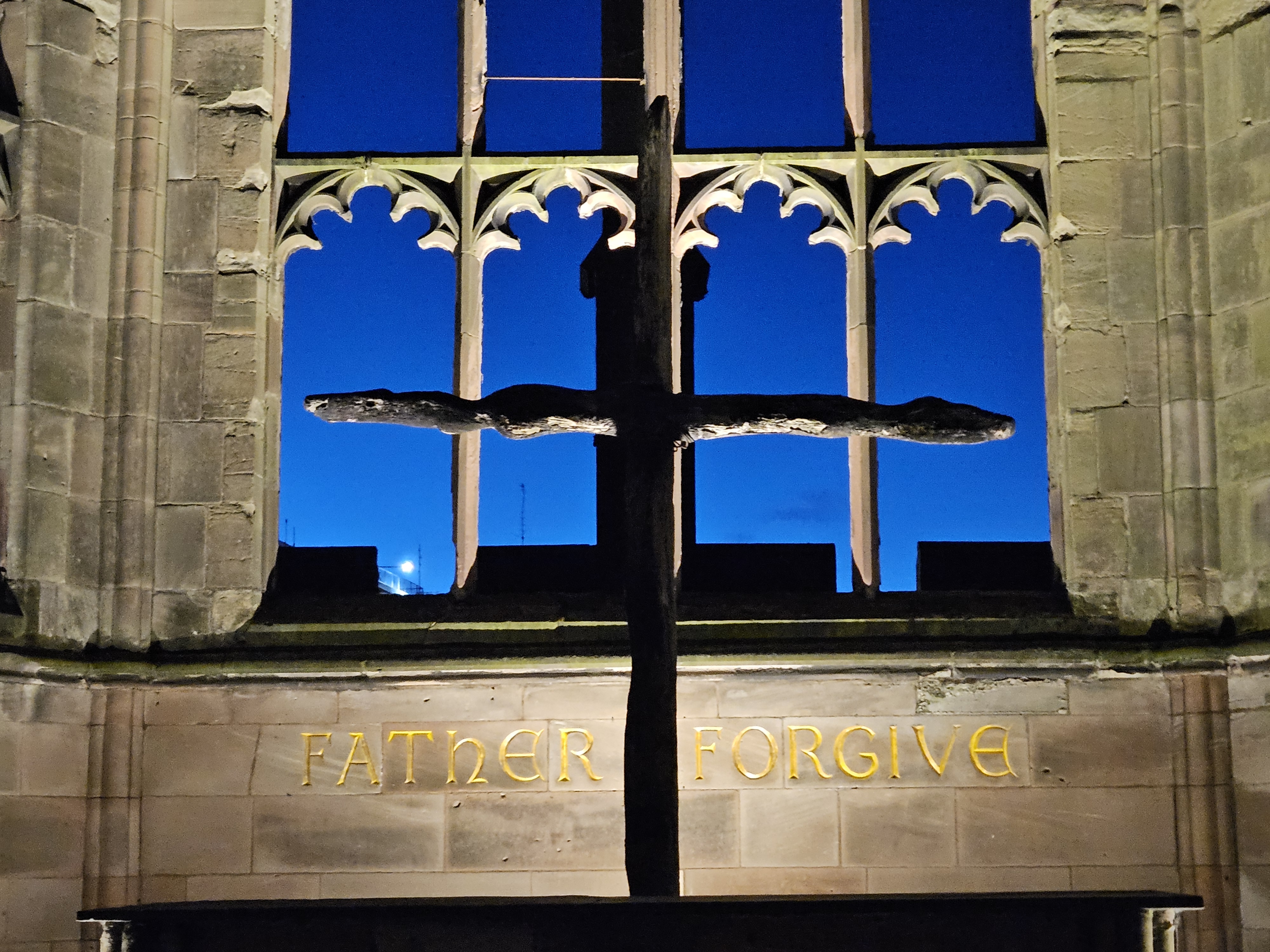
In the ruins of Coventry Cathedral at first light on Easter Day 2026

In 1940, the cathedral was destroyed by bombing.

Stones – not thrown by hand this time,
but falling all the same.

And in the ruins,
Provost Dick Howard did something extraordinary.

He did not call for revenge.

He did not divide the world into “us” and “them”.

Instead, he had these words inscribed:

Father forgive.

Not “forgive them.”
Just: Father forgive.

That is not sentiment.
That is not denial of suffering.

That is someone seeing into heaven.

Someone recognising that the Father’s house
is not destroyed by violence –
because it was never contained in stone.

And that the life of that house
with its many rooms
is forgiveness,
even here.

Even now.

And this is not just something that happened then.

It is something we are caught up in here.

Because in this diocese, when people are ordained,
they are ordained in that cathedral –
in that space opened up in the midst of destruction.

A place where violence did not have the final word.

A place where, in the ruins,
room was found for forgiveness.

Stephen was a deacon –
formed at tables,
among the overlooked,
in the fault lines of his community.

And from there, he learned to see into heaven.

And those ordained in that cathedral
are ordained in that same pattern:

not away from the world’s conflict,
but into it –

trusting that even there,
God has made room.

The room we have for God in our lives
is the room that God has prepared for us –
one of so many rooms.

And we have seen that recently.

Gary and Brittany were confirmed there on Easter Day
at the crack of dawn,
when the Easter fire was lit
in the ruins of the cathedral.

Fire again in that place –
but not the fire that destroys.

Not the fire that reduces everything to ash.

But the fire of resurrection.

The fire of the Spirit.

In the very place where flames once consumed,
a different fire now burns –

not to destroy,
but to give light,
to gather,
to kindle new life.

And there, in that same place,
a life opening to God,
a place being made,
a dwelling beginning.


Not somewhere else.

But here.


So the question is not whether there is room in the Father’s house.

The question is whether we will enter the room
that God has already prepared for us –

in the places where the world is most fractured,

where the fire is still being lit in the ruins,

and where, even there,
heaven is already open.

The Feeding of the Three Thousand and the Small Flock

In a world that prizes numbers, growth, and standing out, the early church points us somewhere different. In Christ, even a small flock—known, gathered, and fed together—is already enough. This reflection for two small churches takes its cue from the scriptures for the Fourth Sunday of Easter (Year A): Acts of the Apostles 2:42–end, Gospel of John 10:1–10, and Psalm 23.


“They devoted themselves to the apostles’ teaching and to fellowship, to the breaking of bread and to prayer.” (Acts 2:42).

That’s how Luke describes the life of the disciples after God has become present to them in a new way.
Those are the first words of our reading this morning from Acts of the Apostles.

But the verse just before – heard in our churches last Sunday – tells us something else.
It tells us that about 3000 people accepted Peter’s message and were added to their number.

Three thousand.

We’ve heard many times, the story of the Feeding of the Five Thousand.
It’s in all the gospels.

And there’s another feeding – the 4000 – told by Matthew and Mark, but not by Luke.

But Luke does give us another feeding.

Not the feeding of the 4000.
But the feeding of the 3000.

In those gospel stories, crowds gather around Jesus.
They are hungry.
And with very little – just a few loaves and fish – Jesus feeds them.

A sign of the kingdom of God:
that what is little becomes enough …
that what is least becomes abundance.

And here, in Acts, there is another crowd.

Three thousand, drawn from a larger crowd in Jerusalem at Pentecost.

And Luke says of them:

They devoted themselves …
They were together …
They had everything in common …

He is speaking about those three thousand.

So again we might say:

Luke doesn’t tell us about the feeding of the 4000.
But he does tell us about the feeding of the 3000.

Because they too were hungry.

You can almost see it on their faces.

But not for bread and fish.

They were hungry for something deeper –
for a new way of life.

And what they are given is this:

Teaching.
Fellowship.
Shared life.
Bread broken together.
Meals shared with glad and generous hearts.

This is the feeding of a deeper hunger.

The hunger for meaning.
The hunger for belonging.
The hunger for righteousness – for things to be as they should be.

And what they are given …
is a whole new life.

Not just food for the day,
but life together in Christ.

The life of the risen Christ,
lived out in humanity.

And that life –
the life of the risen Christ lived out in humanity –
it didn’t end with those three thousand.

It is the life of the church.

It is our life.

And that’s where this meets us.

Because when we hear about the three thousand,
it’s easy to think: that’s not us.

We are not a crowd.
We are small in number.
A handful here … a handful there

More like a small flock than a great multitude.

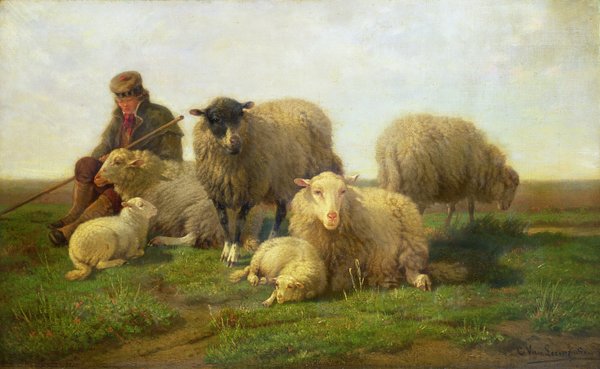
A shepherd with sheep and lambs by Cornelis van Leemputten
This is a small flock. They too need a good shepherd.

But listen again to what Luke describes in Acts of the Apostles.

He doesn’t describe something that only works for large numbers.

He describes something close …
shared …
personal …

They devoted themselves …
They were together …
They broke bread …
They prayed …

That’s not a stadium.
That’s something much more like this.

And then we hear Jesus in John’s Gospel:

“I am the good shepherd …
My sheep hear my voice …
I know them …
and they follow me.”

Not a crowd.

A flock.

So perhaps the question for us is not:
how do we become like the three thousand?

But how do we recognise what we already are?

A small flock.
Known.
Gathered.
Fed.
Held together by the voice of the shepherd.

And the gift of a small flock is this:

You cannot disappear here.

You are not one face in a crowd.

You are known.
You are noticed.
You belong.

And yet … there is a danger for churches like ours,
in times like ours,
when it’s all about numbers, growth and influence.

Because when we hear about the three thousand,
it is very easy to start thinking:

if only we were more …
if only things were different …

And slowly, almost without noticing,
our attention shifts.

Away from who is here …
to who is not.

Away from what we have been given
to what we think we lack.

And when that happens, something else can creep in.

A quiet dissatisfaction.
Even resentment.

A feeling that we are being held back –
by numbers,
by circumstance,
even, perhaps, by one another.

But that is to go after the wrong prize.

Because the prize was never the three thousand.

The gift –
the miracle –
was what they became.

A people who shared life.
A people who belonged to one another.
A people who were fed with the life of Christ.

And that is not something we have to chase.

It is something we have already been given.

Here.

Among us.

So the question is not: how do we become more?

But:
how do we become more deeply what we already are?

More attentive to one another …
More ready to share life …
More open to the voice of the shepherd …

Because when that happens –

this small flock,
this ordinary gathering of people –

becomes something extraordinary.

Not because we stand out from the crowd.

But because we belong to one another,
and are led by the one who knows us by name.

In the end, the gift is not becoming something else,
or someone else,
bigger, better, or whatever it may be –

but recognising that, in Christ,
what we have …
is already enough.

The good shepherd
leads the small flock –

even the two or three –

through the valley overshadowed by death.

He leads us.
He sets a table before us.
He feeds us
as we break bread together.

He satisfies our deepest longings –

as he has satisfied thousands before us.

The Lord is here.
In this small flock.
In this shared life.

The Lord is here.
His spirit is with us.

The Withdom of God

Sometimes a new word is needed — not to replace what we know, but to help us see it more clearly.

Withdom is one such word.

In this Easter reflection, I explore how the risen Jesus is made known not in power or distance, but in presence — walking with, staying with, and being with us wherever we are.


A few weeks ago, some of us met for conversation around the subject of finding our voice in worship.
There were so many of us that we had to break into small groups to get the best out of each other.
As we fed back into the larger group a phrase was coined which seemed to sum up the meaning of our conversation.
We were talking about how we enable the worship of the people of our churches and villages.
A voice of one of our shepherds came over loud and clear.

She had found that the most important thing in her work
was winning the trust of the sheep.
And she talked about how she did that.
By staying with them.
Not driving them. Not fixing them.
Staying with them until they found their own voice.

That opened our eyes to what we were exploring.
How do we enable the worship of the people of God
when so often we are led to believe that we have to be anything but ourselves?
It is by staying with people, as they are, that encourages people to be as they are.

And one good shepherd reminded us of another good shepherd,
who knows the voice of his sheep
and whose sheep know his voice.

And so, a word was born.

And we called that word … withdom.

Some of us weren’t so sure.
Withdom is not a proper word,
it’s not in the dictionary.”

But we let it stand
because it carried our meaning.

It was never meant to find its way into the dictionary,
or become word of the year.

It was meant to lodge
in our theological imagination …


as just the way God is,
with us,
full of withdom,

and the way we’re called to be
with all those God loves
and chooses to be with,
all those blessed by withdom,
the least, the last, the lost.

We dared to imagine
the rule of the kingdom of God
being the withdom of God.

And once we begin to see it,
we notice it everywhere.

There is much withdom
in our readings today.

In our reading from Acts (Acts 2:14a, 36-41),
Peter stands with the eleven
and addresses the crowd who were with them.
Three thousand of them accepted his message
and joined the eleven –
not just agreeing with them,
but coming to be with them.

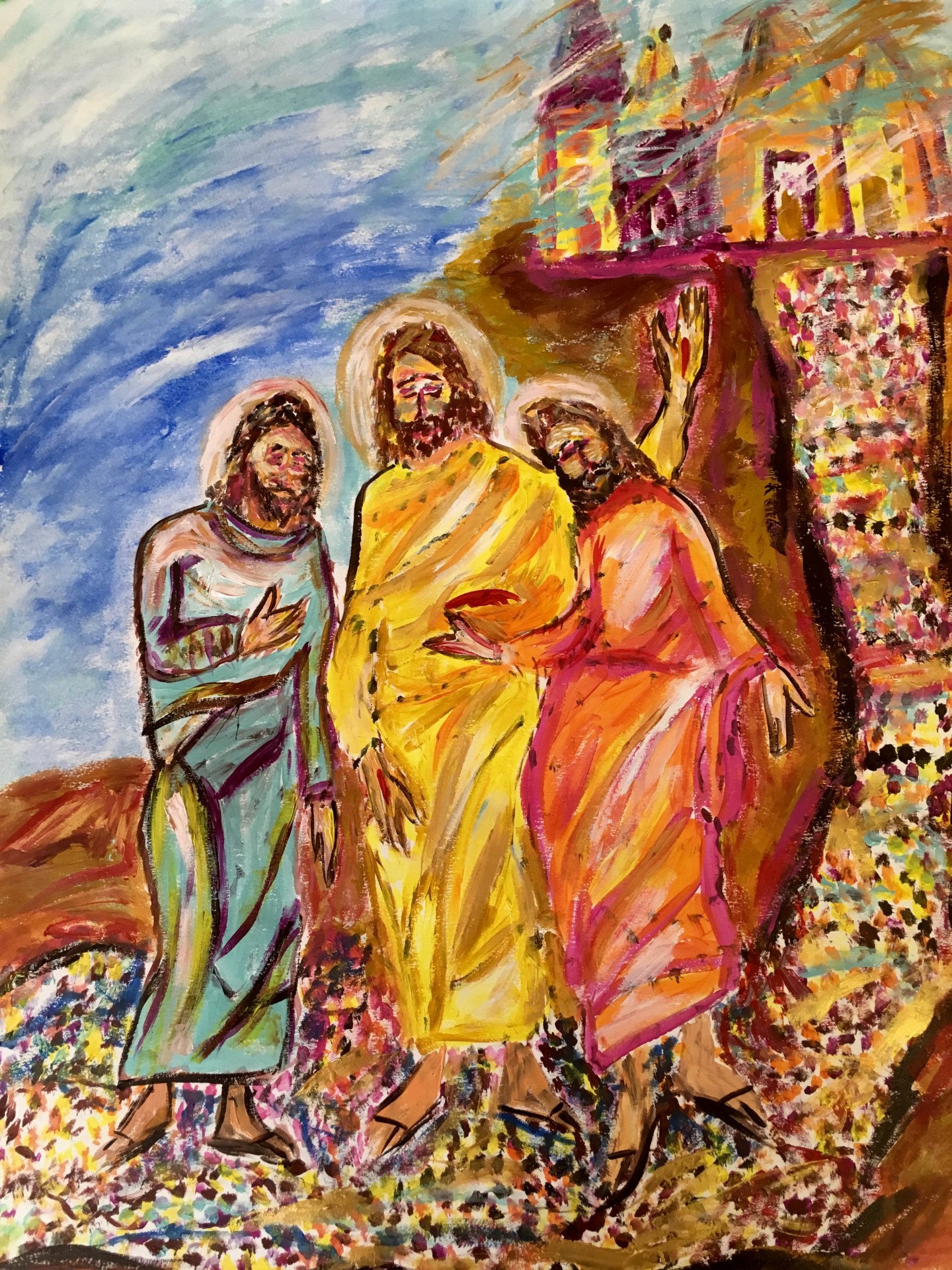
The Road to Emmaus: Painting by: Ronald Raab, CSC

The gospel (Luke 24:13-35) puts us alongside two grief stricken disciples
as they make their way home.
They are joined by a stranger,
who walks with them,
in their grief,
through the valley of the shadow of death.

He is with them.

Nothing could stop him being with them.

Not their confusion.
Not their grief.
Not even their walking away.

He would not be separated
from their lived experience.

This is what he shows them
as he walked with them, stayed with them,
broke bread with them.

And this is the truth we are given –
that nothing … can separate us
from the love of God in Christ Jesus,
neither death nor life,
neither angels nor demons
neither the present nor the future,
nor any powers that be,
nothing in the whole of creation
can break the withdom of God. (Romans 8:38-39)

And if this is the withdom of God …
then this is the life we are called into.

Not to drive people.
Not to fix them.

But to be with them.

To stay with them
until they find their voice.

To be a people who can be trusted …
because we come alongside.

To be with those
who have been told they are not good enough …
and those who are walking away …
and those who don’t recognise hm.

This Easter morning – r evening –
the risen Jesus
comes alongside two disciples
who are confused,
disappointed,
walking away,
not good enough … perhaps in their own eyes.

And he is with them.

Nothing could stop him being with them.

So, if you have ever been led to believe
that you are not good enough …
that God is somehow not with you …
hear this story again.

The Lord is here.
His Spirit is with us.

What We Thought Was Sealed

The first Easter began with people who weren’t sure of anything. They were running, confused, and grieving… until they noticed that what they thought was sealed had been opened.
This sermon explores how resurrection begins not with certainty, but with the slow, surprising discovery that God is already at work — breaking open the boundaries we thought were final.


There’s a quiet pressure around Easter …
that this is the day you’re meant to be sure.
Sure about what happened.
Sure about what it means.
Sure what you believe.

But the strange thing is –
in the very first Easter story …
nobody is sure of anything.

John paints a picture of that first Easter morning.
Everyone seems to be rushing around.
They’re all running.

First there is Mary Magdalen,
then the so-called “beloved disciple”,
then slow-coach Peter.

All running around like headless chickens,
not quite knowing what they’re looking for,
or what they’re going to find.

That’s the risk for the preacher
and for all of us,
running around Easter Day
pretending we’re sure,
pretending we know what we’re talking about  …

when the truth is,
the first Easter began
with people who didn’t.

The first thing they didn’t understand
wasn’t an idea, or a belief, or a theory.

It was something much more concrete than that.

It was a stone.

The stone was supposed to settle things.

To close the story down,
To seal it.
To make it final.

This is how the world works:

when something is over,
it is over.

We know about stones like that.
Moments that feel sealed.
Doors that don’t reopen.
Relationships that don’t come back.
Hopes that have run their course.

And Mary arrives …
not expecting a miracle,
not looking for resurrection …
just coming to a place that would have been closed.

And the first thing she sees is this:
the stone has been moved.

The very first sign of Easter
is not that Jesus appears,
nor that anyone understands

but that what they thought was sealed
isn’t sealed anymore.

And they don’t know what it means.
They don’t suddenly become certain.
They just know this:
something they thought was final …
has been opened.

And that is how resurrection begins.
Not with explanations,
but with boundaries giving way.

The boundary between life and death.
The boundary between what we think is possible
and what God is doing.
The boundary between who we think belongs to God
and who God is already calling.

It will take Peter a long time to understand that.
Years in fact.

Before this moment, he had been confronted with strange visions.
Voices telling him to let go
of what he had always been sure about.
An invitation to enter the house of people
he never imagined God could use.

Step by another stone step, another stone was being moved.
Not at a tomb this time …
but in Peter’s own heart.

And finally he says:
“Now I understand …
God shows no favourites.”

And what he realises is this:

that Gd has been moving stones
that he, Peter, didn’t even know were there.

Stones he had lived with all his life.

Stones that had quietly built walls –
about who belongs
and who doesn’t.

Because Peter had grown up in a world
where there were very clear boundaries.

Between Jew and Gentile.
Clean and unclean.
Inside and Outside.

Lines you didn’t cross.

People you didn’t eat with.
People you didn’t enter the house of.

People you certainly didn’t imagine
were part of what God was doing.

And it’s as if, step by step,
another stone is being moved …
not at the tomb this time,
But in Peter’s own heart.

Peter’s world is not so very different from ours.

We have our own ways of sorting people.

Our own quiet lines
about who fits …
and who doesn’t.

Our own assumptions about
where God is likely to be at work …
and where God couldn’t possibly be.

Isn’t it funny that Jesus called Peter the rock?
The solid one, the dependable one,
the one we might think would always have it together.
And yet here he is, confused, unsure and learning
that God’s work doesn’t obey the walls he’s built.

The rock … is still learning to listen.
And in that, he becomes truly solid –
not because he knows everything,
but because he has learned where God is really at work.

Just as Mary had to learn
that resurrection wasn’t where she expected it …
Peter had to learn
that God wasn’t limited
to where he expected.

This morning, Gary and Brittany were confirmed in Coventry Cathedral.
Not because they’ve worked it all out,
not because they are completely certain,
but because, like Mary, like Peter
they are learning to listen for a voice that calls them by name.

And that’s what Easter invites us to do:
to pay attention, to listen,
to notice where God is already at work
in ways we didn’t expect.

The stone at the tomb
was only the beginning.
Because once that stone moves
all the other stones
we’ve built around us –
and within us –
begin to shift as well.

Just as they had to for Peter.

The stones we place between ourselves and others.
The quiet assumptions about
who belongs,
who counts,
who could possibly be part of God’s life.

Easter begins not with certainty,
but with a stone that refuses to stay in place,

with confusion,
with running,
with not quite understanding what we’re looking at.

And then – slowly –
with learning to listen.

Because in that garden,
everything changes
not when Mary works it out
but when she hears her name.

“Mary.”

And that is perhaps where Easter begins for us.

Not when we are finally sure.
Not when we have all the answers.

But when, somehow,
in the middle of everything that feels closed

we hear God calling our name.

And we begin – slowly,
sometimes hesitantly,
to realise
that what we thought was sealed …
including our fate …

is already being opened.

It turns out –
God has always been in the business
of moving stones.

You might even say
God put the Rolling Stones on the map.

The miracle of hearing at Pentecost

This is a sermon prepared for a small congregation in a small Warwickshire village. The reading for the day is Acts 2:1-21.

We’ve been watching the ITV drama Code of Silence. It is a vivid demonstration  that all of us hear differently.
Rose Ayling-Ellis plays the part of a deaf catering worker who has the gift of being able to read lips.
So, she can hear what others can’t.
She can hear what people are saying even though there may be a screen between them.
She can hear what people are saying in a crowded bar, or the other side of the room.
So long as she can see them she can make out what they are saying.

We all hear differently. 

All of us are listening for different things.
We listen for nuance, tone of voice.
There are things we are wanting to hear.
Each of you will hear this sermon differently.
You may hear a word that sets you off on a train of thought and you lose the track of the rest of the sermon.
You may listen to every word because there is a word you are desperate to hear.
And the word you’re desperate to hear may well be different to the word the person next to you is desperate to hear.

Some will hear nothing.
Either, I the preacher have been so poor that I have failed to engage,
or we are so frazzled and preoccupied that nothing gets through.

Some may be so physically deaf that all they have to read is body language.
What is the bearing of the preacher?
Is there encouragement? Do I count? Is this good news?

Different generations will hear differently.
Young children will get it differently to those who have grown old and tired.
Men and women may listen for different things.

Those who are first have always heard the gospel differently to those who are usually last and weakened by the ways of society.
Those who usually come first and feel entitled, will be offended by the gospel.
Those who are the least and last, the humble and the humiliated, will feel encouraged, strengthened and empowered.
Those who are prosperous will hear the gospel differently to those who are poor.
Those who suffer pain or grief,
Those who have been wronged will hear differently to their wrongdoer.

And here we are – a few of us in this little place, joining the gathering of Christians across the world, of all ages, races, languages and walks of life, each of us having heard the apostles’ teaching in our own way – and all of us drawn, in some form or fashion, to the way of Jesus Christ of Nazareth.

Here we all are, across continents and centuries, hearing so differently from each other, yet all of us hearing God speak the language of our hearts – and all of us drawing closer together as a result, in spite of the many barriers we’ve built between us down the ages.

That is a miracle!
The one who tells the story of Pentecost in our reading from Acts describes the bewilderment of the crowd “because each heard their language being spoken”.
It’s a miracle of communication,
a miracle of hearing,
a miracle of understanding.

The author tells us that the disciples were all together in one place.
These are the same people whose failings have been highlighted throughout the gospels. Again and again we hear of their misunderstandings, their lack of faith, their betrayals. Even after the resurrection, they still don’t understand.
Jesus tells them to wait.
Not to act, not to preach, not to fix it all.
Just wait.

Their wait ends at the festival of Pentecost, 50 days after Passover, just when Jews have flocked into Jerusalem for the ancient harvest festival of Shavuot.
Originally it was the celebration of the grain harvest – a time of thanksgiving, but by Jesus’ time it had become something more. It had become a celebration of the giving of the Law and the harvest of God’s word.

And on that day, the disciples finally discover what they’ve been waiting for.
They were waiting for understanding.
They hear in their heart, deep in their bones, that all those moments of doubt and failure hadn’t disqualified them, but actually prepared them to be vessels of grace.

It turns out that they were waiting to become the Church,
a people breathed on by the Spirit
and set on fire with a purpose of God’s own making.

And the crowds heard them – not just with their ears, but with their hearts.
They heard in their own languages – not the language of religion or power, but the language of their deepest selves.

It was a miracle.

Not that the disciples spoke, but that the people truly heard.
They didn’t hear a lecture.
They didn’t hear a scolding.
They heard the wonder of amazing grace poured out in all flesh –
sons and daughters, old and young,
rich and poor, insiders and outsiders.

That is still the miracle of Pentecost.
The same Spirit who moved in Jerusalem moves here too –
in our waiting, in our words, in our worship, in our hearing.

Even in our misunderstandings and failures, the Spirit can breathe life and make meaning.
Whether we hear clearly or faintly<

Whether we are full of faith or full of doubt,
the Spirit comes to stir us to love, courage and hope.

We may not speak many languages, but the Spirit speaks ours:
the language of fields and farms,
the language of family and loss,
of longing and gratitude.

If we wait, if we are willing and listening,
the Spirit still comes even here, even now.
Thanks be to God.

Love comes home – picking up Lydia’s purple thread

A reflection for the 6th Sunday of Easter based on the readings for the day, Acts 16:9-15 and John 14:23-29.

I love preaching that brings Scripture to life—and that brings Scripture back to life, and I hope you do too. I say this every time as a reminder that when we open scripture together we are bringing it back to life. What matters today is that love comes home. In both our readings today, love comes home.

Hear the promise in John 14:23-29 as Jesus promises that both the Father and himself as Son will make their home with anyone who loves Jesus and obeys his teaching. Love comes home and makes a resurrection appearance.

In our reading from Acts (16:9-15) we begin to understand from Lydia how the Spirit of God opens our hearts for us to open our homes. Our heart is our home, our hearth is our home.

Paul and Silas met Lydia at Philippi. When he set out Paul was expecting to meet a man from Macedonia. Instead he meets a bunch of women.

Philippi was a Roman colony. She wasn’t from Philippi but was from a city called Thyatira. She wasn’t at home in Philippi. Her name emphasizes that. Lydia wouldn’t have been her real name. She was called Lydia because that’s where she was from, where her home far from Philippi was. She was from Thyatira which is in the Turkish province of Lydia. Hence Lydia.

Perhaps Lydia was on a business trip. She was a dealer in purple cloth. Purple cloth would have been in demand in a Roman city.

It was Cleopatra that made purple popular. Julius Caesar travelled to Egypt in 48BC and met Cleopatra. He saw how she loved purple, and embraced it himself, decreeing that only Caesars could wear togas dyed completely purple. It became the colour of imperial power for both the Roman and Byzantine empires. (I got that from the Jamaica Observer – something I’ve never referenced before!) So we begin to build a picture of Lydia as a successful businesswoman who would probably have been dealing with the court representatives of Caesar’s empire. Purple was reserved for royalty, priests and nobles. These are the people Lydia would have been dealing with.

Paul and his group met Lydia at a place of prayer by the river. The storyteller tells us it was outside the city gate. These are details to underline the fact that none of these people, Paul, Silas, Lydia (and perhaps her household), none of them were at home. This is wild praying. They were all travellers.

We don’t know whether Lydia was a Jew or a Gentile. And we don’t know whether that place by the river was a recognised place of prayer, or whether it became a place of prayer because people prayed there. What we do know is that Lydia puts herself in the place of listening Israel as she listened to Paul. The Lord opened her heart to respond to Paul’s message. When she and the members of her household were baptised, she invited Paul and Silas to her home. She persuaded them to come and stay at her house. She was insistently hospitable. But she doesn’t just host the missionaries, she hosts the mission of God by taking love home.

When love comes home she turns our homes inside out. Lydia is a powerful woman, a successful woman. Instead of building her business empire she puts everything at the disposal of God’s mission for the sake of the world.

The Light of the World by Holman Hunt

Holman Hunt paints the picture for us of love coming home, making a resurrection appearance.
It’s Jesus standing at the door and knocking (cf Revelation 3:20).
It is said that one of the reasons the Conclave elected Francis Pope in 2013 was because of a reflection on that passage when he suggested that when Jesus stands at the door and knocks, he’s not only wanting to come in and join us, he’s wanting us to come out to join him.
He calls us out of our comfort zones to embrace the “peripheries” of society in the world he is already loving and calling home.
When love comes home, she casts out fear, knocks down walls and rearranges the furniture of our minds.
Love turns our home inside out.

Holman Hunt’s image fits Lydia’s story perfectly. Her heart opens, and her home follows suit.

Scripture doesn’t usually give us the details of the jobs women did, but we’re told that Lydia was a dealer in purple cloth, the colour of empire, power and status.
I don’t know whether you’ve ever noticed but purple is the Church of England has adopted.
The signage and letterheads are all purple. The shirts our bishops wear are purple.
What does it mean when the church wears purple?
Are we signalling prestige? Or is it Lydia we recall?

Our new Pope, Leo XIV seems to suggest that the church should be more like a home than a palace.
Addressing those who no longer believe, no longer hope and no longer pray, and including those who are fed up with scandals, with misused power, with the silence of a Church that seems more like a palace than a home, he committed the church to being a home for the homeless where the weary find rest and refreshment.

He said that God doesn’t need soldiers. He needs brothers and sisters. We all know that it’s brothers and sisters that make a home.

Following that purple thread, are we then, when we wear purple, reminding ourselves that our calling, like Lydia’s, is to put everything – status, power, influence -at the service of love, to make love feel at home in our world? Purple was the colour Lydia laid down on the table of hospitality to welcome  love home. She dealt in purple and traded it for the gospel.

In a recent speech on immigration Sir Keir Starmer suggested that we are “becoming a nation of strangers”. He’s got himself into a lot of trouble. But what if there is a grain of truth in what he says? It doesn’t mean we should pull up the drawbridge and tighten our controls. Our scriptures tell us that love will come home to those who love Jesus and love often comes in the form of a stranger. Paul thought he was going to meet a man from Macedonia. Instead he met someone stranger, Lydia, a dealer in purple, a worshipper, a listener. She opened her home to him and love came home to her.

Love comes home, and when it does, it never leaves things as they are but turns us inside out. It opens hearts, it opens homes, it opens the Church. It rearranges our priorities, flips our ideas of power and calls us to join Jesus outside the gate – by the river, in the wild places, wherever people are listening.

The Sound of Jesus: hearing his voice, following his call

Using scripture appointed for the 4th Sunday of Easter (YrC), Psalm 23 and John 10.22-30, here’s a reflection on what it means to hear the voice of Jesus in a noisy world.

I love preaching that brings Scripture to life—and that brings Scripture back to life, and I hope you do too. That’s a reminder that every time we open scripture together we are bringing it back to life. What matters today is what we call people, what we call ourselves and what we call God. Today is Vocations Sunday – a day to explore our calling, our calling of one another and God’s calling of us.

That’s the point Jesus makes when he is confronted by Jews at the Festival of Dedication at Jerusalem with the question showing their lack of understanding of him. “How long will you keep us in suspense? If you are the Messiah, tell us plainly.” I’m discovering that John is always telling us the time. In our gospel readings through this Easter season, all from John’s gospel, he has always told us the time. It’s morning, it’s evening, it’s early in the morning. Today, we hear that it is “winter”. Perhaps John wanted to introduce a shiver in his readers to indicate the coldness of these Jews towards Jesus and the frostiness of their relationship towards him.

Jesus replied to them to say “I did tell you, but you do not believe”. He draws the distinction between those who do believe and those who don’t. Those who do believe have listened to his voice and followed him. It’s his voice that makes us think vocationally. We are those who believe. We’ve heard his voice.

Vocation is not just about what we do – it’s about whose voice we listen to, and whose voice we speak with.

We live in noisy days. Everyone has something to say. Social media, politics, advertising, even the voices in our own heads – so many trying to define who we are, what we’re worth, and what matters. Those who follow Jesus make out his voice in all the hullabaloo. As Jesus said, My sheep hear my voice. They listen to my voice and follow me. Even surrounded by the sound of enemies, or even traumatised by suffering, or even as we walk through the darkest valleys overshadowed by death, there is the one call we listen out for. It’s the call that leads us to metaphorical green pasture and the still waters that refresh the soul.

And here’s the gift and challenge of vocation: those who follow Jesus begin to speak like him. They begin to sound like him. It’s not because they have perfect words, nor because they are fluent in the language of the kingdom, but because they speak in love. They echo his truth that so loves the world. They call people “beloved”. They become the kind of people whose words give life.

This is Jesus calling. His calling isn’t just for those who we say “have had a calling”. His calling is for the sake of the world. His calling is for the whole church – to hear, and to follow. On this Vocations Sunday, we’re not just praying for more priests or deacons (though some who hear his call might follow that course). We’re also praying for a church that listens to the voice of Jesus and follows his call, for a church that sounds like Jesus. We are praying for a Pope who sounds like Jesus, for an Archbishop who sounds like Jesus, and for one another, that we dare to follow the voice of Jesus even when it sounds strange in our world of noise.

So, let me ask you. Can you hear his voice?

Do you hear his voice,
the still small voice of calm,
the voice on the lake, in the storm?
Do you hear his voice
in the noise of your lives?
Do you hear his voice
above the voices of harm?
Do you hear his voice
singling you out
for the new rule of the kingdom?

What does he call you?
Are you Forgiven?
Are you his Friend,
freed, no longer slave?
Are you his Beloved?

And what of others?
Can you hear him calling them?
Can you hear him
calling the last first,
the first last?

Can you hear him
calling the stranger
closer as neighbour,
extending the family
by calling brother, sister,
even mother of those
quite unrelated?

His call goes far and wide,
as far as those who are called
“far from the kingdom of God”,
even to those who’ve grown rich
at the expense of others,
the proud and arrogant,
the self-righteous,
the self-satisfied, the guilty.

He calls the warnings of woe,
speaks of mercy to the guilty.
He calls the wayward home,
and calls the proud down.

Love’s call is strong, not mealy-mouthed,
exactly what is needed by those
who put themselves first,
those who are comfortable now.

This is the call of the shepherd
who loves his sheep
and raises his voice
for them to follow.

But the call of the shepherd
also raises the alarm
to disrupt the plans of wolves.

That is not a gentle voice we hear
nor does the shepherd
reassure us to stay where we are.
His is the leading voice,
leading us to fresh pastures,
calling us back, calling us out,
calling us up to the narrow way
that leads to life.

Can you see
how his voice might carry
in every breath of the church,
on the wind and wings
of the Spirit?

Do you know
the messages of your own lives
in your words and deeds?

And can you imagine
all your words being of
the one word that made you
and called you by name
Forgiven and Beloved?

Can you imagine your voice
reverberating his love and
amplifying his call?

Can you imagine
that being your only call?

There are those
who find it hard to hear
and difficult to believe
the voice that calls them
Forgiven, Beloved,
First, not Last
Friend, no longer Stranger,
Brother, Sister, even Mother.

What did he say?

They need the words
in love’s translation,
the amplification
of those who follow
the sound of his voice.

So listen well, church.

Get the sense of vocation.
We know his voice,
we hear his call.

Let us follow the sound
of his voice so truly
that we too call
strangers friends
and the last first.

Let us see how
the voice of Jesus
carries light
into the darkness
of the night.
Let us echo
the good news
that names us
and calls us
Beloved.

© David Herbert

Nostalgia never wins the day: there’s fights to fight and victories still to win

A reflection for VE Day for the 3rd Sunday of Easter. Readings for the day: Acts 9:1-6, Psalm 30 and John 21:1-19

I love preaching that brings Scripture to life—and that brings Scripture back to life, and I hope you do too. That’s a reminder that every time we open scripture together we are bringing it back to life.

Our readings today are those appointed for the 3rd Sunday of Easter (year C) – and they’re a perfect fit for this week when we celebrate the 80th anniversary of VE Day on Thursday, May 8th. How do these readings, Acts 9:1-6, Psalm 30 and John 21:1-19 reflect the experience of victory in Europe, what it meant then in 1945 and what it means now in 2025?

Psalm 30 may well be a reflection on war – and more specifically, a reflection on surviving and winning a war.
You didn’t let my foes triumph over me …
You brought me up from the dead … from among those who go down to the Pit.”

That was God’s doing.
But how many have gone through the hell of war and not survived?
How many were herded into the hell of concentration camps?
How many Jews, Roma, LGBTQ+ people?
How many people were killed resisting evil?
How many families shattered, communities broken, bodies and spirits scarred for life?

And yet …
“You have turned my mourning into dancing;
you have taken off my sackcloth and clothed me with joy.” (verse 11)

Verse 5 may say it best:
Heaviness may endure for a night,
But joy comes in the morning.

That was VE Day – a dawn after a long, dark night.

Then we heard what scripture has to say about Saul before he became Paul (Acts 9:1-6).
Make no mistake. Saul was an absolute tyrant “breathing out murderous threats” against Jesus’s followers.
He was an architect of hell.
He had legal letters giving him power to arrest followers of Jesus.
Earlier in Acts (8:1-4) we are told that after Saul’s involvement in Stephen’s martyrdom Saul ravaged the church, going house after house, dragging men and women off to.
Here was a tyrant, a religious stormtrooper.
He needed to be stopped.
It was a light from heaven that flashed around him that did it.
It blinded him. He was never able to see the same way again.
When he got his sight back, he saw the world completely differently.

In our gospel reading (John 21:1-19) six disciples fished all night and caught nothing.
Then –  “early in the morning”, a stranger stood on the shore.
They didn’t know it was Jesus.
But when they followed his call to cast their net on the other side of the boat, they caught a huge haul of fish.
Only then did they recognise him.
This is the third time, John tells us, that the risen Jesus appeared to his disciples – and he always tells us what time it was.
In our Easter gospel, it was “early on the first day of the week” (John 20:1)
In last Sunday’s gospel, it was “in the evening” (John 20:19),
Today it’s “early in the morning”, the first light at the end of a dismal night.
just as May 8th 1945 must have seemed – the first light after long nights of total blackouts.

It’s breakfast time.
We’re gathering around the table to eat and drink together, just like those first disciples overjoyed with their catch and their rediscovery of Jesus.
This is the breakfast table too.
We gather round to bring the scriptures back to life.

The question is, what does Victory in Europe really mean, not just 80 years ago in 1945, but for us now.
For many in 1945 it meant the end of unimaginable suffering, the fall of a monstrous regime and a return to peace.
But for others, especially in countries like Germany VE Day was the Day of Defeat.
And yet, 40 years later, German President Richard von Weizsacker called it something else.
He called it a “Day of Liberation” – liberation from tyranny, from lies, from fear, from a system that devoured its own people.

Germany was beaten.
But our scriptures have a lot to say about those who are beaten – as we discover in today’s readings.
Those beaten are given a second life.
Think about Jesus, crucified, dead and buried – utterly beaten by the authorities, and still appearing on the seashore.
Think about the disciples defeated by a night of failure, turned around by morning..
Think about the psalmist whose mourning was turned to dancing.
Think about Saul/Paul – persecuted, transformed into the missionary of grace.
Post-war Germany was not just a defeated enemy but a mission field for reconciliation and rebuilding and we should be joining German Christians in giving thanks for all of that.

There was a victory – declared on May 8th 1945.
A huge victory.
But we can’t settle for nostalgia.
There are many more victories yet to be won.
New nationalisms are emerging here and abroad which are undermining the truth of others, of those desperate for refuge.
There are still people who are hungry, broken and forgotten. 

We sing the hymn Peace, perfect peace is the gift of Christ the Lord.
It reminds us that there is such a thing as imperfect peace, and then there is perfect peace.

The perfect peace of the Lord is, as we say, a peace which passes all understanding.
It’s the peace that met Peter and the others on the beach,
the peace that transformed Saul on the road,
and the peace that raised up the psalmist from the pit.
It’s the peace that tends to the hungry, beaten and forgotten,
a peace that puts the last, least and lost first.

In our gospel reading Jesus told the disciples to cast their nets the other way – to try the other side.
As we move beyond VE Day let’s seek the peace of Christ,
casting our nets in a new way
that tells the truth,
that seeks the lost,
that reconciles enemies
and that turns mourning into the scenes of dancing and revelry we remember from VE Day 1945.

So may we, like those disciples, recognise the risen Christ on the shore,
and with joy cast our nets in new ways,
seeking not only peace,
but peace that restores,
peace that heals,
and sets the world dancing once more.

Seeing the wounds Jesus shows us

A sermon for the 2nd Sunday of Easter – Year C for two small churches. The gospel for the day is John 20:19-end.

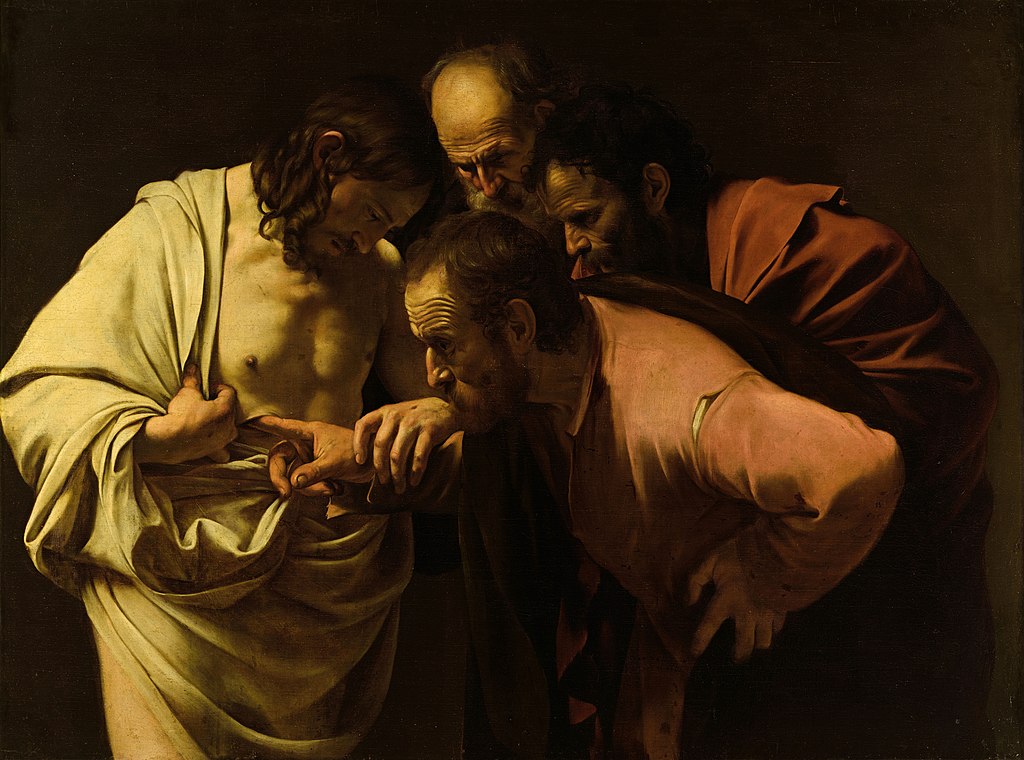
The Incredulity of St Thomas by Caravaggio – or should it be called Jesus showing Thomas his wounds?

I love preaching that brings Scripture to life—and that brings Scripture back to life.

That’s a line I’m going to repeat each week to remind us that every time we open Scripture together we are bringing it back to life.

This morning we return to John’s Gospel, still caught up in the wonder of that first Easter day (John 20:19-end). It’s a story only he tells.

John himself brings scripture back to life.
Particularly we see the influence of the creation story from the 1st chapter of our scriptures.
We can see that in the way that he tells us the time.
On the evening of that first day of the week.
It’s like last week’s gospel reading which began: Early on the first day of the week, while it was still dark. (John 20:1)
We are still on that first day which was like the first day of creation, when, according to Genesis 1:2, earth was a formless void and darkness covered the face of the deep.
That’s the time in today’s gospel. It was the first day of the week, and it was evening.
In other words, darkness was forming.
Taking our cue from Genesis, John’s readers can expect God’s wonders on this new day of creation.

Thomas wasn’t with the disciples when Jesus came on that first day, the day of resurrection.
It was the other disciples who had to let him know that they had seen the Lord.
Thomas told them that he would never believe “unless I see the nail marks in his hands and put my finger where the nails were, and put my hand into his side”.
It is this I suggest we focus on in our worship today.

Thomas is the patron saint of those who are blind because seeing wasn’t enough for him.
He needed to examine Jesus’s wounds by touching them and feeling them.
And the wonderful thing on that second Sunday, the first day of the week following, was that Jesus came and stood among them again and showed Thomas his wounds.
He welcomed his touch. He guided his hand. He let him explore his body.
Thomas is the patron saint of those who struggle to believe what they can’t see—or even what they can.
He shows us that resurrection faith isn’t just about seeing.
Sometimes it’s about touching, questioning and wrestling with God.

Jesus showed Thomas his scars. He wants his disciples to see them.


In the Last Supper, he took a loaf of bread and he broke it.
He wanted them to see his body in the brokenness of the bread.
“Take, this is my body,” he said. (Mark 14:22).
Then he gave them a cup for all of them to drink from.
In that cup he wanted them to see his blood.
“This is my blood of the covenant poured out for many.”
Even before he was wounded he wanted to show his disciples the wounds he was going to suffer.
And in today’s gospel, in one of his resurrection appearances, he invites Thomas to have a look at those wounds – to examine, inspect and see with his hands as well as his eye.

Thomas recognises Jesus through his wounds, just as Jesus wanted him to.
And this is how we come to know Jesus.
Just as Thomas encountered the risen Christ in his wounds, so too we encounter him today in the bread and wine of the Eucharist.
Every Communion we have with Jesus we have this invitation to examine the wounds of Jesus. Every time the bread is broken we are invited to see the brokenness of the body of Christ and to feel that brokenness in our mouths.
Every time we take this cup we are invited to taste the blood of Christ shed for us.

What is it that Jesus showed Thomas?
What did he want his disciples to see?
What does he want us to see when he shows us his wounds, when he invites us to see his body and his blood?

The first things we see are the wounds to his hands and feet where the nails were driven into his body by the hammer blows of empire.
Then, if he turns we see the wounds of the whipping scored into his back for being the scourge of empire and religion.
Then we see the scars on his head where they pressed the crown of thorns and added insult to injury, to press home the point that this “pretender” was nothing.

The rule of the kingdom of God is that the last, the lost and the least come first and those who are first in the kingdoms of this world come last.
The rule of the kingdom of God turns the rules of the world upside down.

In the wounds of Jesus, his disciples see a man who embodies that rule of the kingdom of God. In the brokenness of his body, in the bloodshed, we see a man the religious and political capital tried to reduce to nothing.
The plots against him and his crucifixion were intended to humiliate him and his followers – to make them least, last and lost – GONE for ever.

The problem for them was that the rule of the kingdom of God puts the least, last and lost – those lost and broken by the ways of the world – first.
When Jesus stood among his disciples, first without Thomas, then with him, he was the living proof of the fundamental rule of the kingdom of God.
Here was the humiliated, crucified and killed one.
You can’t get more “least, last and lost” than that.
Here he was, “the first fruits of those who have died”, Christ raised from the dead (1 Corinthians 15:20).

This is what Jesus showed Thomas –
the scars are the living proof of the rule of the kingdom of God.
Jesus stood among them as living proof of the rule he’d always followed,
that puts the last first and the first last.
Here is the one they put last made first.
This is what Thomas saw. This is what he said:
“My Lord, my God” – the rule of the kingdom of God realised in those few words.
“My Lord and my God” – Jesus comes first for Thomas.

So Jesus stands among us still, not with condemnation, but with scars.
What do we see? What difference does it make? Does Jesus come first?

Jesus doesn’t shame Thomas for his questions. He meets him in them.
He doesn’t rush belief. He invites it — gently, patiently, personally.

And he does the same with us.
To all who doubt, who ache, who long to see and touch and know — he says,
“Here I am. Peace be with you.”

He doesn’t hide his wounds. He offers them.
He lets us trace the pain and the mystery of a love that suffers with us and for us.
And in that wounded, risen body, we find our hope.

This morning, he says again:
“This is my body. This is my blood.”
This is how I choose to be known.
Look closely. Taste carefully.
And, if you are among the broken,
do not be afraid.