Rooms in the Ruins: Stephen, Coventry, and the room God makes in the midst of violence

In the ruins a fire is lit.
In the midst of violence, a man sees heaven open.
This sermon traces a thread from Saint Stephen to Coventry cathedral, and from the “many rooms” of John’s Gospel to the fractures places of our own lives – suggesting that the rooms God prepares are not elsewhere, but here, wherever love makes space in the face of conflict.


Easter 5 (A)
This morning we meet Stephen at the very end of his story,
Standing before an angry crowd,
accused, opposed,
and about to be killed.

And we hear that extraordinary line:
Filled with the Holy Spirit, he gazed into heaven …

But if we start there, we miss what makes that moment so powerful.
Because Stephen didn’t begin here.


He first appears a chapter earlier, in Acts of the Apostles,
when the early church is already under strain.

There is a complaint –
that some widows are being overlooked in the daily distribution of food.

It’s about fairness.
Culture.
Whose voice matters.

A real fault line has opened up.

And Stephen is one of those chosen to step into that situation –
because he is known to be full of the Spirit and wisdom.

Not removed from the tensions,
but right in the middle of them.

He learns to follow the Spirit there,
at the tables,
among those who are last, and least, and easily forgotten.


From there, things escalate.

Stephen begins to speak – boldly – about what God is doing.

He challenges the assumption that God can be contained in the temple,
or managed by those in power.

He reminds his hearers of the words of Isaiah:
“Heaven is my throne, and the earth is my footstool …
What kind of house will you build for me?”

God is not contained.
Not controlled.
Not organised around our comfort.

And that is what turns disagreement into fury.

So that by the time we reach today’s reading,
Stephen is no longer serving at tables –
he is standing before those who want him silenced.


And there –
in that moment of pressure, accusation and danger –
we are told:
“Filled with the Holy Spirit, he gazed into heaven …”

Now, we might imagine that this means Stephen is being lifted out of reality –
given a glimpse of somewhere else,
somewhere safer,
somewhere beyond the reach of what is about to happen.

But that cannot be what it means.

Because when he looks into heaven,
he does not see buildings.
He does not see rooms.

He sees the glory of God –
and Jesus Christ standing at the right hand of God.

Standing.
Alive.
Present.


Hold that alongside the words of Jesus in John’s gospel:
“In my Father’s house there are many dwelling places …
I go to prepare a place for you.”

We have often heard those words as a promise about where we go when we die.

A heavenly building.
Rooms prepared somewhere else.

And there is comfort in that.

But Stephen – standing under accusation,
with stones already in the air –
suggests something different.


Because in John’s Gospel, “dwelling” is not about property.
It is about life shared.

“Abide in me, as I abide in you.”
“We will come and make our home with them.”

So when Jesus says,
“I go to prepare a place for you,”
the question is:

How, and in what way?

It’s not about a heavenly mansion with (how) many rooms.
It’s not a building
a building somewhere else.

No.

It’s about what love is building
here and now
    in the middle of the world as it is.

It’s about love making room,
one room on top of another,
room for strangers,
room for sinners,
room even for enemies
and those who attack us,
room for those left out in the cold,
those homeless and neglected
like those widows previously unheard.

The Father’s house isn’t something set in concrete,
built somewhere else.

It is God’s work,
building love,
making room for forgiveness.

And it is here that Stephen stands,
in the place prepared for him.
And he sees it,
and his face so shines,
even as the stones are hurled in anger.

Because to see into heaven
is not to gain information about the afterlife.

It is to see reality as it truly is:

that God is not absent,
not contained,
not defeated –

But present,
active,
and drawing all things into the life of his kingdom.


And once Stephen sees that,

he begins to reflect it.

His face shines, and
his words echo Jesus:
“Lord, do not hold this sin against them.”

This is not weakness.

This is the life of the Father’s house
breaking out
in the middle of the world’s violence.

In the middle of the world’s violence,
there are those who have found room for God –
the room that God has prepared for them.

The room we have for God in our lives
is the room that God has prepared for us –
one of so many rooms.

And it is this life –
this room opened to God
In the middle of the world’s violence –
that cannot be tolerated,
And Stephen will pay for it with his life.

Because if God’s dwelling is not contained,
and not somewhere else,
then neither is God’s authority.

If heaven is breaking out here –
then the systems built on power and control are exposed.

And so they cover their ears.

And they rush at him.


But this way of seeing did not end with Stephen.

It has appeared again and again,
where people have been formed by the Spirit
in the middle of real world fault lines.

In this diocese, we cannot hear this story
without thinking of Coventry Cathedral.
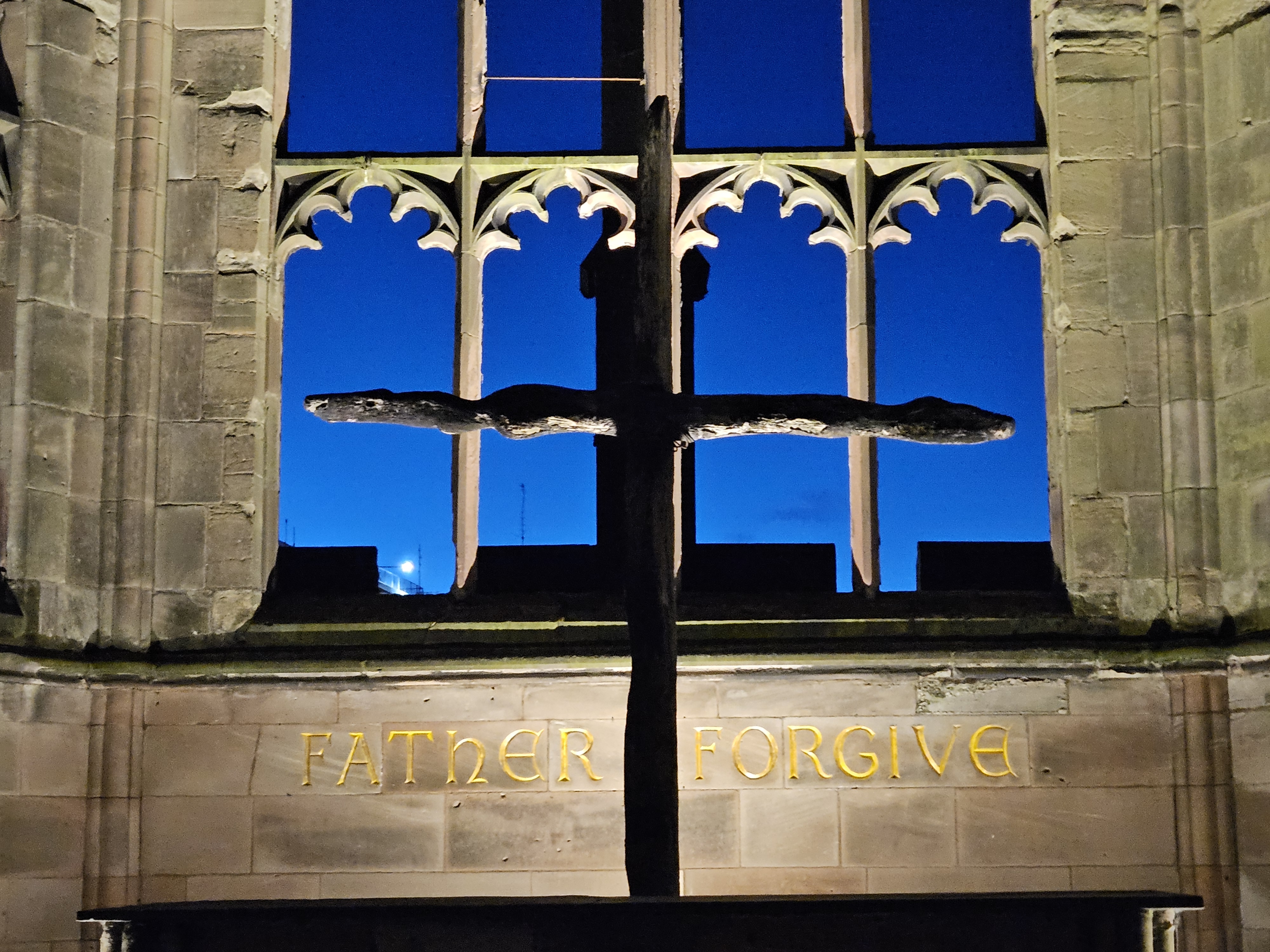
In the ruins of Coventry Cathedral at first light on Easter Day 2026

In 1940, the cathedral was destroyed by bombing.

Stones – not thrown by hand this time,
but falling all the same.

And in the ruins,
Provost Dick Howard did something extraordinary.

He did not call for revenge.

He did not divide the world into “us” and “them”.

Instead, he had these words inscribed:

Father forgive.

Not “forgive them.”
Just: Father forgive.

That is not sentiment.
That is not denial of suffering.

That is someone seeing into heaven.

Someone recognising that the Father’s house
is not destroyed by violence –
because it was never contained in stone.

And that the life of that house
with its many rooms
is forgiveness,
even here.

Even now.

And this is not just something that happened then.

It is something we are caught up in here.

Because in this diocese, when people are ordained,
they are ordained in that cathedral –
in that space opened up in the midst of destruction.

A place where violence did not have the final word.

A place where, in the ruins,
room was found for forgiveness.

Stephen was a deacon –
formed at tables,
among the overlooked,
in the fault lines of his community.

And from there, he learned to see into heaven.

And those ordained in that cathedral
are ordained in that same pattern:

not away from the world’s conflict,
but into it –

trusting that even there,
God has made room.

The room we have for God in our lives
is the room that God has prepared for us –
one of so many rooms.

And we have seen that recently.

Gary and Brittany were confirmed there on Easter Day
at the crack of dawn,
when the Easter fire was lit
in the ruins of the cathedral.

Fire again in that place –
but not the fire that destroys.

Not the fire that reduces everything to ash.

But the fire of resurrection.

The fire of the Spirit.

In the very place where flames once consumed,
a different fire now burns –

not to destroy,
but to give light,
to gather,
to kindle new life.

And there, in that same place,
a life opening to God,
a place being made,
a dwelling beginning.


Not somewhere else.

But here.


So the question is not whether there is room in the Father’s house.

The question is whether we will enter the room
that God has already prepared for us –

in the places where the world is most fractured,

where the fire is still being lit in the ruins,

and where, even there,
heaven is already open.

Mission that ends ends: preaching from Ascension to Pentecost

This is a sermon preached at Holy Trinity, Leamington for Easter 7(A), the Sunday between Ascension and Pentecost. (I am hoping it will be the first in a series of reflections inspired by readings from the Book of Acts.)

The text is Acts 1:6-14.

When we were finding our way round, when we moved to Leamington nearly two years ago, people kept telling us, “you don’t want to go to Coventry”. 

Apologies to those of you who live in Coventry. Never mind. People will be flocking to Coventry if they beat Luton in the play off final next Saturday, possibly taking the place of my team in the Premier League.

It was a punishment to be “sent to Coventry*. Being sent to Coventry meant people turned their back on you, refused to talk to you, shunned you. 

The origin of the sentence probably dates back to the 1640’s to the English Civil War. Royalist troops captured in Birmingham were taken as prisoners to Coventry which was a parliamentarian stronghold. They were not received warmly by the locals. That’s what happened when they were sent to Coventry.

Samaria from this morning’s reading is the Coventry of its day. “You don’t want to go to Samaria” would have been the equivalent for the Jewish people who found a way round Samaria rather than going through it. Part of the power of the parable of the Good Samaritan is that the hero is a Samaritan and that there was a Samaritan that could be called good.

But Jesus puts Samaria on the mission map, along with everywhere else that was considered off limits.

According to Luke, these are the last words of Jesus before his ascension: You will receive power when the Holy Spirit comes on you; and you will be my witnesses in Jerusalem, and in all Judea and Samaria, and to the ends of the earth.

Yes – to Samaria, and to the ends of the earth!

Before this, the disciples ask Jesus this question: Lord, is this the time when you will restore the kingdom to Israel? Jesus refuses to give a direct answer. It was an old question, reflecting the old troubles of nationalism brought on by too narrow a view of God’s love. 

Instead of a direct answer to their question, Jesus gives them his last word: a promise of power as witnesses, not just in Jerusalem and Judea, but even in Samaria, and to the ends of the earth.

These last words of Jesus are the first words in the beginning of the church’s missionary journey, a journey which takes us further that we could ever imagine, and a journey which undermines any boundaries which prevent God’s love reaching where God desires, to the ends of the earth.

To the ends of the earth – that is beyond the boundaries, the borders and margins of our current imaginations, undermining any attachment to nationalism, undermining the certainties and conservatism of our belief systems. Guy Garvey of Elbow sings (in Come On, Blue), love transcends anything that ever ends. Love transcends anything that ever ends, including the ends, limits, boundaries set by our imaginations and culture. 

Jesus’s words, to the ends of the earth, would be far too one-dimensional if we were only to think geographically about the extent of God’s mission, as if the first disciples had a map of the world at their disposal.

To the ends of the earth is about love’s reach. Think sociologically, think psychologically, not just geographically, think musically, think any way you can – to the ends of the earth, as far as your eye can see, and further – that is where the love of God goes, that is where the love of God comes again and again.

Think psychologically about the ends of the earth, those who are on the very edge, those in the darkest places, those in self harm’s way, those bombarded with cruel internal voices – this is where God’s love goes.

Think as peacemakers – or, better, live as peacemakers. Who have we made enemies? This is where God’s love takes us.

Think socio-economically about the ends of the earth. Who are in the margins? Who’s all at sea unable to make safety on land? To the ends of the earth – encompassing all ages, including children and young people (and it was good to hear about our partnership with Thrive from Ryan last Sunday), including those in their dying days. To the ends of the earth – encompassing enemies, strangers and those we’ve thought beyond the pale. Think the extent from cradle to grave, from prison cell to hospice bed, from palace to hovel, this is where God’s love goes.

To the ends of the earth is the scope of God’s love and the measure of God’s desire. Love isn’t just for Israel but for everyone in God’s creation. Love reaches far beyond our borders and boundaries, undermining those borders and boundaries, challenging wherever we draw the line between who’s ruled in and who’s ruled out, who’s right and who’s wrong.

The Book of Acts is often described as a book of beginnings. Our reading comes from the beginning of this book of beginnings. They are Jesus’ last words which become the first words of mission. To the ends of the earth – anything less doesn’t do justice to the desire and power of God. These are Jesus’ last words which last till the end of time, to the ends of the earth.

Acts reports the early days of mission, on the troubles Jesus’ followers got into on this journey. In the beginnings of this mission Luke shows us all the old certainties being cast to the wind, to the violent wind of Pentecost. He excitedly shows us people of all sorts being joined by the Holy Spirit, their differences and disputes being resolved by the wisdom and love which constitute God’s mission. 

He shows us what these first words of mission means as he spotlights the boundaries undermined by God’s mission and those affected by them. These include boundaries of gender, sexuality, ethnicity, class and religion.

Love still struggles against the same borders and boundaries we see beginning to be undermined in Acts, which is why I suggest these days of our lives are still the first days of mission. 

This is the beginning where we have to cast our old certainties to the wind, one of the old certainties being that we aren’t fit for such a tall order of mission. Who am I for such a thing? We are bound by the voices which say we’re not good enough, we’re not clever enough and we know we’re not confident enough.

BUT. Luke tells the story of two men in white who ask the disciples, “why do you stand here looking at the sky”. The disciples had seen Jesus ascend, they’d seen him go. But they kept on looking where he’d gone, where he was no more. The two men in white redirect the gaze of the church. They’re saying, don’t look where he’s disappeared, look for where he comes again.

It’s seeing where he comes again which encourages us and heartens us. 

It is when we see him coming again as we break bread together, as we listen for his word in preaching, teaching and prayer, as we see the wonderful work of reconciliation that we become inspired for the joy of mission, and joined by

the Spirit who makes herself known as the strengthener, the encourager and the comforter, empowering us to reach beyond our comfort zone.

We never know how we are going to be turned out. There isn’t one way of joining mission. There’s no stereotype. 

Paraphrasing Paul, there’s a whole variety of gifts, there’s a whole variety of services, there’s a whole range of activities in the mission of God so some of us will turn out to be wise counsellors, others will become healers, others will have gifts for administration, some will become great encouragers, some will become teachers, or nurses, or the sort of heartening person we are always delighted to meet on our streets, or the shy person who thinks deeply and critically about the way things are. 

When praying in God’s mission none of us ever knows who we are going to turn out to be.

Going back to Coventry. The night of November 14th/15th 1940 must have seemed like the end of the world as 30,000 incendiary bombs were dropped on Coventry, destroying 43,000 homes, 71 factories, the city centre, 2 hospitals, 2 churches, killing 560 people and injuring over 1000 more. 

The Provost of the ruined cathedral, Richard Howard, witnessed Jesus’ words as he chalked his words Father, forgive them on the Cathedral’s sanctuary walls. 

He can’t have known how that would turn out to open up a whole ministry of reconciliation with what happened in Coventry as its capital. Nor could he have known that his words, (Jesus’ words) would be the first words of a missionary journey that has taken the Coventry Cross of Nails to the ends of the earth, to so many situations of conflict.

In those days, the days of prayer between Ascension and Pentecost, the disciples, the men and women gathered together, didn’t know how they were going to be turned out, and how their mission would turn out. Neither did Provost Howard. Neither do we as we wait and pray, with our eyes trained not on where Jesus has disappeared, but on where he comes again in the triumphs of love as well as our falls from grace.

Acts 1:6-14
So when they had come together, they asked him, “Lord, is this the time when you will restore the kingdom to Israel?” He replied, “It is not for you to know the times or periods that the Father has set by his own authority. But you will receive power when the Holy Spirit has come upon you, and you will be my witnesses in Jerusalem, in all Judea and Samaria, and to the ends of the earth.” When he had said this, as they were watching, he was lifted up, and a cloud took him out of their sight. 10 While he was going and they were gazing up toward heaven, suddenly two men in white robes stood by them. 11 They said, “Men of Galilee, why do you stand looking up toward heaven? This Jesus, who has been taken up from you into heaven, will come in the same way as you saw him go into heaven.”
12 Then they returned to Jerusalem from the mount called Olivet, which is near Jerusalem, a Sabbath day’s journey away. 13 When they had entered the city, they went to the room upstairs where they were staying: Peter, and John, and James, and Andrew, Philip and Thomas, Bartholomew and Matthew, James son of Alphaeus, and Simon the Zealot, and Judas son of[a] James. 14 All these were constantly devoting themselves to prayer, together with certain women, including Mary the mother of Jesus, as well as his brothers.

Note: Acts 1:1-11 is read in churches on Ascension Day and Acts 1:6-14 is read on the 7th Sunday of Easter (Year A)