Rooms in the Ruins: Stephen, Coventry, and the room God makes in the midst of violence

In the ruins a fire is lit.
In the midst of violence, a man sees heaven open.
This sermon traces a thread from Saint Stephen to Coventry cathedral, and from the “many rooms” of John’s Gospel to the fractures places of our own lives – suggesting that the rooms God prepares are not elsewhere, but here, wherever love makes space in the face of conflict.


Easter 5 (A)
This morning we meet Stephen at the very end of his story,
Standing before an angry crowd,
accused, opposed,
and about to be killed.

And we hear that extraordinary line:
Filled with the Holy Spirit, he gazed into heaven …

But if we start there, we miss what makes that moment so powerful.
Because Stephen didn’t begin here.


He first appears a chapter earlier, in Acts of the Apostles,
when the early church is already under strain.

There is a complaint –
that some widows are being overlooked in the daily distribution of food.

It’s about fairness.
Culture.
Whose voice matters.

A real fault line has opened up.

And Stephen is one of those chosen to step into that situation –
because he is known to be full of the Spirit and wisdom.

Not removed from the tensions,
but right in the middle of them.

He learns to follow the Spirit there,
at the tables,
among those who are last, and least, and easily forgotten.


From there, things escalate.

Stephen begins to speak – boldly – about what God is doing.

He challenges the assumption that God can be contained in the temple,
or managed by those in power.

He reminds his hearers of the words of Isaiah:
“Heaven is my throne, and the earth is my footstool …
What kind of house will you build for me?”

God is not contained.
Not controlled.
Not organised around our comfort.

And that is what turns disagreement into fury.

So that by the time we reach today’s reading,
Stephen is no longer serving at tables –
he is standing before those who want him silenced.


And there –
in that moment of pressure, accusation and danger –
we are told:
“Filled with the Holy Spirit, he gazed into heaven …”

Now, we might imagine that this means Stephen is being lifted out of reality –
given a glimpse of somewhere else,
somewhere safer,
somewhere beyond the reach of what is about to happen.

But that cannot be what it means.

Because when he looks into heaven,
he does not see buildings.
He does not see rooms.

He sees the glory of God –
and Jesus Christ standing at the right hand of God.

Standing.
Alive.
Present.


Hold that alongside the words of Jesus in John’s gospel:
“In my Father’s house there are many dwelling places …
I go to prepare a place for you.”

We have often heard those words as a promise about where we go when we die.

A heavenly building.
Rooms prepared somewhere else.

And there is comfort in that.

But Stephen – standing under accusation,
with stones already in the air –
suggests something different.


Because in John’s Gospel, “dwelling” is not about property.
It is about life shared.

“Abide in me, as I abide in you.”
“We will come and make our home with them.”

So when Jesus says,
“I go to prepare a place for you,”
the question is:

How, and in what way?

It’s not about a heavenly mansion with (how) many rooms.
It’s not a building
a building somewhere else.

No.

It’s about what love is building
here and now
    in the middle of the world as it is.

It’s about love making room,
one room on top of another,
room for strangers,
room for sinners,
room even for enemies
and those who attack us,
room for those left out in the cold,
those homeless and neglected
like those widows previously unheard.

The Father’s house isn’t something set in concrete,
built somewhere else.

It is God’s work,
building love,
making room for forgiveness.

And it is here that Stephen stands,
in the place prepared for him.
And he sees it,
and his face so shines,
even as the stones are hurled in anger.

Because to see into heaven
is not to gain information about the afterlife.

It is to see reality as it truly is:

that God is not absent,
not contained,
not defeated –

But present,
active,
and drawing all things into the life of his kingdom.


And once Stephen sees that,

he begins to reflect it.

His face shines, and
his words echo Jesus:
“Lord, do not hold this sin against them.”

This is not weakness.

This is the life of the Father’s house
breaking out
in the middle of the world’s violence.

In the middle of the world’s violence,
there are those who have found room for God –
the room that God has prepared for them.

The room we have for God in our lives
is the room that God has prepared for us –
one of so many rooms.

And it is this life –
this room opened to God
In the middle of the world’s violence –
that cannot be tolerated,
And Stephen will pay for it with his life.

Because if God’s dwelling is not contained,
and not somewhere else,
then neither is God’s authority.

If heaven is breaking out here –
then the systems built on power and control are exposed.

And so they cover their ears.

And they rush at him.


But this way of seeing did not end with Stephen.

It has appeared again and again,
where people have been formed by the Spirit
in the middle of real world fault lines.

In this diocese, we cannot hear this story
without thinking of Coventry Cathedral.
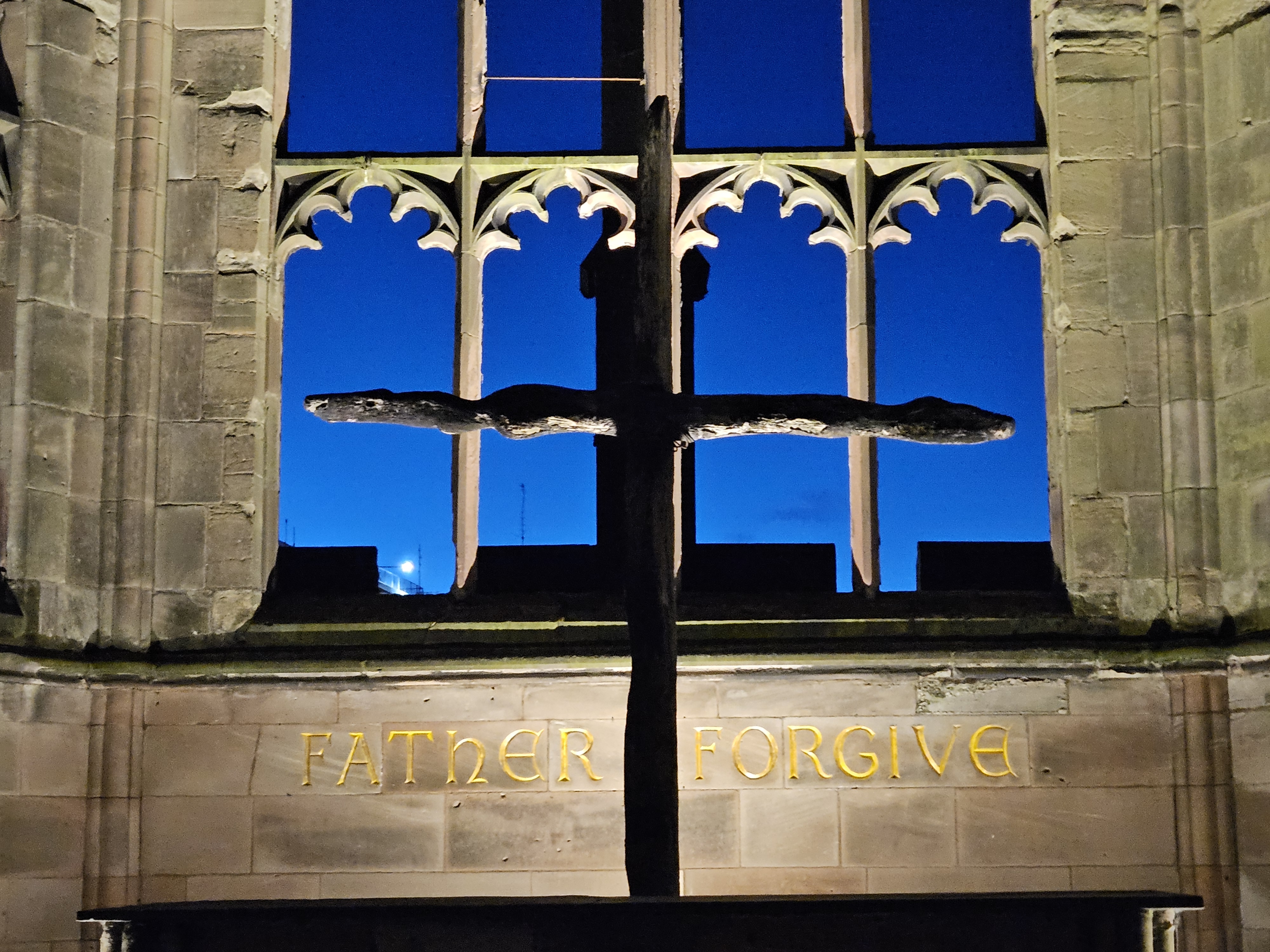
In the ruins of Coventry Cathedral at first light on Easter Day 2026

In 1940, the cathedral was destroyed by bombing.

Stones – not thrown by hand this time,
but falling all the same.

And in the ruins,
Provost Dick Howard did something extraordinary.

He did not call for revenge.

He did not divide the world into “us” and “them”.

Instead, he had these words inscribed:

Father forgive.

Not “forgive them.”
Just: Father forgive.

That is not sentiment.
That is not denial of suffering.

That is someone seeing into heaven.

Someone recognising that the Father’s house
is not destroyed by violence –
because it was never contained in stone.

And that the life of that house
with its many rooms
is forgiveness,
even here.

Even now.

And this is not just something that happened then.

It is something we are caught up in here.

Because in this diocese, when people are ordained,
they are ordained in that cathedral –
in that space opened up in the midst of destruction.

A place where violence did not have the final word.

A place where, in the ruins,
room was found for forgiveness.

Stephen was a deacon –
formed at tables,
among the overlooked,
in the fault lines of his community.

And from there, he learned to see into heaven.

And those ordained in that cathedral
are ordained in that same pattern:

not away from the world’s conflict,
but into it –

trusting that even there,
God has made room.

The room we have for God in our lives
is the room that God has prepared for us –
one of so many rooms.

And we have seen that recently.

Gary and Brittany were confirmed there on Easter Day
at the crack of dawn,
when the Easter fire was lit
in the ruins of the cathedral.

Fire again in that place –
but not the fire that destroys.

Not the fire that reduces everything to ash.

But the fire of resurrection.

The fire of the Spirit.

In the very place where flames once consumed,
a different fire now burns –

not to destroy,
but to give light,
to gather,
to kindle new life.

And there, in that same place,
a life opening to God,
a place being made,
a dwelling beginning.


Not somewhere else.

But here.


So the question is not whether there is room in the Father’s house.

The question is whether we will enter the room
that God has already prepared for us –

in the places where the world is most fractured,

where the fire is still being lit in the ruins,

and where, even there,
heaven is already open.

Luke’s Last Surprise: One Condemned Man Joining Another as the First in Paradise

This Sunday marks the end of the Christian year.
Next Sunday we hop on the next liturgical cycle of readings – it will be Year A.
Each year focuses on a particular gospel. Next year it will be Matthew’s. This year it has been Luke’s.

When I began this preaching year, I wondered what Luke would offer us.
I wondered how he might inspire us, challenge us, lead us.
And now, at the end of the year, I find myself saying one thing above all: WOW.
Luke has surprised us. Luke has stretched us.
Luke has shown us the kingdom of God in places we would never have thought to look.

This Sunday is a WOW moment,
a hinge on which we hang our wonder,
before the new year opens again.
Next week we begin again,
not from cold, not from scratch,
but already warmed by hope,
already knowing what God’s kingdom looks like
in the dominion of darkness.

We will return to the manger
knowing now what Luke has shown us all year –
that God’s kingdom begins with the smallest,
with the least, with the last instead of the first,
in a vulnerable baby held by exhausted parents
on the edges of empire.

These are the readings (Colossians 1:11-20 and Luke 23:33-43) that crown our year.
And this is where Luke has been leading us all along:
not to a palace, but to the place of the skull,
Not to a gold throne, but to a wooden cross.
A king.
A sign nailed above his head.
And a thief beside him.
That’s the gospel picture.
That’s where Luke brings us when the year ends and we crown Christ our King.

Our other reading, from Colossians, may seem difficult at first –
until we recognise it as a hymn.
A hymn praising the God who rescues us from the dominion of darkness,
who strengthens us with endurance,
who qualifies us for the kingdom of his beloved Son –
the kingdom of light,
the kingdom where Christ is King.

Luke paints the scene.
It is the “dominion of darkness” (to use the phrase from Colossians).
The place is the place of the skull,
Death Row in the Dominion of Darkness:
there is the smell of death
and the overpowering smell
of cruelty, injustice and wrongdoing.
There are three crosses.
One is for Jesus, the others for two criminals crucified either side of him.

Luke gives them very different voices.
One sneers – placing him with those who mock, jeer and insult Jesus.
“He saved others, let him save himself if he is who he says he is.”
(In other words, he isn’t who he says he is.)
“Aren’t you the Messiah? Save yourself and us!”

The other criminal rebukes him, saying the two of them deserve their punishment.
Then he protests Jesus’ innocence. “This man has done nothing wrong.”
And in that moment he is just right.
He is right to defend the defenceless
against the forces which have conspired against Jesus.
“This man has done nothing wrong,”
and yet he is facing the same sentence, only worse,
because insult is added to injury.

Then he turns to Jesus.
“Jesus, remember me when you come into your kingdom”

This criminal is the first to defend Jesus publicly.
He is the first to take his stand with Jesus.
And Luke wants us to see him.
This figure.
This last, least, condemned man
who becomes the first to declare Jesus innocent
and the first to receive a royal promise.

He is the last person in the world you’d expect
to be the first to defend Jesus –
(we are led to believe that there is no honour amongst thieves),
but here he is in the picture of paradise – alongside Jesus.
The last becomes the first in paradise,
that kingdom of love –
a relationship, not a place.

And here – right here – you can almost see it happen:

And perhaps this is Luke’s final surprise for us:
that the first to enter paradise with the King is not a saint or a scholar or a faithful disciple,
but a criminal who can offer Jesus nothing but honesty and trust.

He offers no record of virtue.
No proof of goodness.
No last-minute achievements.
He can’t even lift his hands in prayer.
All he can do is speak the truth —
about himself, about Jesus, about the kingdom.
And Jesus takes that truth, that tiny seed of faith,
and makes it bloom.

“Today you will be with me in paradise.”

And that paradise begins there,
in the dominion of darkness,
with a king crowned not with gold but with thorns,
and a wrongdoer who sees more clearly than anyone else.

The only crown Jesus could ever wear is a crown of thorns.
They’re the thorns of scorn, the barbs of bitterness.
They’re our failures, our wounds, our complicity,
our inability to rule even ourselves.

But the kingdom Luke has been showing us week after week
is a kingdom where the last come first,
the lost are found
and where the crucified King gathers in his arms
those the world’s unjust powers condemn.

This is the WOW moment.
Everything has led to this,
when the thorns begin to flower.
This is what Luke is intent on showing us.

His sequel, Acts,becomes the story
of the cross in bloom.
The frightened disciples become bold and generous.
The failures become witnesses.
A crippled beggar stands up and walks.
An Ethiopian outsider becomes the first fully Gentile convert.
A persecutor becomes an apostle.
Prisoners sing hymns; jailers are baptised;
enemies share bread.

Again and again the thorns flower.
Again and again the barren places bear fruit.
Again and again the last become first.

This is where the King of Love leads us:
into a rule of life that puts the last first
and sees thorns flower with grace.

All year long Luke has shown us a kingdom that grows in unlikely places,
and now at the last,
he shows us the unlikeliest place of all,
the place of the skull, Death Row.
Yet even here, if we look through Luke’s eyes,
Something ]begins to bloom.

At the place of the Skull grows the tree of life.
The crown of thorns flowers with grace.
The King of Love
and the convicted criminal
become the first couple in the new creation –
the first to walk the way of mercy,
the first to step into the garden of God’s future.

This is how the Christian year ends:
not with worldly triumph,
but with this strange, saving beauty –
a King who makes the last first,
who turns a place of execution into a place of promise,
who opens paradise to the least likely of all.

This is the kingdom of God and the gentle thorn-crowned rule of Jesus.

Luke 23:33-43

When they came to the place called the Skull, they crucified him there, along with the criminals – one on his right, the other on his left. Jesus said, ‘Father, forgive them, for they do not know what they are doing.’ And they divided up his clothes by casting lots.

The people stood watching, and the rulers even sneered at him. They said, ‘He saved others; let him save himself if he is God’s Messiah, the Chosen One.’

The soldiers also came up and mocked him. They offered him wine vinegar and said, ‘If you are the king of the Jews, save yourself.’

There was a written notice above him, which read: this is the king of the jews.

One of the criminals who hung there hurled insults at him: ‘Aren’t you the Messiah? Save yourself and us!’

But the other criminal rebuked him. ‘Don’t you fear God,’ he said, ‘since you are under the same sentence? We are punished justly, for we are getting what our deeds deserve. But this man has done nothing wrong.’

Then he said, ‘Jesus, remember me when you come into your kingdom.’

Jesus answered him, ‘Truly I tell you, today you will be with me in paradise.’