Rooms in the Ruins: Stephen, Coventry, and the room God makes in the midst of violence

In the ruins a fire is lit.
In the midst of violence, a man sees heaven open.
This sermon traces a thread from Saint Stephen to Coventry cathedral, and from the “many rooms” of John’s Gospel to the fractures places of our own lives – suggesting that the rooms God prepares are not elsewhere, but here, wherever love makes space in the face of conflict.


Easter 5 (A)
This morning we meet Stephen at the very end of his story,
Standing before an angry crowd,
accused, opposed,
and about to be killed.

And we hear that extraordinary line:
Filled with the Holy Spirit, he gazed into heaven …

But if we start there, we miss what makes that moment so powerful.
Because Stephen didn’t begin here.


He first appears a chapter earlier, in Acts of the Apostles,
when the early church is already under strain.

There is a complaint –
that some widows are being overlooked in the daily distribution of food.

It’s about fairness.
Culture.
Whose voice matters.

A real fault line has opened up.

And Stephen is one of those chosen to step into that situation –
because he is known to be full of the Spirit and wisdom.

Not removed from the tensions,
but right in the middle of them.

He learns to follow the Spirit there,
at the tables,
among those who are last, and least, and easily forgotten.


From there, things escalate.

Stephen begins to speak – boldly – about what God is doing.

He challenges the assumption that God can be contained in the temple,
or managed by those in power.

He reminds his hearers of the words of Isaiah:
“Heaven is my throne, and the earth is my footstool …
What kind of house will you build for me?”

God is not contained.
Not controlled.
Not organised around our comfort.

And that is what turns disagreement into fury.

So that by the time we reach today’s reading,
Stephen is no longer serving at tables –
he is standing before those who want him silenced.


And there –
in that moment of pressure, accusation and danger –
we are told:
“Filled with the Holy Spirit, he gazed into heaven …”

Now, we might imagine that this means Stephen is being lifted out of reality –
given a glimpse of somewhere else,
somewhere safer,
somewhere beyond the reach of what is about to happen.

But that cannot be what it means.

Because when he looks into heaven,
he does not see buildings.
He does not see rooms.

He sees the glory of God –
and Jesus Christ standing at the right hand of God.

Standing.
Alive.
Present.


Hold that alongside the words of Jesus in John’s gospel:
“In my Father’s house there are many dwelling places …
I go to prepare a place for you.”

We have often heard those words as a promise about where we go when we die.

A heavenly building.
Rooms prepared somewhere else.

And there is comfort in that.

But Stephen – standing under accusation,
with stones already in the air –
suggests something different.


Because in John’s Gospel, “dwelling” is not about property.
It is about life shared.

“Abide in me, as I abide in you.”
“We will come and make our home with them.”

So when Jesus says,
“I go to prepare a place for you,”
the question is:

How, and in what way?

It’s not about a heavenly mansion with (how) many rooms.
It’s not a building
a building somewhere else.

No.

It’s about what love is building
here and now
    in the middle of the world as it is.

It’s about love making room,
one room on top of another,
room for strangers,
room for sinners,
room even for enemies
and those who attack us,
room for those left out in the cold,
those homeless and neglected
like those widows previously unheard.

The Father’s house isn’t something set in concrete,
built somewhere else.

It is God’s work,
building love,
making room for forgiveness.

And it is here that Stephen stands,
in the place prepared for him.
And he sees it,
and his face so shines,
even as the stones are hurled in anger.

Because to see into heaven
is not to gain information about the afterlife.

It is to see reality as it truly is:

that God is not absent,
not contained,
not defeated –

But present,
active,
and drawing all things into the life of his kingdom.


And once Stephen sees that,

he begins to reflect it.

His face shines, and
his words echo Jesus:
“Lord, do not hold this sin against them.”

This is not weakness.

This is the life of the Father’s house
breaking out
in the middle of the world’s violence.

In the middle of the world’s violence,
there are those who have found room for God –
the room that God has prepared for them.

The room we have for God in our lives
is the room that God has prepared for us –
one of so many rooms.

And it is this life –
this room opened to God
In the middle of the world’s violence –
that cannot be tolerated,
And Stephen will pay for it with his life.

Because if God’s dwelling is not contained,
and not somewhere else,
then neither is God’s authority.

If heaven is breaking out here –
then the systems built on power and control are exposed.

And so they cover their ears.

And they rush at him.


But this way of seeing did not end with Stephen.

It has appeared again and again,
where people have been formed by the Spirit
in the middle of real world fault lines.

In this diocese, we cannot hear this story
without thinking of Coventry Cathedral.
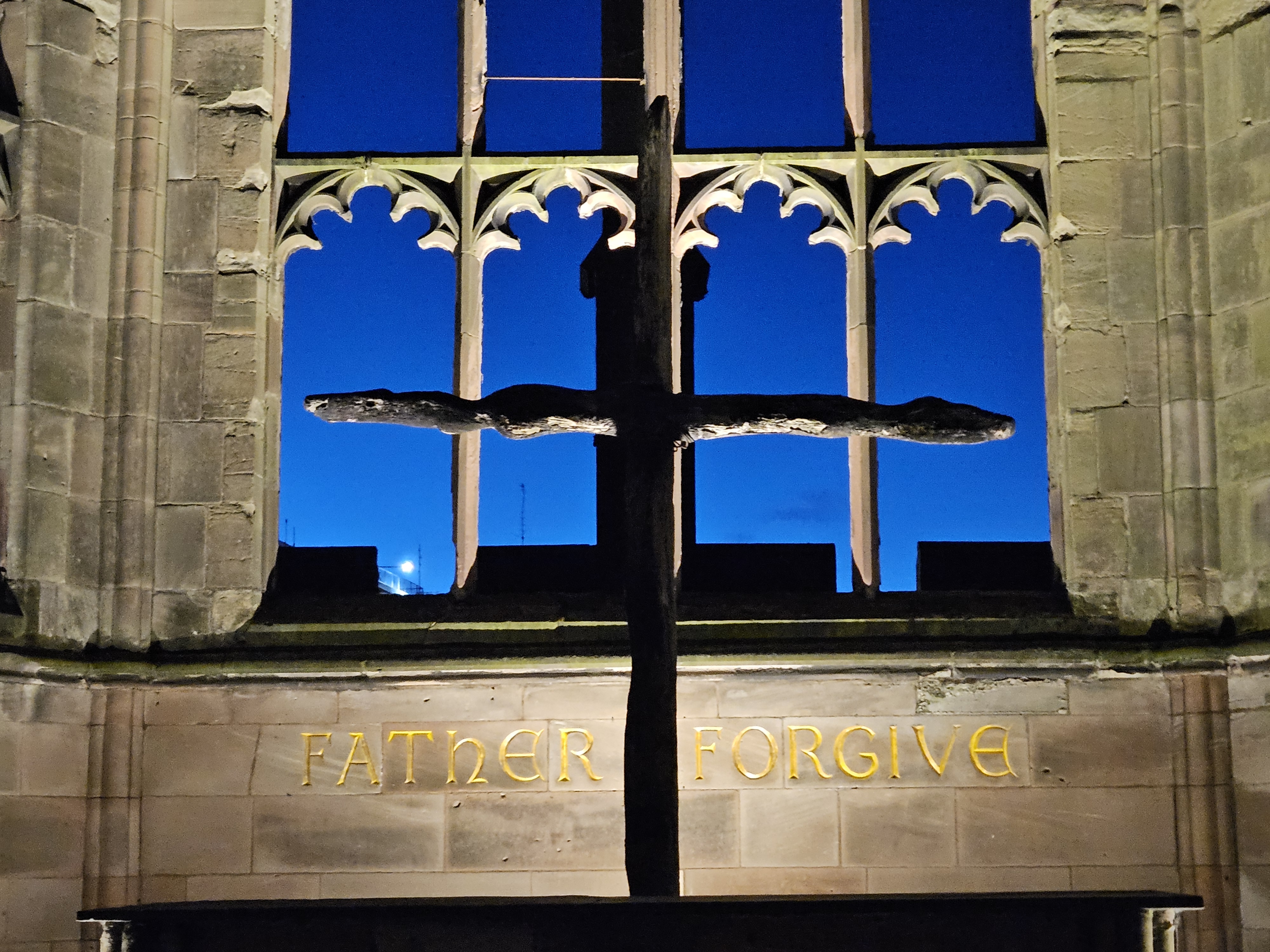
In the ruins of Coventry Cathedral at first light on Easter Day 2026

In 1940, the cathedral was destroyed by bombing.

Stones – not thrown by hand this time,
but falling all the same.

And in the ruins,
Provost Dick Howard did something extraordinary.

He did not call for revenge.

He did not divide the world into “us” and “them”.

Instead, he had these words inscribed:

Father forgive.

Not “forgive them.”
Just: Father forgive.

That is not sentiment.
That is not denial of suffering.

That is someone seeing into heaven.

Someone recognising that the Father’s house
is not destroyed by violence –
because it was never contained in stone.

And that the life of that house
with its many rooms
is forgiveness,
even here.

Even now.

And this is not just something that happened then.

It is something we are caught up in here.

Because in this diocese, when people are ordained,
they are ordained in that cathedral –
in that space opened up in the midst of destruction.

A place where violence did not have the final word.

A place where, in the ruins,
room was found for forgiveness.

Stephen was a deacon –
formed at tables,
among the overlooked,
in the fault lines of his community.

And from there, he learned to see into heaven.

And those ordained in that cathedral
are ordained in that same pattern:

not away from the world’s conflict,
but into it –

trusting that even there,
God has made room.

The room we have for God in our lives
is the room that God has prepared for us –
one of so many rooms.

And we have seen that recently.

Gary and Brittany were confirmed there on Easter Day
at the crack of dawn,
when the Easter fire was lit
in the ruins of the cathedral.

Fire again in that place –
but not the fire that destroys.

Not the fire that reduces everything to ash.

But the fire of resurrection.

The fire of the Spirit.

In the very place where flames once consumed,
a different fire now burns –

not to destroy,
but to give light,
to gather,
to kindle new life.

And there, in that same place,
a life opening to God,
a place being made,
a dwelling beginning.


Not somewhere else.

But here.


So the question is not whether there is room in the Father’s house.

The question is whether we will enter the room
that God has already prepared for us –

in the places where the world is most fractured,

where the fire is still being lit in the ruins,

and where, even there,
heaven is already open.

Here Am I: Embracing God’s Call in Worship

Worship fires us. Worship hires us. This is what we see at the heart of our two readings today. (Isaiah 6:1-8 and Luke 5:1-11). This is a sermon for the 4th Sunday before Lent for a small church “in vacancy”.

The poetry of Mary Oliver is full of worship. Here are some of her lines:

Poems are not words, after all,
but fires for the cold,
ropes let down to the lost,
something as necessary as bread
in the pockets of the hungry.

Poems are not words, but fires for the cold, ropes let down to the lost, something as necessary as food in the pockets of the hungry.

There is poetry in the heart of worship – fires for the cold, ropes let down to the lost. We repeat these lines of poetry in the heart of our worship. We call it the Sanctus. The poetry goes along these two lines:

Holy, holy, holy is the Lord Almighty,
the whole earth is full of his glory.

This is the song of the seraphim overheard by the prophet Isaiah in his vision of heaven when he was transported in worship. They are words which reverberate in our own worship. Holy, holy, holy is the Lord Almighty. The whole earth is full of his glory. This has become our song too.

In Mary Oliver’s words, they are fires for the cold, ropes let down to the lost. Holy, holy, holy is the Lord Almighty; the earth is full of his glory. This is the song of those Isaiah sees around the throne – the song of the seraphim. 

Seraphim are the fiery ones. That is the meaning of seraphim. Their words are fires for the cold, ropes let down to the lost. They are ropes we hang onto as we join Isaiah as he is transported in worship.

The whole earth is full of his glory. This is the faith of the heavenly host. It doesn’t mean that everything is hunky dory. Isaiah knows only too well his own lies and the lies of those around him. I am a man of unclean lips, and I live among a people of unclean lips. And that hasn’t changed over the centuries, has it? We say one thing and mean another. We mislead and are misled. Truth is distorted to our own ends. We, too, are a people of unclean lips living among a people of unclean lips.

In our gospel reading Simon Peter is transported to a similar sense of wonder and worship. Luke paints the scene well. Jesus is on the edge of the lake, with people on the edge. 

Crowds are all around him. The only space he could find was by getting into the boat of one of the fishermen, one whose life was all at sea, a landless labourer on the lowest level of Roman occupations pushed to the edge by the taxes they had to pay for the right to fish and the right to sell their fish. Jesus put himself in the same boat as them.

Jesus told Simon Peter to put out a little from the shore – and there Jesus sat and taught the crowds on the shore. (Interestingly, he would have been on a lower lever to those he was teaching.)

Jesus then told Simon Peter to “put out into deep water, and there let down the nets for a catch”. They were astonished by how much they caught because they had been fishing all night and had caught nothing.

To deep water, far from the safe haven where everything is smooth sailing is where Jesus led Simon Peter, to where life is desperate, dangerous and difficult, the place we’re afraid to go to – and it was there that Simon Peter saw the glory of the Lord in the miraculous catch which would mean that he and his partners had something to take to market.

Both Simon Peter and Isaiah are gifted a vision of the glory of the Lord that fills the earth. Simon Peter’s reaction is similar to Isaiah’s. “Go away from me, Lord; I am a sinful man.” Jesus answers as if to calm the storm arising in Simon Peter. “Don’t be afraid.” he tells Simon Peter. “From now on you will fish for people.” And from that moment they did, pulling their boats onto the shore. They left everything and followed Jesus.

For Isaiah it had been a burning coal from one of the fiery ones to his unclean lips which took away his guilt and opened his mouth to the Lord’s question, “Whom shall I send? And who will go for us?” with his own words, “Here am I. Send me!”

Both recruits, Isaiah and Simon Peter were recruited in worship and their sense of the glory of the Lord that fills the whole earth. Neither recruit thought themselves worthy. One was a man of unclean lips, the other “a sinful man”.  Neither was a strong candidate, neither had anything they needed to prove and neither was recruited on merit. Once again we see the rule of the kingdom of God which starts with the last and the least in the building of that kingdom – the very opposite to the general rules of every other kingdom.

And here are we. Here are we, caught up in worship, sharing the sense of God’s glory in spite of our unworthiness, clinging to the songlines from the heart of heaven through the amazing grace of God. Lines let down to the lost, as necessary as bread in the pockets of the hungry.

Holy, holy, holy is the Lord Almighty,
the whole earth is full of his glory.

And here we are. Here we are in what we call “a vacancy” waiting for someone who knows the earth is full of God’s glory to say to the Bishop “here am I, send me”, someone who will leave everything to follow Jesus to the Bridges Group.

And here we are. Here we are – possibly tiring in waiting. It is, after all, getting to be a long vacancy. Let us not lose heart. Our worship becomes our encouragement however deep the water in which we find ourselves. Let the live coal touch our lips and be the fire for our cold hearts so that we don’t become prophets of doom.

Even in the waiting, God’s glory is at work. It may seem like there is no answer, but His glory fills the earth, and He is already moving in ways we can’t always see.

Here we are, worshipping through the amazing grace of God in sight of the glory which fills the earth. Our worship opens our minds, our hearts and our mouths. Our worship prepares our next step beyond our unworthiness

Our worship calls us back to God’s glory. How shall we respond to that call? Is ours a “yes” to God, or a “no” to God? Peter typifies us. His call reminds us that God is always at work in the deep waters, in the quiet moments, in the challenging seasons preparing his people to fish for people by reaching out in love and serving in faith. How shall we respond? What is the “here am I” that God is waiting to hear from our heart.

Here we are.
Here we are,
a few of us,
too few of us
if we keep saying “No”,
enough of us
if our response is “Yes”,
all of us
growing older by the day.
Here we are
looking round for help.
Who’ll do this,
who’ll do that?

It’s easy to lose heart and to say “nobody will”. That is the language of doomsayers and the sound of bitter experience. It’s a self-fulfilling prophecy and it’s the sound of people speaking for everybody. It’s not the sound of hope and not the sound of those who believe God’s glory is at work throughout the world in ways we can’t always see.

Here we are, without churchwardens. “Nobody wants to be churchwarden”. That is doomsaying and is without hope. When we say “Nobody wants to be ….” we are speaking for everybody. We can’t speak for everybody, only for ourselves.  Somebody will be churchwarden. It’s just a case of waiting for one or two people to be caught up in the glory that fills the earth – for their “yes” to the call they hear in their sense of worship, and for their reassurance that their recruitment is not about their merit but about God’s love and glory.

Even in the waiting, God’s glory is at work. It may seem like there is no answer, but His glory fills the earth, and He is already moving in ways we can’t always see.

How will each of us respond to the call of the moment when we realise Holy, holy, holy is the Lord almighty and the whole earth is full of his glory. The call will be different for each of us. 

What is the “Here am I” that God is waiting to hear from your heart?

Leonard Cohen and his band of angels

At last we see Leonard Cohen – a brilliant concert at the NEC in Birmingham. Jeanette and I both commented on his music being a strong thread through our lives.

Fantastic band of musicians, The audience was spell bound at the end by the singing of the “sublime” Webb Sisters (pictured above) singing “If it be your will”. Here it is – beautiful.

The concert led me to think of this all as a sign of heaven – I mean the band playing together, round one another, giving way to one another, respecting one another – producing harmony in spite of the underlying knowledge shared by LC that there is no such thing as “our perfect offering“.

And on the other hand, I am preparing for our “patronal festival” – church dedicated to St Andrew – and wonder why we use individuals so much as our “icons” of God, instead of community, band, group, family and Trinity. In that case, I wonder what communities (or what sort of communities)become the windows for seeing God’s love. Is it the local church, the communities of reconciliation? Is it the bands of artists who play together, the teams of scientists who work together and the local Christians who pray together?

How about this:

I am so often accused of gloominess and melancholy. And I think I’m probably the most cheerful man around. I don’t consider myself a pessimist at all. I think of a pessimist as someone who is waiting for it to rain. And I feel completely soaked to the skin. … I think those descriptions of me are quite inappropriate to the gravity of the predicament that faces us all. I’ve always been free from hope. It’s never been one of my great solaces. I feel that more and more we’re invited to make ourselves strong and cheerful. …. I think that it was Ben Johnson, I have studied all the theologies and all the philosophies, but cheerfulness keeps breaking through.

Leonard Cohen quoted in “The Joking Troubadour of Gloom” – Telegraph 26th April 1993