In the ruins a fire is lit.
In the midst of violence, a man sees heaven open.
This sermon traces a thread from Saint Stephen to Coventry cathedral, and from the “many rooms” of John’s Gospel to the fractures places of our own lives – suggesting that the rooms God prepares are not elsewhere, but here, wherever love makes space in the face of conflict.
Easter 5 (A)
This morning we meet Stephen at the very end of his story,
Standing before an angry crowd,
accused, opposed,
and about to be killed.
And we hear that extraordinary line:
”Filled with the Holy Spirit, he gazed into heaven …”
But if we start there, we miss what makes that moment so powerful.
Because Stephen didn’t begin here.
He first appears a chapter earlier, in Acts of the Apostles,
when the early church is already under strain.
There is a complaint –
that some widows are being overlooked in the daily distribution of food.
It’s about fairness.
Culture.
Whose voice matters.
A real fault line has opened up.
And Stephen is one of those chosen to step into that situation –
because he is known to be full of the Spirit and wisdom.
Not removed from the tensions,
but right in the middle of them.
He learns to follow the Spirit there,
at the tables,
among those who are last, and least, and easily forgotten.
From there, things escalate.
Stephen begins to speak – boldly – about what God is doing.
He challenges the assumption that God can be contained in the temple,
or managed by those in power.
He reminds his hearers of the words of Isaiah:
“Heaven is my throne, and the earth is my footstool …
What kind of house will you build for me?”
God is not contained.
Not controlled.
Not organised around our comfort.
And that is what turns disagreement into fury.
So that by the time we reach today’s reading,
Stephen is no longer serving at tables –
he is standing before those who want him silenced.
And there –
in that moment of pressure, accusation and danger –
we are told:
“Filled with the Holy Spirit, he gazed into heaven …”
Now, we might imagine that this means Stephen is being lifted out of reality –
given a glimpse of somewhere else,
somewhere safer,
somewhere beyond the reach of what is about to happen.
But that cannot be what it means.
Because when he looks into heaven,
he does not see buildings.
He does not see rooms.
He sees the glory of God –
and Jesus Christ standing at the right hand of God.
Standing.
Alive.
Present.
Hold that alongside the words of Jesus in John’s gospel:
“In my Father’s house there are many dwelling places …
I go to prepare a place for you.”
We have often heard those words as a promise about where we go when we die.
A heavenly building.
Rooms prepared somewhere else.
And there is comfort in that.
But Stephen – standing under accusation,
with stones already in the air –
suggests something different.
Because in John’s Gospel, “dwelling” is not about property.
It is about life shared.
“Abide in me, as I abide in you.”
“We will come and make our home with them.”
So when Jesus says,
“I go to prepare a place for you,”
the question is:
How, and in what way?
It’s not about a heavenly mansion with (how) many rooms.
It’s not a building
a building somewhere else.
No.
It’s about what love is building
here and now
in the middle of the world as it is.
It’s about love making room,
one room on top of another,
room for strangers,
room for sinners,
room even for enemies
and those who attack us,
room for those left out in the cold,
those homeless and neglected
like those widows previously unheard.
The Father’s house isn’t something set in concrete,
built somewhere else.
It is God’s work,
building love,
making room for forgiveness.
And it is here that Stephen stands,
in the place prepared for him.
And he sees it,
and his face so shines,
even as the stones are hurled in anger.
Because to see into heaven
is not to gain information about the afterlife.
It is to see reality as it truly is:
that God is not absent,
not contained,
not defeated –
But present,
active,
and drawing all things into the life of his kingdom.
And once Stephen sees that,
he begins to reflect it.
His face shines, and
his words echo Jesus:
“Lord, do not hold this sin against them.”
This is not weakness.
This is the life of the Father’s house
breaking out
in the middle of the world’s violence.
In the middle of the world’s violence,
there are those who have found room for God –
the room that God has prepared for them.
The room we have for God in our lives
is the room that God has prepared for us –
one of so many rooms.
And it is this life –
this room opened to God
In the middle of the world’s violence –
that cannot be tolerated,
And Stephen will pay for it with his life.
Because if God’s dwelling is not contained,
and not somewhere else,
then neither is God’s authority.
If heaven is breaking out here –
then the systems built on power and control are exposed.
And so they cover their ears.
And they rush at him.
But this way of seeing did not end with Stephen.
It has appeared again and again,
where people have been formed by the Spirit
in the middle of real world fault lines.
In this diocese, we cannot hear this story
without thinking of Coventry Cathedral.
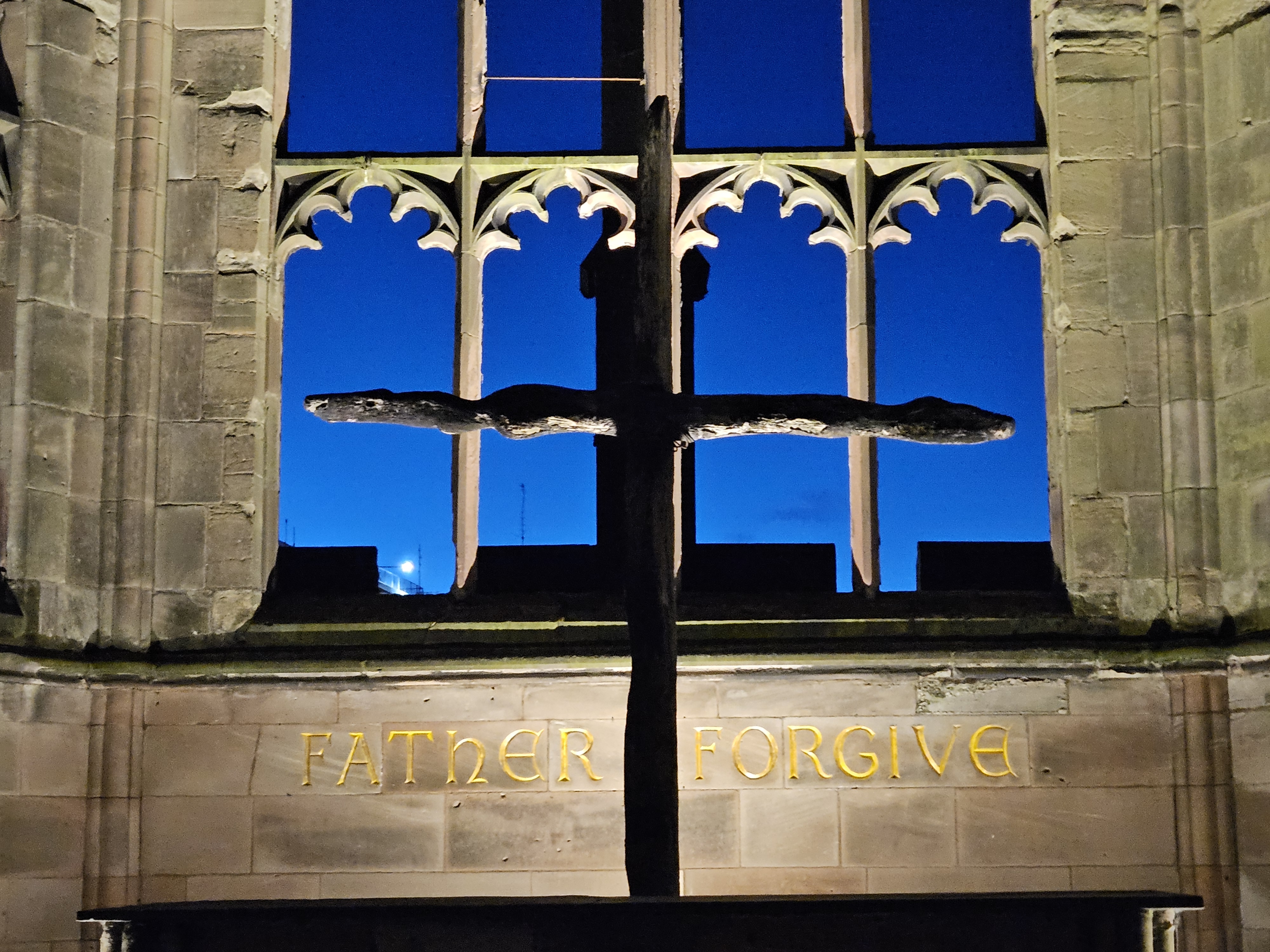
In 1940, the cathedral was destroyed by bombing.
Stones – not thrown by hand this time,
but falling all the same.
And in the ruins,
Provost Dick Howard did something extraordinary.
He did not call for revenge.
He did not divide the world into “us” and “them”.
Instead, he had these words inscribed:
Father forgive.
Not “forgive them.”
Just: Father forgive.
That is not sentiment.
That is not denial of suffering.
That is someone seeing into heaven.
Someone recognising that the Father’s house
is not destroyed by violence –
because it was never contained in stone.
And that the life of that house
with its many rooms
is forgiveness,
even here.
Even now.
And this is not just something that happened then.
It is something we are caught up in here.
Because in this diocese, when people are ordained,
they are ordained in that cathedral –
in that space opened up in the midst of destruction.
A place where violence did not have the final word.
A place where, in the ruins,
room was found for forgiveness.
Stephen was a deacon –
formed at tables,
among the overlooked,
in the fault lines of his community.
And from there, he learned to see into heaven.
And those ordained in that cathedral
are ordained in that same pattern:
not away from the world’s conflict,
but into it –
trusting that even there,
God has made room.
The room we have for God in our lives
is the room that God has prepared for us –
one of so many rooms.
And we have seen that recently.
Gary and Brittany were confirmed there on Easter Day
at the crack of dawn,
when the Easter fire was lit
in the ruins of the cathedral.
Fire again in that place –
but not the fire that destroys.
Not the fire that reduces everything to ash.
But the fire of resurrection.
The fire of the Spirit.
In the very place where flames once consumed,
a different fire now burns –
not to destroy,
but to give light,
to gather,
to kindle new life.
And there, in that same place,
a life opening to God,
a place being made,
a dwelling beginning.
Not somewhere else.
But here.
So the question is not whether there is room in the Father’s house.
The question is whether we will enter the room
that God has already prepared for us –
in the places where the world is most fractured,
where the fire is still being lit in the ruins,
and where, even there,
heaven is already open.