The Withdom of God

Sometimes a new word is needed — not to replace what we know, but to help us see it more clearly.

Withdom is one such word.

In this Easter reflection, I explore how the risen Jesus is made known not in power or distance, but in presence — walking with, staying with, and being with us wherever we are.


A few weeks ago, some of us met for conversation around the subject of finding our voice in worship.
There were so many of us that we had to break into small groups to get the best out of each other.
As we fed back into the larger group a phrase was coined which seemed to sum up the meaning of our conversation.
We were talking about how we enable the worship of the people of our churches and villages.
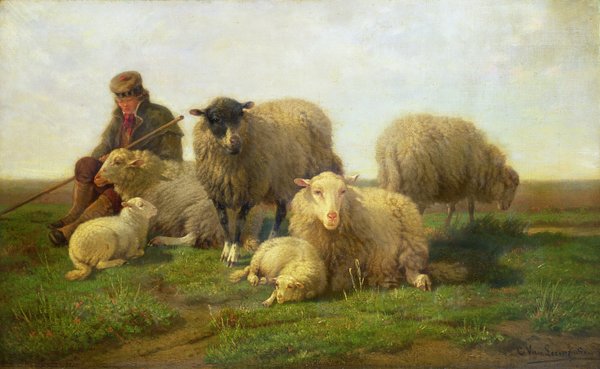
A voice of one of our shepherds came over loud and clear.

She had found that the most important thing in her work
was winning the trust of the sheep.
And she talked about how she did that.
By staying with them.
Not driving them. Not fixing them.
Staying with them until they found their own voice.

That opened our eyes to what we were exploring.
How do we enable the worship of the people of God
when so often we are led to believe that we have to be anything but ourselves?
It is by staying with people, as they are, that encourages people to be as they are.

And one good shepherd reminded us of another good shepherd,
who knows the voice of his sheep
and whose sheep know his voice.

And so, a word was born.

And we called that word … withdom.

Some of us weren’t so sure.
Withdom is not a proper word,
it’s not in the dictionary.”

But we let it stand
because it carried our meaning.

It was never meant to find its way into the dictionary,
or become word of the year.

It was meant to lodge
in our theological imagination …


as just the way God is,
with us,
full of withdom,

and the way we’re called to be
with all those God loves
and chooses to be with,
all those blessed by withdom,
the least, the last, the lost.

We dared to imagine
the rule of the kingdom of God
being the withdom of God.

And once we begin to see it,
we notice it everywhere.

There is much withdom
in our readings today.

In our reading from Acts (Acts 2:14a, 36-41),
Peter stands with the eleven
and addresses the crowd who were with them.
Three thousand of them accepted his message
and joined the eleven –
not just agreeing with them,
but coming to be with them.

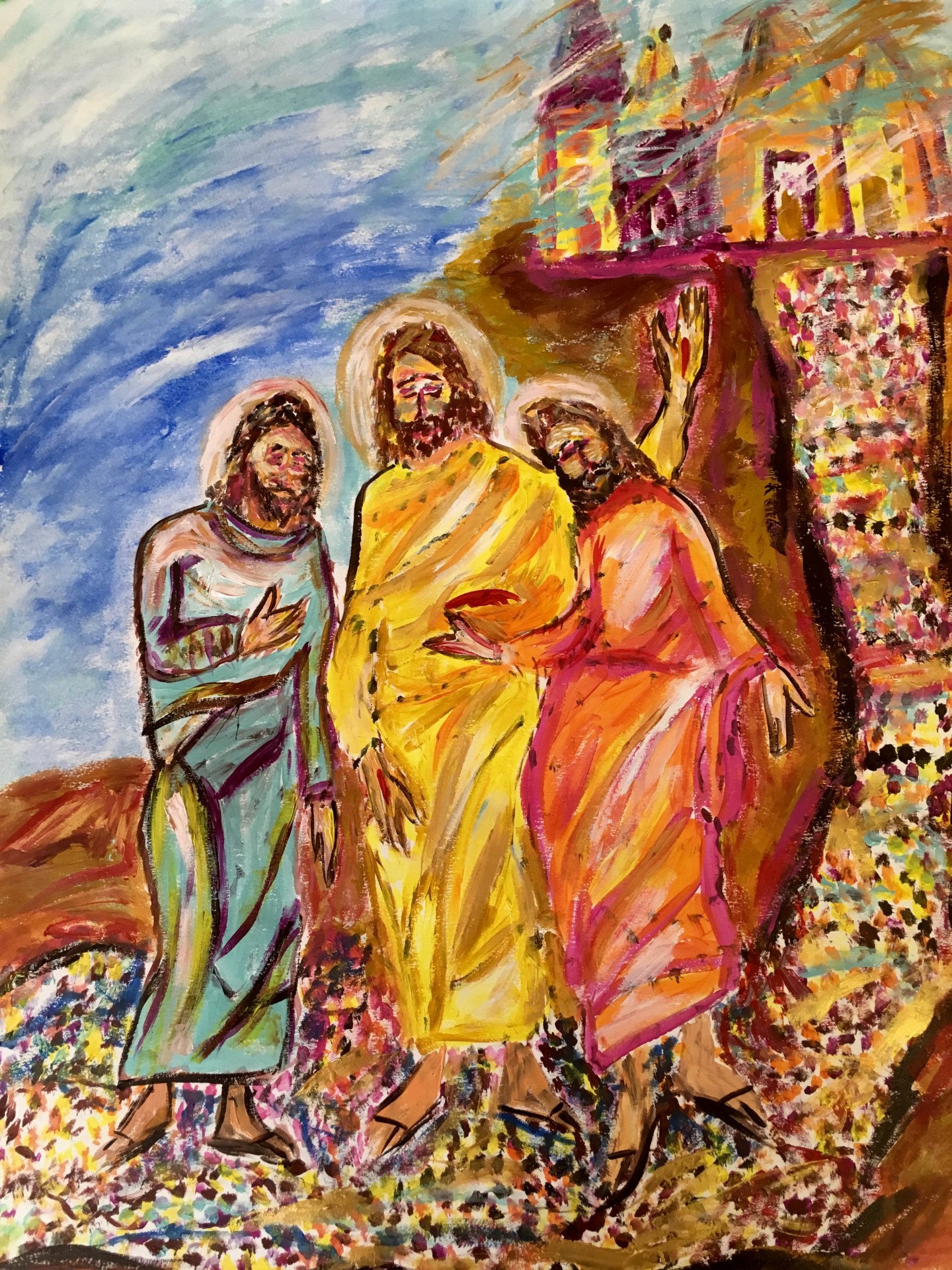
The Road to Emmaus: Painting by: Ronald Raab, CSC

The gospel (Luke 24:13-35) puts us alongside two grief stricken disciples
as they make their way home.
They are joined by a stranger,
who walks with them,
in their grief,
through the valley of the shadow of death.

He is with them.

Nothing could stop him being with them.

Not their confusion.
Not their grief.
Not even their walking away.

He would not be separated
from their lived experience.

This is what he shows them
as he walked with them, stayed with them,
broke bread with them.

And this is the truth we are given –
that nothing … can separate us
from the love of God in Christ Jesus,
neither death nor life,
neither angels nor demons
neither the present nor the future,
nor any powers that be,
nothing in the whole of creation
can break the withdom of God. (Romans 8:38-39)

And if this is the withdom of God …
then this is the life we are called into.

Not to drive people.
Not to fix them.

But to be with them.

To stay with them
until they find their voice.

To be a people who can be trusted …
because we come alongside.

To be with those
who have been told they are not good enough …
and those who are walking away …
and those who don’t recognise hm.

This Easter morning – r evening –
the risen Jesus
comes alongside two disciples
who are confused,
disappointed,
walking away,
not good enough … perhaps in their own eyes.

And he is with them.

Nothing could stop him being with them.

So, if you have ever been led to believe
that you are not good enough …
that God is somehow not with you …
hear this story again.

The Lord is here.
His Spirit is with us.

Pentecost and the love of language

This is the second of a series of reflections inspired by readings from the Book of Acts. Acts is a book of beginnings and the focus of this reflection is on what began at Pentecost through the gift of language.

This is Acts 2:1-6 (I’m using the New Revised Standard Version Updated Edition):

When the day of Pentecost had come, they were all together in one place. And suddenly from heaven there came a sound like the rush of a violent wind, and it filled the entire house where they were sitting. Divided tongues, as of fire, appeared among them, and a tongue rested on each of them. All of them were filled with the Holy Spirit and began to speak in other languages, as the Spirit gave them ability.
Now there were devout Jews from every people under heaven living in Jerusalem. And at this sound the crowd gathered and was bewildered, because each one heard them speaking in the native language of each.

In short, Luke describes a violent rush of wind that shakes up our settled ways of living and possessing. Life can never be the same again. Settled structures are blown apart and the apostles together with some women and some others (Acts 1:14) are blown to join thousands of others through the gift of language and a miracle of hearing.

Language has always been a barrier between people (from Babel) but this miracle brings people together who would have been stranger to each other. Here words are translated by love and the words are taken to heart by people from all parts of the world – “here at last, someone speaking my language”. Alongside that violent rush of wind there is this enormous sigh of people understood – the sigh of relief that here at last, someone is speaking my language.

What does it take to speak the language that makes sense to others, that makes their heart sing? To speak to people in a language they understand requires us to keep silent while we listen to them, while we learn from their words and the emotional history that lies behind them. To speak to a people in any way that makes sense requires an emotional intelligence and empathy that inspires the confidence in one anther that we have something worth saying to one another, and worth hearing from one another. Words on their own will never do because body language communicates far more in the bearing we bring to our words. For a miracle of hearing there needs to be nothing short of love.

The language of vulnerable people is often lost on people of power and many a language has been lost. The English used to forbid the use of Irish in the Irish pig markets insisting that English is the perfect language to sell pigs in. “That English is the perfect language to sell pigs in” is a line from Michael Hartnett’s poem A Farewell to English in which he announced to the world that he would no longer write in English. He did this as resistance and as a way of treasuring the Irish language.

When we think of the languages we are taught in school, they are all the languages of empire, the languages that are supposed to help us get on in life, that help us to get jobs in successful companies. Compulsory language education takes many forms. In the UK language education is benign, but Willie James Jennings writing from an Afro-American perspective, invites us to imagine something far more sinister. In his commentary on Acts he writes: “Imagine centuries of submission and internalised hatred of mother tongues and in the quiet spaces of many villages, many homes, women, men and children practising these new enlightened languages not by choice but by force.”

What of those who insist on the language of empire, who insist on the Queen’s English (should that now be King’s English)? They deprive people of language and understanding : their values, practical wisdom and subtlety are imperilled by a colonising power which conscripts the other for empire. They rob people of their past, present and future. They are responsible for the loss of language. Language makes the store and story of history and all of us want to have ourselves heard and understood. But so many have lost their language, and with it the store and story of their histories.

The book of Genesis sees languages as the curse of empire builders. The story of the Tower of Babel is a story of powerful people thinking they could build all the way to heaven. The seeds of confusion that were sown through their different languages were intended to prevent them getting above themselves.

The way of the empire is not the way of the Spirit or of Spirited people. The Spirit uses the languages long forgotten by the powers that be. In the beginning of this book of beginnings which is Acts Luke goes into detail where everyone has come from. Often readers skip over this long list. They shouldn’t because everyone of them heard the disciples speaking their language. Every one counts and not one of them should be overlooked by us readers.

Imagine this:

Amazed and astonished, they asked, “Are not all these who are speaking Galileans? And how is it that we hear, each of us, in our own native language? Parthians, Medes, Elamites, and residents of Mesopotamia, Judea and Cappadocia, Pontus and Asia, 10 Phrygia and Pamphylia, Egypt and the parts of Libya belonging to Cyrene, and visitors from Rome, both Jews and proselytes, 11 Cretans and Arabs—in our own languages we hear them speaking about God’s deeds of power.” Acts 2:7-11.

We might add other language barriers that would have been present – the young, the old, men, women, deaf, disabled – “we all hear them speaking our language”. This is a beginning for all of them. Now that they have heard God spoken to their heart they now have their own language for God-talk to take back home to their villages and communities. That was a beginning for them.

But we live in a world where divisions won’t go away, where little empires everywhere build their walled communities of exclusion. How do we make sense to one another through the thick walls of separation and in environments made increasingly hostile? What is the way of the Spirit of God? There is a promising beginning in this miracle of Pentecost. The gift of language, the gift in their tongues, is not for one way communication. It is a gift which enables the believers to join others and to enter into their language and life. It is for the act of living together, for the art of heartfelt conversation and for the creation of new relationships.

This is the way with God, embracing others with a love that is utterly understandable. Love translates, and only translates as good news.

Acts 2:1-21 is read in churches at Pentecost.

Listful parading – a sermon for Pentecost

Love the Olympic cauldron. Well done Danny Boyle, well done London. What an opening ceremony.
In our worship we are joined by Christians from around the globe: Nigerian, French, Swedish, Canadians, Chinese. Our Diocese has links with the Melanesian Church and the Congolese Church. Your parish may have other links with churches as well. Some of you may have personal links. The Anglican cycle of Prayer invites us to join other Anglicans around the world in praying for the Dioceses of North Dakota and South Dakota, and their Bishops Michael Smith and John Tarrant.

In worship of our God we are as one. We are brothers and sisters, children of our heavenly father. Thanks be to God, through his work as father, Son and Holy Spirit.

That is the thrust of our reading from Acts as its author Luke recalls the power of God poured out by Jesus from the right hand of God as Holy Spirit on that Harvest festival in Jerusalem.

It was a power so powerful that about 3000 people were added to the other 120 disciples.

It was a power so transformative that “all the believers were together and had everything in common. Selling their possessions they gave to anyone who had need. Every day they continued to meet together in the temple courts. They broke bread in their homes and ate together with glad and sincere hearts, praising God and enjoying the favour of all people.” (Acts 2)

The prophet Joel looked forward to the day when God would pour out his Spirit on all people, young and old, men and women. He knew then that the young would see visions and the old would dream dreams.

I wonder whether the disciples’ commune was one of those dreams, one of those visions.

I wonder if the spirit of Luke’s writing is not wanting us to read this passage as a one-off day in history – for us many centuries ago, but as “today, of all days”, and “today and everyday”.

God showers (that’s the meaning of the Greek word behind out word “baptism”) people with his love, today of all days, and today and everyday.

And then he wants to help us to dream dreams about what is possible, to envision the world in which God’s kingdom comes, on earth, as in heaven. It’s about the future, not the past.

Our news headlines are grim aren’t they? Particularly for the poor.

This week’s news featured a grandmother who committed suicide because of the new bedroom tax, and welfare workers have been trained to recognize suicide risk.

The plight of vulnerable children was highlighted by the Oxfordshire rape case. There was a body discovered buried in a garden in Ellesmere Port. Violence in Iraq has escalated with days of bombings between Sunni and Shia.

Luke’s world was no less divisive. We know there were divisions between oppressed and free, colonized and colonizer, rich and poor, Jew and Greek, men and women.

Luke parades the differences before our very eyes.

In the gospel, he parades the poor, the blind, the prisoners, the lame and the oppressed.

Here, in this reading from Acts, he parades the nations represented at the Pentecost festival.

I’ve heard readers get to that list of nationalities that Luke has measured out for us. Instead of reading the list, they said “Parthians, Medes and Elamites etc etc” which totally misses Luke’s point.

We enjoyed the parade of athletes at the opening ceremony of the Olympics – we discovered countries we never knew existed, like Micronesia. What would it have been like if we were just shown the first three – Team GB, USA and China – with the rest reduced to a blur, as etcetera, while we fast forwarded to something more interesting, like the Queen sky-diving?

No, the list of nations is meant to be long. That is the point. All those people gathered on one place, and in spite of their differences, and their border conflicts, they all heard in their own language what the disciples were saying as they spoke in tongues.

And 3000 of them came together, sold everything, shared everything, met everyday, and enjoyed the favour of all people.

Is it a tall story, a vision or a dream?
Heatherwick's Petals
You saw the Parade of Athletes at the Olympics last year. For a moment I want you to use your imagination. I want you to parade Luke’s people before your eyes, to see their flags, and to also notice the petal each group is carrying.

Here come the (fanfare, dancing, drums, cheering and applause)

Parthians

The Medes

The Elamites

The residents of Mesopotamia

The Judeans

The Cappadocians

People from Pontus,

Phrygia

Pamphilia

Egyptians (why do they walk like that?)

Libyans from the region of Cyrene

Romans

Cretans

Arabs

They parade around, stake their flag in front of our eyes and place their petal in a stand.

Then come seven young boys and girls. They represent the promise of the future. They go to the petals, and they breathe fire on to them. One by one the petals catch a light until they are all ablaze. The flames come together as one cauldron.

Wasn’t it an amazing sight that Danny Boyle offered us? Isn’t it an amazing sight that Luke shows us.

In spite of our differences, all of us understood in our own heart of hearts the Olympic dream.

For the Dean of Durham we saw what we can be.

He wrote: “We saw some important things that spoke about Britishness in the 21st century … like care and compassion, inclusivity and diversity, flair and creativity, modesty and understatement, the confidence to be at ease with ourselves, our ability to question ourselves, our enjoyment of life.”

Likewise, Luke’s parade needs no interpretation and no explanation. Each of them knew the meaning of what was being said in tongues from within the tongues of flame.

We hear of people speaking in tongues and wonder what all that’s about.

But the message of these 120 men and women speaking in tongues was immediately understandable.

Nothing was lost in translation, because although they were speaking in tongues, they were speaking the Mother Tongue, the tongue of the Holy Spirit.

The Mother Tongue is not a difficult language. In the Mother Tongue there is only one word, which was in the very beginning and which will be spoken for ever.

Some chose to think that the disciples were drunk.

But others, 3000 of them, chose to see the power that is God’s, that overcomes difference, that reconciles enemies, that made one community of many interests.

We call that community “the church”.

This is the community that believes in the power of God to turn the world upside down.

This is the community in which members see a chaotic world before their eyes, but they realise their own responsibility to revert to the Mother Tongue in all their interactions.

This is the community which prays for the ending of division and the repair of broken relationships, which prays for Sunni and Shia in Baghdad, slaves, the poor, the abused and their abusers because we know what is possible, today and all days.

This is the community of men and women who dare to dream dreams and who see visions of kingdom come, on earth as it is in heaven.

This is the community that is being constantly licked into shape by the Mother Tongue. Today of all days, and today and every day.

This sermon was preached at Christ Church, Higher Bebington on May 19th 2013.

The photo of the Olympic Cauldreon is by Paul Watson. The Cauldron was designed by Heatherwick.