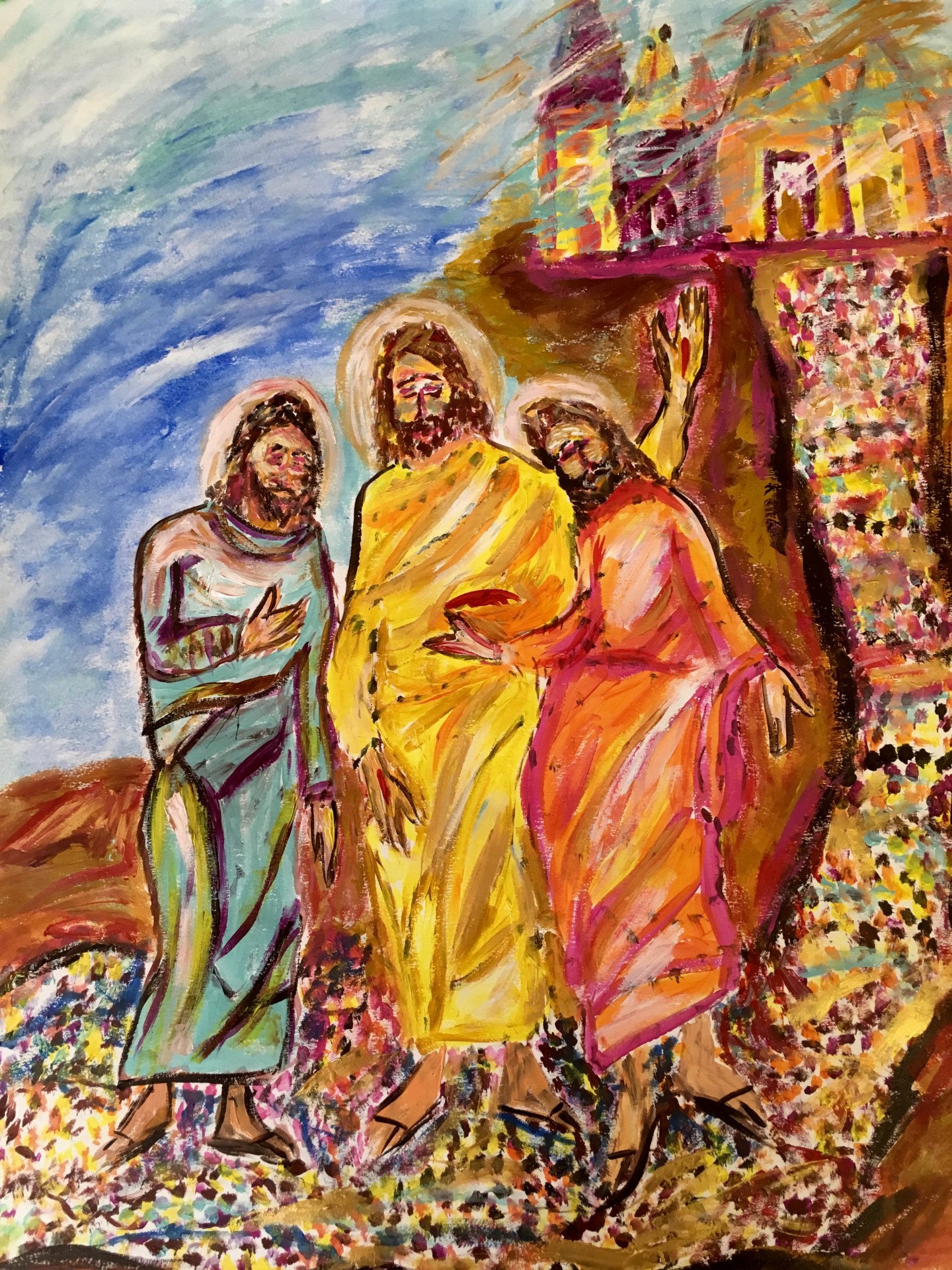
This week’s readings (Romans 8:26-end and Matthew 13:31-33, 44-52) ask one of the most searching questions in the New Testament: Can anything separate us from the love of God? Paul answers with a resounding “No.” Jesus then invites us to discover why—not in the spectacular or the powerful, but in the smallest, most easily overlooked signs of God’s kingdom. Perhaps the first step in following Jesus is simply learning to see what he sees.
Can anything separate us from the love of God?
There could hardly be a greater contrast than the contrast between ourselves and the people Paul was addressing in his letter to the church in Rome.
Just imagine what they were going through.
Paul gives us a glimpse:
hardship,
distress,
persecution,
famine,
nakedness,
peril
and sword.
This is no rhetorical exaggeration.
Paul is writing to communities living under the shadow of the Roman Empire,
where persecution, imprisonment, poverty and execution were genuine possibilities.
These are the lived realities of many of the Christians to whom he writes.
Over the years I have become increasingly aware that much of Scripture comes to us through the experience of people who were oppressed, enslaved, exiled or hated.
We read Scripture, as it were, over their shoulders.
Not that we do not know suffering ourselves.
We face other hardships.
Other powers can seem overwhelming.
Other fears can drain the life from us.
And so we, too, may hear this letter as though it were addressed to us.
We hear Paul insist that nothing in all creation—
not hardship or distress,
persecution or famine,
nakedness, peril or sword
—can separate us from the love of God in Christ Jesus.
Neither death nor life.
Neither angels nor rulers.
Neither things present nor things to come.
Nor powers.
Neither height nor depth.
Nor anything else in all creation.
It is one of the boldest claims in the New Testament.
Paul doesn’t merely hope this is true.
He is utterly convinced of it.
And if Paul tells us that nothing can separate us from the love of God,
Jesus tells us why.
The answer comes in what Jesus sees, and who he sees.
Who he sees first are the least, the last and the lost in the ways of the world.
And he sees the little they are left with,
and the little we have.
He sees in the little people have all the signs of the kingdom,
the love of God, the presence of God, the rule of God.
And he wants us to see what he sees in the things he points out.
There’s the tiny seed – the tiniest of seeds.
There’s the yeast in the bread.
There’s all the things overlooked by the powers that be
with their attention preoccupied with what is bigger and better in their own eyes.
Jesus looks at the ordinary world and sees the kingdom of God.
A seed.
Some yeast.
A field.
Where others see almost nothing, Jesus sees everything.
He sees the tiny mustard seed growing to the huge shelter for the birds of the field.
He sees the yeast folded into the dough for the daily bread that keeps us going.
He sees a field and sees the treasure hidden within it that is never going to be found by those looking for bigger and better things.
He is always asking “What have you got – let me see?”
“What have you got?” Jesus asked
“Five loaves and two fish – what’s the good in that?”, the disciples replied.
“Just wait and see” Jesus said
The disciples see five loaves and Jesus sees a feast.
That’s the miracle.
Jesus sees the ways of God in the little people have,
and he points them out for the world to see:
the love of God,
the presence of God,
the kingdom of God,
hidden in the little things of their lives,
not in the big things.
The kingdom of God is revealed in such little things
and we are captivated by what Jesus sees.
To follow Jesus is to follow his finger –
to look where he is looking,
To notice who he notices,
to treasure what he treasures,
until, little by little,
we begin to see the world through his eyes.
And that is why Paul can say,
with such astonishing confidence,
that nothing can separate us from the love of God.
It is true: the powers can destroy bodies,
they can imprison us,
they can persecute us and hate us for all sorts of reasons,
they can starve us, they can threaten us
but none of that can separate us from the love of God
because God’s love is always finding somewhere to take root
in a seed
in some yeast
in a field
in five loaves and two fish
in a child
in the poor in spirit
in the meek
in those who hunger and thirst for righteousness
in those who mourn
in those who are persecuted
in a cross
in an empty tomb
Nothing can separate us from the love of God
because God’s love is always finding somewhere to take root
in the little we are left with.
After hardship,
after grief,
after disappointment
after persecution,
after loss.
what are we left with?
We don’t always come to Christ with abundance.
Sometimes we come with the little we are left with.
And Jesus says, “let me see”.
“Let me see what you have,
not what you haven’t,
nor what you wish you had.”
His love takes root in the little we have.
In the little faith.
In the little hope.
In this little church.
In this little time
he plants a tiny seed
pointing us to the way of the kingdom,
showing us that this is what the kingdom of God is like.
Nothing can separate us from the love of God
because God’s love is always finding somewhere to take root
in the little we are left with.