Scar City

This sermon is about the crumbs that fall from the sandwich formed by the two feeding stories in Matthew’s gospel: the Feeding of the 5000 and the Feeding of the 4000. Between the two, there’s a woman who talks about the crumbs that drop from that sandwich. (It’s inspired by the readings appointed for today, Trinity 11A, Isaiah 56:1-8 and Matthew 15:21-28)

I’m calling the place where this happens Scar City.
OK. I’ve made that up.
The gospel tells us that Jesus was in the region of Tyre and Sidon.
But I’m telling you,
it’s Scar City.
And it’s where we all live.

Scar City,

where we’re all scared to death
there’s not enough,
not enough resources,
not enough time,
not enough money,
not enough room,
not enough bread.

Scar City.
The locals, who,
– for the most part,
rush around, face down –
pronounce it Scarcity.

Today, in this place where we live,
we are introduced to an array of characters:

There’s the exiled
the foreigners,
the eunuchs,
the Canaanite woman,
her daughter,
– and the dogs!

And they all have one thing in common.
They are all outsiders.

This is no new WOKE nonsense.
This is ancient biblical business.

This is always what the people of God have been engaged with.

Isaiah’s writing goes back over 2500 years.
He is the one who introduces us to the plight of the exiles,
the foreigner and the eunuch,
to those particular people who have been told
by those taking control of their borders:
“You do not belong”
“There is no room for you here”

That’s the trouble in ScarCity.
The fear of ScarCity is one of the forces that produces exclusion.
And it’s here that the scriptures,
treasured and curated by those excluded,
land in our lap to challenge us,

like the eunuchs,
Who we might be tempted to pass over very quickly,
not quite knowing what to do with them.

But Isaiah won’t let us.

The eunuchs are people whose bodies
have been used to tell them
that they have no future among God’s people.
No children.
No descendants.
No name that will carry on.

And God says:
I will give them a name,
a name better than sons and daughters;
an everlasting name
that will endure for ever.

In other words,
God isn’t simply making an exception
for people who don’t fit the rules.
God is changing the rules,
changing the rule of the world,
the rule of scarcity,
for the rule of the kingdom.

In that kingdom rule
it is God who decides who belongs,
and it’s God’s way to keep gathering,
more and more, more and more.
And where do they all come from?
They come from outside, outsiders.

Here’s God’s rule:
“I will gather still others to them
besides those already gathered.”

Isaiah sees God building a house.
It’s the same house talked about by Jesus in John’s gospel,
the house with many rooms,
with so much room.

Isaiah gives the house a name:
it’s a “house of prayer for all nations”
(or “for all people”).

But every house needs a table.
A house without a table is empty.
A table is a sign that the house is a home,
a place of belonging and a place of invitation.
There are rules about who sits where,
and who doesn’t sit anywhere.

Matthew sets the table in today’s gospel.
He sets it between two other tables:
the fields in which Jesus feeds 5000
(plus women and children)
and in which Jesus feeds 4000.

Between those two stories comes this:
a foreign woman coming to Jesus
to ask for help,
because her daughter is demon-possessed
and suffering terribly.

The disciples wanted to send her away.
Jesus also was dismissive.
“I was sent only to the lost sheep of Israel”, he said.
“It is not right to take the children’s bread and toss it to the dogs.”

“Yes it is, Lord” persisted the woman.
Yes it is.

Matthew doesn’t call her a foreigner or a Gentile woman.
He calls her a Canaanite.
She comes from the people Israel displaced
when it claimed this land as its own.

And here she is,
not demanding the land back,
not demanding the children’s bread,
but asking for crumbs.

She takes Jesus to the table
and she shows him that even the dogs eat the crumbs
that fall from their master’s table.

She doesn’t suggest that Jesus take bread from one mouth
and put it into hers.
She simply points out
that there is something about bread
that makes crumbs.

There is enough to fall.
There is enough for those who are not sitting at the table yet.

This woman,
who has been called a dog,
who the disciples wanted to shoo away,
is the one who understands
the abundance of the table.

She is the neighbour
who comes from the other side
of an ancient boundary
and teaches God’s people
that there is room at the table.

She is one of the “still others” Isaiah talks about.
They all have names, histories and memories –
and sometimes they arrive at our table
carrying a history that we would rather not remember.

She refuses to accept that the table
is as small as Jesus and his disciples made it
and reveals the only table that fits
the house God is building,
where all are welcome,
all are fed:
the foreigner,
the eunuch,
the exile.

It’s the table we see prepared for us in Psalm 23,
the table God prepares for us
in the presence of those who trouble us,
who say there isn’t enough
in this Scar City.

And it is this table,
where we gather,
where there is so much to feed on,
where still others, outsiders,
will be gathered beside us,
to teach us the ways of the table
in the kingdom,
in the house of prayer for all people,
in the house prepared for us
with room enough for all those excluded
by the rule of Scar City.

Those who live in Scar City
insist there’s not enough room.
But those who live for the kingdom of God
persist: Yes, there is. Yes, there is.

When we come to  Communion
we walk right into this gospel.
God makes the room
around the table where we gather.
We taste the proof.
Is there enough for sinners like us?
Yes, there is. Yes, there is.
And more besides.
Love Takes Root in the Little We Are Left With

This week’s readings (Romans 8:26-end and Matthew 13:31-33, 44-52) ask one of the most searching questions in the New Testament: Can anything separate us from the love of God? Paul answers with a resounding “No.” Jesus then invites us to discover why—not in the spectacular or the powerful, but in the smallest, most easily overlooked signs of God’s kingdom. Perhaps the first step in following Jesus is simply learning to see what he sees.


Can anything separate us from the love of God?

There could hardly be a greater contrast than the contrast between ourselves and the people Paul was addressing in his letter to the church in Rome.

Just imagine what they were going through.

Paul gives us a glimpse:

hardship,
distress,
persecution,
famine,
nakedness,
peril
and sword.

This is no rhetorical exaggeration.
Paul is writing to communities living under the shadow of the Roman Empire,
where persecution, imprisonment, poverty and execution were genuine possibilities.
These are the lived realities of many of the Christians to whom he writes.

Over the years I have become increasingly aware that much of Scripture comes to us through the experience of people who were oppressed, enslaved, exiled or hated.

We read Scripture, as it were, over their shoulders.

Not that we do not know suffering ourselves.
We face other hardships.
Other powers can seem overwhelming.
Other fears can drain the life from us.

And so we, too, may hear this letter as though it were addressed to us.

We hear Paul insist that nothing in all creation—
not hardship or distress,
persecution or famine,
nakedness, peril or sword
—can separate us from the love of God in Christ Jesus.

Neither death nor life.
Neither angels nor rulers.
Neither things present nor things to come.
Nor powers.
Neither height nor depth.
Nor anything else in all creation.

It is one of the boldest claims in the New Testament.
Paul doesn’t merely hope this is true.
He is utterly convinced of it.

And if Paul tells us that nothing can separate us from the love of God,
Jesus tells us why.

The answer comes in what Jesus sees, and who he sees.

Who he sees first are the least, the last and the lost in the ways of the world.
And he sees the little they are left with,
and the little we have.

He sees in the little people have all the signs of the kingdom,
the love of God, the presence of God, the rule of God.
And he wants us to see what he sees in the things he points out.

There’s the tiny seed – the tiniest of seeds.
There’s the yeast in the bread.

There’s all the things overlooked by the powers that be
with their attention preoccupied with what is bigger and better in their own eyes.

Jesus looks at the ordinary world and sees the kingdom of God.

A seed.
Some yeast.
A field.

Where others see almost nothing, Jesus sees everything.

He sees the tiny mustard seed growing to the huge shelter for the birds of the field.
He sees the yeast folded into the dough for the daily bread that keeps us going.
He sees a field and sees the treasure hidden within it that is never going to be found by those looking for bigger and better things.

He is always asking “What have you got – let me see?”
“What have you got?” Jesus asked
“Five loaves and two fish – what’s the good in that?”, the disciples replied.

“Just wait and see” Jesus said

The disciples see five loaves and Jesus sees a feast.

That’s the miracle.

Jesus sees the ways of God in the little people have,
and he points them out for the world to see:
the love of God,
the presence of God,
the kingdom of God,
hidden in the little things of their lives,

not in the big things.

The kingdom of God is revealed in such little things
and we are captivated by what Jesus sees.

To follow Jesus is to follow his finger –
to look where he is looking,
To notice who he notices,
to treasure what he treasures,

until, little by little,
we begin to see the world through his eyes.

And that is why Paul can say,
with such astonishing confidence,

that nothing can separate us from the love of God.

It is true: the powers can destroy bodies,
they can imprison us,
they can persecute us and hate us for all sorts of reasons,
they can starve us, they can threaten us
but none of that can separate us from the love of God
because God’s love is always finding somewhere to take root

in a seed
in some yeast
in a field
in five loaves and two fish
in a child
in the poor in spirit
in the meek
in those who hunger and thirst for righteousness
in those who mourn
in those who are persecuted
in a cross
in an empty tomb

Nothing can separate us from the love of God
because God’s love is always finding somewhere to take root
in the little we are left with.

After hardship,
after grief,
after disappointment
after persecution,
after loss.
what are we left with?

We don’t always come to Christ with abundance.
Sometimes we come with the little we are left with.

And Jesus says, “let me see”.

“Let me see what you have,
not what you haven’t,
nor what you wish you had.”

His love takes root in the little we have.

In the little faith.
In the little hope.
In this little church.
In this little time

he plants a tiny seed

pointing us to the way of the kingdom,
showing us that this is what the kingdom of God is like.

Nothing can separate us from the love of God

because God’s love is always finding somewhere to take root
in the little we are left with.

A Field of Grace

What do we do when we find fault? That question has stayed with me all week as I’ve reflected on the Parable of the Weeds (Matthew 13:24–30, 36–43), while the Warwickshire wheat fields have been turning wonderfully white for harvest.


Have you noticed how we’re all expected to be experts these days?

We review restaurants.
We rate hotels.
We comment on politicians.
We analyse football managers.
We critique television programmes.
We even write reviews of the products we buy.

Blimey. We even have to review our recent experience at the dentist and how we were treated in our call to TalkTalk – all of which is recorded for training purposes!

When did we suddenly become experts in all of these things?
When did I become an expert on education, politics, liturgy, the church, other people’s motives.
It seems we have become opinionated about everything.
We’ve been trained to be critical and even unhappy about this, that and the other.

We’ve become Fault Finders,

When did that happen?

We all know the answer to that.

It began in the beginning.

It was then we found fault
and someone to blame.
Long before Jesus,
there’s always been fault in our stars,
even in the Garden of Eden.

Jesus tells a story for people like us.
The Parable of the Weeds is for Fault Finders.

it’s the farmer’s servants who are the Fault Finders.
They find fault in the field.
The fault in the field
is the weeds that had come up
just when the wheat sprouted
and started to grow ears.
“Do you want us to dig them out?”
the farmhands asked the farmer.

The farmer,
who had been sowing and harvesting for years,
since Adam was a lad, says,
“No.
Because when you dig the weeds up
you’ll also uproot what I planted.”

It’s as simple as that.

He told it as a parable of the Kingdom.
He even begins it with the words,
“The kingdom of heaven is like …..”
so that those with ears may hear and understand
that this is the way of the kingdom of God
trusting the Farmer while wheat and weeds grow together until the harvest.

For those with ears to hear,
Jesus is offering a new understanding,
a new way of being in a world at fault,
with others in whom we find fault.

It is the seed of an idea
God scatters in the field
of our imagination.
It is a seed of an idea
that has to grow in the crowded field of our imagination,
alongside fear, disappointment, bitterness, anxiety,

The farmer is teaching his servants to see things differently,
and Jesus, in telling this story,
is teaching his disciples to see things differently.

It isn’t wrong to notice faults.

The servants were right.
There were weeds in the field.

Jesus isn’t asking us to pretend that evil isn’t real,
or that wrong doesn’t matter.

The question is not whether we see faults.
The question is how we see them.

The servants saw the weeds
and could see little else.

The farmer saw the weeds too.
But he also saw the wheat.
He saw the harvest.
He saw the damage that impatient judgement would do.

The servants wanted to solve the immediate problem.
The farmer wanted to protect what he loved.

Perhaps that’s what Jesus means when he says,
“Let anyone with ears listen.”

Learn to see the field as the Farmer sees it.

Learn to see faults with the eyes of love.

Not denying them.
Not excusing them.
But keeping them in the larger field of grace.

The Church has been learning that lesson for two thousand years, and it shows in the genius of our liturgy.

Every Sunday we acknowledge the faults we’ve found in ourselves.

We don’t ignore them.
We don’t excuse them.
We confess them.

Not privately, but together.

In the hearing of our brothers and sisters.

I have always loved the Roman Catholic confession:

I confess to almighty God
and to you, my brothers and sisters…

It is wonderfully honest.

It tells the truth.

It doesn’t minimise our fault.

But neither does it linger there.

The confession is brief.
Grace is long.

We hear words of forgiveness.
We exchange the peace.
We’re even entrusted with the gospel.
We gather around one table.
We eat and drink together—
the same Jesus who was criticised for eating with tax collectors and sinners still feeds sinners today.

The Church has learnt something from the Farmer.

The question is not whether we see faults.
The question is how we see them.
Do they become the whole story?

Or do we see them in the larger field of grace?
Because the Farmer sees the weeds.
But he also sees the wheat.
He sees the harvest.

And he teaches us to look with his eyes.

To look at those we find fault with…
and to refuse to let their faults become the whole story.

To remember that they too are standing in the same field,
under the care of the same Farmer,
nourished by the same rain,
waiting for the same harvest.

Every one of us will leave church today and find fault with someone.
That isn’t difficult.

The question is what we see next.
Do we stop at the fault?
Or do we ask the Farmer to lend us his eyes?

Eyes that see the larger field of grace.
Eyes that see what he has planted.
Eyes that trust the harvest.

Finding the Way to Be Ourselves

We all know the feeling of becoming someone we never intended to be. This sermon, based in Romans 7:15-25 and Matthew 11:16-19, 25-end, explores how Paul and Jesus invite us not simply to try harder, but to discover another way of being human.


This is what I don’t understand.
The things I want to do, I don’t do.
I keep making plans
but something always seems to get in the way.
I don’t do the good I want to do

I keep becoming someone I never intended to be.

I wanted to be patient, but then I got tired.
I should have spent more time with my children when they were growing up,
but, you know, the pressures to always be working,
to make a good impression, to get on.
I didn’t want to worry so much, but those credit card bills kept coming.
I wanted to be generous, but never had anything left.
I wanted to be kinder, but ….

That’s what I don’t understand.

I’ve never quite become the person I wanted to be.

Do you get that?
Do you feel that?
Or am I on my own?

I know I’m not on my own because Paul felt it as well
and wrote about it in his letter to the Romans.
I don’t understand what I do.
What I want to do I do not do.
I have the desire to do what is good, but I cannot carry it out.

He knew what all of us know
that there is this sad fact of life
that we are never quite as free to be ourselves as we imagine.

We imagine we’re free to be ourselves,
we imagine we’re self-made
but all the time we are being formed by the powers that be:


by advertising – (why would that be a multi-billion industry if it had no effect on persuading us to be and do differently?)
by social media
by our work place – and its politics and expectations
by our families
by our friends
by the news we consume
even by our churches
and the company we keep

All these things form us.
They have power over us.

Some of it works for our benefit, but
some of it teaches us to live by fear,
scarcity, competition and status.

Some of it wields a power over us
so that we don’t do the good we want to do
and finish up doing the things we hate doing.
Paul put it all down to sin.
I don’t understand what I do.
Why do I do what I hate doing?
We hear his conclusion:
“It’s not me. It’s sin living in me that does it.”

Paul speaks of sin as an occupying power
and he has been “taken prisoner”.
Paul isn’t describing a weak will
so much as humanity living under an oppressive regime.
It’s a regime larger than individual acts of wrongdoing.
It’s everything that enslaves us:
Systems of domination,
fear, violence, exploitation,
and the internalised habits they create.

Paul calls this Sin.
We might recognise it today in what we call
“the powers that be”
those forces, systems and habits
that shape us
until we no longer
know whose voice we’re listening to.

It’s the powers that be that diminish us
and steal our freedom to be
the people we would love to be.

The powers that be aren’t just them.
They’re more pervasive than that.
The powers that be are also inside us.

Their voices have become our inner voice.
We’ve learned their language,
They’re our self-talk
persuading us to measure ourselves by their standards
till we finish up cooperating with the very powers that diminish us.

This is what we don’t understand
because we are confused by the powers that be.

And so we turn to Christ.

He does understand.

He doesn’t begin by blaming us.
He begins by understanding us.

His understanding comes from experience.
The wise and learned have scoffed at him.
The powers that be have laughed him to scorn.

He praises his Father for hiding “these things” from the wise and learned
and revealing them only to “little children”

That’s always been the way with God.
Pharoah cannot see
Herod cannot see
Pilate cannot see
The chief priests cannot see.

The so-called “wise and learned”,
the so-called grown ups,
the so-called leaders
are looking in the wrong places,
with the wrong expectations
using the wrong measures.

They cannot see.
That’s why Jesus insisted
that we have to become as little children
to enter the kingdom of heaven.

But why children?

It’s not because children are innocent.
They’re not.
They can be devious and manipulative.
It’s not because children know less,

but because children are still teachable.

The “wise and learned” have already graduated.
They’ve stopped learning.
They think they know how the world works.
They know what success looks like,
who matters, who wins, who loses.
They think they know it all.
They think they’re experts.

Children are still learning.
“Learn from me.”

That may be the most important sentence in today’s gospel reading.
Jesus says,
Come to me.
Take my yoke.
Learn from me.

He’s inviting people into another school,
another imagination, another kingdom,
another way for being human
for those who become as little children,
vulnerable to all sorts of abuse
in the ways of the world and the powers that be,
and teachable …..

and for the weary.
The invitation is for those who become as little children
and the weary and burdened by modern life
which teaches us to desire things we don’t actually want:

to work more, to work harder,
to consume more, compete more, fear more,
leaving us less able to do the good we want to do.

The ones Jesus was inviting
were wearied and burdened
by the religious establishment
the social hierarchy,
the endless demands of honour and shame,
the burden of purity laws
as well as the crushing demands of empire.

Jesus understands
how we are bound to do what we don’t want to do,

and with mercy and compassion
he invites us
to come to him,
to join him
as our teacher.

Every kingdom forms people in its own image.
Every kingdom has its own idea of what a successful human being looks like.

The powers that be produce anxious people,
competitive people,
frightened people,
striving people,
people who never quite believe
there is enough, or
they are enough.

Jesus doesn’t simply forgive those people.
Those people who come to him,
who turn to him
he patiently teaches,
forms
and reshapes 
into the people
God intended them to be
from the very beginning:

gentle,
humble in heart,
and finally able
to rest.

Jesus Breaks the Uneasy Truce

A sermon on Matthew 10:24-39 exploring what Jesus meant when he said he came not to bring peace but a sword, and why the peace of God’s kingdom is deeper, costlier, and more transformative than any uneasy truce.


What is whispered in your ear?
What is whispered in your ear, proclaim from the rooftop.

You know the image John paints for us of the beloved disciple,
the one Jesus loved,
reclining with him at table.

John chose not to name that “beloved disciple”.
I prefer to name the beloved disciple as “anyone”,
anyone who chooses to stay so close to Jesus
that they can hear his heart beating,
can feel his breath
and catch the whisper of his words in the ear.

What is whispered in your ear?

What is whispered in your ear
proclaim from the rooftop,
in this wounded world.

For the world is wounded

Our Collect today recognises that reality.
It does not pretend otherwise.

God our saviour,
look on this wounded world
in pity and in power;
hold us fast to your promises of peace
won for us by your Son,
our Saviour Jesus Christ.

And so we pray that God our Saviour
will look upon this wounded world
in pity and in power,
and hold fast to his promises of peace.

Deep peace.
A peace beyond all human understanding,
A peace won at enormous cost.

Not the shallow peace
that merely papers over the cracks.

Not the fragile peace
declared with cynical calculation,
while old wounds fester beneath the surface.

Not the peace that can be shattered
by the next angry word,
the next act of violence,
the next grasp for power.

That is a peace that has no love for its enemy,
that’s always ready to flare with hatred,
a peace that is defended at great cost,
with arsenals of weapons of destruction,
even tongues at the ready for lashing out.

That is a momentary peace,
a temporary ceasefire of hostility,
but the peace of God’s kingdom
is different.

In the peace of God’s kingdom,
justice and mercy embrace
and all things are made new.

Jesus breaks the uneasy peace
thank God.

Because the peace we so often settle for
is not peace at all.

It is avoidance.
It is silence.
It is looking away.
It is learning to live comfortably
with somebody else’s suffering.

And that is why Jesus speaks of a sword.
Which is difficult to hear.

Especially on a day when many of us are giving thanks for fathers,
when we are celebrating the love and care that family can give.

Yet Jesus says:
“I have come to set a man against his father.”

Not because fathers do not matter.
Not because families do not matter.

But because the kingdom of God reaches deeper
than every other loyalty we possess.

Not because he delights in conflict.
Not because he blesses violence.

But because truth has a way of disturbing lies,
justice has a way of disturbing privilege,
and love has a way of disturbing anything
that treats God’s children as less than human.

When Jesus stands with the excluded,
the rejected,
the last and the least,
those who benefit from their exclusion
rarely applaud.

The sword is the division that comes
when God’s kingdom collides
with the kingdoms we have built for ourselves.

It is the cost of proclaiming from the rooftops
what has been whispered in the ear.

For when you stay close enough to Jesus
to hear his heartbeat,
You begin to hear what he hears.

The cry of the hungry.
The grief of the forgotten.
The anger of the humiliated.

The longing of those denied dignity,
bread,
or hope.

And once you have heard those voices
beating in the heart of Christ,
it becomes impossible to pretend
that everything is fine.

The old peace begins to crack.

And through those cracks,
the kingdom begins to appear.

Which sounds wonderful.

Until we realise what it asks of us.

Because Jesus is not inviting us
merely to admire the kingdom.

He is inviting us to live for it.
To spend our lives for it.

And that may be a better way to hear
what Jesus says next:
“Whoever loses their life for my sake will find it.”

Perhaps better:
“Whoever spends their life for my sake,
for the sake of the kingdom,
will find it.”

Every one of us spends our life somehow.

Sometimes it can be trivial.
Spending our lives accumulating things.
Spending our lives to make a name for ourselves
(a name that will be so soon forgotten when we’re gone).

Or, we can spend our lives
on the pearl of great price,
spending ourselves on truth
spending ourselves on mercy,
spending ourselves on reconciliation,
spending ourselves on the hard work of God’s peace.

And if we spend our lives this way
we shouldn’t expect everyone to approve.

After all, they called Jesus Beelzebul,
a name which means the lord of filth,
lord of the dung heap,
and the sort of name we might be branded with
if we follow Jesus.

Those who expose what is rotten
are rarely thanked by those who benefit from the smell.
Those who expose wounds
are rarely thanked by those who profit from them.
Those who challenge exclusion
are often accused of causing division.
Those who stand with the last and least
are frequently labelled troublemakers.
Those who dare to believe in a peace
that goes deeper, beyond human imagining,
will be misunderstood,
criticised,
caricatured,
and even crucified.

This is what we are getting into when we become followers of Jesus,
when we become his beloved disciples,
close to the breath of God
whispering the words
that save us from the shallow peace
with its consequences of entrenched privilege,
deepening division and forgotten neighbours.

Jesus tells his beloved disciples:

Do not be afraid.
Do not be afraid of those who misunderstand you.
Do not be afraid of those who mock you.
Do not be afraid of those who call good evil
and evil good.
Do not be afraid of losing your reputation.
Do not be afraid of spending your life this way.

For the kingdom of God
is worth a life.

The kingdom where justice and mercy embrace.
The kingdom where the last are welcomed first.
The kingdom where wounds are healed.
The kingdom where all things are made new.

So, perhaps the question for us this morning is:
What is whispered in your ear?

What is Christ saying to you
when you stay close enough
to hear his heart beat,

close enough to hear in his heart
the cry of the earth,
the forgotten,
the humiliated,
the excluded?

And what is whispered in your ear,

proclaim from the rooftops,
whatever the cost.

When we no longer like ourselves

In Matthew’s gospel, Jesus repeatedly seeks out people who feel bad rather than good about themselves, and calls them by name. Drawing on Matthew 9:9–13, 18–26, this sermon explores some of those moments in our lives when we have felt far from good.


I’ve not been well this week.
Don’t worry, it’s just been a mouth abscess – and it’s been treated with antibiotics.
The pain level – I’d give it 4/10.
Nothing much.

I’ve felt annoyed more than anything.
I’ve not felt good.
In fact, I’ve felt bad.

But not as bad as at other times,
such as when we’re tired at the end of the day
looking after grandchildren
and have to organise their tea time and the feeding of three dogs.

I don’t just feel bad,
I hate myself and the way that I am,
stressed and ratty (my apologies to rats).

And as for those times when there’s so much to do and so little time ….

Does illness, tiredness and stress make you feel like that?
Or, am I on my own?

It’s strange, isn’t it, how feeling physically unwell can spill over into everything else?

We don’t just hurt,
we become shorter-tempered,
less patient, less generous versions of ourselves,
and dangerous to those around us.

I remember the prayer of a woman leading intercessions.
Leaning on her walking frame, she said something along the lines of,
“Lord, you know that when we are in pain, or are ill, we no longer like ourselves”
Perhaps we can all join that prayer.

When we feel bad,
when we don’t feel well,
when we don’t feel good,

In today’s gospel (Matthew 9:9-13, 18-26) Jesus turns from one person to another,
to Matthew,
tax collectors and sinners,
the woman who had been bleeding for 12 years,
Jairus and his household

all, who, for one reason or another,
felt bad,
unwell, far from good.

Jesus meets Matthew sitting at the tax collector’s booth,
just the place we all try to evade –
even more so when the tax is going to a foreign power.

Matthew was working for Rome.
The money he collected was not for the benefit of his neighbours.
It helped keep the empire running, reinforcing its power.
To many of his fellow Jews, he was a collaborator,
a traitor, a bad man in a place of shame.

Jesus sees him,
calls him,
“follow me”
and he even has dinner with him.

The gospel tells us that this was the pattern for Jesus and those who followed him:
they ate with tax collectors,
the morally compromised,
and sinners who transgressed the rules of society,
made to feel bad: shamed and ashamed.

Maybe it was their reputation,
the reputation that Jesus and his followers kept bad company,
that attracted the woman who had been bleeding all those years,
a woman beyond the pale, physically unwell
and socially isolated because of her incessant bleeding.

That she even dared to touch his cloak was scandalous.
In the eyes of many, she was not merely sick.
She had become a problem,
a source of contamination,
someone to be avoided.

And then we come to Jairus – the synagogue ruler,
desperate for Jesus to touch his dead daughter,
so she might live.
Another scandal – reaching beyond where good people go,
touching the dead, failing to keep the proper distance.

These are incidents to remember when we count ourselves among the unwell,
when we don’t feel good,
when we feel bad.

It is little wonder that people scoffed and laughed at Jesus
and that those who felt good about themselves
criticised them.
They thought they were keeping the law, following regulations,
maintaining their religion ….
and what is more,
they were doing it in spite of the difficulties they faced in their lives.
They made sacrifices to be proud of.

And Jesus turned on them.
“It is not the healthy who need a doctor, but those who are ill.”
“Go and learn what this means:
“I desire mercy, not sacrifice.”

Jesus was picking up on Hosea’s prophesy,
which we have also heard this morning.
“I desire mercy, not sacrifice.”

One old translation uses the phrase “loving-kindness”.

I rather like that expression.
Is it kindness that is loving?
Or is it loving that is kind?

And the answer, of course, is yes
to both.

In Hosea’s prophecy God is revealed
as having a preference for loving-kindness.

It comes as a surprise to the religious leaders,
whose religion had become organised around sacrifice,
performance and proving oneself worthy.

But God says:
“I desire mercy, not sacrifice.”

Our ears catch some of the meaning when we hear the French word merci,
a response to kindness received.

The Hebrew word is hesed.

It means mercy, steadfast love, covenant loyalty, loving-kindness.
No single English word can quite contain this wealth of meaning.

It is God’s determination to remain kind towards us,
faithful to us.

And perhaps we need to hear that.

For it is not only illness that makes us feel bad.
Sometimes it is the diagnosis.
Sometimes it is the operation.
Sometimes it is discovering that life has changed us in ways we never wanted.

A diagnosis can give us a new name.
Cancer patient.
Stroke survivor.
Widow.
Carer.
Disabled.
Dependent.
Bereaved.

The surgery may have been successful.
The treatment may have worked..

But we are still left to learn who we are now.
And sometimes we do not much like this new version of ourselves.
Sometimes we grieve for the person we used to be.
Sometimes we wonder whether anyone else can still see us beneath the diagnosis,
beneath the loss, beneath the changes that have been forced on us.

That prayer comes back to me:
“Lord, you know that when we are in pain, or are ill, we no longer like ourselves.

And the gospel answers:
Yes.

And still Christ comes towards us.
Matthew had become “the tax collector”.
The woman had become “the one who bleeds”.
Jairus had become “the father of a dead daughter”.

But Jesus refuses to let the worst thing in their lives become their name.
He sees the person.
He calls Matthew.
He welcomes the woman.
He enters Jairus’s house.
He reaches out his hand.

Because God’s loving-kindness is greater than all the labels that life places upon us.

God’s mercy is deeper than our shame.
God’s faithfulness survives all the unwanted changes of our lives.

So if there are days when you do not feel good about yourself,
when you do not recognise yourself,
when you wonder whether you really belong among God’s people,
remember this and give thanks:

God desires mercy, not sacrifice.

Jesus did not come for those who felt good about themselves.
He came for those who knew their need.

God desires mercy, not sacrifice.

Not the sacrifices we make to prove ourselves,
but the mercy God delights to give.

And that mercy is reaching out to you now.

Just as you are.

This is where mercy takes her stand: far off, in the distance

Readings: Luke 18:9–14; Ecclesiasticus 35:12–17

The clocks have changed. The weather’s changed.
And we stand now on the bridge between seasons.

Today is the last Sunday after Trinity.
Next Sunday is the first in the new Kingdom season –
when we see the darkness of the kingdoms of this world,
and pray again for the world to be turned the right way up
with the rule of God’s Kingdom founded in heaven.

As the light shortens and we cross that bridge between seasons,
it feels right to pause and ask what endures –
what stands firm when the world tilts and turns.

And Jesus gives us this story;
a parable about where mercy truly stands.

This is where mercy takes her stand: far off, in the distance.

I want us to notice this morning
the two men Jesus talks about in the parable –
a story he addressed to some
who were confident of their own righteousness
and looked down on everyone else.

Notice how the Pharisee did what was expected of him,
just as he was supposed to,
obedient to the teachings of his religion.

He tithed and he fasted.
He did just what was right.
He was a religious success –
the sort of success to make a temple proud.

He stood confidently still,
as if he owned the place –
the temple where he was the perfect fit,

And he smugly gave thanks
that he wasn’t like the others:
robbers, evildoers, and adulterers.

In fact, he put himself first,
the best he could be,
better than all the rest,
better than the tax collector they all despised,
standing over there, at a distance.

He gave himself the prize,
he was the pride of the temple –
the one to catch the eye
of those like him on centre stage:
the success stories,
the ones who come first in their own eyes
and the eyes of the world,
those who are proud of their achievement,
who look down on those who can’t match them.

But he’s not the one who catches Jesus’ eye.
Mercy’s gaze has turned elsewhere.

This is where mercy takes her stand —
not in the proud posture of the Pharisee,
but with the one who stands at a distance,
head bowed, heart open,
praying only, “God, be merciful to me, a sinner.”

The tax collector hasn’t much to commend him.
He’s made a living making compromises,
lining his own pocket when he must,
doing the bidding of an empire,
taxing his people, cheating his people,
keeping them poor.

He too has come to pray.
He stands apart.
He knows he’s not fit
to join those who look down on him.
He knows the weight of those eyes
and their condemnation, surely justified.

But still he prays where he’s been pushed aside –
in that low place, in that honest place –
and he finds the only prayer he can manage:
“God, be merciful to me, a sinner.”

That’s all.

There are people good at praying, like the Pharisee.
It comes easy to them.

But this tax collector has nothing to claim.
He can’t make comparisons; he can’t claim to be good.
He has no list of good intentions.
All he has are these few words –
and that’s enough for Jesus.

Jesus has highlighted two men –
two types, one self-righteous and sure of himself,
the other “worse” by some distance.

There’s only one who goes home justified,
and it’s not the one we expected,
the one who thanks God he’s better than all the rest,
the one who thinks he’s the best he can be.

It’s the other one, the one on the edge,
the one in the distance, going home justified
(whatever “going home” might mean).

That’s quite some punchline from Jesus,
punching the pride of the temple,
and those confident in their own goodness,
who look down on everyone else.

“All who exalt themselves will be humbled,
and those who humble themselves will be exalted.”


That’s turning the world upside down,
and the truth inside out.

And it still happens today,
whenever we’re brave enough to look beyond ourselves.

There’s a man who sits under the bridge in our town.
I’ve passed him many times,
hesitating, not sure what to say,
worried about what it might cost to engage.
But this week, I stopped.
I’d found my opening line.
We talked.
He had plenty to say.
I found him articulate, intelligent, resilient,
unhealthy, unlucky.
I went away thankful.

I wasn’t thankful I wasn’t like him –
God forbid.
Rather, I was thankful that I am.
Thankful that mercy makes us kin,
that empathy builds bridges and common ground.

I had stood my distance – the shame was all mine.
The shame that it’s taken me so long
to learn how to join those down and those out.

This is where mercy takes her stand —
on the bridges, in the margins,
in the hearts of those who stand at a distance.

And maybe this is a small thing to notice,
but it strikes me that the Pharisee, in his way,
is saying what we so often hear today —
“I’m feeling blessed.”
Blessed that life’s gone well,
blessed that I’m not struggling,
blessed that I’m not like those who’ve fallen on hard times.
But the tax collector doesn’t say that.
He doesn’t feel blessed —
he only feels the weight of mercy.
And yet he’s the one who goes home justified,
seen, forgiven, restored.
Maybe that’s what blessing really looks like —
not success, but mercy meeting us
when we’ve nothing left to boast about.

Today is Bible Sunday,
a reminder that Scripture isn’t just something we read —
it’s something that reads us.
The Pharisee knew his Bible well,
but he used it to build himself up.
The tax collector may not have known a verse,
yet he lived the truth of one we’ve heard this morning:
“The prayer of the humble pierces the clouds” (Ecclesiasticus 35).
God’s Word lands where mercy already waits.

And that is what this parable shows us —
the way God’s kingdom comes:
not through pride or perfection,
but through mercy that stoops low
and finds us where we are.

For God sides with the penitent sinner,
with the humble, with the broken,
with those the world overlooks.
And when we begin to see as God sees —
when we recognise the brother under the bridge,
the sister on the edge —
we discover that the kingdom has already drawn near.

This is where mercy takes her stand:
far off, in the distance,
on the edge where humility meets hope,
and where God is already at work,
turning the world the right way up.

All who exalt themselves will be humbled,
and all who humble themselves will be exalted.
That’s not a threat.
That’s a promise.
That’s the way the world is set right.

Luke 18:9-14
To some who were confident of their own righteousness and looked down on everyone else, Jesus told this parable: ‘Two men went up to the temple to pray, one a Pharisee and the other a tax collector. The Pharisee stood by himself and prayed: “God, I thank you that I am not like other people – robbers, evildoers, adulterers – or even like this tax collector. I fast twice a week and give a tenth of all I get.”
‘But the tax collector stood at a distance. He would not even look up to heaven, but beat his breast and said, “God, have mercy on me, a sinner.”
‘I tell you that this man, rather than the other, went home justified before God. For all those who exalt themselves will be humbled, and those who humble themselves will be exalted.

LimpLight

This one’s for all who wrestle in the dark and rise, blessed but limping, inspired by reading Genesis 32:22-31 and Luke 18:1-8 – the Revised Common Lectionary readings for October 19th 2025.

How shall we describe the state of Israel today?

The state of Israel today begins with both our readings —
from Genesis 32, the story of Jacob whose name means twister;
and from Luke 18, the story of the widow struggling for justice.

The state of Israel begins at the end of a night of struggle for the twister,
a night of struggle in which Jacob never discovers
the name of the one he’s wrestling with,
but finds himself called by a new name — Israel.

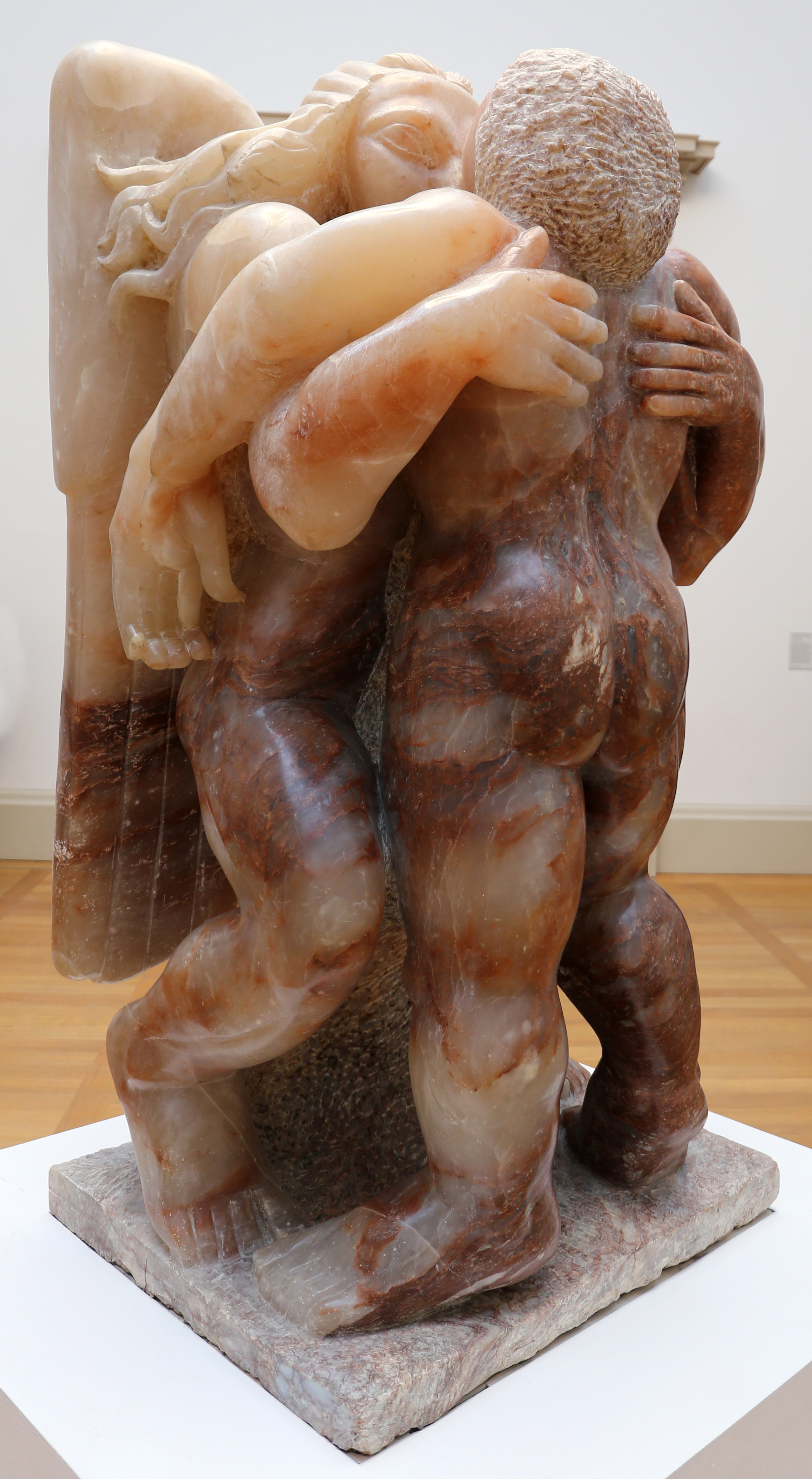
Jacob’s struggle as portrayed by Sir Jacob Epstein (shown in Tate Gallery, London)

Israel struggles with God,
and God struggles with Israel.
That is the very meaning of Israel.
If Israel means anything,
it means struggling with God.

Jacob is the first to be called Israel,
and he is called (renamed) that by the one he struggled with
because he “struggled with God and with people”
and withstood the whole night.

It is the calling of Israel to struggle faithfully through the night.

Jacob is the patriarch of Israel —
the patriarch of those who struggle with God and with people,
and who carry on wrestling through long nights and times of darkness
without being overcome,

people like the widow singled out by Jesus —
a victim of some injustice.
In the face of an utterly unjust justice system,
personified by a judge who neither feared God
nor cared what people thought,
she struggled.

For some time she struggled.
She kept coming at that lousy judge.
She wouldn’t let go until he gave in.

Those who struggle through the night,
with God and with people —
those who struggle to see the night through,
for whom the night is very dark,
and for whom there is little daylight,
those who won’t give up whatever the night brings —
they are the ones whose hope is rewarded.

They carry a blessing for all who wrestle with God
and with the wounds people inflict.

It’s the blessing of God
who himself wrestles through the darkness of the world,
who struggles with people and the suffering they cause,
but who, in spite of all that,
wrestles the whole night long.

This is the love that shines in the darkness
to the break of day.

And yet, the night is long.
Not just one night in Jacob’s life,
not just one night in ours,
but the long night of the world —
a night as long as history.

Through that long night we wrestle,
and God wrestles with us.

There are three struggles woven into this story,
and all three belong to Israel:

We struggle with God.
We struggle with people —
and people struggle with us.
And through it all,
God struggles with us.

That’s what it means to be called Israel:
to live the long night of wrestling,
and to trust that, at the end of it,
there will still be blessing.

The struggle with God

Sometimes it’s the long silence of prayer —
when we ask and wait and hear nothing.
Sometimes it’s the ache of loss,
or the questions that faith won’t easily answer.
We wrestle with God when life doesn’t fit the promise,
when love feels hidden,
when blessing comes only after a wound.

But still we hold on.
Faith is not certainty —
faith is the grip that will not let go until morning.

The struggle with people

And we wrestle with people too.
Not just those who hurt or wrong us,
but in all the difficult ways love tests us —
learning to forgive, to be patient,
to stay kind when we’d rather give up,
to bear with one another’s weakness.

People struggle with us too —
our faults, our sharp words, our stubbornness.
We are all part of each other’s wrestling.

These are the struggles that form the fruits of the Spirit —
the quiet strength that grows only in the dark:
patience, gentleness, self-control,
love that endures through the night.

The struggle with ourselves

And maybe there’s a fourth struggle too —
the one Jacob knew best —
the struggle with ourselves.
The fight to face what we’ve twisted,
to tell the truth about who we are,
and to accept the new name that grace gives us.

Before we can meet God face to face,
we have to face ourselves in the dark —
the parts we’d rather not see,
the wounds we’ve caused as well as borne.
Even that struggle can become blessing.

The struggle of God

And through it all, God struggles too —
not against us, but for us.
God wrestles through the night of the world,
bearing our pain,
refusing to give up on us.
The cross itself is the mark of that struggle —
God’s own wound,
the divine limp that still bears the weight of love.

This is the love that shines in the darkness
to the break of day.

Jacob wanted to know the man’s name,
but the man would not tell him.

Maybe that’s the mercy of God —
that we never get to hold the name too tightly.
The namelessness keeps the struggle open.
It reminds us that this wrestling is for everyone,
that God stands with all who struggle through the night —
beyond borders, beyond certainty, beyond control.

It was not for ease that prayer shall be.
The story of Israel is not the story of the untroubled.
The story of Israel is the story of the very troubled —
the story of slavery, exile, persecution,
the horrors of history, the nightmare.

Amos got it right three thousand years ago.
He condemned the complacent,
those who are at ease in Zion.
He said they put off the day of disaster
and bring near a reign of terror.
They are not fit to be called Israel.
They duck the fight and ignore the struggle.

But Jacob did not.
The widow did not.
And the God who wrestles through the night does not.

Jacob’s blessing comes with a wound.
He carries it into the dawn,
every step a reminder of the night he endured
and the God who would not let him go.

Perhaps this is the mark of the blessed —
not the ones who have had an easy time of it,
but the ones who have been wounded and changed.
The ones who know that life is not straightforward,
that faith is not certainty,
and that love costs something real.

Israel limps into the sunrise,
blessed and broken.

And still, the night is long —
as long as history,
as wide as the world.
Still, God wrestles with us,
still struggles with his people,
still bears our wounds,
and still blesses us.

And when the dawn comes —
as surely it will —
the blessing will not erase the limp,
but redeem it.

For the love that shines in the darkness
will shine until the whole world
limps into the light.

Afterthoughts
What might it mean for a people, or for a church, to be known by its limp – to be blessed not in strength but in struggle?
If God still wrestles through the long night of the world, where do you see that struggle – and that love – happening today?

Border Crossing: the dangerous way of grace

Our politics, like our hearts, are haunted by borders and fear. But Luke’s gospel shows Jesus walking the edge — not to keep people out, but to draw them in. Preached in a week when fragile talk of a ceasefire in Gaza flickers across the news, this reflection on Luke 17:11–19 and 2 Timothy 2:8–15 explores what happens when the unchained word of God crosses the lines we draw, healing what fear divides.


Jesus is on his way to Jerusalem, travelling along the border between Samaria and Galilee.
This is what Luke wants us to notice —
that Jesus is on the edge, not in the middle.
He’s on the edge where belonging is uncertain.

In nature, the edge is often where life is richest.
When two landscapes meet — forest and field, land and river —
there’s a place called an ecotone.
It’s a place of tension, yes,
but also of surprising life,
where species from both sides mingle
and new life appears.

Perhaps that’s why Jesus walks the edge —
because that’s where new life is breaking out.

We’ve all walked that edge:
in the playground,
the first days in a new job,
moving into a new community —
will we be included, will we settle?

Luke introduces us to ten lepers,
forced to live on that edge
by their communities who have wrenched them from home,
from all they’ve ever known, by one word — Unclean.

They are the wrong side of the border,
cast over the edge —
and that’s why they have to shout to Jesus.
They have to get their word across that boundary.

This is how Jesus gets to Jerusalem —
by walking the edge,
the dangerous way,
where grace and fear meet,
where the kingdom begins to break through.

But not every edge is walked the same way.
Our leaders keep pointing us to the edge too —
the edge of our borders, our safety, our identity.
They edge us with fear.
They tell us who to blame, who not to trust,
who belongs, and who should stay outside.

And we see again what happens
when fear builds its own borders.
Across the news this week —
the fragile talk of ceasefire,
the first steps toward peace in Gaza —
we glimpse what it costs to live so long
behind walls of pain and suspicion.

Every side has its wounds,
every border its fear.
And yet even there,
the smallest word of peace,
the tiniest crossing of compassion,
is a holy thing.
It’s where grace dares to walk the edge again.

And that’s the challenge for us, too.
Because we all have borders of our own —
those quiet lines we draw in our hearts,
between those we find easy to love
and those we keep at a distance.

The question is:
whose edge are we walking?
The one that fear builds,
or the one Jesus blesses —
the edge where healing begins?

Fear has its own language,
and it spreads easily.
You can hear it in the way people talk,
the way headlines shout,
the way words build walls
long before bricks ever do.

That’s what happened to the ten lepers.
They were pushed to the edge by words —
words that said Unclean,
words that exiled them from home,
from family, from touch.

And now they have to shout from a distance,
just to be heard —
their voices straining across the border,
trying to bridge the gap
that other people’s words created.

And Jesus sends a word back.
No touch, no ceremony —
just a word that crosses the border:
“Go, show yourselves to the priests.”

And as they go, they are made clean.
The word runs free.
It doesn’t stop at the boundary;
it heals as it goes.

Paul once wrote, chained in a prison cell:
“I may be in chains,
but the word of God is not chained.”

It’s the same truth here.
The unchained word runs ahead of Jesus,
crossing the lines that fear has drawn,
healing what twisted speech has broken.

This isn’t the first time Luke shows us Jesus on the edge.
From the very beginning, his gospel has been about
the outsiders God draws in.
It’s Luke who tells of the shepherds —
night workers, unclean in their own way —
hearing angels sing of peace on earth.
Luke remembers the woman who wept on Jesus’ feet,
the prodigal welcomed home,
the beggar Lazarus lifted up,
and another Samaritan —
the one who stopped on the roadside to bind up wounds.

In Luke’s world,
the people we push aside
become the very ones who show us what mercy looks like.
And here again, it’s the Samaritan —
the one no one expected —
who becomes the model of faith,
the first to come home to God.

But one turns back.
One crosses the border again.
He’s the foreigner —
the one who, by every rule, should have stayed outside.
Yet he comes closer,
falls at Jesus’ feet,
and his first word isn’t a cry for help,
but a word of thanks.

Ten were made clean —
but only this one is made whole.
Because healing isn’t complete
until it finds its voice in thanksgiving.

That’s the word Jesus has been waiting for —
not Unclean, not Go away,
but Thank you.
A word that restores relationship,
that binds what fear has torn apart.

The Samaritan becomes the first citizen
of this new borderland kingdom —
a kingdom without fences,
where mercy is the mother tongue.

And maybe this is what it means
to follow Jesus on his way to Jerusalem —
to walk the edge,
not the safe, well-marked path,
but the dangerous way,
where love meets fear
and refuses to turn back.

Because that’s where the unchained word still runs free —
crossing borders,
breaking through divisions,
making strangers into neighbours,
and outcasts into brothers and sisters.

Prayer

May the Christ who walks the edges
find us there —
where fear builds walls
and grace dares to cross.
May his word set us free
to speak peace,
to live thanks,
and to walk the dangerous way of grace.

From the Riverbank

– Sister Itchen and the River of Life
A sermon for Harvest Festival at St Lawrence’s Napton, inspired by St Francis’s Canticle of the Creatures, the Warwickshire River Itchen, artist Stephen Broadbent’s River of Life sculpture in Warrington, the writing of Robert Macfarlane and the indigenous wisdom represented by Robin Wall Kimmerer. It’s a thanksgiving for the quiet grace that still flows through creation, and a reminder that we are family with all that lives.


We are brothers and sisters together,
one family, caring for one another.
It’s 800 years this year since St Francis highlighted the interdependence of all things that have life,
and I thought it would be appropriate to have Francis helping us in our Harvest thanksgiving,
when we give thanks for the fruits of God’s creation.

Today we praise God for his creation,
for the nature given to us.

We would be mistaken to think we praise God alone.
For Francis, all creation sings God’s praise —
our whole family: Brothers Sun, Wind and Fire,
Sisters Moon and Water.

If St Francis had walked here,
I think he would have sung of Brother Itchen
the river that rises at Wormleighton and flows its way
past Priors Hardwick through here in Napton.

It seeps quietly through our fields,
watering crops and feeding wildlife,
joining its voice to the River Leam and the Avon beyond.

It’s not a mighty river like the Jordan or the Nile,
but a patient, life-giving one —
a reminder that the grace of God often flows quietly,
unnoticed, yet sustaining everything around it.

Robert Macfarlane asks in a book I’m reading,
“Is a river alive?”
I think the Itchen would answer yes.
It breathes, moves, nourishes —
and if we listen carefully, we can almost hear it praise.

Other songs of the church treasures spell this interdependence of praise out in more detail.
The Benedicite calls
the sun, moon and stars,
every shower of rain and fall of dew,
all winds, and fire and heat,
winter and summer,
the chill and cold,
frost and cold, ice and sleet,
mountains and hills,
everything that grows upon the earth,
springs of water, seas and streams,
whales and everything that moves in the water,
all the birds of the air, the beasts of the wild,
flocks and herds, men and women
all to praise and glorify God,
alongside those of upright spirit,
those who are holy and humble in heart.

Psalm 148 is a call to worship
for the angels, the sun, the moon and stars of light,
for the waters, sea monsters and all deeps,
for fire and hail, snow and mist,
for mountains and hills, fruit trees and cedars,
wild beasts, all cattle, creeping things, birds,
kings of the earth and all people,
men and women, boys and girls
to worship and praise together.

The prophet, Isaiah, anticipated the joy of creation.
He saw the mountains and the hills bursting into song
and the trees of the field clapping their hands.

And, of course, we know that the hills are alive with the sound of music.

This is ancient wisdom that is treasured in many indigenous cultures
but which has been forgotten over the years.
We forget we are called to worship with the whole of creation
and we presume we worship alone — homo sapiens.

Is that why our family ties with the rest of nature have broken?
We’ve stopped caring as brothers and sisters.
Instead, we’ve used our dominance for exploitation of our brothers and sisters.

Robert Macfarlane asks in a book I’m reading (and heartily recommend),
“Is a river alive?”
“Is a river alive?”
I think the Itchen would answer yes.
She breathes, she moves, she nourishes —
and if we listen carefully, we can almost hear her praise.

That same living flow runs through the Bible —
through the river that rises in Eden, watering the garden,
through the waters that break open in the desert,
through the River of Life that Ezekiel and John both saw,
flowing from the throne of God,
their trees bearing fruit each month,
and their leaves for the healing of the nations.

The artist Stephen Broadbent knows something of that healing power.
His River of Life sculpture in Warrington
was created after two boys were killed by a terrorist bomb there in 1993.
In that place of loss and grief,
Stephen imagined a river of life flowing through the heart of the town —
a river that gathers up pain and turns it into hope.

The bronze figures he shaped seem to rise from the water itself.
They are imprinted with the hands of children,
contemporaries of the boys killed,
their hands open in welcome and peace.

By the river are the leaves of trees – 12 of them,
one for each month of the year,
a monthly reminder that the river and her trees
are there for all time, even the worst of times,
always remembering, healing and renewing life.

That is what God’s river does —
whether in scripture, in the heart of a town like Warrington,
or in the quiet fields of Warwickshire.
She carries life wherever she goes.
She invites us to join her flow —
to live as people of blessing, healing, and renewal.

I’ve got an allotment this year.
I see something of that same grace there.

An allotment teaches you that nothing is wasted.
Weeds go on the compost, scraps rot down into soil,
and what looks like death becomes food for life.

The tiniest seed, almost too small to hold,
can multiply into a hundredfold abundance.
And if you care for the soil, safeguard the earth,
you discover her astonishing energy for renewal.

It changes the way you look at things.
You learn the value of everything,
you learn to work with the grain of creation, not against it.
And you discover joy in being part of that family again —
brother soil, sister seed, mother earth,
working alongside us in God’s garden.

So today, at Harvest, our thanksgiving is not a private prayer.
It is part of a chorus with the sun, the moon, the wind, the water —
with rivers that sing and trees that clap their hands,
with a creation that still waits for healing,
yet never stops praising.

St Francis knew it 800 years ago.
The Bible has sung it for thousands of years.
Artists and poets remind us in scarred places.
And even the humble allotment teaches us:
we are family with all creation.

Our calling is to live as grateful brothers and sisters,
giving thanks, safeguarding the earth,
and letting the river of life flow through us
for the healing of the world