Love Takes Root in the Little We Are Left With

This week’s readings (Romans 8:26-end and Matthew 13:31-33, 44-52) ask one of the most searching questions in the New Testament: Can anything separate us from the love of God? Paul answers with a resounding “No.” Jesus then invites us to discover why—not in the spectacular or the powerful, but in the smallest, most easily overlooked signs of God’s kingdom. Perhaps the first step in following Jesus is simply learning to see what he sees.


Can anything separate us from the love of God?

There could hardly be a greater contrast than the contrast between ourselves and the people Paul was addressing in his letter to the church in Rome.

Just imagine what they were going through.

Paul gives us a glimpse:

hardship,
distress,
persecution,
famine,
nakedness,
peril
and sword.

This is no rhetorical exaggeration.
Paul is writing to communities living under the shadow of the Roman Empire,
where persecution, imprisonment, poverty and execution were genuine possibilities.
These are the lived realities of many of the Christians to whom he writes.

Over the years I have become increasingly aware that much of Scripture comes to us through the experience of people who were oppressed, enslaved, exiled or hated.

We read Scripture, as it were, over their shoulders.

Not that we do not know suffering ourselves.
We face other hardships.
Other powers can seem overwhelming.
Other fears can drain the life from us.

And so we, too, may hear this letter as though it were addressed to us.

We hear Paul insist that nothing in all creation—
not hardship or distress,
persecution or famine,
nakedness, peril or sword
—can separate us from the love of God in Christ Jesus.

Neither death nor life.
Neither angels nor rulers.
Neither things present nor things to come.
Nor powers.
Neither height nor depth.
Nor anything else in all creation.

It is one of the boldest claims in the New Testament.
Paul doesn’t merely hope this is true.
He is utterly convinced of it.

And if Paul tells us that nothing can separate us from the love of God,
Jesus tells us why.

The answer comes in what Jesus sees, and who he sees.

Who he sees first are the least, the last and the lost in the ways of the world.
And he sees the little they are left with,
and the little we have.

He sees in the little people have all the signs of the kingdom,
the love of God, the presence of God, the rule of God.
And he wants us to see what he sees in the things he points out.

There’s the tiny seed – the tiniest of seeds.
There’s the yeast in the bread.

There’s all the things overlooked by the powers that be
with their attention preoccupied with what is bigger and better in their own eyes.

Jesus looks at the ordinary world and sees the kingdom of God.

A seed.
Some yeast.
A field.

Where others see almost nothing, Jesus sees everything.

He sees the tiny mustard seed growing to the huge shelter for the birds of the field.
He sees the yeast folded into the dough for the daily bread that keeps us going.
He sees a field and sees the treasure hidden within it that is never going to be found by those looking for bigger and better things.

He is always asking “What have you got – let me see?”
“What have you got?” Jesus asked
“Five loaves and two fish – what’s the good in that?”, the disciples replied.

“Just wait and see” Jesus said

The disciples see five loaves and Jesus sees a feast.

That’s the miracle.

Jesus sees the ways of God in the little people have,
and he points them out for the world to see:
the love of God,
the presence of God,
the kingdom of God,
hidden in the little things of their lives,

not in the big things.

The kingdom of God is revealed in such little things
and we are captivated by what Jesus sees.

To follow Jesus is to follow his finger –
to look where he is looking,
To notice who he notices,
to treasure what he treasures,

until, little by little,
we begin to see the world through his eyes.

And that is why Paul can say,
with such astonishing confidence,

that nothing can separate us from the love of God.

It is true: the powers can destroy bodies,
they can imprison us,
they can persecute us and hate us for all sorts of reasons,
they can starve us, they can threaten us
but none of that can separate us from the love of God
because God’s love is always finding somewhere to take root

in a seed
in some yeast
in a field
in five loaves and two fish
in a child
in the poor in spirit
in the meek
in those who hunger and thirst for righteousness
in those who mourn
in those who are persecuted
in a cross
in an empty tomb

Nothing can separate us from the love of God
because God’s love is always finding somewhere to take root
in the little we are left with.

After hardship,
after grief,
after disappointment
after persecution,
after loss.
what are we left with?

We don’t always come to Christ with abundance.
Sometimes we come with the little we are left with.

And Jesus says, “let me see”.

“Let me see what you have,
not what you haven’t,
nor what you wish you had.”

His love takes root in the little we have.

In the little faith.
In the little hope.
In this little church.
In this little time

he plants a tiny seed

pointing us to the way of the kingdom,
showing us that this is what the kingdom of God is like.

Nothing can separate us from the love of God

because God’s love is always finding somewhere to take root
in the little we are left with.

A Field of Grace

What do we do when we find fault? That question has stayed with me all week as I’ve reflected on the Parable of the Weeds (Matthew 13:24–30, 36–43), while the Warwickshire wheat fields have been turning wonderfully white for harvest.


Have you noticed how we’re all expected to be experts these days?

We review restaurants.
We rate hotels.
We comment on politicians.
We analyse football managers.
We critique television programmes.
We even write reviews of the products we buy.

Blimey. We even have to review our recent experience at the dentist and how we were treated in our call to TalkTalk – all of which is recorded for training purposes!

When did we suddenly become experts in all of these things?
When did I become an expert on education, politics, liturgy, the church, other people’s motives.
It seems we have become opinionated about everything.
We’ve been trained to be critical and even unhappy about this, that and the other.

We’ve become Fault Finders,

When did that happen?

We all know the answer to that.

It began in the beginning.

It was then we found fault
and someone to blame.
Long before Jesus,
there’s always been fault in our stars,
even in the Garden of Eden.

Jesus tells a story for people like us.
The Parable of the Weeds is for Fault Finders.

it’s the farmer’s servants who are the Fault Finders.
They find fault in the field.
The fault in the field
is the weeds that had come up
just when the wheat sprouted
and started to grow ears.
“Do you want us to dig them out?”
the farmhands asked the farmer.

The farmer,
who had been sowing and harvesting for years,
since Adam was a lad, says,
“No.
Because when you dig the weeds up
you’ll also uproot what I planted.”

It’s as simple as that.

He told it as a parable of the Kingdom.
He even begins it with the words,
“The kingdom of heaven is like …..”
so that those with ears may hear and understand
that this is the way of the kingdom of God
trusting the Farmer while wheat and weeds grow together until the harvest.

For those with ears to hear,
Jesus is offering a new understanding,
a new way of being in a world at fault,
with others in whom we find fault.

It is the seed of an idea
God scatters in the field
of our imagination.
It is a seed of an idea
that has to grow in the crowded field of our imagination,
alongside fear, disappointment, bitterness, anxiety,

The farmer is teaching his servants to see things differently,
and Jesus, in telling this story,
is teaching his disciples to see things differently.

It isn’t wrong to notice faults.

The servants were right.
There were weeds in the field.

Jesus isn’t asking us to pretend that evil isn’t real,
or that wrong doesn’t matter.

The question is not whether we see faults.
The question is how we see them.

The servants saw the weeds
and could see little else.

The farmer saw the weeds too.
But he also saw the wheat.
He saw the harvest.
He saw the damage that impatient judgement would do.

The servants wanted to solve the immediate problem.
The farmer wanted to protect what he loved.

Perhaps that’s what Jesus means when he says,
“Let anyone with ears listen.”

Learn to see the field as the Farmer sees it.

Learn to see faults with the eyes of love.

Not denying them.
Not excusing them.
But keeping them in the larger field of grace.

The Church has been learning that lesson for two thousand years, and it shows in the genius of our liturgy.

Every Sunday we acknowledge the faults we’ve found in ourselves.

We don’t ignore them.
We don’t excuse them.
We confess them.

Not privately, but together.

In the hearing of our brothers and sisters.

I have always loved the Roman Catholic confession:

I confess to almighty God
and to you, my brothers and sisters…

It is wonderfully honest.

It tells the truth.

It doesn’t minimise our fault.

But neither does it linger there.

The confession is brief.
Grace is long.

We hear words of forgiveness.
We exchange the peace.
We’re even entrusted with the gospel.
We gather around one table.
We eat and drink together—
the same Jesus who was criticised for eating with tax collectors and sinners still feeds sinners today.

The Church has learnt something from the Farmer.

The question is not whether we see faults.
The question is how we see them.
Do they become the whole story?

Or do we see them in the larger field of grace?
Because the Farmer sees the weeds.
But he also sees the wheat.
He sees the harvest.

And he teaches us to look with his eyes.

To look at those we find fault with…
and to refuse to let their faults become the whole story.

To remember that they too are standing in the same field,
under the care of the same Farmer,
nourished by the same rain,
waiting for the same harvest.

Every one of us will leave church today and find fault with someone.
That isn’t difficult.

The question is what we see next.
Do we stop at the fault?
Or do we ask the Farmer to lend us his eyes?

Eyes that see the larger field of grace.
Eyes that see what he has planted.
Eyes that trust the harvest.

Finding the Way to Be Ourselves

We all know the feeling of becoming someone we never intended to be. This sermon, based in Romans 7:15-25 and Matthew 11:16-19, 25-end, explores how Paul and Jesus invite us not simply to try harder, but to discover another way of being human.


This is what I don’t understand.
The things I want to do, I don’t do.
I keep making plans
but something always seems to get in the way.
I don’t do the good I want to do

I keep becoming someone I never intended to be.

I wanted to be patient, but then I got tired.
I should have spent more time with my children when they were growing up,
but, you know, the pressures to always be working,
to make a good impression, to get on.
I didn’t want to worry so much, but those credit card bills kept coming.
I wanted to be generous, but never had anything left.
I wanted to be kinder, but ….

That’s what I don’t understand.

I’ve never quite become the person I wanted to be.

Do you get that?
Do you feel that?
Or am I on my own?

I know I’m not on my own because Paul felt it as well
and wrote about it in his letter to the Romans.
I don’t understand what I do.
What I want to do I do not do.
I have the desire to do what is good, but I cannot carry it out.

He knew what all of us know
that there is this sad fact of life
that we are never quite as free to be ourselves as we imagine.

We imagine we’re free to be ourselves,
we imagine we’re self-made
but all the time we are being formed by the powers that be:


by advertising – (why would that be a multi-billion industry if it had no effect on persuading us to be and do differently?)
by social media
by our work place – and its politics and expectations
by our families
by our friends
by the news we consume
even by our churches
and the company we keep

All these things form us.
They have power over us.

Some of it works for our benefit, but
some of it teaches us to live by fear,
scarcity, competition and status.

Some of it wields a power over us
so that we don’t do the good we want to do
and finish up doing the things we hate doing.
Paul put it all down to sin.
I don’t understand what I do.
Why do I do what I hate doing?
We hear his conclusion:
“It’s not me. It’s sin living in me that does it.”

Paul speaks of sin as an occupying power
and he has been “taken prisoner”.
Paul isn’t describing a weak will
so much as humanity living under an oppressive regime.
It’s a regime larger than individual acts of wrongdoing.
It’s everything that enslaves us:
Systems of domination,
fear, violence, exploitation,
and the internalised habits they create.

Paul calls this Sin.
We might recognise it today in what we call
“the powers that be”
those forces, systems and habits
that shape us
until we no longer
know whose voice we’re listening to.

It’s the powers that be that diminish us
and steal our freedom to be
the people we would love to be.

The powers that be aren’t just them.
They’re more pervasive than that.
The powers that be are also inside us.

Their voices have become our inner voice.
We’ve learned their language,
They’re our self-talk
persuading us to measure ourselves by their standards
till we finish up cooperating with the very powers that diminish us.

This is what we don’t understand
because we are confused by the powers that be.

And so we turn to Christ.

He does understand.

He doesn’t begin by blaming us.
He begins by understanding us.

His understanding comes from experience.
The wise and learned have scoffed at him.
The powers that be have laughed him to scorn.

He praises his Father for hiding “these things” from the wise and learned
and revealing them only to “little children”

That’s always been the way with God.
Pharoah cannot see
Herod cannot see
Pilate cannot see
The chief priests cannot see.

The so-called “wise and learned”,
the so-called grown ups,
the so-called leaders
are looking in the wrong places,
with the wrong expectations
using the wrong measures.

They cannot see.
That’s why Jesus insisted
that we have to become as little children
to enter the kingdom of heaven.

But why children?

It’s not because children are innocent.
They’re not.
They can be devious and manipulative.
It’s not because children know less,

but because children are still teachable.

The “wise and learned” have already graduated.
They’ve stopped learning.
They think they know how the world works.
They know what success looks like,
who matters, who wins, who loses.
They think they know it all.
They think they’re experts.

Children are still learning.
“Learn from me.”

That may be the most important sentence in today’s gospel reading.
Jesus says,
Come to me.
Take my yoke.
Learn from me.

He’s inviting people into another school,
another imagination, another kingdom,
another way for being human
for those who become as little children,
vulnerable to all sorts of abuse
in the ways of the world and the powers that be,
and teachable …..

and for the weary.
The invitation is for those who become as little children
and the weary and burdened by modern life
which teaches us to desire things we don’t actually want:

to work more, to work harder,
to consume more, compete more, fear more,
leaving us less able to do the good we want to do.

The ones Jesus was inviting
were wearied and burdened
by the religious establishment
the social hierarchy,
the endless demands of honour and shame,
the burden of purity laws
as well as the crushing demands of empire.

Jesus understands
how we are bound to do what we don’t want to do,

and with mercy and compassion
he invites us
to come to him,
to join him
as our teacher.

Every kingdom forms people in its own image.
Every kingdom has its own idea of what a successful human being looks like.

The powers that be produce anxious people,
competitive people,
frightened people,
striving people,
people who never quite believe
there is enough, or
they are enough.

Jesus doesn’t simply forgive those people.
Those people who come to him,
who turn to him
he patiently teaches,
forms
and reshapes 
into the people
God intended them to be
from the very beginning:

gentle,
humble in heart,
and finally able
to rest.

When we no longer like ourselves

In Matthew’s gospel, Jesus repeatedly seeks out people who feel bad rather than good about themselves, and calls them by name. Drawing on Matthew 9:9–13, 18–26, this sermon explores some of those moments in our lives when we have felt far from good.


I’ve not been well this week.
Don’t worry, it’s just been a mouth abscess – and it’s been treated with antibiotics.
The pain level – I’d give it 4/10.
Nothing much.

I’ve felt annoyed more than anything.
I’ve not felt good.
In fact, I’ve felt bad.

But not as bad as at other times,
such as when we’re tired at the end of the day
looking after grandchildren
and have to organise their tea time and the feeding of three dogs.

I don’t just feel bad,
I hate myself and the way that I am,
stressed and ratty (my apologies to rats).

And as for those times when there’s so much to do and so little time ….

Does illness, tiredness and stress make you feel like that?
Or, am I on my own?

It’s strange, isn’t it, how feeling physically unwell can spill over into everything else?

We don’t just hurt,
we become shorter-tempered,
less patient, less generous versions of ourselves,
and dangerous to those around us.

I remember the prayer of a woman leading intercessions.
Leaning on her walking frame, she said something along the lines of,
“Lord, you know that when we are in pain, or are ill, we no longer like ourselves”
Perhaps we can all join that prayer.

When we feel bad,
when we don’t feel well,
when we don’t feel good,

In today’s gospel (Matthew 9:9-13, 18-26) Jesus turns from one person to another,
to Matthew,
tax collectors and sinners,
the woman who had been bleeding for 12 years,
Jairus and his household

all, who, for one reason or another,
felt bad,
unwell, far from good.

Jesus meets Matthew sitting at the tax collector’s booth,
just the place we all try to evade –
even more so when the tax is going to a foreign power.

Matthew was working for Rome.
The money he collected was not for the benefit of his neighbours.
It helped keep the empire running, reinforcing its power.
To many of his fellow Jews, he was a collaborator,
a traitor, a bad man in a place of shame.

Jesus sees him,
calls him,
“follow me”
and he even has dinner with him.

The gospel tells us that this was the pattern for Jesus and those who followed him:
they ate with tax collectors,
the morally compromised,
and sinners who transgressed the rules of society,
made to feel bad: shamed and ashamed.

Maybe it was their reputation,
the reputation that Jesus and his followers kept bad company,
that attracted the woman who had been bleeding all those years,
a woman beyond the pale, physically unwell
and socially isolated because of her incessant bleeding.

That she even dared to touch his cloak was scandalous.
In the eyes of many, she was not merely sick.
She had become a problem,
a source of contamination,
someone to be avoided.

And then we come to Jairus – the synagogue ruler,
desperate for Jesus to touch his dead daughter,
so she might live.
Another scandal – reaching beyond where good people go,
touching the dead, failing to keep the proper distance.

These are incidents to remember when we count ourselves among the unwell,
when we don’t feel good,
when we feel bad.

It is little wonder that people scoffed and laughed at Jesus
and that those who felt good about themselves
criticised them.
They thought they were keeping the law, following regulations,
maintaining their religion ….
and what is more,
they were doing it in spite of the difficulties they faced in their lives.
They made sacrifices to be proud of.

And Jesus turned on them.
“It is not the healthy who need a doctor, but those who are ill.”
“Go and learn what this means:
“I desire mercy, not sacrifice.”

Jesus was picking up on Hosea’s prophesy,
which we have also heard this morning.
“I desire mercy, not sacrifice.”

One old translation uses the phrase “loving-kindness”.

I rather like that expression.
Is it kindness that is loving?
Or is it loving that is kind?

And the answer, of course, is yes
to both.

In Hosea’s prophecy God is revealed
as having a preference for loving-kindness.

It comes as a surprise to the religious leaders,
whose religion had become organised around sacrifice,
performance and proving oneself worthy.

But God says:
“I desire mercy, not sacrifice.”

Our ears catch some of the meaning when we hear the French word merci,
a response to kindness received.

The Hebrew word is hesed.

It means mercy, steadfast love, covenant loyalty, loving-kindness.
No single English word can quite contain this wealth of meaning.

It is God’s determination to remain kind towards us,
faithful to us.

And perhaps we need to hear that.

For it is not only illness that makes us feel bad.
Sometimes it is the diagnosis.
Sometimes it is the operation.
Sometimes it is discovering that life has changed us in ways we never wanted.

A diagnosis can give us a new name.
Cancer patient.
Stroke survivor.
Widow.
Carer.
Disabled.
Dependent.
Bereaved.

The surgery may have been successful.
The treatment may have worked..

But we are still left to learn who we are now.
And sometimes we do not much like this new version of ourselves.
Sometimes we grieve for the person we used to be.
Sometimes we wonder whether anyone else can still see us beneath the diagnosis,
beneath the loss, beneath the changes that have been forced on us.

That prayer comes back to me:
“Lord, you know that when we are in pain, or are ill, we no longer like ourselves.

And the gospel answers:
Yes.

And still Christ comes towards us.
Matthew had become “the tax collector”.
The woman had become “the one who bleeds”.
Jairus had become “the father of a dead daughter”.

But Jesus refuses to let the worst thing in their lives become their name.
He sees the person.
He calls Matthew.
He welcomes the woman.
He enters Jairus’s house.
He reaches out his hand.

Because God’s loving-kindness is greater than all the labels that life places upon us.

God’s mercy is deeper than our shame.
God’s faithfulness survives all the unwanted changes of our lives.

So if there are days when you do not feel good about yourself,
when you do not recognise yourself,
when you wonder whether you really belong among God’s people,
remember this and give thanks:

God desires mercy, not sacrifice.

Jesus did not come for those who felt good about themselves.
He came for those who knew their need.

God desires mercy, not sacrifice.

Not the sacrifices we make to prove ourselves,
but the mercy God delights to give.

And that mercy is reaching out to you now.

Just as you are.

The Feeding of the Three Thousand and the Small Flock

In a world that prizes numbers, growth, and standing out, the early church points us somewhere different. In Christ, even a small flock—known, gathered, and fed together—is already enough. This reflection for two small churches takes its cue from the scriptures for the Fourth Sunday of Easter (Year A): Acts of the Apostles 2:42–end, Gospel of John 10:1–10, and Psalm 23.


“They devoted themselves to the apostles’ teaching and to fellowship, to the breaking of bread and to prayer.” (Acts 2:42).

That’s how Luke describes the life of the disciples after God has become present to them in a new way.
Those are the first words of our reading this morning from Acts of the Apostles.

But the verse just before – heard in our churches last Sunday – tells us something else.
It tells us that about 3000 people accepted Peter’s message and were added to their number.

Three thousand.

We’ve heard many times, the story of the Feeding of the Five Thousand.
It’s in all the gospels.

And there’s another feeding – the 4000 – told by Matthew and Mark, but not by Luke.

But Luke does give us another feeding.

Not the feeding of the 4000.
But the feeding of the 3000.

In those gospel stories, crowds gather around Jesus.
They are hungry.
And with very little – just a few loaves and fish – Jesus feeds them.

A sign of the kingdom of God:
that what is little becomes enough …
that what is least becomes abundance.

And here, in Acts, there is another crowd.

Three thousand, drawn from a larger crowd in Jerusalem at Pentecost.

And Luke says of them:

They devoted themselves …
They were together …
They had everything in common …

He is speaking about those three thousand.

So again we might say:

Luke doesn’t tell us about the feeding of the 4000.
But he does tell us about the feeding of the 3000.

Because they too were hungry.

You can almost see it on their faces.

But not for bread and fish.

They were hungry for something deeper –
for a new way of life.

And what they are given is this:

Teaching.
Fellowship.
Shared life.
Bread broken together.
Meals shared with glad and generous hearts.

This is the feeding of a deeper hunger.

The hunger for meaning.
The hunger for belonging.
The hunger for righteousness – for things to be as they should be.

And what they are given …
is a whole new life.

Not just food for the day,
but life together in Christ.

The life of the risen Christ,
lived out in humanity.

And that life –
the life of the risen Christ lived out in humanity –
it didn’t end with those three thousand.

It is the life of the church.

It is our life.

And that’s where this meets us.

Because when we hear about the three thousand,
it’s easy to think: that’s not us.

We are not a crowd.
We are small in number.
A handful here … a handful there

More like a small flock than a great multitude.

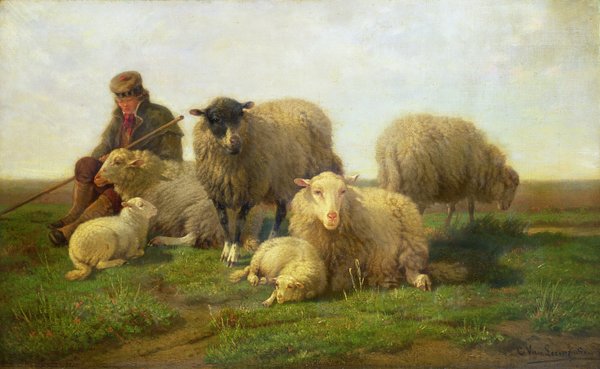
A shepherd with sheep and lambs by Cornelis van Leemputten
This is a small flock. They too need a good shepherd.

But listen again to what Luke describes in Acts of the Apostles.

He doesn’t describe something that only works for large numbers.

He describes something close …
shared …
personal …

They devoted themselves …
They were together …
They broke bread …
They prayed …

That’s not a stadium.
That’s something much more like this.

And then we hear Jesus in John’s Gospel:

“I am the good shepherd …
My sheep hear my voice …
I know them …
and they follow me.”

Not a crowd.

A flock.

So perhaps the question for us is not:
how do we become like the three thousand?

But how do we recognise what we already are?

A small flock.
Known.
Gathered.
Fed.
Held together by the voice of the shepherd.

And the gift of a small flock is this:

You cannot disappear here.

You are not one face in a crowd.

You are known.
You are noticed.
You belong.

And yet … there is a danger for churches like ours,
in times like ours,
when it’s all about numbers, growth and influence.

Because when we hear about the three thousand,
it is very easy to start thinking:

if only we were more …
if only things were different …

And slowly, almost without noticing,
our attention shifts.

Away from who is here …
to who is not.

Away from what we have been given
to what we think we lack.

And when that happens, something else can creep in.

A quiet dissatisfaction.
Even resentment.

A feeling that we are being held back –
by numbers,
by circumstance,
even, perhaps, by one another.

But that is to go after the wrong prize.

Because the prize was never the three thousand.

The gift –
the miracle –
was what they became.

A people who shared life.
A people who belonged to one another.
A people who were fed with the life of Christ.

And that is not something we have to chase.

It is something we have already been given.

Here.

Among us.

So the question is not: how do we become more?

But:
how do we become more deeply what we already are?

More attentive to one another …
More ready to share life …
More open to the voice of the shepherd …

Because when that happens –

this small flock,
this ordinary gathering of people –

becomes something extraordinary.

Not because we stand out from the crowd.

But because we belong to one another,
and are led by the one who knows us by name.

In the end, the gift is not becoming something else,
or someone else,
bigger, better, or whatever it may be –

but recognising that, in Christ,
what we have …
is already enough.

The good shepherd
leads the small flock –

even the two or three –

through the valley overshadowed by death.

He leads us.
He sets a table before us.
He feeds us
as we break bread together.

He satisfies our deepest longings –

as he has satisfied thousands before us.

The Lord is here.
In this small flock.
In this shared life.

The Lord is here.
His spirit is with us.

What We Thought Was Sealed

The first Easter began with people who weren’t sure of anything. They were running, confused, and grieving… until they noticed that what they thought was sealed had been opened.
This sermon explores how resurrection begins not with certainty, but with the slow, surprising discovery that God is already at work — breaking open the boundaries we thought were final.


There’s a quiet pressure around Easter …
that this is the day you’re meant to be sure.
Sure about what happened.
Sure about what it means.
Sure what you believe.

But the strange thing is –
in the very first Easter story …
nobody is sure of anything.

John paints a picture of that first Easter morning.
Everyone seems to be rushing around.
They’re all running.

First there is Mary Magdalen,
then the so-called “beloved disciple”,
then slow-coach Peter.

All running around like headless chickens,
not quite knowing what they’re looking for,
or what they’re going to find.

That’s the risk for the preacher
and for all of us,
running around Easter Day
pretending we’re sure,
pretending we know what we’re talking about  …

when the truth is,
the first Easter began
with people who didn’t.

The first thing they didn’t understand
wasn’t an idea, or a belief, or a theory.

It was something much more concrete than that.

It was a stone.

The stone was supposed to settle things.

To close the story down,
To seal it.
To make it final.

This is how the world works:

when something is over,
it is over.

We know about stones like that.
Moments that feel sealed.
Doors that don’t reopen.
Relationships that don’t come back.
Hopes that have run their course.

And Mary arrives …
not expecting a miracle,
not looking for resurrection …
just coming to a place that would have been closed.

And the first thing she sees is this:
the stone has been moved.

The very first sign of Easter
is not that Jesus appears,
nor that anyone understands

but that what they thought was sealed
isn’t sealed anymore.

And they don’t know what it means.
They don’t suddenly become certain.
They just know this:
something they thought was final …
has been opened.

And that is how resurrection begins.
Not with explanations,
but with boundaries giving way.

The boundary between life and death.
The boundary between what we think is possible
and what God is doing.
The boundary between who we think belongs to God
and who God is already calling.

It will take Peter a long time to understand that.
Years in fact.

Before this moment, he had been confronted with strange visions.
Voices telling him to let go
of what he had always been sure about.
An invitation to enter the house of people
he never imagined God could use.

Step by another stone step, another stone was being moved.
Not at a tomb this time …
but in Peter’s own heart.

And finally he says:
“Now I understand …
God shows no favourites.”

And what he realises is this:

that Gd has been moving stones
that he, Peter, didn’t even know were there.

Stones he had lived with all his life.

Stones that had quietly built walls –
about who belongs
and who doesn’t.

Because Peter had grown up in a world
where there were very clear boundaries.

Between Jew and Gentile.
Clean and unclean.
Inside and Outside.

Lines you didn’t cross.

People you didn’t eat with.
People you didn’t enter the house of.

People you certainly didn’t imagine
were part of what God was doing.

And it’s as if, step by step,
another stone is being moved …
not at the tomb this time,
But in Peter’s own heart.

Peter’s world is not so very different from ours.

We have our own ways of sorting people.

Our own quiet lines
about who fits …
and who doesn’t.

Our own assumptions about
where God is likely to be at work …
and where God couldn’t possibly be.

Isn’t it funny that Jesus called Peter the rock?
The solid one, the dependable one,
the one we might think would always have it together.
And yet here he is, confused, unsure and learning
that God’s work doesn’t obey the walls he’s built.

The rock … is still learning to listen.
And in that, he becomes truly solid –
not because he knows everything,
but because he has learned where God is really at work.

Just as Mary had to learn
that resurrection wasn’t where she expected it …
Peter had to learn
that God wasn’t limited
to where he expected.

This morning, Gary and Brittany were confirmed in Coventry Cathedral.
Not because they’ve worked it all out,
not because they are completely certain,
but because, like Mary, like Peter
they are learning to listen for a voice that calls them by name.

And that’s what Easter invites us to do:
to pay attention, to listen,
to notice where God is already at work
in ways we didn’t expect.

The stone at the tomb
was only the beginning.
Because once that stone moves
all the other stones
we’ve built around us –
and within us –
begin to shift as well.

Just as they had to for Peter.

The stones we place between ourselves and others.
The quiet assumptions about
who belongs,
who counts,
who could possibly be part of God’s life.

Easter begins not with certainty,
but with a stone that refuses to stay in place,

with confusion,
with running,
with not quite understanding what we’re looking at.

And then – slowly –
with learning to listen.

Because in that garden,
everything changes
not when Mary works it out
but when she hears her name.

“Mary.”

And that is perhaps where Easter begins for us.

Not when we are finally sure.
Not when we have all the answers.

But when, somehow,
in the middle of everything that feels closed

we hear God calling our name.

And we begin – slowly,
sometimes hesitantly,
to realise
that what we thought was sealed …
including our fate …

is already being opened.

It turns out –
God has always been in the business
of moving stones.

You might even say
God put the Rolling Stones on the map.

Passion That Stays

Ezekiel stands in a valley of dry bones. Jesus stands at a tomb that smells of death. Neither turns away. This sermon explores a quieter, deeper meaning of passion—not as feeling, but as staying. And what might happen when we remain present in the places where hope seems lost.


Perhaps I should not ask what comes to mind when we hear the word passion.

We often hear the word passion and think of strong feelings.
Intensity. Emotion.

But the scriptures speak of something deeper.
Our scriptures give meaning to the word.

Passion is engagement.
Passion makes you stay with something,
with someone,
refusing to walk away.

It is remaining present
even where everything feels lost.


Our scriptures are not lifeless words on a page.
They are not dry bones,
or dead leaves,
pages in a book.

They have a life of their own.

It is passion that brings them to life,
and it is their life that inspires passion.

These scriptures have been carried through the generations:
people who have known defeat, exile, grief, and despair.

They belong to such people.

They cling passionately
to our experiences of devastation and annihilation.

They will not let us go.


Such is the character of our scripture,
such is the passion of scripture
for those who feel abandoned, lost.

They cling to them,
and they belong
to the people
in those places
at those times
when hope seems lost.

They’re not nice reading.
They’re not polite texts.

They are full of grit,
full of determination,
full of passion,

because they come from the valley—
the metaphorical valley
that stands in the shadow of death.

They belong to those who have stood in the valley
and wondered if anything could live again.


The vision Ezekiel shares with us this morning
comes straight from that valley,

a bleak valley
of bleached bone,
dried and scattered,

in a scene so devastating
that we’ve hardly been able to contemplate it
without making light of it—
turning it to comedy:
dem bones, dem bones, dem dry bones.


From the devastation
comes the question:

Can these bones live?

It’s a question Ezekiel hears from heaven.

How else could he have heard it?

It’s a question none of us would ever think to ask,
because the evidence of an ending
is so overwhelming.

We can almost feel him hesitate.

“What a question…”

“I don’t know.”

“Can these bones live?”

“I don’t know.”

And yet—he stays with it.

He does not turn away.

He remains.

“O Lord God, you know.”

And the wind begins to stir.

From all directions,
through all times,

the breath moves—

clinging to dry bones,
wrapping them in a love that will not let go,
stirring hope
where everything seemed lost.

We stay in the valley in the gospel reading.

The valley in the shadow of death.

As John tells us about Lazarus,
and the passion of Jesus for his friend,
and the passionate mourning of his sisters.

Lazarus has been dead four days.

John does not soften it.

The grief is real.
The loss is final.

This is a passage that stinks.

“Lord, already there is a stench.”

And again, there is no hurry to escape.

Jesus stands there—
overwhelmed in all his senses by loss,
in the midst of wailing,
with the stench of death.

And he weeps.

That is passion.

Before anything is changed,
before anything is restored,

passion is remaining—
particularly at the point
when all seems lost.

And it is there—
in that place—

that something happens.

Not an explanation.
Not an answer.

A call.

“Lazarus, come out.”

No one expects this.

No one is ready for this.

Because nothing in that place
suggests that life is possible.

And yet—

life does not wait
for another time,
or another place.

It comes here.

Into the tomb.
Into what has already been given up for lost.

And then—almost quietly—

“Unbind him, and let him go.”

The life is given.

But the unbinding—
the restoring, the freeing—
is given to others.

To those who stayed.

That call of Jesus—
“Lazarus, come out”…
and, “Unbind him, let him go”—

has echoed far beyond that tomb,
into every place
where people feel bound:

by grief,
by fear,
by the weight
of what others have said about them.

That voice still calls.

Jesus calls—
but leaves the unbinding
to others.

And perhaps we recognise this.

On a Radio 5 phone in,
I heard a cancer survivor—
speaking about what brought her through.

She spoke about treatment.

But more than that, she spoke about people.

The doctors who cared for her.
The nurses who stayed with her.
Those who sat alongside her.
Those who did the small, unnoticed things—
even making tea.

And she spoke about someone
whose vision and determination
had built that place of care over time.

They weren’t speaking about religion.

They simply spoke about people
who did not walk away.

People who remained
in a place most of us would rather avoid.

People through whom, slowly, patiently,
life was given back.

And perhaps this is what begins to happen
when we stay.

When we do not turn away.

When we remain present
in the places that feel like the end.

Something of that same passion
begins to take hold of us.

Not a loud passion.
Not a dramatic one.

But a steady, quiet refusal
to let go of life.

It becomes a passion for people—
for their dignity, their healing, their wellbeing.

A passion for the fragile life of this world—
for all that can so easily be lost.

A passion for justice—
that what is broken might be made right.

A passion to take our place
in the work of restoring life.

And perhaps we do not need
to name it too quickly.

Perhaps it is enough
to recognise it—

in the valley,
at the tomb,
in those who stay,
in those who serve,
in those who help unbind
what has been bound.

Because this is where the scriptures live.

Not far from us.
Not above us.

But here.

In the places where hope feels thin,
where loss is real,
where the ending seems certain.

And here—
not somewhere else, not later, but here—

breath begins to stir.

A voice is heard.

And where people will not walk away,
where they stay, and serve, and love,

even now,

the dead begin to live.

Seventy-Five and Still Counting

Abram was seventy-five when God told him to go.
Nicodemus was long established when Jesus told him he must be born again.
New birth is not punishment for failure — it is rescue from stagnation. It is never too late for God to be the making of us.
A sermon for the 2nd Sunday of Lent (Year A)


One goes, another comes.

It is Abram who goes.
It’s Nicodemus who comes,
Carefully, at night, to see Jesus.

For both, it’s about being born again.

Abram, we are told, was 75.
75.
By that age you’d expect him to be set.
If you’re not settled by 75, when will you be?
He’s established, formed and known.

Then he hears God say:
GO.

Leave your country.
Leave your people –
the people who made you who you are.
Leave your father’s house.
Leave everything you’ve ever known.

Even, in a way, leave your whole identity.

This man is Abram. That is who he is.
Abram is the “exalted father” –
“high father” – that’s what his name means.

And yet he has no child.

He sets out as Abram.
He sets out before anything has changed.
Before the promise is visible.
Before the future is secure.

And only later does God give him a new name:
Abraham – father of a multitude, father of nations –
the one through whom all the families of the earth shall be blessed,
and from whom, to this day,
Jewish, Christian and Muslim families
trace their story
and count their blessings.

It is Abram who goes.

Then there is the one who comes,
out of the dead of night he comes,
emerging from the shadows of
darkness and despair comes Nicodemus.

We don’t know his age, but he is no youngster.
He is old enough to have made his mark.
He is a Pharisee – a serious student of the Torah.
He is a member of the Jewish ruling council.
He is a teacher of Israel.
In fact, he is a person of substance,
and has spent a lifetime becoming someone.

And yet, he comes to Jesus and says:
“Rabbi, we know that you are a teacher who has come from God.”

Jesus tells him,
“No one can see the kingdom of God,
unless they are born again.”
“You must be born again.”

There we have it.
Abram is seventy-five.
And Nicodemus is no spring chicken.
Both are too old, humanly speaking,
for new beginnings.

Their story matters to us.
The two of them, they are both settled.
Abram is settled geographically, socially, economically.
Nicodemus is settled intellectually, religiously, institutionally.
Neither of them is wicked.
They’ve just grown old.
And we can become rather settled in our ways when we get old, can’t we?
Sometimes we are just tired.
Sometimes we get fixed in our opinions.
Sometimes we know our lines too well.
Sometimes we have become experts in being ourselves.
Some of us have had a lifetime of building ourselves,
making something of our lives,
with a lifetime of defending ourselves,
and the castles of our achievements,
Probably just like Abram and Nicodemus.

Perhaps we are too settled.
Settled in habits.
Settled in grudges.
Settled in roles.
Settled in the versions of ourselves we defend.

Perhaps, we too, need to stop that.

These scriptures spell out the good news
that we can stop that
and that we can be born again,
that we can stop all of that
so God can be the making of us.

New birth is not punishment for failure.
It is rescue from stagnation.
Nicodemus is right to ask the question,
“How can someone be born when they are old?
Surely they can’t enter a second time
into their mother’s womb to be born!”

We cannot make the new start ourselves.
We cannot birth ourselves.
It is God who makes the new start.
It’s God’s creation story.

In our own creation story
the firstborn stands secure.
The firstborn inherits.
The firstborn has position.
The younger is “spare”.

But in God’s story
it’s the younger who carries the promise,
the one born last – as we see in Abraham’s own family.
It’s younger Isaac, not older brother Ishmael.
It’s grandson Jacob, not Esau.
It’s Ephraim, not Manasseh.

The line of blessing doesn’t follow seniority,
it follows grace.

The last born is the new born.
The first born is always the older one,
relatively speaking.
The first born is the settled one,
just like Abram, just like Nicodemus,
just like all of us.
And the first born is never the new born,
unless willing to be born again.

The Gospel of John tells it different to the other gospel singers:

“No one can see the kingdom of God unless they are born again.”
The other gospel writers say it like this:
“Noone can enter the kingdom of God
unless they become like a little child”.
The newborn are the last and the least.
They come with nothing.
They’re not dressed up with status or with achievements.

The newborns are never first.
Nicodemus is first.
He is first in power – he’s on the ruling council.
He is first in knowledge – he’s the teacher.
He’s the first in religious competence

But if he is to see the kingdom of God,
if he is to understand the way of God,
he must become new,
he must become small enough to receive
He must become, in a sense, last.

And the same with Abram.
He was established, named, known,
but becomes the stranger,
and the beginner again.

Abram was seventy-five.
Seventy-five.
That’s the age to qualify for lifetime achievement awards.
We spend our lives making ourselves,
our opinions,
our reputation,
our security,
our case before others.

Seventy-five.
It’s never too late
for God to be the making of us.

If Abram can begin at seventy-five,
and if Nicodemus can learn again
after a lifetime of teaching,
then none of us are stuck.
No one here is “too formed”.
No one is past beginning.

No one is past beginning.

And if we need one more witness —

there is Saul.

Certain.
Certain he was right.
Certain he knew God.
Certain he was defending the truth.

Established in his learning.
Established in his zeal.
Established in who he was.

And then —
stopped.

On the road.
Thrown down.
Blinded.

Led by the hand like a child.

He who saw so clearly
cannot see at all.

He who led
must now be led.

He who was first
must become last.

God does not improve him.
God remakes him.

He too must be born again.


Seventy-five.
It’s never too late

Abram was my age when he left it all.
I am still at that age when I don’t know,
when I don’t always like how I am,
when I need to hear “stop that”,
so that I can begin as the new-born,
as the last.
Heaven forbid I ever get settled in the way I am
and the way we are.

The amazing thing about God’s grace
is that we can always start again.
God so loved the world,
loves the world too much to leave it settled,
too much to leave us stuck,
so much as to come to us in the night,
to call us out of what we have made of ourselves.


Let us pray.

Lord God,
Father of Abraham,
giver of new birth,

We pray for the first borns among us —
for those who have grown established,
respected, secure.

For those who know their lines too well.
For those who have built lives
and learned how to defend them.

For those of us
who have become experts in being ourselves.

Make us willing to become small again.
Make us teachable.
Make us new.

And we pray for the new borns —
for the fragile beginnings,
for tender faith,
for hesitant steps into the unknown.

For those setting out not knowing where they go.
For those coming in the night with questions.

Breathe your Spirit upon them.
Guard what you are bringing to birth.
Carry to fullness what you have begun.

For you so loved the world
that you did not leave us settled,
but came among us
that we might be born from above.

Make us new, Lord.
Amen.

It is never too late for God to be the making of us.

There is a Hum in Humanity

There is a hum in humanity — a low note that runs through our lives. From the garden of Genesis to the wilderness of Gospel of Matthew, that hum carries the strain of mistrust, hunger and longing. But in the desert, Jesus holds a truer note — and the music of the world begins to change. A reflection for the first Sunday of Lent (Year A).

There is a hum in humanity.
A low note that runs through our lives.

It is there in the very beginning of the word itself,
the hum as we grow up as humans,
part of humanity,
challenged to be humane,
struggling to keep our feet on the ground – the humus,
finding humility so difficult.

There is a hum in humanity.
A low note that rumbles through our lives.

It is not just the hum of dust and breath –
but the hum of strain.

It is the hum of a myth
that resounds through all our lives,
a myth that can’t be dismissed
because it rings so true,
so true that it becomes the earworm
that casts our psyche
and scripts our story.

This is the story from Genesis.

It is not a fairy tale about a perfect world once upon a time,
but the beginning of difficulty.

The first mistrust.
The first fracture.
The first hiding.
The first blaming.

And the rest, as they say, is history,
herstory and ourstory.

Ever since, life has carried that note.

Work that exhausts.
Relationships that bruise.
Bodies that fail.
Power that corrupts.
Fear that whispers.

There is a hum in our ears and hearts
that tells us life should be easier than this –
easier than it has ever been.

A hum that suggests it was never meant to be this hard.

And yet –
it has been this hard from the beginning.

And then we hear the Gospel from Matthew.

The same hum.
The same strain.
The same voice that once whispered in a garden now speaks in a wilderness.

“Turn these stones to bread.”
Make it easier.
Fix the hunger.
Work a little magic.

“Throw yourself down.”
Let God catch you.
Prove yourself.
Court admiration.

“All this can be yours.”
Take control.
Overrule the chaos.
Dominate rather than trust.

These are not exotic temptations.
They are ours.

The temptation to solve difficulty by spectacle.
To escape vulnerability by popularity.
To end uncertainty by control.

Jesus stands where we stand.
He feels the same pull.
He hears the same hum.

But he stays.

He stays with the hunger.
He stays with the trust.
He stays with the limits of being human.

And he answers —
not with magic,
not with drama,
not with force —

but with Scripture,
with remembered truth,
with the steady note of dependence.

And that steady note
sees the back of the devil.

After the discord of the devil,
a new note sounds,
a different music,
harmonies and the ring of truth.
This is the sound of angels,
the sound of heaven attending earth.

This is the sound that swells our hearts
as we walk our 40 days of Lent,
through our temptation,
through difficulty,
through wilderness.

It’s not the sound of despair and desolation,
nor the sound of punishment and shame,
it is the note Jesus brings to the garden,
the hopeful note of humankind.

This is the joy Paul conveys to us in his letter to the Romans.
By the obedience of one
the music of our lives has changed.
Not by the brilliance of one.
Not by the power of one.
By the obedience of one –
in the wilderness,
in the difficulties, pressures and temptations of life,
humanity is re-tuned.

The hum of strain is not denied.
Jesus is still hungry.
Jesus is always hungry.
As long as anyone is hungry,
Jesus is hungry.

But discord becomes fidelity.

That’s the good news.

The gospel is not that life suddenly becomes easy.
The good news is that within the difficulty –
the wars, the privations, the despair –
a new sound has entered the world.

The hum is still there.
The world is still hard.

But now –
it is not the only sound.

These forty days are a gift to us –
time to learn again how to listen
for the music of accompaniment.

The Glory that Straightens Us

A reflection for the Sunday just before Lent, when the Church’s readings gently remind us that Lent is not about self-improvement, but about staying with the glory of God.

There is a great noise in the world just now.
Nations in tumult. Rulers devising their plots. Power protecting itself.
The psalmist’s question hardly feels ancient:
Why are the nations in tumult, and why do the peoples devise a vain plot?”
It is the sound of anger, of rivalry, of ambition —
the sound of a world bent in on itself.

And beneath the public noise there is another noise:
the private ache,
the anxiety we carry,
the way we can find ourselves almost doubled up with it —
bent backs and bowed heads under the weight of it all.

This is how we’ve come to worship today,
with our minds dripping with the headlines
from the Sunday papers, the TV news
and fed by the crooked algorithms of social media.
This is how we began our worship,
with those lines from the psalm appointed for today,
Psalm 2: Why are the nations in tumult,
and why do people plot so cruelly against one another?

This is the noise that we take into Lent,
the noise of anger and anxiety.

And then, in today’s gospel,
Jesus leads his friends away from the tumult.
Up a high mountain.
Not to escape the world, but to see it truly.
The air is thinner there.
The noise falls away.
The cloud settles.
The voice speaks.

And as we stand on the edge of Lent —
forty days that echo Moses in the cloud —
we are invited to climb with him.
Not to try harder.
Not to straighten ourselves by effort.
But to behold a glory that does not crush us,
does not dazzle us into denial,
but straightens us.
“This is my Son, the Beloved. Listen to him.”

The mountain is not where we live.
We live mostly in the valleys —
in the ordinary press of work and worry,
in the shadowed places Psalm 23 calls “the valley of the shadow of death,”
in the deadly ways that bend our backs and narrow our vision.

But in Exodus, Moses is called up into the cloud,
into fire and mystery,
for forty days and forty nights —
not to escape the people below,
but to receive something that will sustain them in the wilderness.

And as Lent opens before us,
those forty days are not an ordeal to be survived,
nor a spiritual boot camp in self-improvement.
They are a grace-filled ascent.
An invitation to step, however falteringly, into the cloud with Christ —
to let the noise fall away,
to let our sight be cleared,
to let our crooked wills be gently bent back toward God’s goodness and glory —
to have our hearts set straight and our wills aligned with his love
so that when we walk again through the valleys,
we do not walk weakened,
but strengthened by the glory we have glimpsed.

So we will walk down the mountain again.
We always do.
The noise will still be there.
The nations will still rage.
The valleys will still wind their way through shadowed places.
Lent will not remove us from the world’s tumult,
nor from the private aches that sometimes leave us doubled over.
But we will not walk alone, and we will not walk unstrengthened.

For we have heard the voice: “This is my Son, the Beloved. Listen to him.”

And if we listen —
not perfectly, not heroically, but honestly —
something in us begins to straighten.
Not by effort, but by grace.

The glory of Christ does not crush us;
it steadies us.
It does not blind us;
it clears our sight.

It does not demand that we prove ourselves;
it bends our wills gently back toward the goodness and glory of God.

This is what these forty days are for.
Not self-improvement, but reorientation.
Not spiritual ambition, but deeper attention.
So that when we walk through the valleys —
even through the valley of the shadow of death —
we are not bent by fear or twisted by the world’s rage,
but strengthened by the glory we have seen,
and guided by the voice we have learned to trust.

The Glory that straightens us is not found in noise or power or spectacle.
It is found in the Beloved Son — and it is enough.