In a world that prizes numbers, growth, and standing out, the early church points us somewhere different. In Christ, even a small flock—known, gathered, and fed together—is already enough. This reflection for two small churches takes its cue from the scriptures for the Fourth Sunday of Easter (Year A): Acts of the Apostles 2:42–end, Gospel of John 10:1–10, and Psalm 23.
“They devoted themselves to the apostles’ teaching and to fellowship, to the breaking of bread and to prayer.” (Acts 2:42).
That’s how Luke describes the life of the disciples after God has become present to them in a new way.
Those are the first words of our reading this morning from Acts of the Apostles.
But the verse just before – heard in our churches last Sunday – tells us something else.
It tells us that about 3000 people accepted Peter’s message and were added to their number.
Three thousand.
We’ve heard many times, the story of the Feeding of the Five Thousand.
It’s in all the gospels.
And there’s another feeding – the 4000 – told by Matthew and Mark, but not by Luke.
But Luke does give us another feeding.
Not the feeding of the 4000.
But the feeding of the 3000.
In those gospel stories, crowds gather around Jesus.
They are hungry.
And with very little – just a few loaves and fish – Jesus feeds them.
A sign of the kingdom of God:
that what is little becomes enough …
that what is least becomes abundance.
And here, in Acts, there is another crowd.
Three thousand, drawn from a larger crowd in Jerusalem at Pentecost.
And Luke says of them:
They devoted themselves …
They were together …
They had everything in common …
He is speaking about those three thousand.
So again we might say:
Luke doesn’t tell us about the feeding of the 4000.
But he does tell us about the feeding of the 3000.
Because they too were hungry.
You can almost see it on their faces.
But not for bread and fish.
They were hungry for something deeper –
for a new way of life.
And what they are given is this:
Teaching.
Fellowship.
Shared life.
Bread broken together.
Meals shared with glad and generous hearts.
This is the feeding of a deeper hunger.
The hunger for meaning.
The hunger for belonging.
The hunger for righteousness – for things to be as they should be.
And what they are given …
is a whole new life.
Not just food for the day,
but life together in Christ.
The life of the risen Christ,
lived out in humanity.
And that life –
the life of the risen Christ lived out in humanity –
it didn’t end with those three thousand.
It is the life of the church.
It is our life.
And that’s where this meets us.
Because when we hear about the three thousand,
it’s easy to think: that’s not us.
We are not a crowd.
We are small in number.
A handful here … a handful there
More like a small flock than a great multitude.
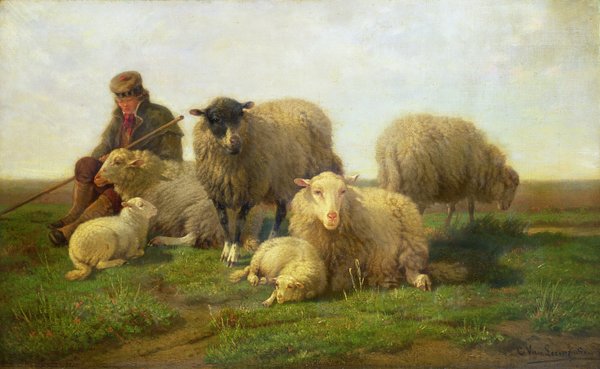
This is a small flock. They too need a good shepherd.
But listen again to what Luke describes in Acts of the Apostles.
He doesn’t describe something that only works for large numbers.
He describes something close …
shared …
personal …
They devoted themselves …
They were together …
They broke bread …
They prayed …
That’s not a stadium.
That’s something much more like this.
And then we hear Jesus in John’s Gospel:
“I am the good shepherd …
My sheep hear my voice …
I know them …
and they follow me.”
Not a crowd.
A flock.
So perhaps the question for us is not:
how do we become like the three thousand?
But how do we recognise what we already are?
A small flock.
Known.
Gathered.
Fed.
Held together by the voice of the shepherd.
And the gift of a small flock is this:
You cannot disappear here.
You are not one face in a crowd.
You are known.
You are noticed.
You belong.
And yet … there is a danger for churches like ours,
in times like ours,
when it’s all about numbers, growth and influence.
Because when we hear about the three thousand,
it is very easy to start thinking:
if only we were more …
if only things were different …
And slowly, almost without noticing,
our attention shifts.
Away from who is here …
to who is not.
Away from what we have been given
to what we think we lack.
And when that happens, something else can creep in.
A quiet dissatisfaction.
Even resentment.
A feeling that we are being held back –
by numbers,
by circumstance,
even, perhaps, by one another.
But that is to go after the wrong prize.
Because the prize was never the three thousand.
The gift –
the miracle –
was what they became.
A people who shared life.
A people who belonged to one another.
A people who were fed with the life of Christ.
And that is not something we have to chase.
It is something we have already been given.
Here.
Among us.
So the question is not: how do we become more?
But:
how do we become more deeply what we already are?
More attentive to one another …
More ready to share life …
More open to the voice of the shepherd …
Because when that happens –
this small flock,
this ordinary gathering of people –
becomes something extraordinary.
Not because we stand out from the crowd.
But because we belong to one another,
and are led by the one who knows us by name.
In the end, the gift is not becoming something else,
or someone else,
bigger, better, or whatever it may be –
but recognising that, in Christ,
what we have …
is already enough.
The good shepherd
leads the small flock –
even the two or three –
through the valley overshadowed by death.
He leads us.
He sets a table before us.
He feeds us
as we break bread together.
He satisfies our deepest longings –
as he has satisfied thousands before us.
The Lord is here.
In this small flock.
In this shared life.
The Lord is here.
His spirit is with us.


