The Feeding of the Three Thousand and the Small Flock

In a world that prizes numbers, growth, and standing out, the early church points us somewhere different. In Christ, even a small flock—known, gathered, and fed together—is already enough. This reflection for two small churches takes its cue from the scriptures for the Fourth Sunday of Easter (Year A): Acts of the Apostles 2:42–end, Gospel of John 10:1–10, and Psalm 23.


“They devoted themselves to the apostles’ teaching and to fellowship, to the breaking of bread and to prayer.” (Acts 2:42).

That’s how Luke describes the life of the disciples after God has become present to them in a new way.
Those are the first words of our reading this morning from Acts of the Apostles.

But the verse just before – heard in our churches last Sunday – tells us something else.
It tells us that about 3000 people accepted Peter’s message and were added to their number.

Three thousand.

We’ve heard many times, the story of the Feeding of the Five Thousand.
It’s in all the gospels.

And there’s another feeding – the 4000 – told by Matthew and Mark, but not by Luke.

But Luke does give us another feeding.

Not the feeding of the 4000.
But the feeding of the 3000.

In those gospel stories, crowds gather around Jesus.
They are hungry.
And with very little – just a few loaves and fish – Jesus feeds them.

A sign of the kingdom of God:
that what is little becomes enough …
that what is least becomes abundance.

And here, in Acts, there is another crowd.

Three thousand, drawn from a larger crowd in Jerusalem at Pentecost.

And Luke says of them:

They devoted themselves …
They were together …
They had everything in common …

He is speaking about those three thousand.

So again we might say:

Luke doesn’t tell us about the feeding of the 4000.
But he does tell us about the feeding of the 3000.

Because they too were hungry.

You can almost see it on their faces.

But not for bread and fish.

They were hungry for something deeper –
for a new way of life.

And what they are given is this:

Teaching.
Fellowship.
Shared life.
Bread broken together.
Meals shared with glad and generous hearts.

This is the feeding of a deeper hunger.

The hunger for meaning.
The hunger for belonging.
The hunger for righteousness – for things to be as they should be.

And what they are given …
is a whole new life.

Not just food for the day,
but life together in Christ.

The life of the risen Christ,
lived out in humanity.

And that life –
the life of the risen Christ lived out in humanity –
it didn’t end with those three thousand.

It is the life of the church.

It is our life.

And that’s where this meets us.

Because when we hear about the three thousand,
it’s easy to think: that’s not us.

We are not a crowd.
We are small in number.
A handful here … a handful there

More like a small flock than a great multitude.
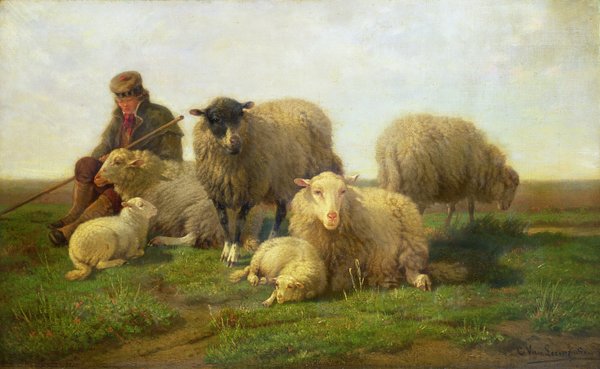
A shepherd with sheep and lambs by Cornelis van Leemputten
This is a small flock. They too need a good shepherd.

But listen again to what Luke describes in Acts of the Apostles.

He doesn’t describe something that only works for large numbers.

He describes something close …
shared …
personal …

They devoted themselves …
They were together …
They broke bread …
They prayed …

That’s not a stadium.
That’s something much more like this.

And then we hear Jesus in John’s Gospel:

“I am the good shepherd …
My sheep hear my voice …
I know them …
and they follow me.”

Not a crowd.

A flock.

So perhaps the question for us is not:
how do we become like the three thousand?

But how do we recognise what we already are?

A small flock.
Known.
Gathered.
Fed.
Held together by the voice of the shepherd.

And the gift of a small flock is this:

You cannot disappear here.

You are not one face in a crowd.

You are known.
You are noticed.
You belong.

And yet … there is a danger for churches like ours,
in times like ours,
when it’s all about numbers, growth and influence.

Because when we hear about the three thousand,
it is very easy to start thinking:

if only we were more …
if only things were different …

And slowly, almost without noticing,
our attention shifts.

Away from who is here …
to who is not.

Away from what we have been given
to what we think we lack.

And when that happens, something else can creep in.

A quiet dissatisfaction.
Even resentment.

A feeling that we are being held back –
by numbers,
by circumstance,
even, perhaps, by one another.

But that is to go after the wrong prize.

Because the prize was never the three thousand.

The gift –
the miracle –
was what they became.

A people who shared life.
A people who belonged to one another.
A people who were fed with the life of Christ.

And that is not something we have to chase.

It is something we have already been given.

Here.

Among us.

So the question is not: how do we become more?

But:
how do we become more deeply what we already are?

More attentive to one another …
More ready to share life …
More open to the voice of the shepherd …

Because when that happens –

this small flock,
this ordinary gathering of people –

becomes something extraordinary.

Not because we stand out from the crowd.

But because we belong to one another,
and are led by the one who knows us by name.

In the end, the gift is not becoming something else,
or someone else,
bigger, better, or whatever it may be –

but recognising that, in Christ,
what we have …
is already enough.

The good shepherd
leads the small flock –

even the two or three –

through the valley overshadowed by death.

He leads us.
He sets a table before us.
He feeds us
as we break bread together.

He satisfies our deepest longings –

as he has satisfied thousands before us.

The Lord is here.
In this small flock.
In this shared life.

The Lord is here.
His spirit is with us.

So you want to be a sheep then: sermon notes for Christ the King (Sunday and church)

Sermon – Nov 23rd 2014

Christ the King, Birkenhead.

Christ the King Sunday

So you want to be a sheep, do you?

Do you remember PE at school – when teams were picked. “Pick me”. We prayed didn’t we that we wouldn’t be the last person chosen. There are two teams in today’s gospel (Matthew 25:31-end). On the one hand there are Sheep, and there are Goats on the other. The Sheep are the winning team, the Goats are the losers – although the team looks anything other than a winning team.  The Sheep are promoted by the Son of Man – they have a podium position. The Goats are relegated and put out of business.

Who do we want to play for: the Sheep or the Goats?

But then, there are good sheep and bad sheep, according to our OT reading (Ezekiel 34:11-16, 20-24). Ezekiel explains how we can tell them apart when he talks about God’s way of judging them apart. The fat sheep are accused of being violent, abusive and non-caring within their community, pushing their way around. “You pushed”, God says. “You pushed with flank and shoulder. You butted at all the weak animals with all your horns until you got your own way and had it all for yourself. You scattered them far and wide.”

Ezekiel is one of the “lean sheep”, pushed around, butted and scattered – forced into exile.

His complaint rings true through all ages. There always seem to be people who behave like this, like bad sheep. Back then, Ezekiel’s people have been scattered far and wide in a way that reminds us of what happens in our world today, when so many people are dislodged from their families, forced to flee their homes, communities, work and livelihood.

For Ezekiel and his fellow exiles, the problem has been poor leadership (the leaders are referred to as shepherds). The leaders have only been interested in themselves, feeding themselves at the expense of the people, failing to provide any welfare or benefit system. The sick were ignored. The injured were ignored – and the leaders ruled with a rod of iron. That is why the people were scattered. Ezekiel and his fellow exiles had no choice. They had to go. That is largely the case today as well. The villagers under attack by Islamic State have no choice but to flee. The victims of domestic violence who pluck up the courage to leave their situation say “we had no choice, we had to get out”, and others who can’t leave also say “we had no choice, there was nowhere to go.”

Life should have been uncomplicated for them. They should have led settled lives in straightforward communities, in close contact with parents, grandparents and grandchildren. Instead their lives were disrupted.

The calamity of weak and/or violent leadership catches up with people so quickly, at all levels of our lives. It’s the national tragedies which catch our eye in the news – but the tragedies are lived out small in our workplaces, in the playground (bullying) and in our homes (we are used to hearing about domestic abuse, elder abuse and child abuse). The victims are the lean sheep, pushed around, butted, battered, scattered, unfairly and cruelly treated.

We know what happens to them:

to the children who are neglected, who go unheard, who deserve better.

  • Some of our children are treated so badly – maybe their parents caring only for themselves in the manner of the bad shepherds that Ezekiel riles against. Some of the children manage to run away – scatter – and we all know that there are many adults preying on vulnerable youngsters. Why should they be denied a home? Why should they be denied safety? Why should they be denied care? These lambs deserve the care of a good shepherd – by their very nature. Any different and the natural order of things is turned upside down.
  • to those who become refugees, clinging desparately to their identities, crossing boundaries into lives where they’re still not wanted forced to do work which really was beneath their dignity. The skills of doctors being wasted as they become cleaners. Fully trained nurses having to take any job they could find – zero hours contracts. The dream is somewhere safe to escape to – somewhere you’ll be wanted for what you can offer, but then discover that you’re fenced in from making the border crossing. Some become desparate – casting out to sea with a vague hope that they might make it, but fearful of other wild creatures who lurk in the deep

There is a charity called Eaves which runs the Poppy Project. They report Ellie’s story (which I didn’t use in the sermon):

When Ellie, 32, describes the first part of her life, she races through the disturbing details in a neutral tone; the problems she experienced as a child and a young woman are not what makes her angry. She grew up in a slum outside Kampala in Uganda. She was sent to live with another family when she was seven and sexually abused by the head of the household; when she turned 15, she was forced to marry him. He was violent, so when a neighbour offered to help her escape to a new life abroad, she agreed.

She was taken by plane to the UK with a group of six other women. Ellie thought that she was going to work as a cleaner, but on the day she arrived, she was driven to the home of a white man who told her she would have to work as a prostitute to pay back her debts for the passport and air travel. For two years she was locked in a house with the other women, and periodically driven to customers’ homes.

She only escaped when a sympathetic client gave her £60 and explained how to get to London. In London, she met a man who allowed her to stay with him, but who quickly began to ask for sex in exchange for shelter. One night when he was violently abusive, she called the police.

This is the moment, in a life story of unmitigated misfortune, when you might expect that things would begin to improve. However, it marked the beginning of a new wave of difficulty, and this is where she begins to get angry. She was taken to hospital, but not treated; later the police took her to a police station, where she was fingerprinted and told she had no visa. Since she had only been given a passport to hold for a few seconds when she passed border control at the airport, she knew nothing about visas.

“They were asking each other: ‘Did she come here legally or illegally?’ The way they were talking was very intimidating. They didn’t ask about the attack. They were more interested in why I was staying in the country without a visa.” The man who hit her was not arrested, but she was taken to Yarl’s Wood detention centre. “I’d never been in detention before. It felt like a prison: being locked up, eating your food at certain times, sleeping at certain times. Most of the time you can’t go outside; you can barely see daylight.”

The other inmates laughed at her when they found out she had called the police, and told her she was stupid to have expected them to help her. She was quickly put on suicide watch because she told staff that she would kill herself rather than be deported back to a country where she would be in danger from her husband and her traffickers. “They wouldn’t let me buy tinned food in case I took the tin and cut myself; they watched me while I showered in case I hanged myself,” she says. For a while she regretted having escaped from her trafficker, and thought returning to her existence as a sex slave might be preferable.

It was only when she was in Yarl’s Wood that she realised she had been trafficked. “So many of the women I met in detention had been trafficked. I don’t think the police who interviewed me knew about trafficking. They were more interested in catching someone for being an illegal migrant than in helping someone who has called for help. All they were talking about was deporting me,” she says.

It was only when a sympathetic guard suggested that she put her name down for legal aid that she was put in touch with Eaves. Her asylum claim on the grounds of trafficking was rejected initially, but with Eaves’ help, this was overturned.

She wishes there was greater awareness of trafficking throughout the system. If border staff had been on the lookout for people-trafficking when she arrived in the UK, she would have been prevented from coming into the country. “If they had stopped me on the border, I would have been so much happier; I wouldn’t have done all the bad things that I was made to do. But I came here and I was turned into a prostitute.”

She is calm when we speak; very articulate and very angry about what has happened to her. “Putting trafficked people in prison – that is the worst part of it. You have gone through bad times, and then you find yourself in detention, told you are going to be deported back to the traffickers. That man is still there and he is still bringing in women. That’s why I’m so upset.”

Pushed around, butted, battered and scattered. In exile with a longing for the care of something like a good shepherd.

Tuesday is White Ribbon Day – a day for men to pledge to “never commit, condone or remain silent or remain silent about men’s violence against women” – tantamount to a commitment to playing a proper part in home, family and community.

Good sheep don’t push their way round. Good sheep aren’t selfish. Good sheep aren’t frightening.

Good sheep have good shepherds who they follow. The people of God have had many shepherds. Some have been good, many of them have been bad (Ezekiel is speaking from experience). Ezekiel looks forward to the time when the bad shepherd has had his day, looking forward to the time of good shepherding when the scattered sheep will be gathered in good grazing land.

Jesus shows himself as the good shepherd. It is how he describes himself as the good shepherd, and that is why he is interested in the sheep. His place is with them, not with the goats. At times, at the worst of times, his sheep look awful – and no wonder, because they are the ones pushed around, butted and scattered. They are hungry, thirsty, naked and sick. They are strangers and prisoners. Good sheep who have responded to the shepherd’s call.

If we are sheep, how do we play our part amongst them? Do we act big or play gentle? Are we one of them, or are we acting the goat?

Acknowledgements: