Finding the Way to Be Ourselves

We all know the feeling of becoming someone we never intended to be. This sermon, based in Romans 7:15-25 and Matthew 11:16-19, 25-end, explores how Paul and Jesus invite us not simply to try harder, but to discover another way of being human.


This is what I don’t understand.
The things I want to do, I don’t do.
I keep making plans
but something always seems to get in the way.
I don’t do the good I want to do

I keep becoming someone I never intended to be.

I wanted to be patient, but then I got tired.
I should have spent more time with my children when they were growing up,
but, you know, the pressures to always be working,
to make a good impression, to get on.
I didn’t want to worry so much, but those credit card bills kept coming.
I wanted to be generous, but never had anything left.
I wanted to be kinder, but ….

That’s what I don’t understand.

I’ve never quite become the person I wanted to be.

Do you get that?
Do you feel that?
Or am I on my own?

I know I’m not on my own because Paul felt it as well
and wrote about it in his letter to the Romans.
I don’t understand what I do.
What I want to do I do not do.
I have the desire to do what is good, but I cannot carry it out.

He knew what all of us know
that there is this sad fact of life
that we are never quite as free to be ourselves as we imagine.

We imagine we’re free to be ourselves,
we imagine we’re self-made
but all the time we are being formed by the powers that be:


by advertising – (why would that be a multi-billion industry if it had no effect on persuading us to be and do differently?)
by social media
by our work place – and its politics and expectations
by our families
by our friends
by the news we consume
even by our churches
and the company we keep

All these things form us.
They have power over us.

Some of it works for our benefit, but
some of it teaches us to live by fear,
scarcity, competition and status.

Some of it wields a power over us
so that we don’t do the good we want to do
and finish up doing the things we hate doing.
Paul put it all down to sin.
I don’t understand what I do.
Why do I do what I hate doing?
We hear his conclusion:
“It’s not me. It’s sin living in me that does it.”

Paul speaks of sin as an occupying power
and he has been “taken prisoner”.
Paul isn’t describing a weak will
so much as humanity living under an oppressive regime.
It’s a regime larger than individual acts of wrongdoing.
It’s everything that enslaves us:
Systems of domination,
fear, violence, exploitation,
and the internalised habits they create.

Paul calls this Sin.
We might recognise it today in what we call
“the powers that be”
those forces, systems and habits
that shape us
until we no longer
know whose voice we’re listening to.

It’s the powers that be that diminish us
and steal our freedom to be
the people we would love to be.

The powers that be aren’t just them.
They’re more pervasive than that.
The powers that be are also inside us.

Their voices have become our inner voice.
We’ve learned their language,
They’re our self-talk
persuading us to measure ourselves by their standards
till we finish up cooperating with the very powers that diminish us.

This is what we don’t understand
because we are confused by the powers that be.

And so we turn to Christ.

He does understand.

He doesn’t begin by blaming us.
He begins by understanding us.

His understanding comes from experience.
The wise and learned have scoffed at him.
The powers that be have laughed him to scorn.

He praises his Father for hiding “these things” from the wise and learned
and revealing them only to “little children”

That’s always been the way with God.
Pharoah cannot see
Herod cannot see
Pilate cannot see
The chief priests cannot see.

The so-called “wise and learned”,
the so-called grown ups,
the so-called leaders
are looking in the wrong places,
with the wrong expectations
using the wrong measures.

They cannot see.
That’s why Jesus insisted
that we have to become as little children
to enter the kingdom of heaven.

But why children?

It’s not because children are innocent.
They’re not.
They can be devious and manipulative.
It’s not because children know less,

but because children are still teachable.

The “wise and learned” have already graduated.
They’ve stopped learning.
They think they know how the world works.
They know what success looks like,
who matters, who wins, who loses.
They think they know it all.
They think they’re experts.

Children are still learning.
“Learn from me.”

That may be the most important sentence in today’s gospel reading.
Jesus says,
Come to me.
Take my yoke.
Learn from me.

He’s inviting people into another school,
another imagination, another kingdom,
another way for being human
for those who become as little children,
vulnerable to all sorts of abuse
in the ways of the world and the powers that be,
and teachable …..

and for the weary.
The invitation is for those who become as little children
and the weary and burdened by modern life
which teaches us to desire things we don’t actually want:

to work more, to work harder,
to consume more, compete more, fear more,
leaving us less able to do the good we want to do.

The ones Jesus was inviting
were wearied and burdened
by the religious establishment
the social hierarchy,
the endless demands of honour and shame,
the burden of purity laws
as well as the crushing demands of empire.

Jesus understands
how we are bound to do what we don’t want to do,

and with mercy and compassion
he invites us
to come to him,
to join him
as our teacher.

Every kingdom forms people in its own image.
Every kingdom has its own idea of what a successful human being looks like.

The powers that be produce anxious people,
competitive people,
frightened people,
striving people,
people who never quite believe
there is enough, or
they are enough.

Jesus doesn’t simply forgive those people.
Those people who come to him,
who turn to him
he patiently teaches,
forms
and reshapes 
into the people
God intended them to be
from the very beginning:

gentle,
humble in heart,
and finally able
to rest.
Making choices, making life

A reflection on the stories of creation in Genesis 2 and the storm on the lake in Luke 8:22-25. These are the readings set for the 2nd Sunday before Lent (C).

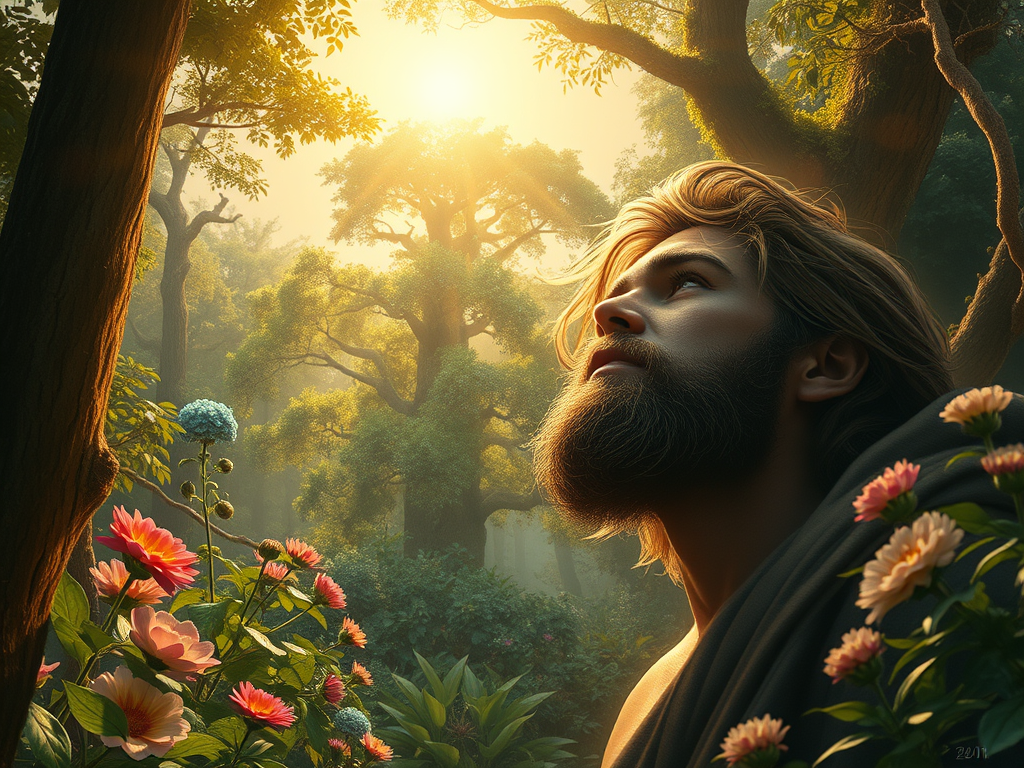
This image was created by AI from the words of the sermon. Interestingly and controversially AI has made a choice for a white Adonis – more filmstar than gardener!

In the beginning everything was so good, and so well made.
Everything was generated from the heavens and the earth when they were created, when the Lord God made the earth and the heavens.

This story of creation is not the history of creation – as if this happened, then that happened, and the rest is history, sort of thing.
This story of creation is the theology of creation, and is true.
It is true for those who believe in God, who see God in all our beginnings, who trust in God’s blessing. It is spiritually true, not scientifically true.
Spiritual truth stands the test of time.
It is so true that it moves us to wonder and reverence.

It comes from a faith that sees God’s blessing in the beginnings of all life, that sees heaven and earth knitted together by a God who in the first place only ever wanted to give life. It comes from a faith that sees God loving everything he has made, delighting in what he has so well made.

It is a faith which realises that without God we are nothing.
Here God brings man to life by getting into his face and breathing into his nostrils the breath of life, and the first breath of language.

God brought to the man in the garden everything he’d made from the dust of the ground.
This was to see what he’d call them and whatever he called them, that became their name. 

God wanted to see what he called them.
That is something we’ve stopped imagining isn’t it?
Do we imagine God being interested in the names we call things, and the names we call people?
How different our world would be if we did have that imagination to name others in a way that would please God.
How different our world would be if, with that imagination, we didn’t demean the creatures of God’s making.

Our naming, our calling, the language we use, is part of the choice that is fundamental to the book of Genesis. In a world where language so much divides us we could usefully reflect on the choices of words and names we make and how they reflect our relationship with God and creation. 

The choices we make about language can be mighty acts of creation.
But remember, it takes time to call someone “lovely” in a way they will understand and take to heart.
It takes no time at all to voice a hurtful call that will break the heart of a relationship.
Our words have creative power and they have destructive power.
The choice is ours to make.

From the beginning there is choice.
There’s always been choice. 

Besides our naming and calling there’s the choice of obedience and disobedience.
The choice is there for the couple in the garden.
Can we get away with eating the fruit from the tree of the knowledge of good and evil?
There was only one thing forbidden by God and that was it.
The man and the woman only had to be obedient in that one thing and they weren’t.
They were disobedient and took the law into their own hands. 

This was their first bad choice, and the rest they say is history.
One bad choice led to another, and then another and then another in rapid succession.
They got dressed to cover their shame (bad choice, but perhaps necessary), they ducked their responsibility and blamed something else (the serpent) and they hid themselves from God.

One rotten choice after another.
Hot on the heels of these choices comes the story of the children of the first procreation, the story of Adam and Eve’s two sons, Cain and Abel, the story of the first murder, a shocking murder, fratricide, the killing of brother by brother.
God had tried to help Cain. “Why are you angry?”
(Perhaps we all need God to ask us that question in our anger.)
“Why are you angry? Why is your face downcast?
If you do what is right, will you not be accepted?
But if you do not do what is right, sin is crouching at your door; it desires to have you, but you must rule over it.” (Genesis 4:6-7).

That’s the choice.
That’s the choice for Cain and it’s the choice for us.
Sin crouches at the door.
We must rule over it.
That’s the way with sin, isn’t it?
It makes itself small and then looms large.
It makes itself seem so small that we often think that we have done little wrong. 

The book of Genesis concludes with stories about Joseph and the right choices he made.
He goes from being a tactless 17 year old (37:2) to become a powerful and self-disciplined man by the choices he make.
He refuses sex when it’s offered him on a plate, and he refuses to retaliate against his brothers for their jealous bullying, instead he saves their lives and the lives of all in Egypt.
Sin was always at his door, but he nails it.
His good choices undo some of the harm caused by the bad choices of his brothers – including their jealousy of Joseph, their intention to kill Joseph (another fratricide) and their intention to deceive their father into believing his son was dead.

The picture painted by Genesis is that in all our beginnings is God’s love of life, love for our life and blessing in abundance.
There are all the blessings of creation, all the animals, the flora and fauna, and all living beings – all to enjoy.
There is almost too much to choose from and choices become challenging and difficult decisions have to be made. 

From the beginning it’s the choices we make that intrigue God.
He wants to see what we will call others.
He wants to see how we will manage the passions he has given us to work the garden and take care of everything.
He wants to see how we manage our emotions.
He wants to see the choices we make when all around us people are choosing to hate and despise others.
He wants to see the choices we make about brotherhood and sisterhood. He wants to love all the choices we make.

Genesis is a book about beginnings, but is also about the mean time, when times get mean in the midst of life, when life gets challenging and difficult, like the time depicted in today’s gospel in the crossing of the lake (Luke 8:22-25).
At first, it’s all plain sailing, so much so that Jesus fell asleep.
Then a squall came down on the lake, and the boat was swamped and they were in danger.
They panicked.
“We’re going to drown!”

Isn’t this the way life goes?
First it’s plain sailing – then as we grow up life gets rough and we have choices to make.
The choice is whether we become doomsayers – “we are drowning in this, or in that”, or whether we remain hopeful, constant in love, believing our blessing.
When the storm subsided, when all was calm, Jesus asked those who were with him, “where is your faith?”

They were amazed.
“Even the winds and the water obey him”.
Their choice was to follow him.
How do the choices we make show our faith and our choice to trust that God is with us in the storms of our lives, longing to love the choices we make within those storms – whether we choose life, whether we choose peace, whether we choose kindness, whether we choose obedience?

Here’s the link to the readings