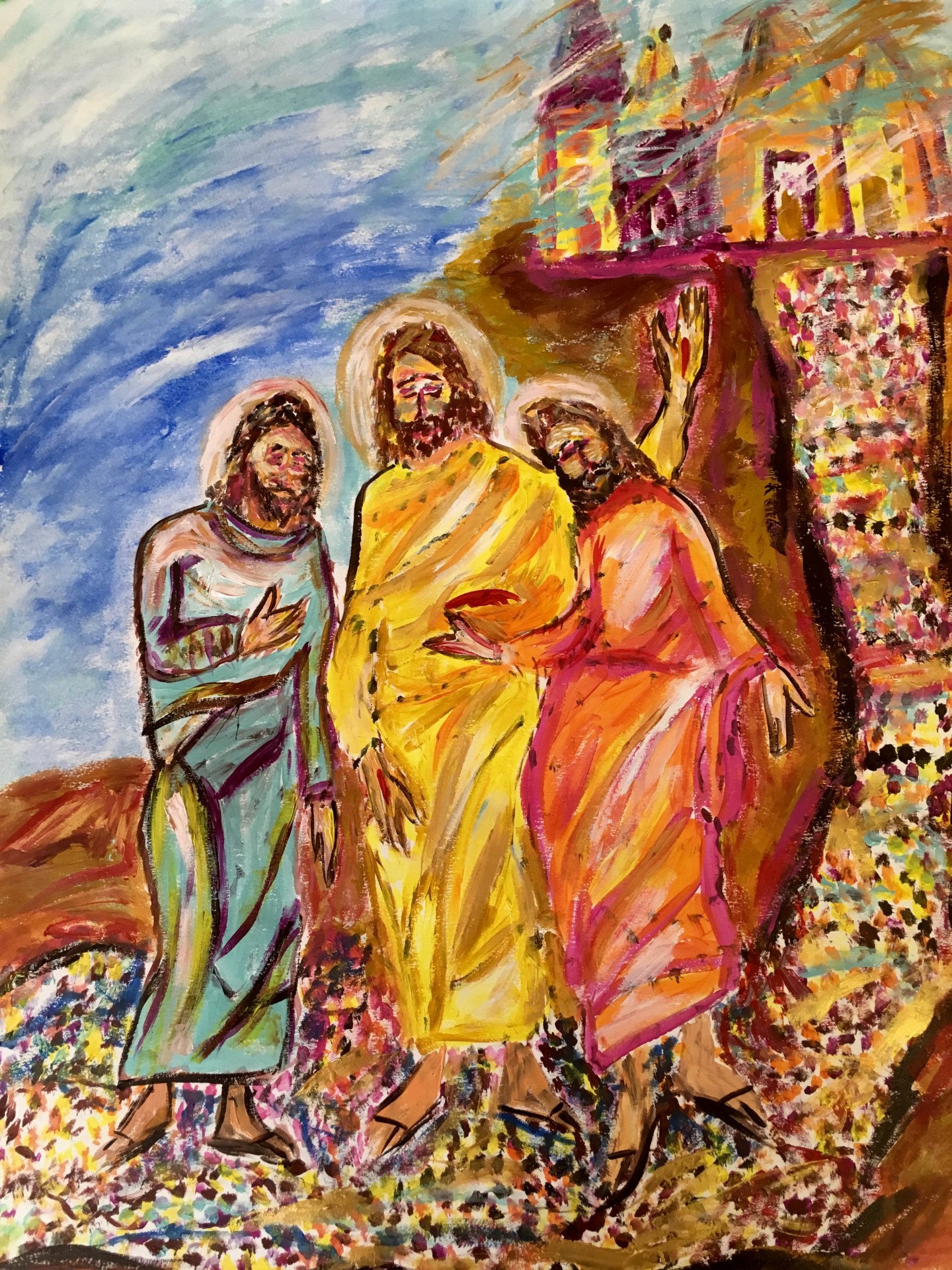
A sermon for Trinity Sunday reflecting on the last words of Paul to the church in Corinth and the last words of Matthew’s gospel: 2 Corinthians 13.11-end & Matthew 28.16-end
Final words matter.
We know this.
When someone knows these may be the last things they say, they do not usually waste words.
Final words are often concentrated words.
Distilled words. Words carrying weight.
And this morning we have two sets of final words.
The closing words of Paul to the Corinthians.
And the closing words of Jesus in Matthew’s gospel.
Famous last words.
And what strikes me is how full of verbs they are.
So much doing.
Paul concludes his difficult letter with a flurry of verbs:
Rejoice.
Strive for full restoration.
Encourage one another.
Be of one mind.
Live in peace.
And then perhaps most awkwardly for many English Christians:
Greet one another with a holy kiss.
That is quite a list. It’s a lot to be doing.
Paul is not writing these words into a peaceful, tidy church.
Something has gone wrong in Corinth.
There has been conflict, bruised relationships, suspicion, division, hurt.
This letter has carried frustration and pain.
So these verbs are not decorative.
They are medicine and prescription,
born of blood, sweat and tears.
This is what you must do, says Paul,
if you are to become again the community God calls you to be.
Not merely what you should believe.
But what you should be doing.
And then we come to Matthew.
Matthew ends his gospel in much the same way.
Again—final words.
Again—a mountain.
That should sound familiar.
Matthew has brought us up mountains before.
The mountain of the Sermon on the Mount, where Jesus taught his disciples how life in God’s kingdom works.
And now, at the end, the disciples are doing what Jesus told them to do.
They go to the mountain.
Already, before Jesus speaks, they are obeying.
And there Matthew gives us an honest little detail:
When they saw him, they worshipped him; but some doubted.
Isn’t that wonderfully human?
Not certainty and triumph.
Not spiritual superheroes.
Just disciples –
worship and doubt standing side by side.
And to that mixed-up group—to worshippers and doubters alike—Jesus gives his final command.
And again the verbs come tumbling out:
Go.
Make disciples.
Baptise.
Teach.
Teach them to obey all that I have commanded you.
Again—so much doing.
And perhaps we hear these as tasks. Instructions.
A church to-do list.
A very different list to how we normally list all we do in church!
Why all these verbs?
Why this insistence on action?
And the answer, I think, is because the God revealed in Jesus is not static.
The God we meet in scripture is alive in relationship.
Father, Son and Holy Spirit.
Trinity, not solitary.
Not self-enclosed.
But eternally giving,
receiving, loving, sending.
The doctrine of the Trinity was never meant to be a mathematical puzzle to solve.
It is an attempt—our stumbling human attempt—to say something true about the God we have encountered.
God is relationship.
God is communion.
God is love shared and given.
And if we are made in the imago Dei—the image of God—then we discover who we are not in isolation but in relationship too.
Which means these verbs are not arbitrary religious duties.
They are invitations into God’s own life.
Rejoice. Because joy belongs to God.
Encourage one another. Because God is giver and sustainer.
Live in peace. Because peace is the atmosphere of God’s kingdom.
Go. Because God is always sending love outward.
Make disciples. Not recruits or customers or winners of arguments—but people learning the way of Jesus.
Baptise.
And notice here, this is Trinity Sunday after all, –
Jesus says:
Baptising them in the name of the Father and of the Son and of the Holy Spirit.
Not names.
Name.
One name.
One life.
One communion of love into which people are welcomed.
Baptism is not simply joining an institution.
It is immersion into the life of the triune God.
Into belonging.
Into relationship.
Into grace.
And then:
Teach them to obey everything I have commanded you.
That word obey can sound severe to modern ears.
But Jesus is not asking for cold compliance.
What has Matthew shown us Jesus commanding?
Love your enemies.
Bless the poor.
Forgive.
Show mercy.
Seek first the kingdom.
Obedience here is learning the practices of love.
Learning how to live God’s life.
And perhaps that matters especially for us gathered here today,
the 5th Sunday of the month,
a gathering from six churches,
not a huge number,
not hugely impressive by the world’s arithmetic,
but enough for now.
Paul wrote to small churches.
Jesus entrusted his mission to a small uncertain group on that mountain.
Small is beautiful.
Small numbers count in the kingdom of God.
Where two or three gather, there I am among them.
The shepherd leaves the ninety-nine to search out the one lost.
God seems remarkably unembarrassed by small beginnings.
And then Matthew ends with what may be the greatest verb of all.
Or perhaps not a verb, but a name.
A promise.
After all the commands:
Go.
Make.
Baptise.
Teach.
There comes this:
And remember…
Or more literally:
Behold.
See this.
Never lose sight of this.
And then the great divine declaration:
I am with you always, to the end of the age.
Not I was.
Not I will be, if you get things right.
I AM.
The eternal verb.
The name God has always spoken to those he loves.
The name spoken to Moses from the burning bush.
The deep grammar of God.
I AM.
And perhaps this is the truth holding all the other verbs together.
We do not rejoice, restore, encourage, go, baptise or teach in order to make God present.
We do these things because God already is present.
Because the great I AM is with us,
Father, Son and Holy Spirit –
not distant,
not abstract,
but the living God drawing near,
inviting us into the holy work of relationship,
the joyful labour of love,
and the shared life of God.
Always.
To the end of the age.