Our world counts scarcity. God’s Kingdom discovers abundance. This reflection explores how Isaiah’s invitation, the Feeding of the Five Thousand, and the Eucharist widen our imagination and teach us the arithmetic of grace.
It has been such a privilege to come alongside you over these three years,
to take my place with you among those whom Isaiah invites:
the thirsty,
those with no money,
those who come to listen that they may live;
and to take my place with you among the crowds gathered around Jesus;
learning with you and discovering with you
ever more of the Kingdom of God.
It has been a joy, a privilege and a responsibility
to preside at your Communion,
your Eucharist of celebration and thanksgiving,
the Mass that sends us out into God’s mission;
to proclaim that the Lord is here and his Spirit is with us;
to hear again the Scriptures appointed for the day;
to witness your love for one another;
and with you to learn the way of God’s Kingdom.
Because the Kingdom has its own way of doing things.
It has its own economy, where everything is gift.
In Isaiah’s vision, those with no money are told to come and eat.
Come all you who are thirsty,
and you who have no money,
Come, buy and eat
without money, without cost.
This is not how the world does business:
it is not how the world’s economy works.
But this is God’s economy in which everything is gift and grace.
When we turn to the gospel, we hear about the Feeding of the 5000.
We know this so well.
But we might never have put two and two together
(that’s the way Noah did arithmetic!)
and realised that this is the crowd Isaiah was inviting,
or one very like it,
the thirsty, and those with no money,
giving ear to Jesus,
listening that they may live.
They had listened long into the day,
the disciples wanted to send them away,
so they could buy food for themselves from the villages.
Jesus insisted: “They don’t need to go away.”
“They can stay here. You give them something to eat.”
The disciples pointed out that all they had were five loaves and two fish.
In their hands, in their minds, in their hearts, they knew
that was never enough.
But Jesus took what they had.
Jesus only ever takes what we have,
never what we don’t have,
not even wishing we had more.
Jesus took what they had,
sat everybody down.
Taking what the disciples had,
he looked to heaven,
gave thanks and broke the loaves,
gave them to the disciples
for the disciples to give to the people.
The disciples must have been amazed.
They thought they had nowhere near enough,
but Jesus had made it more than enough.
And that is the arithmetic of the kingdom,
where compassion comes before counting
and leaves enough for everyone.
The arithmetic of the world adds things up
and persuades us that there is never enough,
that resources are scarce.
The arithmetic of the world is always looking for more.
The arithmetic of the kingdom
takes the little we have, and carries on adding
until the little we have becomes abundance:
enough for friends and for strangers,
enough for neighbours and those who hate us.
Matthew adds it all up for us.
There were 5000.
Then there were the women and children.
And then there were twelve baskets left over,
twelve baskets for all the tribes of Israel,
twelve baskets for all the people of God.
This arithmetic of the kingdom,
(call it multiplication if you like)
makes disciples confident
that they can repeat the call of Isaiah.
Come all you who are thirsty,
and you who have no money,
Come, buy and eat
without money, without cost.
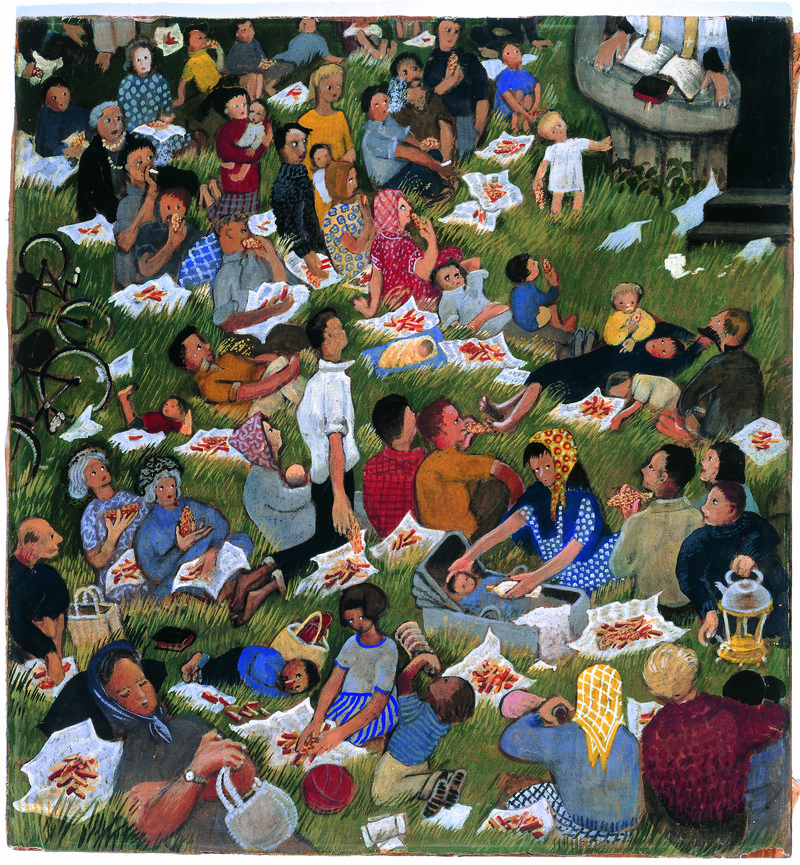
The Feeding of the Five Thousand was never meant to be remembered as a one-off miracle.
It was a sign of the Kingdom:
a sign that whenever Jesus gathers people,
there is room for everyone,
enough for everyone,
and grace enough to spare.
The first Christians recognised that.
They saw in the breaking of bread on the hillside
the same Lord who took bread in the upper room,
the same Lord who was recognised in the breaking of bread at Emmaus,
the same Lord who still gathers his people around his table.
So every Eucharist becomes another glimpse of the Kingdom.
Here too,
what little we bring
is received with thanksgiving.
Here too,
the hungry are fed.
Here too,
strangers become brothers and sisters.
Here too,
God’s arithmetic overcomes ours.
In a few moments we shall pray:
Holy Father,
who gathered us here around the table of your Son
to share this meal with the whole household of God…
Notice where that prayer ends.
Not here.
It ends with God’s future.
Gather people of every race and language
to share in the eternal banquet
of Jesus Christ our Lord.
Every Eucharist is a rehearsal for the future.
Every time we gather around this table,
we practise the Kingdom.
For a moment,
we become the world
as God always intended it to be.
Amen.


