An uprising – the mustard seed and the seed growing secretly

Here’s a sermon for the 3rd Sunday after Trinity focusing on Jesus’s parables of the seed growing secretly and the mustard seed. They speak of uprisings and encouragement, perseverance and patience.

June 16th 2024

Our scriptures are the creation of a bruised and battered people, treasured and passed on by bruised and battered people for the sake of other bruised and battered people. It is a troubled people who have chosen the scriptures we inherit, and who have handed them on.

I keep saying this to remind myself whose these scriptures are and to remind myself to read the scriptures from that point of view.

Today’s gospel features a couple of parables used by Mark to end a sermon by Jesus. The sermon is given from a boat, to a crowd of people on the shore.

Their place on the shore is significant. Jesus and the crowd are from poor peasant communities, subsistence farming communities pushed to the edge by the taxation policies of the temple and Roman authorities. They were clinging on to life in any way they could. Jesus is one of them. 

His sermon was  particularly for them, the least and the frequently lost in the kingdoms of the world. Appropriately, for an audience of the least Jesus uses what is the least to make his points. Today, he picks a seed that grows secretly, and a mustard seed, “the smallest of all seeds”, which amazingly grows to be the “greatest of all shrubs” – and that picks up the prophecy of Ezekiel in our first reading. 

Ezekiel points us to a “lofty tree”.
In his mind it stands for empire and the highness and might of emperors and kings and all those who problematically lord it over others.
Ezekiel sees God cutting a sprig from the lofty top and planting it on a high mountain so that it produces boughs, fruit and shelter for all kinds of bird.
He calls this a “noble” tree rather than a “lofty tree”.
What makes the lofty tree is its highness, whereas the nobility of the noble tree rests in the shelter it gives.

Jesus is the sower.

He sowed seeds in his preaching – seeds of faith, hope and love – seeds of imagination which would grow in the hearts and minds of those poor enough in spirit to have the ears to hear and the eyes to see Jesus’ meaning of love in these parables. 

They will have loved his talk of the seeds for him highlighting the smallest of things as being full of life. They will have known that about themselves though generations of occupation, foreign rule and religious oppression will have eaten at their self belief.

Jesus takes two seeds. That in itself reveals so much about the kingdom of God, namely that the rule of God focuses on the smallest of things, the miniscule, on the least. When did you last hear an emperor, or a Mr Big, or a gang leader wondering about the smallest and least in creation?

Jesus casts the mustard seed as the smallest seed, which grows to become the greatest of shrubs giving shelter, shade and blessing to all the birds of the air. His hearers will have loved that. This is what can become of us is what Jesus is leading them to imagine. This is what can happen to the least of us. The least of us can become the most hospitable. The least of us can be the shelter, shade and blessing for so much and so many.

These are parables for the poor in spirit, for the weary, for the belittled.

They encourage us to believe
life will change for the better for the least, the lost and the last –
that the little, least, lost are great in the eyes of God and come first in his kingdom,

They remind us that the seeds of the kingdom are already embedded in the world
by Jesus the sower,
in our own paths and ways
a seed in edgeways

And those seeds have a life of their own.
We don’t know the effect of them – and we can’t control the effects of a kind word, or affirming gesture.

And they make small beautiful.

Small is beautiful in the eyes of the one who puts the least, the lost and last first.
We don’t need to lie
about how little we are
or what little we have
when Jesus sees the kingdom in a seed.

These parable have always encouraged the church,
particularly encouraging us these days
when the church is struggling,
when you’re feeling like there is so much to do
with fewer and fewer people – in a vacancy as well
we can love being small,
being the unlikely seed of the kingdom,
for ever unsure how it’s going to turn out,
just going day to day
with our small seed of faith
our small seed of hope
and our small seed of love,
sprigs cut from the high and mighty,
cut down to size and carefully planted
to be noble in the kingdom.

These parables encourage us to persevere with patience,
to carry on scattering seed in our small ways along the paths of our lives,
never put off by the idea of a harvest we will never see,
to carry on with those small things
that come naturally to those with a joyful heart:
a smile,
a touch,
a word of welcome,
small kindnesses
in all our ways
scattered like seed.

There was a song Jesus heard at home. He’d heard his Mum singing it. We know it as the Magnificat. It goes like this:

Her song praises the work of God showing mercy on those that fear him from generation to generation, scattering the proud in their conceit, casting down the mighty from their thrones, lifting up the lowly, filling the hungry with good things, sending the rich away empty.

This is the song that seeded Jesus’ imagination.

It is no wonder that he turns to the smallest in his preaching, to seeds to show us faith, hope and love. The seed growing secretly and the mustard seed represent an uprising – an uprising of the least, the tired and the broken.

Mark 4:26-34
He also said, ‘The kingdom of God is as if someone would scatter seed on the ground, and would sleep and rise night and day, and the seed would sprout and grow, he does not know how. The earth produces of itself, first the stalk, then the head, then the full grain in the head. But when the grain is ripe, at once he goes in with his sickle, because the harvest has come.’
He also said, ‘With what can we compare the kingdom of God, or what parable will we use for it? It is like a mustard seed, which when sown upon the ground, is the smallest of all the seeds on earth; yet when it is sown it grows up and becomes the greatest of all shrubs, and puts forth large branches, so that the birds of the air can make nests in its shade.’
With many such parables he spoke the word of to them, as they were able to hear it; he did not speak to them except in parables, but he explained everything in private to his disciples.

Ezekiel 17:22-end
Thus says the Lord God:
I myself will take a sprig
from the lofty top of a cedar;
I will set it out,
I will greek a tender one
from the topmost of its young twigs;
I myself will plant it
on a high and lofty mountain.
On the mountain height of Israel
I will plant it
in order that it may produce boughs and bear fruit,
and become a noble cedar.
Under it every kind of bird will live;
in the shade of its branches will nest
winged creatures of every kind.
All the trees of the field shall know
that I am the Lord.
I bring low the high tree,
I make high the low tree;
I dry up the green tree
and make the dry tree flourish.
I the Lord have spoken;
I will accomplish it.

Who is the strong man who needs binding and casting out?

This is the question I explore with a small congregation in rural Warwickshire for the 2nd Sunday after Trinity (year B) at the end of a week where we have celebrated the bravery of the boys involved in the D-Day landings in Normandy, who forced their way to a toehold in the strong man’s stronghold. The gospel, binding the strong man, is printed below – Mark 3:20-end.

D-Day 75 Garden at Arromanches-les-Bains
D-Day 75 Garden at Arromanches-les-Bains – photo by Alan Wilson, picturing a 97 year old veteran looking back at himself as a 22 year old climbing on to the beach.

The Ins and Outs of the gospel.

Today’s gospel passage is crucial for the gospel of Mark. It is so crucial that one of the most important commentaries on Mark’s gospel lifts words from today’s passage for its title, Binding the Strong Man, as if this sums up Mark’s gospel and the mission of Jesus (and work of God).

In the week we’ve celebrated the 80th anniversary of the D-Day landings it becomes appropriate to explore this understanding of Mark’s gospel and the particular verse: no one can enter a strong man’s house and plunder his property without first tying up the strong man. By doing so we will honour the bravery of those involved in the D-Day landings – and the bravery of Jesus.

The strong man, Hitler, was always driven by his need for lebensraum (living room) and his occupation of France was a mighty extension of his living room. The D-Day landings were very much about the allied forces breaking and entering the strong man’s house, getting a foothold in his door on the beaches of Normandy, to tie up the strong man and free France.

Those who break into the houses of the strong man are brave – some, as we see in today’s gospel, think them foolish.

Mark wants us to know the ins and outs of his gospel.

Mark’s gospel is a journey. It starts in the wilderness, then working its way through Galilee (land of the poor and weakened) and then onto Jerusalem, the capital, the heartland of the STRONG MAN, with its fine buildings, its temple and its palace. Mark’s gospel follows Jesus all the way into the house of the strong and oppressive man.

These are the ins and outs of our gospel reading for today.

On the inside is Satan
and his demons
and Jesus
and those around Jesus.

On the outside
are the demons cast out by Jesus
and Jesus’ family – his mother, brothers and sisters.

The scene is set inside a house.
It’s the strong man’s house that somehow Jesus has got into.

Satan is a mythic figure who stands for actual people.
The demons too are mythic figures, and we know them in real life too. We often have to fight them.
The house too is metaphorical – just a domain name.

The actual people Satan stands for according to Mark is the STRONG MAN – who needs tying up and binding. 

Our popular imagination easily goes to the likes of Putin when casting for the villainous strong man.
But if we cast our search wider

The strong man is the cruel man,
the ruthless man,
the exploitative, oppressive, abusive man.
The strong man is the boss man.
He takes over our lives,

our opportunities and freedoms.
He grooms us, traps us,
and uses us
to build his empire
his power, his glory.
The strong man is the human trafficker,

with his demons his agents.
He is the scammer, the bully, the tyrant.
He’s the media mogul who hides the truth.
He’s the guarded.
He’s the first, the entitled,
and the one who puts himself first.
He’s the one we’re afraid of
in all his guises, the liar,
the master of disguise.

He’s the one
who sets his people onto people,
or against people.

But if truth be known
he’s also you and me,
no longer pronoun HE,
but you, me, she, we
whenever we are cruel like him

whenever we speak like him,
act like him, profit like him.
He’s #metoo, #wetoo,
with our power and strength
crying out for love’s binding.

This is how Mark portrays Jesus – as breaking and entering the house of the strong man, to bind him and tie him.

This is what God does.
This is what our scripture witnesses –
the binding of the strong man:
the Pharoah,
the Emperor,
the Dictator,
the Tyrant,
the High Priest,
the Devil incarnate,
the ones who come first
and the ones
who put themselves first.
This is what God does:
Father, Son and Holy Spirit
in perfect unity
they break into the house
the strong man has made
his strong hold
and makes it their kingdom,
the kingdom of God.

It reminds me of the way Jesus speaks in John’s gospel of the house he prepares for us. You know, “the house with many rooms”, the house with enough room even for us – with all our differences and diversity.

Mark takes us inside the house.
We’re his readers on the inside, the inside of the house seized from the strong man and Satan.
(I’d call it “the house of Israel” were it not for the cruelty that has taken over the strong men acting in Israel’s name in Gaza.)

Mark takes us inside the house.
We’re with Jesus, on the inside.
There’s an air of celebration.
We can sense victory.
We can see the end of the strong man.

But then comes an incoming call,
from the outside.

Outside the house are Jesus’s mother,
his brothers and sisters.
They want to see Jesus.
They call him OUT.
They think he’s gone out of his mind,
breaking into the house of the strong man
like that. They’re worried for him.
They’re worried for themselves,
and their reputations
and what the strong men
will do to them and their village.

They don’t hear Jesus’ response because they’re outside and Jesus is inside.
Inside, Jesus looks at those sitting around him, in the room he has prepared for them by binding the strong man.
Looking at those sitting round him he says: “Here are my mother and brothers! Whoever does the will of God is my brother and sister and mother.”

With all its “ins and outs”, Mark’s gospel begs the question of where “the strong man” is now, and whether we are insiders or outsiders.
Are we on the inside? Are we among those doing the will of God, in that place of bravery with Jesus, binding the strong man – even the strong man in us – with Jesus?
Or, are we outsiders, along with the outcast demons, amongst the scoffers and accusers of Jesus?

Mark 3:20-end
and the crowd came together again, so that they could not even eat. When his family heard it, they went out to restrain him, for people were saying, ‘He has gone out of his mind.’ And the scribes who came down from Jerusalem said, ‘He has Beelzebul, and by the ruler of the demons he casts out demons’.
And he called them to him and spoke to them in parables, “How can Satan cast out Satan? If a kingdom is divided against itself, that kingdom cannot stand. And if a house is divided against itself, that house will not be able to stand. And if Satan has risen up against himself and is divided, he cannot stand, but his end has come. But no one can enter a strong man’s house and plunder his property without first tying up the strong man; then indeed the house can be plundered.
Truly I tell you, people will be forgiven for their sins and whatever blasphemies they utter; but whoever blasphemes against the Holy Spirit can never have forgiveness, but is guilty of an eternal sin’ – for they had said, ‘He has an unclean spirit.’
Then his mother and his brothers came; and standing outside, they sent to him and called him. A crowd was sitting around him; and they said to him, “Your mother and your brothers and sisters are outside, asking for you.’ And he replied, ‘Who are my mother and my brothers?’
And looking at those who sat around him, he said, “Here are my mother and brothers! Whoever does the will of God is my brother and sister and mother.’

Love translates: a sermon for Pentecost

Portuguese, Polish, Punjabi – these are just some of the languages I hear when I walk around Leamington. They’re just the ones beginning with P. There’s a lot of people who speak Hindi. I know that there are Afghans, and so many others speaking in tongues other than English. Our language goes wherever we go. The languages we hear have been carried far from home, often through great hardship and danger.

Language is so important. Our words carry our meaning and find our understanding. The good news of Pentecost is a miracle of language and hearing. 

Filled with the Holy Spirit, they began to speak in other languages, as the Spirit gave them ability. Their hearers were “amazed and astonished”. In their amazement and astonishment they asked, “are not all these speaking Galileans? And how is it that we hear, each of us, in our own native language?”

How come, so many people, so far from home, from so many different places, could each tell what the disciples were saying in their own language? They came from as far apart as Libya, Cappadocia in Turkey, Egypt etc, etc. They weren’t near neighbours, they were Jews from different countries, even different continents, and they all heard the disciples speak in their own native languages, in their mother tongues, taking them back home. How come?

It shows what love can do.

These people were all staying in Jerusalem. They will have been using Greek to get by in the city because that was the common language of empire at the time. They will have known Hebrew from their scriptures. They would have only been using their mother tongue in their family groups. Their ears would have been picking up the Greek of commerce and the sound of foreign tongues – but NOW they heard and understood love speaking in their language. Parthians, Medes, Elamites, and residents of Mesopotamia, Judea and Cappadocia, Pontus and Asia, Phrygia and Pamphylia, Egypt and the parts of Libya belonging to Cyrene, and visitors from Rome, both Jews and proselytes, Cretans and Arabs, young and old, men and women, members of sub cultures, gay and straight, slave and free – all of them heard love speaking to them in their own native language.

Luke tells us that there was a sound like the rush of a violent wind.
We talk about a breath of wind.
The Spirit came in a breath, like the wind, in a moment.
The disciples had been waiting for this moment.
They’d stayed together – all of them, not just the 12, but others with them, men and women together.
Then the promised moment came, like a breath of wind.
They breathed her in, and then breathed her out in words that carried on the wind all the meaning of love.

And their hearers breathed their words in, and they breathed out.
They breathed in the Spirit, and they breathed out their amazement and astonishment.
They breathed in their relief and breathed out their relief.
At last, they said, someone speaking my language.

One of our greetings is “The Lord is here”.
We hear that greeting.
We breathe it in and we breathe out our response: “His Spirit is with us”.
That breath, in and out, is full of joy. “The Lord is here”, “His Spirit is with us”.
We know his Spirit is with us when we hear love speaking our language, when we know we are understood.
Then we know love can hear our cries, our prayers, our broken hallelujahs.
The Lord is here. His Spirit is with us.

Here begins the life of the Spirit through the acts of the apostles and disciples of Jesus. In his book of Acts, Luke goes from this opening act to describe one act after another of the apostles and disciples engaging with the movement of God’s Spirit going out to people of all nations, accommodating their different diets and cultural practices, not demanding that converts come to them but bringing the good news of Jesus to meet everyone where they are – in the language of their heart and home.
Men, women, children, prisoners (and their jailers), soldiers, strangers, disabled, eunuchs – even murderers (because that was what Saul aka Paul was) – they’re all included in this mission of the Holy Spirit.

And here we stand, in this church, in this church in the heart of England, breathing in the Spirit of God.
The Lord is here.
His Spirit is with us. 

And we’re all speaking English.
And we speak it in a certain way.
For so much of our Christian history we have spoken in a certain way – the king’s English or the Latin language of Roman empire, rather than the vernacular.
People stay away.
The astonishment and amazement of those who hear us is often not the astonishment and amazement of the apostles’ hearers on that day of Pentecost.
Theirs was an astonishment of love.
Too often the astonishment of our hearers is one of confusion.
They can’t quite believe us.
“Toxic” is how one commentator described the church.
“The Conservative Party at prayer” is another damning description.

The call of the gospel is not to settle for the one language, but to translate God’s love into all the languages and ways of life.
This is the mission of the Holy Spirit and the mission of the church.
This is the reason for the church, and why God has a church, for the act of translation so others can know that they are seen and heard for who they are, so we can be seen and heard for who we are.

When I was first ordained I served in a church dedicated to Saint Aidan. It was in Sheffield, on CIty Road.

Aidan lived in the 7th century at a time when paganism had taken over from Christianity in large parts of Britain.
He was an Irish monk based in the Iona community founded by St Columba, another Irish monk.
Also there, there was a king-in-waiting, Oswald.
His aim was to bring Christianity back to his people.
His chance came when he was made king of Northumbria.
He requested monks from Iona to do this.

They sent Aidan.. He made Lindisfarne his base.
He walked everywhere.
He went from one village to the next, chatting politely with the people he met, gently and slowly interesting them in Christianity.
That way, he spread the gospel amongst the nobility and the socially deprived.

He was given a horse.
Presumably they thought he could get round more easily on a horse,  that he could get further and faster, that he could be more efficient.
But Aidan famously refused the horse. I think he gave it away. 
Going horseback would have put him out of touch, on a different level.
The way he was going to share the gospel was by being on the level with people, not on his high horse.
He refused the horse power and shared the gospel using the transport of the poor.

He had to learn their language to speak their language.
To do that, he needed to listen and learn from them.
There was a language barrier.
Aidan’s language was Irish, but he came to speak the language of their heart.

The name Aidan means “born of fire”.
He’s the “little fiery one”.

He wasn’t Iona’s first choice to send to Northumbria.
The first they sent was a bishop called Corman.
He returned to Iona a failure.
He alienated people by his harshness and returned to Iona complaining that the Northumbrians were too stubborn to be converted.
Aidan’s methods were so different and far more effective.

We take inspiration from “the fiery ones” when we celebrate Pentecost.
We are amongst those who have heard the apostles in our own language.
We have taken the gospel to heart.

The fiery ones show the way the gospel goes – not on the high horse of judgement or prestige.
Love makes her way gently by walking: listening and learning the language of the heart.

The Lord is here. His Spirit is with us.
She walks with us, alongside us,
the way we walk, the pace we walk,
as slow as we like.
She comes, like the wind,
rushing to us, never past
the slowest, the weakest,
the poorest and turns her mind
to where we’ve been,
the troubles we’ve seen,

in step along the path we tread,

less Corman, more Aidan
and Jesus on the way to Emmaus:

the wind beneath our wings.

Acts 2:1-21
When the day of Pentecost had come, they were all together in one place. And suddenly from heaven there came a sound like the rush of a violent wind, and it filled the entire house where they were sitting. Divided tongues, as of fire, appeared among them, and a tongue rested on each of them. All of them were filled with the Holy Spirit and began to speak in other languages, as the Spirit gave them ability.

Now there were devout Jews from every nation under heaven living in Jerusalem. And at this sound the crowd gathered and was bewildered, because each one heard them speaking in the native language of each. Amazed and astonished, they asked, ‘Are not all these who are speaking Galileans? And how is that we hear, each of us, in our own native language? Parthians, Medes, Elamites, and residents of Mesopotamia, Judea and Cappadocia, Pontus and Asia, Phrygia and Pamphylia, Egypt and the parts of Libya belonging to Cyrene, and visitors from Rome, both Jews and proselytes, Cretans and Arabs – in our own languages we hear them speaking about God’s deeds of power.’ All were amazed and perplexed, saying to one another, ‘What does this mean?’ But others sneered and said, ‘They are filled with new wine.’

But Peter, standing with the eleven, raised his voice and addressed them: ‘Men of Judea and all who live in Jerusalem, let this be known to you, and listen to what I say. Indeed, these are not drunk, as you suppose, for it is only nine o’clock in the morning, No, this is what was spoken through the prophet Joel:

“In the last days it will be, God declares, that I will pour out my Spirit upon all flesh,
and your sons and daughters shall prophesy,
and your young men shall see visions,
and your old men shall dream dreams.
Even upon my slaves, both men and women,
in those days I will pour out my Spirit;
and they shall prophesy.
And I will show portents in the heaven above
and signs on the earth below,
Blood, and fire, and smoky mist.
The sun shall be turned to darkness
and the moon to blood,
before the coming of the Lord’s great and glorious day.
Then everyone who calls on the name of the Lord shall be saved.”

Abide in my love: a tiny passage into Love’s building

This sermon explores a small passage that leads to the rooms love builds in our lives. It’s a passage of just four words from the gospel of the day (Easter 6B) that leads into the house of so much room and so many dwelling places (John 14:1-6).

John 15:9-17
As the Father has loved me, so I have loved you; abide in my love. If you keep my commandments, you will abide in my love, just as I have kept my Father’s commandments and abide in his love. I have said these things to you so that my joy may be in you, and that your joy may be complete.
This is my commandment, that you love one another as I have loved you. No one has greater love than this, to lay down one’s life for one’s friends. You are my friends if you do what I command you. I do not call you servants any longer, because the servant does not know what the master is doing; but I have called you friends, because I have made known to you everything that I have heard from my Father. You did not choose me but I chose you. And I appointed you to go and bear fruit, fruit that will last, so that the Father will give you whatever you ask him in my name. I am giving you these commands so that you may love one another.

Sometimes our spiritual discipline hangs on just a few words, a phrase we can cling onto when life is difficult, when we are tempted, when we are distracted, when we could go another way. Abide in my love is one such phrase.

As the Father has loved me so I have loved you: abide in my love. There is the hint of an imperative here. Abide in my love. Abide – a funny word these days. It’s not a word we use much unless we turn it into a negative in saying “I can’t abide you/him/her/them”.

Abide. Sometimes, the strangeness of a word can make us alert to its fuller meanings. In the word abide  are the elements of waiting, expectation, delay and survival. The Oxford English Dictionary admits the word is “somewhat archaic” but underlines its meaning of waiting defiantly and withstanding particularly when it comes to combat. 

I prefer the fuller meaning of the archaic. Abide in my love. We might prefer to roll the phrase “stay in my love” around our hearts and minds. Or “dwell in my love”. I suggest, whatever works for you – particularly when you’re anxious, or tired, or threatened. That is when we need to hear Jesus saying to his beloved community, Abide in my love, stay in my love, dwell in my love, don’t let your hearts and minds be tempted to be anywhere else.

In our work, in our comings and goings, as we consume the news media (with its not wholly honourable commitments) – in our everyday there is that calling of Jesus, Abide in love.

Love has no chance to build when we choose to dwell in anxiety, or while we nurse our hurts and grievances, or while we wish we were in someone else’s shoes, or when we get washed away on a tide of hatred, or while we are indulging our obsessions, addictions and greed. There’s a discipline to staying in love – and, note the word, there is disciple in the word discipline. When we choose to stay in love rather than any other state we are following Jesus, learning from Jesus as disciples of Jesus, giving love her opportunity.

Love builds for those who are looking for such a place to stay. Love builds around those who make love their choice, around those who have chosen, above all places for their hearts and minds, the place of love as the place to stay. Around them, love carries on building. When love builds we find ourselves entertaining the very people we could not abide, the people we had no time for.

Love builds her place around those who abide with her. She builds room by room, shelter by shelter, so that those who stay there find themselves the people others turn to for help and shelter. Her place gets bigger and bigger as the person who stays there discovers all the people they can abide in spite of their many dangers. The family grows, there’s room for strangers – and even room for enemies.

Love builds room in our lives. Love prepares the place for the time of our lives. 

I don’t know about you, but I have always been troubled by Jesus’ “father’s house” as told in John’s gospel (chapter 14). You know the passage. Do not let your hearts be troubled. Believe in God, believe also in me. In my father’s house there are many dwelling places. You may be more familiar with the translation of the Authorised Version: In my father’s house are many mansions. How does that work? So many mansions in one house! It’s not helped my reading of this passage that this is a favourite for funeral services and has perhaps become for us just a promise for when we’ve died.

But the place he prepares for us is here and now, down to earth, not there and then, pie in the sky. Being alive is very much about the place of love in our lives here and now and our decision to dwell in that place permitting love to carry on building in our lives till in the end we find room (time and space) for what we never imagined that we would be able to abide or find room for.

This isn’t about romance. The landscape Jesus and the gospel writers paint is not one of romantic walks, or staring lovingly into the horizon. Abiding in my love is about staying in love in times of trouble, even when our inclination is to do anything but love one another. Such love doesn’t come cheap. It takes our life in so many more ways than one. A cross marks the spot.

I’ve just finished reading a novel by Ken Follett which is set in 14th century England at the time of the plague of Black Death. One of the heroes is a woman called Caris. Her very name, Caris, carries the meaning of love, full of grace and truth. She lives up to that name. In spite of being condemned by the church as a witch, she finds sanctuary in the nunnery. Their hospital is a place for the sick to lie while they die. 

The monks flee the town when the plague hits. But Caris rallies the nuns, stays in love with the town in their suffering. She adopts modern measures for dealing with the plague – including the wearing of PPE, social distancing and lockdowns. When the plague dies down the monks return – and they take over the hospital, scoffing at Caris’s methods. The town helps Caris to build a new hospital for her to run. When the plague returns after a few years – guess what the monks did – they ran for their lives. When the temptation was to run, Caris stayed in love. People turned to her for help. They flocked to her and were guided by her. They found their protection and care in the rooms love had prepared for Caris.

There is always room for Caris. There is always room for grace, for the love that stays. Even when the world turns against those who stay in love, even when they silence them, kill them and crucify them love carries on building their place in our lives – in the thin spaces, in the places of pilgrimage, in hospitals, in shelters, love carries on making room.

As long as we keep Jesus’s commandments we stay in his love. He only gave us one commandment, that is that we love one another as he has loved us. When we stop doing that then we have left love’s building and then there’s plenty of room for hate. Love can only build in our lives when we abide in his love.

Abide in my love. Just four words about the place to stay. A four word phrase to cling onto when life gets difficult, when we are tempted to go another way. Abide in my love – such a small passage for our lives, but a passage for us to walk in, a passage that reaches deep into love’s building, to the many rooms love builds with us and for us.

Note: Ken Follett’s book is World without End, part of his Kingsbridge series.

A prayer born of old age

There are some profound prayers in Cole Arthur Riley‘s Black Liturgies. This is a prayer for aging that follows her letter “to mortal souls”. Her prayers are long and articulate. They may not be our first prayer language and need some work by us if we are to make the prayer our own. I have added the line breaks and retained her American spellings. There’s a lot of love in them. One line particularly resonated with me. I have made that bold.

God of old,
Some days it’s as if the world is looking right through us.
Comfort us as we are bombarded with a hundred tiny reminders that to some we matter less and less.
In a world that devalues and discards the elderly, make our dignity known.
We have been cast to the margins of society’s most pressing conversations.

Help us to possess a stability of heart as we are forced to question our worth and contribution daily.
Protect us from the ageism of a culture that fetishizes youth.
They want every trace of our days erased from our flesh, our skin, our hair.
Reveal the toxic irony of this, for it is in the days that we’ve lived that we have become more human.
Each year that passses brings us closer in alignment with our true selves.
May we know our own interior landscapes by heart, that we would be familiar enough with our own thoughts, fears, and loves to find rest with ourselves.

Grant us imagination for new ways of existing in the world, that we would not be confined by time’s expectations, but would retain a sacred vigor for life in the company of those who love us.
We have lived.
Give us the wisdom to make sense of our days.
This body has carried us.
Give us courage to honor it, as we meet it anew each day.
Amen

Black Liturgies was published by Hodder and Stoughton in January 2024. In her preface, Cole Arthur Riley promises her readers: “every word in this book has been written, interrogated, and preserved with an imagination for collective healing, rest, and liberation.

A fierce gospel for savage times – reflecting on the Good Shepherd

A sermon for two rural churches without a “pastor”. The gospel for the day is John 10:11-18 (text below).

I am, I am, I am.

This is the name that rolls round the mind of the beloved community.
I AM, the very being of God as disclosed to Moses. Simply, I AM who I AM.
I AM, I AM, the name given even to Jesus by the community of beloved disciples as they explore the meaning of the God they find in Jesus.
I AM
This is what being is all about.

I am, I am, I am.
There are seven I AM sayings of the beloved community in John’s gospel.
Seven, as in the days of the week, as in the sign of perfection and completion.
This is how they loved Jesus. This is how they found God. This is how they saw salvation.
I am, I am, I am.

I am the bread of life,
the light of the world I am.
I am the door,
the good shepherd I am.
I am the resurrection,

the way, the truth and the life I am.
I am the vine.
I am.

This is how the beloved community singles Jesus out, in these seven sayings. Jesus is who we say he is. Jesus is who he says “I am”. This is who Jesus is to the beloved disciple – incidentally ruling out who he is not. 

Today is the fourth Sunday of Easter, known as Good Shepherd Sunday. These are the words ringing in the ears of the beloved community this morning. “I am the good shepherd”.

I know how important sheep and lambs are in your lives round here – how much you care for them and how you’ve worried for their welfare through these months of exceptionally wet weather. You know what good shepherding is all about.

I also know that you are waiting patiently for good shepherds to pastor you, and that you are praying that those the diocese appoints to these parishes will be good shepherds who will themselves have ruled out what the beloved community know Jesus isn’t – the opposite of the hired hand, the opposite of the one who leaves the sheep and runs away as soon as he sees the wolves coming, thinking only of themselves and abandoning the  sheep.

That’s not the Lord, our shepherd, who stays with his people even while they walk through the valley overshadowed by death, spreading a table before us so we can eat even while others trouble us.

I am the good shepherd. The Lord is my shepherd. These are the words at the heart of the people God makes his beloved community. And we, the beloved community know the truth of what makes a good shepherd. 

The good shepherd lays down his life for the sheep he owns and knows.

Have you thought about this? The good shepherd lost his life to the wolves. The wolves circled and he didn’t run.
The wolves licked their lips and he didn’t budge.
The wolves scented blood and he gave them his own.

These are metaphorical wolves. Actual wolves have virtues and they have their rightful place in our animal kingdom. Metaphorical wolves have none. They are devious and deceitful. They are around us and they are savage.

They can eat your grandma and then disguise themselves as grandma to little Red Riding Hood. “Grandma, what a deep voice you have!” “All the better to greet you with”. “Grandma, what big eyes you have!” “All the better to see you with.” “And what big hands you’ve got!” “All the better to embrace you with.” “Grandma, what a big mouth you have!” “All the better to eat you with.”

These metaphorical wolves are masters of disguise. The good shepherd sees their danger. He knows wolves come in sheep’s clothing and infiltrate his beloved community. Sometimes the wolf even takes on the shepherd’s clothing and grooms the metaphorical sheep, (beloved disciples) for his wicked ways. (I believe that is a storyline currently being explored in Eastenders.)

The wolves are around us in their many disguises. I don’t know where you’re at in your personal journeys. Some of you may be enjoying  a relatively easy path in your lives. Others may be on rockier roads, in the pits, even walking the valley in the shadow of death. 

For some, their road is very dangerous. They are particularly vulnerable to attack from those who would groom them, harm them, ridicule them, profit from them, even kill them. 

We must never forget the long and really difficult journeys refugees from around the world are having to take. Hounded from their homes by metaphorical wolves, they are prey to wolves in every twist and turn of their journey as they put their lives into the hands of one agent after another – each wanting their cut and their piece of flesh. And there are those living in the crossfire of wolves in warzones, such as Gaza and Ukraine.

I’m reading a book set in England in the middle of the 14th century – the time of the plague. Is plague one of the wolf’s disguises? Was Covid?

Good shepherds stand with their sheep. They don’t run away when they see the wolf coming. They sound the alarm. They take precautions. They stand firm.They take the front line. They absorb the shocks. They become shelter. And sometimes they lose their life.

Like Jesus. The wolves savaged him. They were disguised as religious leaders and political leaders. The following he was getting (the sheep and the size of the flock) frightened them. They came for him, so that they could get at them. They took him away. They accused him. They mocked him. They stripped him. They slashed him. They crucified him.

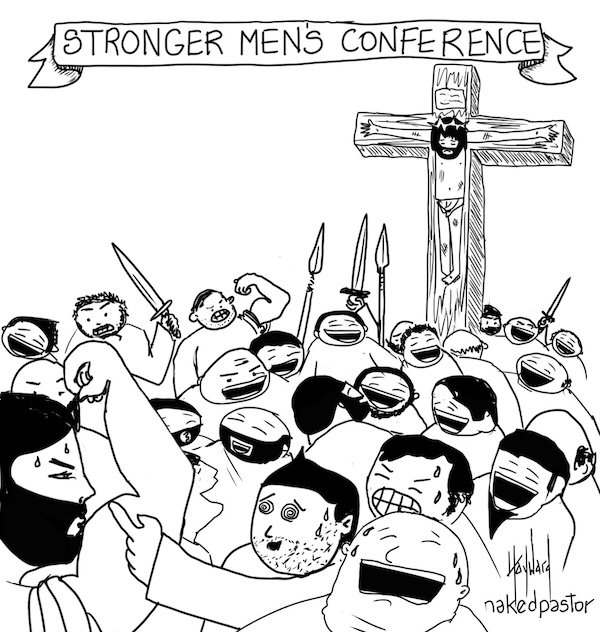
by David Hayward at http://www.Nakedpastor.com

The Naked Pastor draws many gospel cartoons. His name is David Hayward. This cartoon by the Naked Pastor is of the naked pastor. Pastor means shepherd, and here we see the good shepherd, the pastor stripped naked on the cross. In the foreground we see the wolves. They are taunting Jesus, making fun of him. They’re laughing at him, gritting their teeth at him, flexing their muscle against him, and raising their arms, their weapons of war, showing their killing teeth.

This is Jesus being savaged by a pack of wolves.

Over and over again we marvel. The good shepherd does not run away when the wolves come. He lays down his life for the sheep so that the wolves can’t scatter and snatch the sheep. I dare say we have sweetened this gospel over time – but what John is describing here is fierce. The opposition to the beloved community is fierce, but the attachment of the good shepherd to the flock is just as fierce. Blood is spilled and life is lost. But just as the good shepherd has the power to lay down his life, so he has the power to take it up again. And that places this gospel in our Easter liturgy – this fourth Sunday of Easter.

It’s a fierce gospel for savage times when metaphorical wolves roam our streets in their many disguises. It’s a gospel for our times – our mean time in which we need the protection of good shepherds – the sort who will give their lives for the sheep – the sort you wait to be pastor in your community.

At the moment, wolves and sheep remain enemies. The wolf continues to prey on the  sheep who rely on the protection of good shepherds – the sort who will give their lives for the sheep – the sort you wait for to be pastor in this community. But the time will come when there will be a peace way beyond our understanding and way beyond our imagination when the wolf will lie with the sheep. That’s what God lives for. The time will come when the wolf will live with the lamb, the leopard will lie down with the goat, the calf, the lion and the yearling together, and instead of tyrants and empire builders, a little child will be the leader. (Isaiah 11:9) Until that time we follow the call of the good shepherd as he leads us through the valleys and low points overshadowed by wolves and our fear of them.

John 10:11-18
‘I am the good shepherd. The good shepherd lays down his life for the sheep. The hired hand, who is not the shepherd and does not own the sheep, sees the wolf coming and leaves the sheep and runs away – and the wolf snatches them and scatters them. The hired hand runs away because a hired hand does not care for the sheep. I am the good shepherd. I know my own and my own know me, just as the Father knows me and I know the Father. And I lay down my life for the sheep. I have other sheep who do not belong to this fold. I must bring them also, and they will listen to my voice. So there will be one flock, one shepherd. For this reason the Father loves me, because I lay down my life in order to take it up again. No one takes it from me, but I lay it down of my own accord. I have power to lay it down, and I have power to take it up again. I have received this command from my Father.’

Being Believed we Become Beloved – on seeing our wounds

A sermon for the 2nd Sunday of Easter for a lively congregation in a Warwickshire village. The gospel for the day is John 20:19-end (text below)

 ‘Unless I see the mark of the nails in his hands, and put my finger in the mark of the nails and my hand in his side, I will not believe.’ So says Thomas – who is not really “the doubter” but the scientist who needs to see the evidence.

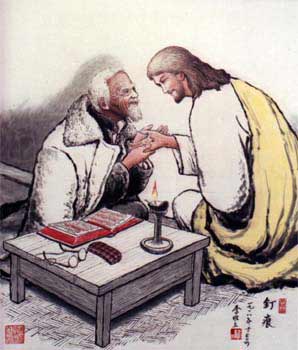
Nail Mark by Li Wei San.

Jesus showed him. He said: ‘Put your finger here and see my hands. Reach out your hand and put it in my side”. Normally we read Thomas’s response as a confession of faith – “My Lord and my God!” with a sense of joy. We could read it very differently – again with Thomas, the forensic scientist examining the body, probing Jesus, talking to to Jesus, as if a patient sufferer, while processing what he is seeing. “They did this to you?” “How deep that wound goes.” “This is what you put yourself through?” “You did this for me?” 

The realisation this examination evoked would have  a very different tone to the one we are used to. Read it differently. Instead of the tone of triumphant joy – as in “My Lord and my God” there may have been the tone of “Myyyyyy Looooord!” “Myyyyyyy God, what have they done to you?”

Thomas is the one who sees the wounds of Jesus, and the truth is in what he sees.

I want to explore what it is to see the wounds of others and our responses. It’s a growing question because there seems to be a battleground developing between those who want their wounds to be seen and those who very intentionally refuse to look, dismissing people for their whining. The battle has been fought down the ages, but is now being fought with a renewed intensity in the forefront of our politics.

The battle lines have been drawn between those who are “woke” and those who are “anti-woke”. The word “woke” made its way into our vocabulary through its usage in the African-American communities where it means staying “alert” to the wounds of racial discrimination. Its use spread through the Black Lives Matter movement and  the word was added to the Oxford English Dictionary in 2017. Being woke is being alert to the woundedness of others. But, most recently, woke has been turned into an offensive word and a term of abuse by those who are anti-woke who accuse the wounded and their sympathisers of being “snowflakes”.

“Unless I see your wounds” – that’s what this is about. The inspiration is Thomas and the wounds he sees, and the wounds Jesus carries. They take us to the heart of the battle.

Can we see one another’s wounds and the pain we bear. 

Can I see your wounds? Can I see how hurt you are? Can you tell us what hurts you?

We can only believe when we see the wounds and understand the back story to those wounds.

Gareth Malone has recently done a series where he put together a choir of eight singers to perform St John’s Passion by Johann Sebastian Bach. Some of you may have seen it. What made it so interesting was getting to know the eight people who formed their choir, hearing their stories and seeing their wounds. 

For example, a close relative of one of them, a niece, had been killed in a road traffic accident the previous week – and there Simon, her uncle, was there rehearsing, finding the rehearsing something that helped with the wounds.

Another of them, Joy, was one of the few who knew the passion story. She grew up in the church. Her wounds were wounds of rejection. She carried the scars of having been rejected by her parents when she was a baby, and then again felt rejected by her church at the age of 12 when it became clear to her that she was gay. (Incidentally, that has been thought to be an appropriate age for the Holy Spirit to confirm faith in a service of Confirmation.) Here we have a rejection, not a confirmation – with all the wounds and scarring that go with it. Her faith is still important to her. She was wearing a prominent cross of another rejected one.

Already, in two of them, we see their wounds. The wounds we were shown were fairly typical – the wounds of sudden loss and the wounds inflicted on some who are gay. It was only the surface we were touching. We obviously weren’t shown the complications which are personal to each wounding.

Bach himself was sore wounded. By the age of 10 he had lost both his parents. His first wife died after they’d been married 13 years. 12 of his 20 children died before they were 3. Research by John Eliot Gardiner reveals the violent, thuggish world of the young Bach. Gang warfare and bullying typified his schooling with inspection reports showing that boys were brutalised. They were “rowdy, subversive, thuggish, beer and wine loving, girl-chasing, breaking windows, brandishing daggers”. He missed 258 days of schooling in 3 years – kept at home, like many for fear of what went on in school. Do we understand his music more, do we see his musical score better for seeing the scarring and scale of his wounds?

Can we see the woundedness in others? The wounds of those who are gay. The wounds of those who have grown old and tired. The wounds of those who have had to fight through war. Can we see the woundedness of those who have had to flee – the refugee, the jilted. The wounds of those who are black those who are disabled. So many of their wounds have been inflicted by those who haven’t cared for them/us as they should

These wounds matter. The wounded don’t want to hide their wounds. Their wounds are who they are. Our wounds are who we are. They have made us who we are. As I said, it’s the Black Lives Matter movement which has encouraged wokeness. Members of the Black Lives Matter movement insist the wounds are part of who they are. Their history matters – their wounds matter.

With our own loved ones it is important to see their wounds. When a child is upset we want to know where it hurts. With a partner, we want to understand the story of their scars and the wounds they carry.

And all of us want to be believed for the stories we tell about ourselves, our battles, challenges and wounds. That is what is so important about a community like this. Our best chance of being believed is being amongst people who trust one another – who we can trust with our very lives – sheltered from the indifference and cynicism of those too wrapped up in themselves to see the gaping wounds so many have to hide because they fear they’d never be believed.

Some of our wounds are self-inflicted – maybe a relationship breakdown which was my fault, or the wounds may be the result of personal neglect, or the way we’ve misused our bodies. Our sense of shame covers up the wounds. 

Through prayer and encouragement
we may begin to open up
to the one who wants to see,
to the one who says “let me see”,
to the one we can trust
with the shame we are showing them,
to the one we trust will believe us,
even God who wants to see, to heal
what matters to us matters to him
what’s wounded us, wounded him,
crowned with agony.

It’s not “wokeness” that alerts us to the pain and wounds of others. It’s our passion for the other which we call compassion. We mustn’t let the anti-woke brigade prevent us seeing the pain and suffering of others. Not seeing why, how and what is hurting rubs salt into the wounds and isolates them from us.

When we are trusted enough for people to show themselves to us, and when we truly see them, we believe. Seeing is believing – and our hearts go out to those who have so trusted us to believe in them. They are believed and beloved. They are known.

Thomas said: “Unless I see the mark of the nails in his hands, and put my finger in the mark of the nails and my hand in his side, I will not believe.” Nor will we believe people unless we also see the marks of the nails, the cuts in their bodies, the scarring of their minds. Unless his/her/their/our nail marks are seen and his/her/their/our wounds felt he/she/they/we will not be believed and will not be beloved.

John 20:19-end

When it was evening on that day, the first day of the week, and the doors of the house where the disciples met were locked for fear of the Jews, Jesus came and stood among them and said, ‘Peace be with you.’ After he said this, he showed them his hands and his side. Then the disciples rejoiced when they saw the Lord. Jesus said to them again, ‘Peace be with you. As the Father has sent me, so I send you.’ When he had said this, he breathed on them and said to them, ‘Receive the Holy Spirit. If you forgive the sins of any, they are forgiven them; if you retain the sins of any, they are retained.’
But Thomas (who was called the Twin), one of the twelve, was not with them when Jesus came. So the other disciples told him, ‘We have seen the Lord’. But he said to them, ‘Unless I see the mark of the nails in his hands, and put my finger in the mark of the nails and my hand in his side, I will not believe.’
A week later the disciples were again in the house, and Thomas was with them. Although the doors were shut, Jesus came and stood among them and said, ‘Peace be with you.’ Then he said to Thomas, ‘Put your finger here and see my hands. Reach out your hand and put it in my side. Do not doubt but believe.’ Thomas answered him, ‘My Lord and my God!’ Jesus said to him, ‘Have you believed because you have seen me? Blessed are those who have not seen and yet have come to believe.’
Now Jesus did many other signs in the presence of his disciples, which are not written in this book. But these are written so that you may come to believe that Jesus is the Messiah, the Son of God, and that through believing you may have life in his name.

The young man in white linen – and the first Easter sermon

This sermon was prepared for a group of churches coming together to celebrate Easter. The gospel is the ending of Mark’s gospel (16:1-8 (printed below))- the last spoken words being the first Easter sermon.

March 31st 2024

This is how Mark’s gospel ends – with three women (call them the spice girls!) fleeing from the tomb, seized by terror and amazement, saying nothing to anyone because they were afraid. There is nothing else. 

People have wondered about this ending. Some have said that we’ve lost the ending. Some have tried to change the ending: we can see when we look in the print versions of our Bibles. Those false endings attempt to correct what they see missing but are so out of character of Mark’s gospel that they have been dismissed by one commentator as “betrayals”. 

They’re also misleading – they take our eye off the ending of Mark’s gospel. Instead of seeing a line drawn under the fear of those three women, our eye is taken elsewhere. If only we could take scissors to those false endings, then our eyes would be taken by what’s there in Mark’s ending, not by what is missing.

What’s there for us to see? There are three women. Mark names them. They are Mary Magdalene, Mary, the mother of James and Salome. And there’s a young man. He plays the lead part. I’ve never paid any attention to him before – my apologies to him. There is no one else.

(There is the usual power dynamic with the young mansplaining to the women – but let’s not get distracted by that, I say mansplainingly!). Mark wants us to see the interplay between them to finish the gospel. 

So, the young man. He’s wearing white linen. Seeing that gives us a smell. There is a perfume called White Linen – a costly fragrance. According to the Estee Lauder website, White Linen captures the very essence of a perfect day: early Spring breezes tinged with the fragrance of fresh flowers and endless blue sky. Blissful. It smells like Easter!

In my mind I’ve called this sermon White Linen because the threads of that white linen weave themselves through Mark’s gospel and on into our own lives. 

We’re going in deep this morning – we have to to bring this gospel to life. I hope you will bear with me in following the threads of this white linen worn by the young man.

The young man is the last person with anything to say in Mark’s gospel. (The women are too afraid to speak.) We’ll look at those words later.

I wonder where he got the linen from. Could it be the grave clothes left behind by Jesus? And where did Jesus get the white linen from? 

Mark tells us that Joseph of Aramathea (one of the ruling council and authorities responsible for Jesus’ crucifixion) bound Jesus’ body in linen refusing him the proper burial rites so that they could bury him in a hurry before the sabbath. Is the young man wearing the linen cloth abandoned by the risen Jesus who was no longer there?

And where did Joseph of Aramathea get the cloth from? Well, Mark tells us that when Jesus was arrested all his followers “deserted him and fled”. Mark singles out from among  them “a certain young man”. “A certain young man was following him, wearing nothing but a linen cloth. They caught hold of him, but he left the linen cloth and ran off naked.”

Is this the same young man to whom Mark gives the last words of his gospel? Is this the same young man the women find? And if so, what happened to the linen cloth that he ran off naked without? Was that what the crowd, with their swords and clubs got hold of? And is that what they gave Joseph to bind Jesus in death when they sealed him in the tomb?

You might think rightly that this linen cloth would be anything but white. It would have been dirty with  dust and sweat – and it passed into the grubby hands of the authorities. But Mark tells us about Jesus’ transfiguration earlier in his gospel, when his own clothes became dazzling white such as noone on earth could bleach them. (9:3)

Do you see the connection? If Jesus’s clothes became dazzling white at his transfiguration, why not at his resurrection? 

So we see the young man in white linen in the intentional ending of Mark’s gospel. 

He is sat at the right hand of the empty tomb. That’s where Mark places him for our imagination to feast on – the seat at the right hand being the seat of power. He’s become the person of power for the church Mark is writing his gospel for. Even though, (even if), this is the same young man who three days earlier was last seen fleeing – deserting Jesus along with all the others, in this last scene of Mark’s gospel, he is highlighted as seated in the seat of power at the scene of glory.

He stands for all those who flee, including those who leave everything behind, even going naked. He stands for the disciples who failed and betrayed Jesus. He stands for those too frightened to speak. 

Mark gives his last spoken words to the young man. They are a challenge and invitation to the frightened, fleeing, failing friends of Jesus to follow again. He says: “Do not be alarmed: you are looking for Jesus of Nazareth, who was crucified. He has been raised; he is not here. Look, there is the place they laid him. But go, tell his disciples and Peter that he is going ahead of you to Galilee; there you will see him, just as he told you.”

And after that there is not a single word spoken. In spite of the young man’s instruction, “Go, tell”, all there is is a telling silence, and the only sound is the sound of fear. The women, “they said nothing to anyone, for they were afraid.”

The ending of Mark’s gospel is abrupt. The other gospel writers detail resurrection appearances in contrast to Mark, who in just a few words, the last words of the young man, promises his followers that they will see him if they follow him. He says “He is going ahead of you to Galilee, there you will see him.” He is going ahead of those who follow. They will see him in Galilee – down to earth, not pie in the sky.

I wonder who the young man is. I wonder if the young man also stands for the church. When the church shares the young man’s words, identifying Jesus of Nazareth, who was crucified, who has been raised and who goes before us, who we follow and often fail. Is Mark picturing the church, in the form of the young man, at the right hand of the tomb as the power of God for as long as we say to one another, “Go. Tell. Follow.”

Is that the white linen churches are bedecked with? Is the dazzling white linen on the altar the cloth that draped the young man, that was first snatched from him when he fled naked, that was picked up by the powers that be and used to bind the body of Jesus?

Is what the young man said to the women also intended for us? Surely so. “He is going ahead of you to Galilee, there you will see him.” Galilee was their home. Galilee was where they had come from. Galilee was the place they were troubled, impoverished, exploited and where life was never easy. According to the young man that’s where Jesus headed – to their homes, to their work, to their villages, to their neighbours, to their enemies.  There they would see him if they followed him – not anywhere else.

Galilee isn’t our home. But if we trust the gospel which is Mark’s, we can surely trust that the risen Jesus goes before us to the places where we are troubled, impoverished and exploited, to our workplaces, to our street corners, to our shelters. We will see him there, only ever there, only ever down to earth.

The ending of Mark’s gospel raises so many questions. They’re glorious questions.

But one thing is for sure. That is that Jesus won’t be wearing white linen. He shed that at the tomb for the young man who had failed and fled, and for the women who failed to tell, for all of us who fail and yet still want to follow – and for the church – to pick up the threads. Jerusalem and the tomb was never Jesus’ final destination. He went ahead to Galilee inviting followers. His destination is our everyday. We will find him there, in the rest of our lives, if we follow. Promise.

Mark 16:1-8

When the sabbath was over, Mary Magdalene, and Mary the mother of James, and Salome bought spices, so that they might go and anoint him. And very early on the first day of the week, when the sun had risen, they went to the tomb. They had been saying to one another, ‘Who will roll away the stone for us from the entrance to the tomb?’ When they looked up, they saw that the stone, which was very large, had already been rolled back. As they entered the tomb, they saw a young man, dressed in a white robe, sitting on the right side; and they were alarmed. But he said to them, ‘Do not be alarmed; you are looking for Jesus of Nazareth, who was crucified. He has been raised; he is not here. Look, there is the place they laid him. But go, tell his disciples and Peter that he is going ahead of you to Galilee; there you will see him, just as he told you.’ So they went out and fled from the tomb, for terror and amazement had seized them; and they said nothing to anyone, for they were afraid.

PS I am grateful for the insights of Ched Myers in his commentary on Mark’s gospel, Binding the Strong Man, and for insights from Alan, Jeanette, Karen and Lesley.

Seeing the wood for the trees – something for Palm Sunday

Here’s a sermon with donkeys, trees and their glad hosannas for two churches in the heart of Warwickshire countryside. We used Mark 11:1-11 and Philippians 2:5-11 as our readings.

March 24th 2024

The Cubbington Pear, European Tree of the Year 2015

They announced the winner of the European Tree of the Year this week. The winner is a Polish Beech called Heart of the Garden. It’s the third year in a row that a Polish tree has won. The UK Tree of the Year is a Sweet Chestnut in Acton Park in Wrexham. The Cubbington Pear won the award in 2015.

The Heart of the Garden took me all the way back to the tree at the heart of the Garden of Eden to the pomegranate tree we know as the Tree of Life where we made the choice of listening to one another, making our own decisions, breaking free and breaking bad in the same moment. In Holy Week we follow a carpenter to a cross made from a broken tree – a tree they broke to break Jesus. That tree is for us the Tree of Life. That’s the tree we gather round. It is the Tree of the Year all our years. It is where we meet God, hear him, and learn the practice of obedience in following him.

We can trace the roots of the tree broken for Jesus to the tree grown for us, the tree at the heart of the garden. Jesus’ journey to Jerusalem traces that route.

It begins with temptation. When Jesus told his followers that he must go to Jerusalem and will face suffering, Peter took him aside and rebuked him suggesting that there was an easier way of life for Jesus. Jesus dismissed this temptation of Peter in the same way he’d dismissed the temptations he faced in the wilderness. He used the same words to Peter as he had to the other tempter – “get behind me Satan”.

The journey to Jerusalem goes from the tree at the heart of the garden, all the way to the tree that was broken, bruised and cut for the crucifixion of the one they wanted to break, bruise and cut. Trees play their part all the way. Branches from palm trees cheer him on his way to the olives of the Garden of Gethsemane to the greatest of all tests of obedience as he faced up to his betrayal, arrest and murder. The journey to Jerusalem takes us from the first sense of human shame all the way to the final sense of divine glory, when, in the words of Isaiah, the mountains and hills will burst into song and the trees of the field will clap their hands.

The journey to Jerusalem goes from the wilderness of temptation to the heart of power, to the religious and political capital. Jesus moves from the edge, from the margins to the centre. Hosannas ring in his ears. Palms are waving, clapping their hands.

We left last week’s gospel with the promise that “Now is the judgement of this world; now the ruler of this world will be driven out”. (John 12:20-33) That is what the Hosannas are about. That’s the reason for the palm waving. That’s the point of the donkey.

Hosanna is a cry for help from those who need helping. It means “help, I pray”, or “save us, I pray”. It’s a cry as old as time, reverberating from the tree at the heart of the garden of Eden, that weeping pomegranate. It’s the sound of despair. But it’s also the sound of jubilation for those who realise that the one who is able to help and save is with them. They are seeing the ruler of this world being driven out. They have been the victims of those who have made them struggle, who have made them poor and who have made them suffer. They clap their hands. They wave their palms. Celebration is in the air. Their help is in the name of the one who comes riding a donkey.

How absurd.

How absurd to have a king on a donkey.

Donkeys are known as beasts of burden and carry those burdens with patient determination. This donkey carried the one who himself had burdened himself with the world and was bearing it with patient suffering. Those who waved their palms could see that. They could see in the absurdity a different sort of power – the power of humility which would drive out the ruler of this world.

They had a picture in their minds, drawn for them by Zechariah the prophet. Here’s what Zechariah envisaged:

Rejoice greatly, Daughter Zion! Shout, Daughter Jerusalem!
See your king comes to you, righteous and victorious,
lowly and riding on a donkey,
on a colt, the foal of a donkey.
I will take away the chariots from Ephraim
and the warhorses from Jerusalem,
and the battle bow will be broken.
He will proclaim peace to the nations.

Zechariah 9:9-10

You get the picture. It’s the one who rides the donkey against the riders of chariots and those who sit on their high horses – and the humble donkey wins. Jesus drew on the faith of the Psalms. He will have known Psalm 147 – where God’s delight is not in the strength of the horse, nor his pleasure in the speed of a runner. The Lord takes pleasure in those who hope in his steadfast love, like those whgo shout “Hosanna!”

Many rulers of this world will have come and gone in Jerusalem invading with their war horses. The people of Jerusalem will have been used to the sight of the chariots used by their Roman occupiers and overrulers. And, here on a donkey, is the peasant teacher who walks alongside the poor as their helper and deliverer, driving out the rulers of their world. The donkey highlights Jesus’ affrontery and the scorn he pours on those who use their power to exploit and oppress others.

We may think that the way our gospel ends this morning is a bit of an anticlimax. Mark says, Jesus went into Jerusalem. He went into the temple, looked around at everything, as it was already late and then went away again. But he comes back later in the week with his disciples. While they are awestruck by the magnificence of the Temple, particularly the wonderful stonework (Mark 13:1-2), Jesus is condemning the Temple and its rulers for turning the house of prayer for all nations into a den of thieves. Not one stone would be left standing on another as the rulers of that world would be driven out.

The rulers Jesus has in his sights are not those who run their affairs with love and compassion. He would have been delighted if he had found the temple was being run so that it was truly of place of prayer for all nations.

The rulers he wants to drive out are the same ones all those who shout “Hosanna” want out. Those who are self-serving, cruel, exploitative and oppressive. They are the tyrants and dictators – not just those in government, or with empires, but all those who abuse their power becoming bullies in the playground, tyrants in the workplace and violent abusers in their homes.

Jesus plodded into Jerusalem, at the same pace as those he walked alongside, their hosannas ringing in his ears. Just being on the back of the donkey was like a parody sketch through which Jesus poured scorn on the rulers of this world. It is an insult to them high and mighty and an assault on their fortifications and defences. Of course, they are going to fight back, and they did get their own back. They were able to turn the weapons of betrayal and the force of empire on Jesus, manipulating the crowd into calling for his crucifixion.

This is how hope arrives. It plods alongside the slowest, the weakest, the last and the least. It is as David to Goliath. It is an absurd way. It is the way of the cross. It is the way of love. It is the way the rulers of this world are driven out and the just and gentle rule of God begins. It is the way the “Hosannas” of desparation become the “Hosannas” of joyous celebration. Our help is in the name of the Lord (Psalm 124:8). The Lord is here. His spirit is with us.

The fight goes on – not on horseback, but on donkeyback. With our palms we join the trees of the field as they clap their hands and we sing our hosannas.

Our second reading, Philippians 2:5-11 explains how we believe the just and gentle rule of God begins:

In your relationships with one another, have the same mindset as Christ Jesus:

Who, being in very nature God,
    did not consider equality with God something to be used to his own advantage;

rather, he made himself nothing
    by taking the very nature of a servant,
    being made in human likeness.

And being found in appearance as a man,
    he humbled himself
    by becoming obedient to death—
        even death on a cross!

Therefore God exalted him to the highest place
    and gave him the name that is above every name,

that at the name of Jesus every knee should bow,
    in heaven and on earth and under the earth, and every tongue acknowledge that Jesus Christ is Lord,
    to the glory of God the Father.

Mark 11:1-11

When they were approaching Jerusalem, at Bethphage and Bethany, near the Mount of Olives, he sent two of his disciples and said to them, ‘Go into the village ahead of you, and immediately as you enter it, you will find there a colt that has never been ridden; untie it and bring it. If anyone says to you, “Why are you doing this?” just say this, “The Lord needs it and will send it back immediately.”’

They went away and found a cold tied near a door, outside in the street. As they were untying it, some of the bystanders said to them, ‘What are you doing, untying the colt?’ They told them what Jesus had said; and they allowed them to take it. Then they brought the colt to Jesus and threw their cloaks on it; and he sat on it. 

Many people spread their cloaks on the road, and others spread leafy branches that they had cut in the fields. Then those who went ahead and those who followed were shouting, ‘Hosanna! Blessed is the one who comes in the name of the Lord! Blessed is the coming kingdom of our ancestor David! Hosanna in the highest heaven!’

Then he entered Jerusalem and went into the temple; and when he had looked around at everything, as it was already late, he went out to Bethany with the twelve.

Inspired by love and anger – a sermon for Passion Sunday

A reflection on our own passion (or lack of passion) for Passion Sunday. The readings (Jeremiah 31:31-34 and John 12:20-33) are below. It’s St Patrick’s Day, 2024, and we’re in two churches in the heart of England, in rural Warwickshire. The quotes from Cole Arthur Riley are from her book, Black Liturgies.

Today is known as Passion Sunday. 

I have given this sermon a title – Inspired by love and anger. They are words of a hymn from two members of the Iona Community, John Bell and Graham Maule. (Hear it sung here)

The author of our first reading, Jeremiah was inspired by love and anger to hope in hopeless times when his people had lost everything – their home, their land, their institutions and their identity. At great cost to himself, he reiterates the promise of God to make himself known in a way that people could relate to. They would know God by heart, not by head and teaching or by law and obedience. He promises to write his law (or rule) in the heart of his people – the rule of God, self-imposed by God, the only rule of God, that he will only love, and that we will only know him in his love – in his passion. From that point the relationship between God and his people becomes an affair of the heart – where all our passions stir.

Jesus has this rule of God in his heart, living his life with this rule, and passionate for this rule of God’s love to be the rule of life on earth, just as it is in heaven. He taught his followers to make that our constant prayer. Thy kingdom come, on earth, as it is in heaven.

And as he resisted the temptations of an easier life so he insisted that we who are his followers should follow him in similar all-consuming passion, resisting the temptations of an easier life, to passionately engage with the rule of God for our lives – that rule being, only love.

Normally, on Passion Sunday, we would focus on Jesus’s passion without questioning our own. Jesus’ passion is well known. 

But what of our own passion? Are we passionate? Are we inspired by love and anger? Are we passionate for the kingdom of God, in the way of Jesus? Are we passionate for, and compassionate with those who are always counted first in the kingdom of God who  as a rule in the world are counted last or least, or not counted at all and get lost and disappear? The rule of God is that they come first.

Or are we too preoccupied and too easily distracted? Or, are our passions just about our selves? Or, has our passion become too domesticated so that our passion stays at home never reaching beyond our front doors?

Or have we been worn down and out by a hopelessness leading us to believe that there is no point in our passion because we can’t make any difference or we can’t change anything? Has our experience embittered our hearts?

Have we become numb? The opposite of passion is apathy. Apathy literally means without feeling, without passion.

Or have we never been helped to direct our passions? Have we ever had friends to help us safely explore the things of our heart – both the love and the anger?

Or have we become too nice for that sort of thing becoming the sort of people who never get angry? I looked up the meaning of nice. Apparently it is from the Latin nescire. Nescire means not knowing or ignorant. Nice became a word in Middle English to mean stupid?

How do we help one another to be more than the nice people we undoubtedly are?

Jesus wasn’t nice. He was fiery, fierce and furious – as we see in what happened when he went to the temple in the last days of his life, turning the tables on the moneychangers and condemning the religious authorities for their exploitation of the poor – the very people who come first in the rule of God.

We only have to listen to what the spirit says to the churches to realise that nice doesn’t even cut the mustard.

Hear the words of the Amen, the faithful and true witness, to the church of Laodicea (revelation 3:14-22): “I know your works: you are neither cold nor hot. I wish that you were either cold or hot. So, because you are lukewarm, and neither cold nor hot, I am about to spit you out of my mouth. For you say, “I am rich, I have prospered, and I need nothing.” You do not realise that you are wretched, pitiable, poor, blind and naked.”

We need to what what the spirit is saying to the churches.

Nothing good comes from being nice. Nothing changes if we remain apathetic. Nothing comes from being lukewarm, If we aren’t passionate and compassionate.

Passion is never served cold. It is heated by love and anger. Anger, rage and fury are part of our created order. They are very much part of ourselves. And they are very much part of our passionate selves. 

Those counted last and least as a rule, those usually discounted and lost need the anger, rage and fury of those who have taken the rule of God to their heart. They need that encouragement from fresh hearts.

It is anger, rage and fury which wins wars, defends the abused and bullied, defeats fascism, establishes justice, rights wrongs – it is never done cold and it is never done by being nice. It’s how the rulers of this world are driven out.

We have a problem. We are schooled to be nice. In the playground we were told to be nice, particularly to those who weren’t nice. We have demonised anger. Who wants us to be nice? Powers that be do. Controlling people do. They prefer us not to know. They don’t want to hear us. They don’t want our disruptions and protests. They want to keep us in the dark – the very place Jesus doesn’t want to keep us. His whole mission was to shed light in our darkness.

Cole Arthur Riley puts it like this: “Happiness and sadness and even fear are met with tenderness, understanding; they are permitted to speak without constant scrutiny. But anger we require to use the back door – to come and go quietly without attracting too much attention to itself… The oppressors of this world have told you to play nice, be civil. They tell you to control yourself. But by this they only mean they want you easy to be controlled.”

She confesses “We have exalted being nice and calm as a pinnacle of character, repressing that which stirs our souls so deeply we must shout” and she prays to God to “release us from the kind of niceness that only serves and protects the oppressor”. 

There is so much wrong, so many things are broken. There’s plenty to be furious about. How are things going to change without our fury, anger and passion? 

We can’t take it all on, but we can let love lead us. (Hatreds can also make us angry – they’re the furies we don’t want. They’re the furies we will fight with a passion).

I suspect that few of us are any good at being angry or furious. It often comes out wrong, doesn’t it? We often finish up only hurting those we love. This isn’t surprising because we have repressed anger. We’ve kept it hidden and not given it voice. We haven’t kept up our practice.

Here we can practice that love, among friends, through our prayer, learning all the time how to be angry better, how to balance anger with love, how to live passionately in the rule of God which is only love, how to live compassionately with those Jesus always counts first.

Can we help one another redirect our passion to join the passion of Jesus for the rule of God, and so that our whole lives are inspired by love and anger?

Jeremiah 31:31-34
The days are surely coming, says the Lord, when I will make a new covenant with the house of Israel and the house of Judah. It will not be like the covenant that I made with their ancestors when I took them by the hand to bring them out of the land of Egypt – a covenant that they broke, though I was their husband, says the Lord. But this is the covenant that I will make with the house of Israel after those days, says the Lord: I will put my law within them, and I will write it on their hearts; and I will be their God, and they shall be my people. No longer shall they teach one another, or say to each other, ‘Know the Lord’, for they shall all know me, from the least of them to the greatest, says the Lord, for I will forgive their iniquity, and remember their sin no more.

John 12:20-33
Now among those who went up to worship at the festival were some Greeks. They came to Philip, who was from Bethsaida in Galilee, and said to him, ‘Sir, we wish to see Jesus’. Philip went and told Andrew; then Andrew and Philip went and told Jesus. Jesus answered them, ‘The hour has come for the Son of Man to be glorified. Very truly, I tell you, unless a grain of wheat falls into the earth and dies, it remains just a single grain; but if it dies it bears much fruit. Those who love their life lose it, and those who hate their life in this world will keep it for eternal life. Whoever serves me must follow me, and where I am, there will my servant be also. Whoever serves me, the Father will honour.
‘Now my soul is troubled. And what should I say – “Father, save me from this hour”? No, it is for this very reason that I have come to this hour. Father glorify your name.’ Then a voice came from heaven, ‘I have glorified it, and I will glorify it again.’ The crowd standing there heard it and said it was thunder. Others said, ‘An angel has spoken to him.’ Jesus answered, ‘This voice has come for your sake, not for mine. Now is the judgement of this world; now the ruler of this world will be driven out. And I, when I am lifted up from the earth, will draw all people to myself.’ He said this to indicate the kind of death he was to die.