Famous Last Words and a To Do List

A sermon for Trinity Sunday reflecting on the last words of Paul to the church in Corinth and the last words of Matthew’s gospel: 2 Corinthians 13.11-end & Matthew 28.16-end


Final words matter.
We know this.

When someone knows these may be the last things they say, they do not usually waste words.
Final words are often concentrated words.
Distilled words. Words carrying weight.

And this morning we have two sets of final words.
The closing words of Paul to the Corinthians.
And the closing words of Jesus in Matthew’s gospel.

Famous last words.

And what strikes me is how full of verbs they are.
So much doing.

Paul concludes his difficult letter with a flurry of verbs:
Rejoice.
Strive for full restoration.
Encourage one another.
Be of one mind.
Live in peace.

And then perhaps most awkwardly for many English Christians:
Greet one another with a holy kiss.

That is quite a list. It’s a lot to be doing.

Paul is not writing these words into a peaceful, tidy church.
Something has gone wrong in Corinth.
There has been conflict, bruised relationships, suspicion, division, hurt.

This letter has carried frustration and pain.
So these verbs are not decorative.
They are medicine and prescription,
born of blood, sweat and tears.

This is what you must do, says Paul,
if you are to become again the community God calls you to be.
Not merely what you should believe.
But what you should be doing.

And then we come to Matthew.

Matthew ends his gospel in much the same way.
Again—final words.
Again—a mountain.

That should sound familiar.
Matthew has brought us up mountains before.
The mountain of the Sermon on the Mount, where Jesus taught his disciples how life in God’s kingdom works.

And now, at the end, the disciples are doing what Jesus told them to do.
They go to the mountain.

Already, before Jesus speaks, they are obeying.

And there Matthew gives us an honest little detail:

When they saw him, they worshipped him; but some doubted.
Isn’t that wonderfully human?
Not certainty and triumph.
Not spiritual superheroes.
Just disciples –
worship and doubt standing side by side.

And to that mixed-up group—to worshippers and doubters alike—Jesus gives his final command.
And again the verbs come tumbling out:
Go.
Make disciples.
Baptise.
Teach.
Teach them to obey all that I have commanded you.

Again—so much doing.
And perhaps we hear these as tasks. Instructions.
A church to-do list.
A very different list to how we normally list all we do in church!

Why all these verbs?
Why this insistence on action?

And the answer, I think, is because the God revealed in Jesus is not static.
The God we meet in scripture is alive in relationship.

Father, Son and Holy Spirit.

Trinity, not solitary.
Not self-enclosed.
But eternally giving,
receiving, loving, sending.

The doctrine of the Trinity was never meant to be a mathematical puzzle to solve.
It is an attempt—our stumbling human attempt—to say something true about the God we have encountered.

God is relationship.
God is communion.
God is love shared and given.

And if we are made in the imago Dei—the image of God—then we discover who we are not in isolation but in relationship too.

Which means these verbs are not arbitrary religious duties.
They are invitations into God’s own life.

Rejoice. Because joy belongs to God.

Encourage one another. Because God is giver and sustainer.

Live in peace. Because peace is the atmosphere of God’s kingdom.

Go. Because God is always sending love outward.

Make disciples. Not recruits or customers or winners of arguments—but people learning the way of Jesus.

Baptise.
And notice here, this is Trinity Sunday after all, –
Jesus says:
Baptising them in the name of the Father and of the Son and of the Holy Spirit.

Not names.

Name.

One name.

One life.

One communion of love into which people are welcomed.

Baptism is not simply joining an institution.
It is immersion into the life of the triune God.
Into belonging.
Into relationship.
Into grace.

And then:

Teach them to obey everything I have commanded you.

That word obey can sound severe to modern ears.
But Jesus is not asking for cold compliance.

What has Matthew shown us Jesus commanding?
Love your enemies.
Bless the poor.
Forgive.
Show mercy.
Seek first the kingdom.

Obedience here is learning the practices of love.
Learning how to live God’s life.

And perhaps that matters especially for us gathered here today,
the 5th Sunday of the month,
a gathering from six churches,

not a huge number,
not hugely impressive by the world’s arithmetic,

but enough for now.

Paul wrote to small churches.
Jesus entrusted his mission to a small uncertain group on that mountain.

Small is beautiful.
Small numbers count in the kingdom of God.
Where two or three gather, there I am among them.
The shepherd leaves the ninety-nine to search out the one lost.
God seems remarkably unembarrassed by small beginnings.

And then Matthew ends with what may be the greatest verb of all.
Or perhaps not a verb, but a name.
A promise.
After all the commands:
Go.
Make.
Baptise.
Teach.
There comes this:
And remember…

Or more literally:
Behold.
See this.
Never lose sight of this.

And then the great divine declaration:

I am with you always, to the end of the age.
Not I was.
Not I will be, if you get things right.

I AM.

The eternal verb.
The name God has always spoken to those he loves.
The name spoken to Moses from the burning bush.
The deep grammar of God.

I AM.

And perhaps this is the truth holding all the other verbs together.
We do not rejoice, restore, encourage, go, baptise or teach in order to make God present.
We do these things because God already is present.

Because the great I AM is with us,
Father, Son and Holy Spirit –
not distant,
not abstract,
but the living God drawing near,
inviting us into the holy work of relationship,
the joyful labour of love,
and the shared life of God.

Always.
To the end of the age.

A fierce gospel for savage times – reflecting on the Good Shepherd

A sermon for two rural churches without a “pastor”. The gospel for the day is John 10:11-18 (text below).

I am, I am, I am.

This is the name that rolls round the mind of the beloved community.
I AM, the very being of God as disclosed to Moses. Simply, I AM who I AM.
I AM, I AM, the name given even to Jesus by the community of beloved disciples as they explore the meaning of the God they find in Jesus.
I AM
This is what being is all about.

I am, I am, I am.
There are seven I AM sayings of the beloved community in John’s gospel.
Seven, as in the days of the week, as in the sign of perfection and completion.
This is how they loved Jesus. This is how they found God. This is how they saw salvation.
I am, I am, I am.

I am the bread of life,
the light of the world I am.
I am the door,
the good shepherd I am.
I am the resurrection,

the way, the truth and the life I am.
I am the vine.
I am.

This is how the beloved community singles Jesus out, in these seven sayings. Jesus is who we say he is. Jesus is who he says “I am”. This is who Jesus is to the beloved disciple – incidentally ruling out who he is not. 

Today is the fourth Sunday of Easter, known as Good Shepherd Sunday. These are the words ringing in the ears of the beloved community this morning. “I am the good shepherd”.

I know how important sheep and lambs are in your lives round here – how much you care for them and how you’ve worried for their welfare through these months of exceptionally wet weather. You know what good shepherding is all about.

I also know that you are waiting patiently for good shepherds to pastor you, and that you are praying that those the diocese appoints to these parishes will be good shepherds who will themselves have ruled out what the beloved community know Jesus isn’t – the opposite of the hired hand, the opposite of the one who leaves the sheep and runs away as soon as he sees the wolves coming, thinking only of themselves and abandoning the  sheep.

That’s not the Lord, our shepherd, who stays with his people even while they walk through the valley overshadowed by death, spreading a table before us so we can eat even while others trouble us.

I am the good shepherd. The Lord is my shepherd. These are the words at the heart of the people God makes his beloved community. And we, the beloved community know the truth of what makes a good shepherd. 

The good shepherd lays down his life for the sheep he owns and knows.

Have you thought about this? The good shepherd lost his life to the wolves. The wolves circled and he didn’t run.
The wolves licked their lips and he didn’t budge.
The wolves scented blood and he gave them his own.

These are metaphorical wolves. Actual wolves have virtues and they have their rightful place in our animal kingdom. Metaphorical wolves have none. They are devious and deceitful. They are around us and they are savage.

They can eat your grandma and then disguise themselves as grandma to little Red Riding Hood. “Grandma, what a deep voice you have!” “All the better to greet you with”. “Grandma, what big eyes you have!” “All the better to see you with.” “And what big hands you’ve got!” “All the better to embrace you with.” “Grandma, what a big mouth you have!” “All the better to eat you with.”

These metaphorical wolves are masters of disguise. The good shepherd sees their danger. He knows wolves come in sheep’s clothing and infiltrate his beloved community. Sometimes the wolf even takes on the shepherd’s clothing and grooms the metaphorical sheep, (beloved disciples) for his wicked ways. (I believe that is a storyline currently being explored in Eastenders.)

The wolves are around us in their many disguises. I don’t know where you’re at in your personal journeys. Some of you may be enjoying  a relatively easy path in your lives. Others may be on rockier roads, in the pits, even walking the valley in the shadow of death. 

For some, their road is very dangerous. They are particularly vulnerable to attack from those who would groom them, harm them, ridicule them, profit from them, even kill them. 

We must never forget the long and really difficult journeys refugees from around the world are having to take. Hounded from their homes by metaphorical wolves, they are prey to wolves in every twist and turn of their journey as they put their lives into the hands of one agent after another – each wanting their cut and their piece of flesh. And there are those living in the crossfire of wolves in warzones, such as Gaza and Ukraine.

I’m reading a book set in England in the middle of the 14th century – the time of the plague. Is plague one of the wolf’s disguises? Was Covid?

Good shepherds stand with their sheep. They don’t run away when they see the wolf coming. They sound the alarm. They take precautions. They stand firm.They take the front line. They absorb the shocks. They become shelter. And sometimes they lose their life.

Like Jesus. The wolves savaged him. They were disguised as religious leaders and political leaders. The following he was getting (the sheep and the size of the flock) frightened them. They came for him, so that they could get at them. They took him away. They accused him. They mocked him. They stripped him. They slashed him. They crucified him.

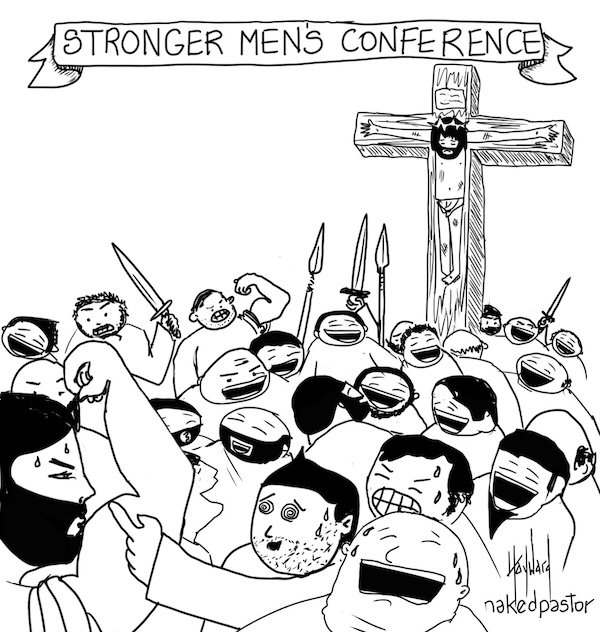
by David Hayward at http://www.Nakedpastor.com

The Naked Pastor draws many gospel cartoons. His name is David Hayward. This cartoon by the Naked Pastor is of the naked pastor. Pastor means shepherd, and here we see the good shepherd, the pastor stripped naked on the cross. In the foreground we see the wolves. They are taunting Jesus, making fun of him. They’re laughing at him, gritting their teeth at him, flexing their muscle against him, and raising their arms, their weapons of war, showing their killing teeth.

This is Jesus being savaged by a pack of wolves.

Over and over again we marvel. The good shepherd does not run away when the wolves come. He lays down his life for the sheep so that the wolves can’t scatter and snatch the sheep. I dare say we have sweetened this gospel over time – but what John is describing here is fierce. The opposition to the beloved community is fierce, but the attachment of the good shepherd to the flock is just as fierce. Blood is spilled and life is lost. But just as the good shepherd has the power to lay down his life, so he has the power to take it up again. And that places this gospel in our Easter liturgy – this fourth Sunday of Easter.

It’s a fierce gospel for savage times when metaphorical wolves roam our streets in their many disguises. It’s a gospel for our times – our mean time in which we need the protection of good shepherds – the sort who will give their lives for the sheep – the sort you wait to be pastor in your community.

At the moment, wolves and sheep remain enemies. The wolf continues to prey on the  sheep who rely on the protection of good shepherds – the sort who will give their lives for the sheep – the sort you wait for to be pastor in this community. But the time will come when there will be a peace way beyond our understanding and way beyond our imagination when the wolf will lie with the sheep. That’s what God lives for. The time will come when the wolf will live with the lamb, the leopard will lie down with the goat, the calf, the lion and the yearling together, and instead of tyrants and empire builders, a little child will be the leader. (Isaiah 11:9) Until that time we follow the call of the good shepherd as he leads us through the valleys and low points overshadowed by wolves and our fear of them.

John 10:11-18
‘I am the good shepherd. The good shepherd lays down his life for the sheep. The hired hand, who is not the shepherd and does not own the sheep, sees the wolf coming and leaves the sheep and runs away – and the wolf snatches them and scatters them. The hired hand runs away because a hired hand does not care for the sheep. I am the good shepherd. I know my own and my own know me, just as the Father knows me and I know the Father. And I lay down my life for the sheep. I have other sheep who do not belong to this fold. I must bring them also, and they will listen to my voice. So there will be one flock, one shepherd. For this reason the Father loves me, because I lay down my life in order to take it up again. No one takes it from me, but I lay it down of my own accord. I have power to lay it down, and I have power to take it up again. I have received this command from my Father.’

Love never stops

This is a reflection on words from Isaiah 44: I am the first and I am the last.

As well as the first
I am the last I am
the last the victim
forgotten I am
the last is my name
my first word
the lasting word
beaming hope
for the last at last
everlasting love

This was written for the Twitter hashtag #cLectio – a hashtag used by some for reflecting on the first reading of Morning Prayer