Wherever is Jesus? Where in the world is Jesus? Where on earth is he? Questions for the search team

A reflection on the loss of Jesus for the first Sunday of Christmas (year C). The gospel is from Luke 2:41-end when Joseph and Mary lost Jesus.
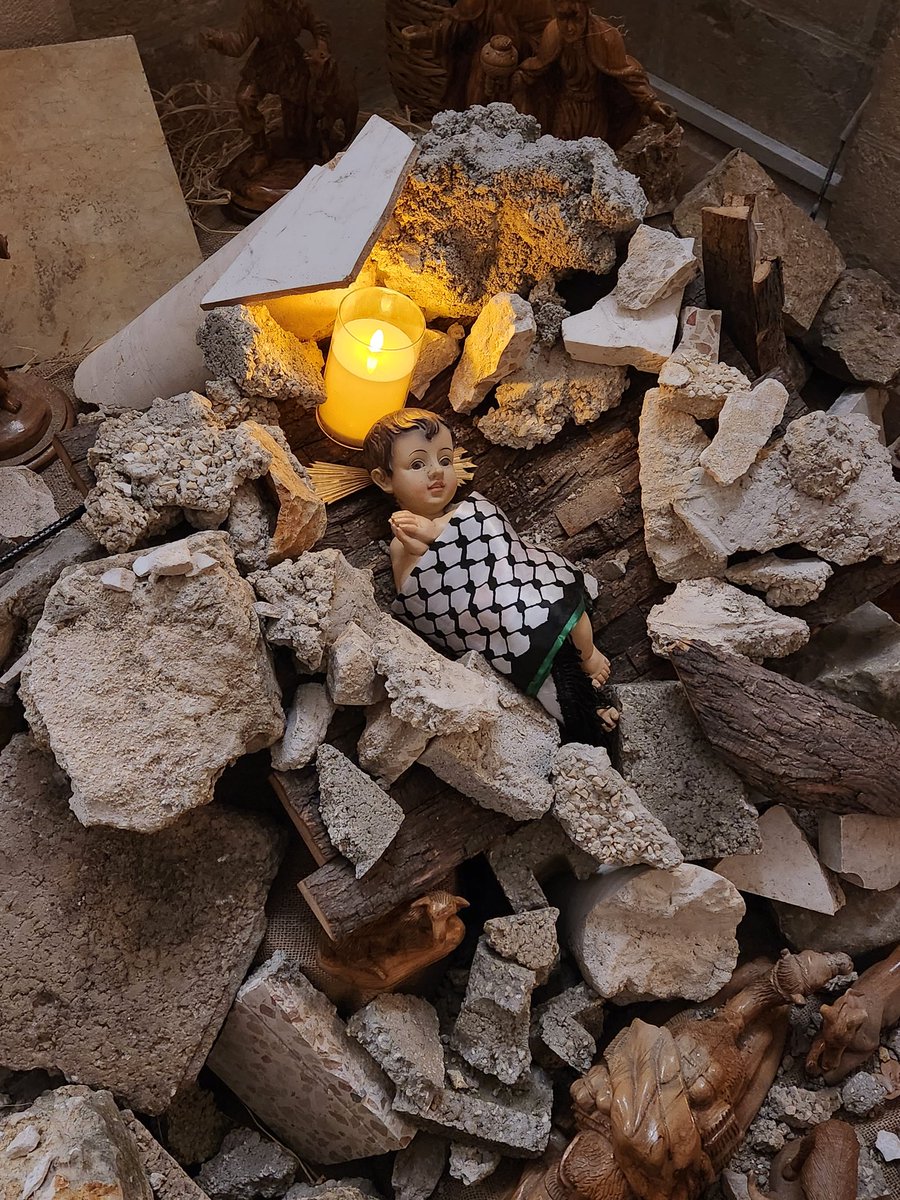
Crèche, December 2023, Evangelical Lutheran Christmas Church, Bethlehem. Photo: Munther Isaac

Today is the 1st Sunday of Christmas. Christmas is far from over as we revel in its meaning for us. Tradition has given us the 12 days of Christmas. Today is the 5th day.

What did my love give me on the 5th day? I’m sure someone will sing the answer.

What’s that all about? Maybe we can guess the significance of the 4 calling birds, the 3 French hens, the 2 turtle doves, and the partridge in the pear tree. Can we?

But what are those 5 gold rings, the four calling birds, the three French hens, the two turtle doves and the partridge in a pear tree?

We see the five rings flying on the Olympic flags, bringing separated nations to play games to bring the world together. Five gold rings, each one representing a continent, all of them representing the whole world. On this 5th day of Christmas, has my true love given me the whole world?

On this 5th day of Christmas our true love gives us this story of Jesus staying behind in Jerusalem and the worry he caused. It leaves us with the question “where in the world is Jesus?” “Where on earth is he?”

This story isn’t told in the other gospels. Luke uses the story to transition from the story of Jesus’ birth to the bigger story of Jesus’ ministry. Instead of staying with his parents for their journey home to Nazareth from the temple festival in Jerusalem Jesus stays behind.

The story gives us Jesus’ first words and they’re the words I suggest we focus on this morning – just in case we lose Jesus and struggle to find him.

We can perhaps all relate to the panic of losing someone in the crowd – so we can relate to what Mary and Joseph must have felt when they realised that Jesus was no longer with them. They thought he was walking back with their relatives or friends but he wasn’t to be found amongst them. They had to go back to Jerusalem to search for him. After three days they found him in the temple courts, among the teachers, listening to them and asking questions.

Remember, this is the beginning of Luke’s gospel. What’s at the beginning of the gospel should remind us of what’s at the end and fulfilment of the gospel, and vice versa. In the end there is another walk – from Jerusalem to Emmaus. Two people walking along the road, talking together about what had happened  – and joined by a third person who turns out to be Jesus. At the beginning of the gospel there were two walking together only because one had separated himself from them. In the fulfilment of the gospel there are three only because one had joined the two.

This is the gospel of Jesus being found in the gospel of the lost and found.

In both stories it takes three days to find Jesus, and three days is a hell of a long time to have lost someone. It was in the breaking of the bread that Jesus had become known to the two disciples in Emmaus. Subsequently he is found in his speech of just four words: “Peace be with you” (24:36) and recognised in his wounds. And this is where Jesus has been found in the church ever since: in the breaking of bread, wherever the greetings of peace are heard, and in the wounds he bravely bears These are the places to look for Jesus. This is where we find Jesus.

Now, that’s a lot to say about the end of his life, particularly as it’s the fifth day of Christmas and we’ve still got the nativity set up in our homes and minds. But already at Christmas we have a birth as well as a death and resurrection. One draws attention to the other in Luke’s telling of them.

Back to the beginning with Mary and Joseph being cross with Jesus. “Son, why have you treated us like this?” And Jesus’s reply to them, “Why were you searching for me? Didn’t you know I had to be in my Father’s house?” These are Jesus’ first words in the gospel of Luke. “Didn’t you know I had to be in my Father’s house?” But they didn’t know what he was saying to them.

This is the question I hope stays with us on this 5th day of Christmas, as we leave one secular year behind and are about to enter another – with fresh resolution to find Jesus wherever he may be – with a commitment to finding him and following him.
Where do we find Jesus?
Where do we find Jesus when we’ve lost him?
Where do we find Jesus when he’s stayed behind?
Why does he stay behind rather than going with us?

Mary and Joseph didn’t understand Jesus’ question. Luke tells us they didn’t understand what he was saying to them. Translators have struggled to capture Jesus’ meaning and have offered an alternative in the footnotes of the NIV – Did you not know I had to be about my Father’s business? But they thought he was in the family business – carpenters for the poor families of Nazareth – Joseph & Son.

But we don’t read the question “did you not know I had to be about my Father’s business? “. We read “Didn’t you know I had to be in my Father’s house?” The question is important because it is a question about where in the world Jesus can be found.

The translation in my Father’s house doesn’t quite seem right. Firstly it suggests the place Jesus can be found is so limited, and secondly it suggests Jesus can be found in a building and that leads us to churchianity rather than Christianity – with church buildings and the institution of church being the place to find Jesus when we know there are so many who love Jesus who’ve not joined a church.

Does this work as a question of Jesus for all his followers, for those who’ve lost him and those looking for him? “Did you not know you’d find me in what my Father is building?” Or, “did you not know you’d find me in whatever my Father is building?” Is that the guiding question? Is that the question to guide our search? As we build our resolution for the New Year, is that the clue to intensify our search for Jesus in what his father, our father, is building?

A couple of chapters further on in Luke’s gospel we come to what is called The Nazareth Manifesto when Jesus read in the synagogue in Nazareth from Isaiah the words, “The Spirit of the Lord is upon me to bring good news to the poor. He has sent me to proclaim release to the captives and recovery of sight to the blind, to let the oppressed go free.” He commented afterwards, “Today this scripture has been fulfilled in your hearing.”

The word manifesto  means showing. Here is Jesus showing what he is about. He is about his father’s business. He is in whatever his father is building. It is on that building site we will find him.

They’ve built a shrine for Jesus in Bethlehem. It shows baby Jesus lying in a pile of rubble in the devastation of his people while Mary, Joseph, the shepherds, the wise men and ourselves search for him. It’s on the side of the altar at Bethlehem’s Lutheran Church. The pastor there, Munther Isaac, a prominent Palestinian peacemaker says that he wants the world to know that is what Christmas looks like in Palestine these days.

Where in the world is Jesus? Where on earth is he? These questions going through the minds of Mary and Joseph go through our minds too.

This is where to find Jesus, in the devastation, wherever there is oppression and suffering, captivity and blindness. 

He’s in the news – in the good news for the poor.
He’s in the sharing of bread.
He’s in the making of peace.
He’s among the wounded.
That is where to find him.

We need look no further.

Taking sides on the road to Emmaus

A sermon for the third Sunday of Easter (April 23rd 2023) for Holy Trinity, Leamington, based on the gospel for the day – Luke 24:13-35 (text below)

Lovers in Arles by Vincent van Gogh

When you walk through a storm
Hold your head up high
And don’t be afraid of the dark

At the end of a storm
There’s a golden sky
And the sweet silver song of a lark

Walk on through the wind
Walk on through the rain
For your dreams be tossed and blown

Walk on, walk on
With hope in your heart
And you’ll never walk alone
You’ll never walk alone.

This Rogers and Hammerstein song has stood the test of time. It was originally part of their 1945 musical, Carousel. It is the anthem of Liverpool. It is also the anthem for Celtic and Borussia Dortmund, several Dutch teams, a Belgian team, and also became the anthem of support for medical workers, first responders and those in quarantine during the pandemic.

It’s an anthem which has stood the test of time. It’s seen us through the pandemic and saw Liverpool fans through Hillsborough and other tragedies. It was sung as a tribute to the Busby Babes at Manchester United’s first home game after the Munich air disaster in 1958 and was also used to support those affected by the fire at Bradford City’s Valley Parade which killed 58. Some of you may have YNWA tattooed on your body somewhere.

This is a song with legs. Behind it is a truth with even longer legs. The last words of Matthew’s gospel are “Remember, I am with you to the end of time”. These are the words of the risen Jesus even though he has walked through the valley of the shadow of death. Remember, I am with you to the end of time. These are the daddy long legs behind the Liverpool anthem and all the songs of faith which have sustained so many on their long and difficult walks to freedom through storms of betrayal, injustice and pain.

In today’s gospel, Jesus, the I AM of “I am with you always”, joins two people on their way home from the festival in Jerusalem. He asked them what they were discussing, and Luke tells us “they stood still, looking sad”. They had reason to be sad. They had hoped that Jesus was the one to free Israel, but their own leaders and priests had handed Jesus over to be condemned to death by crucifixion

They walked on. They walked on with Jesus. They walked on, with Jesus listening to the hope that was in their heart and his response: his explanation of things in all the scriptures about him.

Here, as in other resurrection appearances, Jesus appears as stranger. They don’t know the one who has joined them is Jesus, and only discover his identity when he broke bread with them and reflected on the change of heart they felt as they walked with Jesus.

Jesus becomes known in the breaking of bread and through companionship. Companions are literally those we eat bread with. That is the meaning of the word companion.

When Jesus accepted the invitation of these two (Cleopas and the other whose name isn’t given) he joined them as companions, and they found him in the intimacy of companionship.

Was the revelation, and is the revelation, through the way the bread was taken, blessed, broken and shared? Was it, and is it, through the visibility of the scars and vulnerability. All of us will have our stories to tell about how Jesus has become known to us through the companionship of breaking bread together.

Through Ezekiel (Ezekiel 36:26) God promised God’s people a new heart – a heart of flesh instead of hearts of stone. When the penny drops, Cleopas and his companion say to each other with the benefit of hindsight, “Were not our hearts burning within while he was talking to us on the road?” Is this not the fulfilment of that promise? 

The road home from Jerusalem had been a road of desolation for the two of them – they shared their heartbreak with the one who joined them at their side and then found all the consolation they could ever have wished for, and more. It was with a fresh heart that they rushed back to Jerusalem and told the eleven what had happened to them on the road. We’re not told what happened next for them. We can only assume that their next steps were to walk on, with that fresh heart to their being, with hope at their heart.

I was leading worship in a strange church a couple of weeks ago. It was a service I had never led before. I sat in the church beforehand, on my own when someone joined me, sitting at my side. She was calm, a non-anxious presence, who quietly engaged me in conversation. I knew her slightly – enough for us to have a conversation about what matters to us. So it wasn’t small-talk. I immediately knew what she had done. Of all the things that she could have been doing, she had joined me, she had taken my side.

She will never know the effect of that simple action – taking my side. It was certainly heart-warming. It was immensely encouraging (encouraging literally means heartening). It gave me confidence. I knew I wasn’t on my own.

All of us, feeling vulnerable,
love it when others take our side,
when they sit with us, 
when they walk with us, 
when their heart goes out to us, 
when they make sure 
we never walk alone. 

When they join our side 
with a love that is patient and kind, 
that isn’t boastful or rude, 
that bears all things, 
believes all things, 
hopes all things, 
endures all things – 
well, (in the words of Andrew Lloyd Webber), 
that changes everything, 
doesn’t it? 

Is it not Christ
in such love
who takes our side
even as a stranger?

Isn’t it this love,
joining us at our side
who gives us new heart,
a heart-warming of flesh,
emboldened and encouraged?

Emboldened and encouraged
enough for us also 
through Christ and in Christ
to take the side of others
along their roads of sorrow,
even through the valley
of shadows marked Death

heartened to side with them
as part of the promise
“You’ll never walk alone”,
joined by the insistence of Jesus,
“I am with you always,
to the end of time.”

So, who is it  who has joined you on your journey, particularly when you have felt like Cleopas and his companion? Who has taken your side, particularly when you have felt forsaken? Who has stayed by your side through thick and thin? Who has loved with a love divine? These are the people who have encouraged us and given us fresh heart. These are the people through whom Christ lives his life in ways we often don’t recognise.

We give thanks for them and their presence in our lives – and we pray that we too may commit ourselves to Jesus’ risen life by siding with those Jesus sides with – those who are poor, or lost, or broken – in fact, everyone apart from the proud and self-satisfied – walking with them, standing up for them, taking their side, joining them.

Note: the information about YNWA is from https://en.wikipedia.org/wiki/You%27ll_Never_Walk_Alone

Luke 24:13-35

Now on that same day two of them were going to a village called Emmaus, about seven miles from Jerusalem, and talking with each other about all these things that had happened. While they were talking and discussing, Jesus himself came near and went with them, but their eyes were kept from recognising him. And he said to them, ‘What are you discussing with each other while you walk along? They stood still, looking sad. Then one of them, whose name was Cleopas, answered him, ‘Are you the only stranger in Jerusalem who does not know the things that have taken place there in these days?’ He asked them, ‘What things?’ They replied, ‘The things about Jesus of Nazareth, who was a prophet mighty in deed and word before God and all the people, and how our chief priests and leaders handed him over to be condemned to death and crucified him. But we had hoped that he was the one to redeem Israel. Yes, and besides all this, it s now the third day since these things took place. Moreover, some women of our group astounded us. They were at the tomb early this morning, and when they did not find his body there, they came back and told us that they indeed had seen a vision of angels who said that he was alive. Some of those who were with us went to the tomb and found it just as the women had said, but they did not see him.’ Then he said to them, ‘Oh, how foolish you are, and how slow of heart to believe all that the prophets have declared! Was it not necessary that the Messiah should suffer these things and then enter into his glory?’ Then beginning with Moses and all the prophets, he interpreted to them the things about himself in all the scriptures.

As they came near to the village to which they were going, he walked ahead as if he were going on. But they urged him strongly, saying, ‘stay with us because it is almost evening and the day in now nearly over.’ So he went in to stay with them. When he was at the table with them he took bread, blessed and broke it, and gave it to them. Then their eyes were opened and they recognised him; and he vanished from their sight. They said to each other, ‘Were not our hearts burning within us while he was talking to us on the road, while he was opening the scriptures to us?’ That same hour they got up and returned to Jerusalem; and they found the eleven and their companions gathered together. They were saying, “The Lord has risen indeed, and he has appeared to Simon!’ Then they told what had happened on the road, and how he had been made known to them in the breaking of the bread.