Egged on by Mary and Elizabeth, here I go again

Here I go again, egged on by Elizabeth, Mary and Micah – a reflection for Advent 4C. I don’t seem able to help myself. I can’t stop preaching that small is so beautiful, thanks to God who raises the lowly, graces the dis-graced and scatters the proud. Maybe it’s because I’ve been helping small churches this year.

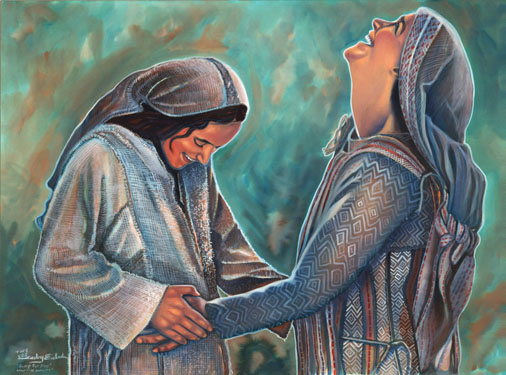
Jump for Joy by Corby Eisbacher reproduced with permission

In these Sundays of Advent we come face to face with the faith of Israel. It is not the faith of all Israel. If everyone agreed in their faith Jesus would not have had to face such opposition. The faith we come face to face with in Advent is the faith that has been passed down the generations in our scriptures, and lived out by so many. The faith of Israel is about what we expect and what we live for.

It’s a faith which celebrates God’s opposition to the proud and Gods’ favour for those who are lowly, humble and poor in spirit.

So we have today’s readings, from the prophet Micah (5:2-5a) and Luke (1:39-55).

But first, a diversion. 

When the wise men went looking for the one born king of the Jews they stupidly went about it the wrong way. They went looking in Jerusalem. They did not know the rule of the kingdom of God that the first come last and the last come first. The capital wouldn’t cradle the Messiah. In fact, the capital did nothing other than scoff and plot against the one born king of the Jews. Their satnav took them to Jerusalem, nine miles wide of the mark, the cross on the map where Jesus was born.

It was the chief priests and scribes that directed Herod’s attention to Bethlehem as the place where the ruler to shepherd Israel would be born. It was Herod who sent the wise men to Bethlehem to search for the child.

That’s probably the way most of us would go. You could be excused for expecting to find what you’re looking for in the capital, the seat of power.

But the faith of Israel knows different, Micah expresses that prophetic faith, implicitly warning us not to look for leadership in the usual places but to expect the one to rule in Israel to come from one of the little clans of Judah, one of the little clans of Jews, even from Bethlehem of Ephrathah.

Ephrathah is the old name for Bethlehem. It means fruitfulness and Bethlehem means the house of bread. It was the place of fruitfulness that Micah directs us to – not to Jerusalem. The thing about fruitfulness is its abundance but the abundance is the fruit of tiny seed, scattered by the fall and the wind and pollinated by the humble bee. 

The faith of Israel is found in the tiny, the lowly and the humble. This is the faith that follows the rule of the kingdom of God.

We know where Jesus was born, but we don’t know where John was. All we know is that Mary set out to a “judean town in the hill country”, to Zechariah’s house, to greet her cousin Elizabeth. Luke doesn’t tell us the town’s name, but it sounds like it was a place off the beaten track and follows the rule that the kingdom of God is hidden in small places, in the smallest of clans and in the most barren of landscapes.

It is in these places that God grows a kingdom. From the smallest of clans, from the dust of the earth, from the least and the last God works wonders. This is the faith of Israel. This is the faith of Israel which even now leaves many Jews horrified by what is being done in the name of Israel as it uses its military might. Those Jews who are horrified need our prayers as they protest and resist what is going on. The faith in Israel they see in Netanyahu is not the faith of Israel they treasure in their scripture.

The faith in Israel that has stood the test of time is, in the words of the epistle of James (4:6) that God scatters the proud, but gives grace to the humble.

Elizabeth and Mary come together in our gospel reading. There aren’t many readings where we listen to women talking together. Together they represent the truth that God gives grace to the humble. It is written loud and clear in their body language. Their joy is undeniable.

Luke describes how both Zechariah and Elizabeth were both “getting on in years” (1:7) and that theirs was a childless marriage. In those days that was the woman’s fault and that explains the “disgrace” she felt among her people even though she had lived a blameless life. Now with the promise of a son Elizabeth knows God’s favour for the dis-graced. In her pregnant body God’s favour for the dis-graced, humiliated and humble is told yet again. Elizabeth looks at her body, feels her baby and says, “this is what the Lord has done for me when he looked favourably on me and took away the disgrace I have endured among my people.” (1:25).

Then Luke has us look at Mary’s body through the eyes of Elizabeth and we hear her praise. It comes from the heart of Israel’s songbook about how her soul magnifies the Lord. Mary calls herself a lowly woman. That was no mere figure of speech. Her lowliness wasn’t her mental attitude. It was  that she truly was a poor woman. She occupied a place of poverty and powerlessness in her society. She rejoices in the favour God has shown to her, the great things he had done for her, the way he lifts up the lowly and fills the hungry with good things, while all the time opposing the proud and powerful, scattering the proud and bringing down the powerful from their thrones.

This was the faith of Israel that Mary was repeating. This was the song Jesus heard when he was growing up: Mary magnifying the Lord, praising God for his favour for the lowly.

This is the faith of Israel. This is the faith of Jesus that we hear time and again in his preaching. This is the faith we follow, not taking the foolish way of the wise men to the powerhouses, but feeling our way to find God’s favour in the insignificant, humiliated, disgraced, lowly, poor and powerless.

Inasmuch as he did for Mary and Elizabeth he does for all his people. He lifts up the lowly. He gives grace to the disgraced, scattering the arrogant and proud and the disgraceful.

This is the faith of Israel. This is the faith of Mary and Elizabeth. This is the faith of Jesus. This is our faith, the faith of the church, though sometimes you’d hardly know it infected as we are with the imperial spirit which wants to see us bigger than we are. God grows a kingdom and works wonders from the smallest of clans, from the dust of the earth, from the least. That is the reason the lowly and humble rejoice and the proud and arrogant just scoff.

Note: The artwork is by Corby Eisbacher and reproduced with her permission. Prints are available from her www.artbycorby.etsy.com

The readings:

Micah 5:2-5a
But you, O Bethlehem of Ephrathah, who are one of the little clans of Judah, from you shall come forth for me one who is to rule in Israel, whose origin is from of old, from ancient days. Therefore he shall give them up until the time when she who is in labor has brought forth; then the rest of his kindred shall return to the people of Israel. And he shall stand and feed his flock in the strength of the Lord, in the majesty of the name of the Lord his God. And they shall live secure, for now he shall be great to the ends of the earth; and he shall be the one of peace. If the Assyrians come into our land and tread upon our soil, we will raise against them seven shepherds and eight installed as rulers.

Luke 1:39-55
39In those days Mary set out and went with haste to a Judean town in the hill country, 40where she entered the house of Zechariah and greeted Elizabeth. 41When Elizabeth heard Mary’s greeting, the child leaped in her womb. And Elizabeth was filled with the Holy Spirit 42and exclaimed with a loud cry, “Blessed are you among women, and blessed is the fruit of your womb. 43And why has this happened to me, that the mother of my Lord comes to me? 44For as soon as I heard the sound of your greeting, the child in my womb leaped for joy. 45And blessed is she who believed that there would be a fulfillment of what was spoken to her by the Lord.” 46And Mary said, “My soul magnifies the Lord, 47and my spirit rejoices in God my Savior, 48for he has looked with favor on the lowliness of his servant. Surely, from now on all generations will call me blessed; 49for the Mighty One has done great things for me, and holy is his name. 50His mercy is for those who fear him from generation to generation. 51He has shown strength with his arm; he has scattered the proud in the thoughts of their hearts. 52He has brought down the powerful from their thrones, and lifted up the lowly; 53he has filled the hungry with good things, and sent the rich away empty. 54He has helped his servant Israel, in remembrance of his mercy, 55according to the promise he made to our ancestors, to Abraham and to his descendants forever.”

What should we do? Everybody’s asking according to Luke

This sermon is for the 3rd Sunday in Advent (C) prompted by a question everyone seems to be asking in Luke. The question being what should we do? It’s prepared for two small churches I’m helping out in a vacancy. The gospel reading is Luke 3:7-18 (the text is at the end of the post).
December 15th 2024

What should we do? That question keeps cropping up.

Three times we hear that question in today’s reading. Luke pictures three audiences of John the Baptist. There’s the “the crowds”, there’s the “tax collectors” and there’s “the soldiers”. Each of those audiences ask the same question. “What should we do?”

Before being specific John had already told them to bear fruits worthy of repentance while also saying they couldn’t take their place in God’s kingdom for granted just because they had Abraham as their ancestor. They needed to repent.

“What should we do?” It’s a question which keeps cropping up in Luke/Acts. As well as the crowd, the tax collectors and the soldiers featured in today’s gospel, it’s a question asked by:

  • A lawyer asking “what must I do to inherit eternal life?” (Luke 10:25)
  • A rich man worrying about his abundant crops, “what should I do, for I have no place to store my crops?” (Luke 12:17)
  • An unscrupulous agent  getting sacked: “what will I do, now that my master is taking the position from me?” (Luke 16:3)
  • A rich ruler asking Jesus “what must I do to inherit eternal life?” (Luke 18:18)
  • The owner of the vineyard asks “what shall I do?” (Luke 20:13)
  • The Jews in Jerusalem for Pentecost asking the disciples “what shall we do?” (Acts 2:37)
  • A jailer asking Paul and Silas (what must I do to be saved?” (Acts 16:30)
  • Saul (aka Paul) asking Jesus “What am I to do Lord” (Acts 22:10)

I list these examples to highlight how important this question is to the people of God. The same question asked time and again through Luke/Acts: “What should I do?” And every time the answer comes back that they have to do things differently, and radically so. 

Significantly the question crops up at the beginning of both volumes of Luke’s work. It’s there in today’s gospel, and it’s there at the beginning of Acts. John the Baptist answers the question in the gospel. Peter answers the question in Acts.

John’s answer is that they should bear fruits worthy of repentance. Peter’s answer is that they should be baptised, and that day, 3,000 were, and they devoted themselves to the apostles’ teaching and fellowship. Luke comments: “all who believed were together and had all things in common; they would sell their possessions and goods and distribute the proceeds to all, as any had need.” In other words, here were people bearing fruits worthy of repentance.

I’m sure that Luke wanted this question to hang over all his readers. Why else would he keep repeating it? What should we do?

What should we do to count in the kingdom of God where the rule is to love God wholeheartedly, to love our neighbour as ourselves (whether we are like them or not) and to realise that those who come last in the ways of the world, and those who are counted least come first, and those usually first, come last?

Repentance means that we make a turn in our lives, that we turn ourselves round from self-ishness, self-satisfaction, self-absorption and self indulgence so that we see God and our neighbours face to face. Repentance means turning back, re-turning to where we started – loved by God from the beginning. Repentance means we change our ways and our minds with the result that we will do things very differently and see one another very differently.

I was saying last week that we might have focused so much on our forgiveness that we don’t see anything wrong with us. We might feel that we have done little wrong. But there are those we’ve wronged, those we’ve hurt, those we’ve taken advantage of, those we’ve demeaned and those we’ve neglected – and those who are frightened of us. Yes, the question is for us too. What are we to do?

I’ve looked at the three groups of people featured in today’s gospel. They have something in common. They are all potentially menacing, dangerous and harmful. The soldiers were obviously in a position where they could extort money by threats, could take backhanders and could blackmail people – and many probably did. Woe betide their vulnerable victims. John tells them to be satisfied with their wages and not to extort money from anyone by threats or false accusation.

The tax-collectors were obviously in a position where they could collect more in tax and make money for themselves at the expense of people who were reduced to poverty by the excessive triple tax demands of empire, state and temple. Woe betide you if you were on the wrong side of the tax-collector. Remember Zacchaeus. He admitted to Jesus that he’d wronged people – and in penitence offered to repay what he’d wrongly taken four times over. John tells the tax-collectors to collect no more than is their due.

Then there’s the crowd. How menacing is the crowd. How quickly can a crowd turn nasty by a single word, or a rumour? How toxic can groupthink be – how fearful it can be – and how demeaning and controlling the supposed crowd can be. You know when you’re told “everyone is saying”, “everyone thinks”, “everyone knows” that the virtual crowd has your back against the wall. Even when Christians say “Christians believe in x, y or z” when they know not all Christians do – that is crowd behaviour designed to intimidate and control others into conformity.

The crowd is the place to hide in. The crowd is what we follow so often. The crowd is what condemned Jesus – one day praising him and the next cursing him. The way John tells them to change is to be kind and generous: “whoever has two coats must share with anyone who has none; and whoever has food must do likewise”.

So, what should we do? What does repentance mean for us? It means we have to keep changing, changing our minds, our attitudes and our behaviours. And there is no place better to start than with our gospel reading.

We’ve noted how dangerous and harmful those three groups are – and why. The crowd, the tax-collectors, the soldiers were all people that those who come first in the kingdom of God – the last and the least – the most vulnerable are the most likely to be a major cause of their suffering. In other words, they were their enemies.

But watch what Luke does with them in the telling of his gospel. He shows that they’re not written off. He shows that they are capable of repentance. He shows them redeemed. They (at least some of them) come to be saved and become “true children of Abraham”. 

Here is one of the “enemy”.

Several soldiers feature in Luke’s writing. There was the centurion who asked Jesus for help whose faith, Jesus said, was like the faith he’d ever seen in Israel. It was one of the centurions at the crucifixion who stood out from the crowd  who praised God for Jesus believing “certainly this man was innocent.” (23:47) And right at the end of Luke’s work it was a soldier who stood up against his fellow soldiers to spare Paul’s life after their ship had run aground off the shores of Malta. (Acts 27:42, 43).

Here are some of the enemy.

Luke can even demonstrate the repentance of the crowd, those thousands who heard the word from Peter at Pentecost. They repented and produced fruits worthy of repentance. They devoted themselves to the apostles’ teaching and fellowship. They were united and held everything in common. They would sell their possessions and goods and share the proceeds as any had need.

Here was a crowd to love. And Luke comments that they had “the goodwill of all the people”. The gospel of Luke is so inclusive. There is good news especially for our enemies. 

For that very reason we need to change the way we see our enemies.

What shall we do?

Here’s something we can do.
Those who can harm us,
those who can exploit us,
do not condemn them
with our fearful judgement
(dangerous though those enemies are).

Instead, leave a window open
for the word of God
which from the beginning
spreads the table
even with my enemies present
so making all things possible.

Yes, we’ve been drilled
to hate our enemies,
but don’t let that fool us
or crowd our minds
so we can’t see
the possibility of change.

The word made flesh
suffered all his enemies
could throw at him.
Every stone became a prayer
as the word of God

came near for us to hear
that word “Repent” and change.
It’s our turn to turn Jesus’ way.
That’s what we can do this day
love the enemies that come our way
till some turn the kingdom way, the only way
to save ourselves from ourselves.

Luke 3.7-18
7   John said to the crowds that came out to be baptized by him, ‘You brood of vipers! Who warned you to flee from the wrath to come?
8  Bear fruits worthy of repentance. Do not begin to say to yourselves, “We have Abraham as our ancestor”; for I tell you, God is able from these stones to raise up children to Abraham.
9  Even now the axe is lying at the root of the trees; every tree therefore that does not bear good fruit is cut down and thrown into the fire.’
10   And the crowds asked him, ‘What then should we do?’
11  In reply he said to them, ‘Whoever has two coats must share with anyone who has none; and whoever has food must do likewise.’
12  Even tax-collectors came to be baptized, and they asked him, ‘Teacher, what should we do?’
13  He said to them, ‘Collect no more than the amount prescribed for you.’
14  Soldiers also asked him, ‘And we, what should we do?’ He said to them, ‘Do not extort money from anyone by threats or false accusation, and be satisfied with your wages.’
15   As the people were filled with expectation, and all were questioning in their hearts concerning John, whether he might be the Messiah,
16  John answered all of them by saying, ‘I baptize you with water; but one who is more powerful than I is coming; I am not worthy to untie the thong of his sandals. He will baptize you with the Holy Spirit and fire.
17  His winnowing-fork is in his hand, to clear his threshing-floor and to gather the wheat into his granary; but the chaff he will burn with unquenchable fire.’
18   So, with many other exhortations, he proclaimed the good news to the people.