Egged on by Mary and Elizabeth, here I go again

Here I go again, egged on by Elizabeth, Mary and Micah – a reflection for Advent 4C. I don’t seem able to help myself. I can’t stop preaching that small is so beautiful, thanks to God who raises the lowly, graces the dis-graced and scatters the proud. Maybe it’s because I’ve been helping small churches this year.

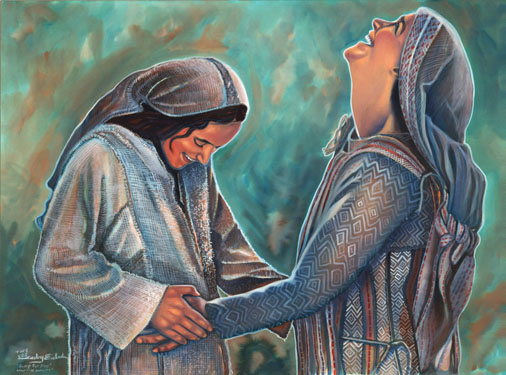
Jump for Joy by Corby Eisbacher reproduced with permission

In these Sundays of Advent we come face to face with the faith of Israel. It is not the faith of all Israel. If everyone agreed in their faith Jesus would not have had to face such opposition. The faith we come face to face with in Advent is the faith that has been passed down the generations in our scriptures, and lived out by so many. The faith of Israel is about what we expect and what we live for.

It’s a faith which celebrates God’s opposition to the proud and Gods’ favour for those who are lowly, humble and poor in spirit.

So we have today’s readings, from the prophet Micah (5:2-5a) and Luke (1:39-55).

But first, a diversion. 

When the wise men went looking for the one born king of the Jews they stupidly went about it the wrong way. They went looking in Jerusalem. They did not know the rule of the kingdom of God that the first come last and the last come first. The capital wouldn’t cradle the Messiah. In fact, the capital did nothing other than scoff and plot against the one born king of the Jews. Their satnav took them to Jerusalem, nine miles wide of the mark, the cross on the map where Jesus was born.

It was the chief priests and scribes that directed Herod’s attention to Bethlehem as the place where the ruler to shepherd Israel would be born. It was Herod who sent the wise men to Bethlehem to search for the child.

That’s probably the way most of us would go. You could be excused for expecting to find what you’re looking for in the capital, the seat of power.

But the faith of Israel knows different, Micah expresses that prophetic faith, implicitly warning us not to look for leadership in the usual places but to expect the one to rule in Israel to come from one of the little clans of Judah, one of the little clans of Jews, even from Bethlehem of Ephrathah.

Ephrathah is the old name for Bethlehem. It means fruitfulness and Bethlehem means the house of bread. It was the place of fruitfulness that Micah directs us to – not to Jerusalem. The thing about fruitfulness is its abundance but the abundance is the fruit of tiny seed, scattered by the fall and the wind and pollinated by the humble bee. 

The faith of Israel is found in the tiny, the lowly and the humble. This is the faith that follows the rule of the kingdom of God.

We know where Jesus was born, but we don’t know where John was. All we know is that Mary set out to a “judean town in the hill country”, to Zechariah’s house, to greet her cousin Elizabeth. Luke doesn’t tell us the town’s name, but it sounds like it was a place off the beaten track and follows the rule that the kingdom of God is hidden in small places, in the smallest of clans and in the most barren of landscapes.

It is in these places that God grows a kingdom. From the smallest of clans, from the dust of the earth, from the least and the last God works wonders. This is the faith of Israel. This is the faith of Israel which even now leaves many Jews horrified by what is being done in the name of Israel as it uses its military might. Those Jews who are horrified need our prayers as they protest and resist what is going on. The faith in Israel they see in Netanyahu is not the faith of Israel they treasure in their scripture.

The faith in Israel that has stood the test of time is, in the words of the epistle of James (4:6) that God scatters the proud, but gives grace to the humble.

Elizabeth and Mary come together in our gospel reading. There aren’t many readings where we listen to women talking together. Together they represent the truth that God gives grace to the humble. It is written loud and clear in their body language. Their joy is undeniable.

Luke describes how both Zechariah and Elizabeth were both “getting on in years” (1:7) and that theirs was a childless marriage. In those days that was the woman’s fault and that explains the “disgrace” she felt among her people even though she had lived a blameless life. Now with the promise of a son Elizabeth knows God’s favour for the dis-graced. In her pregnant body God’s favour for the dis-graced, humiliated and humble is told yet again. Elizabeth looks at her body, feels her baby and says, “this is what the Lord has done for me when he looked favourably on me and took away the disgrace I have endured among my people.” (1:25).

Then Luke has us look at Mary’s body through the eyes of Elizabeth and we hear her praise. It comes from the heart of Israel’s songbook about how her soul magnifies the Lord. Mary calls herself a lowly woman. That was no mere figure of speech. Her lowliness wasn’t her mental attitude. It was  that she truly was a poor woman. She occupied a place of poverty and powerlessness in her society. She rejoices in the favour God has shown to her, the great things he had done for her, the way he lifts up the lowly and fills the hungry with good things, while all the time opposing the proud and powerful, scattering the proud and bringing down the powerful from their thrones.

This was the faith of Israel that Mary was repeating. This was the song Jesus heard when he was growing up: Mary magnifying the Lord, praising God for his favour for the lowly.

This is the faith of Israel. This is the faith of Jesus that we hear time and again in his preaching. This is the faith we follow, not taking the foolish way of the wise men to the powerhouses, but feeling our way to find God’s favour in the insignificant, humiliated, disgraced, lowly, poor and powerless.

Inasmuch as he did for Mary and Elizabeth he does for all his people. He lifts up the lowly. He gives grace to the disgraced, scattering the arrogant and proud and the disgraceful.

This is the faith of Israel. This is the faith of Mary and Elizabeth. This is the faith of Jesus. This is our faith, the faith of the church, though sometimes you’d hardly know it infected as we are with the imperial spirit which wants to see us bigger than we are. God grows a kingdom and works wonders from the smallest of clans, from the dust of the earth, from the least. That is the reason the lowly and humble rejoice and the proud and arrogant just scoff.

Note: The artwork is by Corby Eisbacher and reproduced with her permission. Prints are available from her www.artbycorby.etsy.com

The readings:

Micah 5:2-5a
But you, O Bethlehem of Ephrathah, who are one of the little clans of Judah, from you shall come forth for me one who is to rule in Israel, whose origin is from of old, from ancient days. Therefore he shall give them up until the time when she who is in labor has brought forth; then the rest of his kindred shall return to the people of Israel. And he shall stand and feed his flock in the strength of the Lord, in the majesty of the name of the Lord his God. And they shall live secure, for now he shall be great to the ends of the earth; and he shall be the one of peace. If the Assyrians come into our land and tread upon our soil, we will raise against them seven shepherds and eight installed as rulers.

Luke 1:39-55
39In those days Mary set out and went with haste to a Judean town in the hill country, 40where she entered the house of Zechariah and greeted Elizabeth. 41When Elizabeth heard Mary’s greeting, the child leaped in her womb. And Elizabeth was filled with the Holy Spirit 42and exclaimed with a loud cry, “Blessed are you among women, and blessed is the fruit of your womb. 43And why has this happened to me, that the mother of my Lord comes to me? 44For as soon as I heard the sound of your greeting, the child in my womb leaped for joy. 45And blessed is she who believed that there would be a fulfillment of what was spoken to her by the Lord.” 46And Mary said, “My soul magnifies the Lord, 47and my spirit rejoices in God my Savior, 48for he has looked with favor on the lowliness of his servant. Surely, from now on all generations will call me blessed; 49for the Mighty One has done great things for me, and holy is his name. 50His mercy is for those who fear him from generation to generation. 51He has shown strength with his arm; he has scattered the proud in the thoughts of their hearts. 52He has brought down the powerful from their thrones, and lifted up the lowly; 53he has filled the hungry with good things, and sent the rich away empty. 54He has helped his servant Israel, in remembrance of his mercy, 55according to the promise he made to our ancestors, to Abraham and to his descendants forever.”

Taking the unsweetened Christmas story into our resolutions

This sermon was prepared for the first Sunday after Christmas when I suspect many are tired of Christmas and want to get back to normal. We have to hope we don’t – go back to normal, that is – because then the “lowly” and demeaned are left out as normal. It is to them, the likes of the shepherds and Mary and Joseph, that the glory of God takes us. The gospel text is Luke 2:15-21.

This week, the danger is that life will get back to normal, that we will go back to our old ways, to the old gods which hold our thoughts, and that this coming year, 2024 will be just like any other year with its low expectations and vague hopes for world peace, a lottery win a nice holiday and just getting by.

But if we go back to normal won’t Mary’s pain have been in vain? Time turns on Jesus’s birth. There was a time for us “before Christ”, and there is time after his birth, a new time, the time when we know God’s favour – the day of the Lord, the years anno domini – the time that will surely never be the same again.

I suspect that those who will be glad to “get back to normal”, relieved it’s all over will have imbibed too much sugar or tried to do too much.

How much sugar we take with our Christmas is a good question. The way most people know the Christmas story is through sugar-coated carols and cards. Christmas can get so sweetened that we have difficulty getting the real flavour of Christmas as presented, unsweetened, by the gospel writers, Matthew, Luke and John.

There’s usually a “free from” aisle in our supermarkets these days. I suggest that we keep this aisle in church as a free from aisle. Free from sugar and syrup so that we can get into the meaning of Jesus’ birth. Luke, Matthew and John didn’t tell these stories lightly or sweetly. They tell them deeply, from the depths of a whole community’s memory and experience. And they tell their stories darkly – there is a dark reality to all the elements of their stories. We need to feel their weight, not their lightness. We need to feel their weight to grow in worship, resilience and love for the lowly and the stranger.

Our gospel this morning begins after the angel left the shepherds. An angel had appeared to them, and the glory of the Lord shone around them. The angel brought good news to them that was to cause great joy for all people. A child, wrapped in cloth, lying in an improvised cot was the sign. The great company of the heavenly host join the angel and the shepherds. They praise God for the news singing at the top of their voices, “Glory to God in the highest heaven, and on earth peace to those on whom his favour rests”.

This morning’s gospel begins with the shepherds deciding to go to Bethlehem to see for themselves what God had made known to them. They went with haste and found Mary and Joseph and the child lying in the manger. They made known what they’d been told about the child. Their hearers were amazed and Mary treasured their words and pondered them in her heart.

With Mary we treasure their words and ponder them in the heart of the church. But, please, no sugar because if we put sugar in we miss the point that Luke is here making as he paints the picture of those on whom God’s favour rests, around whom God’s glory shines and through whom, and for whom, God chooses the way of saving the world that is lost.

God’s glory shines around the shepherds. These were men who lived out in the fields, on the wasteland around Bethlehem on land which was no good for anything else than grazing sheep. They were there in all weathers, warding off wolves and thieves, working nights, protecting the lives of their sheep, their livelihood – doing the work which was to inspire Jesus’s own self understanding of being the good shepherd. They were an underclass, living rough. Around them the glory of God shines. The press release of the birth isn’t carefully planned for maximum impact in the corridors of power, but is focused in the isolation of these shepherds.

The sweetened versions of the Christmas story, the sweetened Nativity, can never convey the darkness and will always shy away from the poverty. It is the unsweetened versions, given to us by the gospel writers which shows us where God’s favour rests – around the shepherds, on Joseph (a poor artisan carpenter in an obscure village) and Mary – a young girl whose song of praise Jesus will have heard growing up. In her song, the song we know as Magnificat she praises God for looking “with favour on the lowliness of his servant”.

Lowly is the collective noun for those who have been demeaned. The word lowliness is used throughout the Bible to denote misery, pain, persecution and oppression. In our unsweetened version of Jesus’ birth story, Mary embodies the experience of her people, the Jews – their whole history threaded with misery, pain, persecution and oppression. She knew God’s favour rests there, with her people – and those who have joined Mary have come to realise he favours all like her, all those in misery, pain, persecution and oppression. The glory of God is all about them – Mary, Joseph, the shepherds – and all the lowly who make up the extended holy family, and those who want to relate to them as relatives. The love of God is for them – to turn life round in their favour.

Poet W H Auden puts these words into the mouths of the shepherds in his Christmas Oratario For the Time Being:

We never left the place where we were born,
Have only lived one day, but every day

Have walked a thousand miles yet only worn
The grass between our work and home away.

Lonely we were though never left alone.
The solitude familiar to the poor
Is feeling that the family next door,
The way it talks, eats, dresses, loves, and hates,
Is indistinguishable from one’s own.

Tonight for the first time the prison gates
Have opened.
Music and sudden light
Have interrupted our routine tonight,
And swept the filth of habits from our hearts.
O here and now our endless journey starts.

We’ve come to the end of the year, the end of the Christmas holidays is in sight. We may be relieved it’s all over – we have, after all, consumed far too much sugar. 

But, let’s not go back to normal. 

Let’s join the shepherds just as their endless journey starts when they find a baby wrapped in cloths, lying in a manger – the sure sign that starts us off. 

Let’s join Mary treasuring the words of the angels and pondering their words in our hearts. 

Let’s join those who are demeaned, those who are lowly. 

Let’s make our resolutions for the new year, for new time, a resolution everyday undergirded with daily prayer to join with them; those who suffer misery, pain, persecution and oppression.

Renowned black preacher and theologian Howard Thurman has this to say:

When the song of the angels is stilled,
When the star in the sky is gone,
When the kings and princes are home,
When the shepherds are back with their flock,
The work of Christmas begins:
To find the lost,
To heal the broken,
To feed the hungry,
To release the prisoner,
To rebuild the nations,
To bring peace among people,
To make music in the heart.

How about that for our new year’s resolution? How about that as resolution for the rest of our lives? That is coming alive in the unsweetened story of Jesus’s birth and being part of God’s favour and glory.

The gospel of the day – Luke 2:15-21

When the angels had left them and gone into heaven, the shepherds said to one another, ‘Let us go now to Bethlehem and see this thing that has taken place, which the Lord has made known to us.’

So they went with haste and found Mary and Joseph, and the child lying in the manger. When they saw this, they made known what had been told them about this child; and all who heard it were amazed at what the shepherds told them. But Mary treasured all these words and pondered them in her heart. The shepherds returned, glorifying and praising God for all they had heard and seen, as it had been told them.

After eight days had passed, it was time to circumcise the child; and he was called Jesus, the name given by the angel before he was conceived in the womb.

A Pearl from Dietrich Bonhoeffer

dafjas9u8aenm4b
Dietrich Bonhoeffer’s statue is one of ten to modern martyrs, unveiled in July 1998, which stand above the west entrance to Westminster Abbey. The sculptor was Tim Crawley.

On this day, 1945, Dietrich Bonhoeffer was martyred – aged 39. His life, teaching and death are constant reminders of the cost of discipleship and the need for political engagement. Here is one of his pearls:

God travels wonderful ways with human beings, but he does not comply with the views and opinions of people. God does not go the way that people want to prescribe for him; rather, his way is beyond all comprehension, free and self-determined beyond all proof.

Where reason is indignant, where our nature rebels, where our piety anxiously keeps us away: that is precisely where God loves to be. There he confounds the reason of the reasonable; there he aggravates our nature, our piety—that is where he wants to be, and no one can keep him from it.

Only the humble believe him and rejoice that God is so free and so marvelous that he does wonders where people despair, that he takes what is little and lowly and makes it marvelous. And that is the wonder of all wonders, that God loves the lowly…. God is not ashamed of the lowliness of human beings. God marches right in.

He chooses people as his instruments and performs his wonders where one would least expect them. God is near to lowliness; he loves the lost, the neglected, the unseemly, the excluded, the weak and broken.

Dietrich Bonhoeffer, God is in the Manger: Reflections on Advent and Christmas