Righteousness rights wrongs

Not for ever in green pastures …….

This simple reflection for the 2nd Sunday in Lent (B) is for a small group who gather once a month for worship following the Book of Common Prayer. Hymn singing is not part of what they do, except today when the focus is on the hymn Father, hear the prayer we offer as a way of a simple exploration of Jesus’s way of suffering in Mark 8:31-end.

We have prayed this morning:

Almighty God,
you show to those who are in error the light of your truth,
that they may return to the way of righteousness:
grant to all those who are admitted into the fellowship of Christ’s religion,
that they may reject those things that are contrary to their profession,
and follow all such things as are agreeable to the same

We have prayed to God who shows to those in error the light of his truth that they may walk in the way of righteousness. God wants his people to walk the way of righteousness, and he gives us the means to do that.

What is the way of righteousness?

Righteousness is the translation of the Greek word in the New Testament which gives us also the word justice. In other words, that Greek word, is translated in two different ways: righteousness and justice – and can be summed up in the word rectification. So the way of righteousness is the way of rectification, the way of setting right what is wrong, the way of rectifying what is unjust. It is the way of God, Father, Son and Holy Spirit. Another word we use is salvation. We, alongside many others, including many non-Christians lovingly long for this rectification and salvation.

And we know it’s not an easy way.

A song from the heart of the church is Father, hear the prayer we offer.
Father, hear the prayer we offer, not for ease that prayer shall be, but for strength that we may ever live our lives courageously.

In today’s gospel Peter again gets it wrong. Jesus was talking openly about how the Son of Man had to undergo great suffering, be reject and be killed, and Peter took him aside to rebuke Jesus about this. To which Jesus said to him what he’d already said to the tempter in the wilderness – “Get behind me Satan”. Peter was suggesting an easier way for Jesus. Father hear the prayer we offer, not for ease that prayer shall be.

We went to see the film about Nicholas Winton this week – One Life. He was a stockbroker who in 1938 went to Prague to witness the plight of refugees there – people fleeing for their lives. He took an enormous risk going there. His mother didn’t want him to go. She knew how dangerous it was. She wanted an easier way for her son. But he insisted, “I have to go”.

He was horrified by what he found in Prague and immediately set about finding a way to rescue some of them. It was the plight of the children which most affected him. He didn’t know how he was going to be able to help them – nor did those who were with him. He just knew that he had to find a way – a way that would need visas, foster homes and money. Gradually he found the way and organised the trains that would rescue 669 children.

Father, hear the prayer we offer:

Not for ever in green pastures do we ask our way to be, but the steep and rugged pathway may we tread rejoicingly.

Esther Rantzen’s programme, That’s Life, featured his story. They invited him as a guest and in great appreciation surprised him with an audience made up of the children he had saved back in 1938. The final credits of the film One Life suggested that over 6000 people owed their life to him – taking account of the families the children he rescued went on to have. He never talked about his work. His wife only discovered what he had done when she found a scrapbook in their home many years later.

He is remembered in Israel and named as one of The Righteous among the Nations – they are non-Jews who saved Jews during the Holocaust. He is one of the righteous who followed the way of righteousness, righting wrongs in his small ways, the only ways he could.

We have heard a lot this week about the former leader of opposition to Vladimir Putin. Alexei Navalny died in his cell in his prison inside the Arctic Circle – most likely he was killed. Alexei Navalny was a Christian. The Beatitudes were his inspiration. He called them his instruction book. He was particularly inspired by the blessing on those who hunger and thirst after righteousness. That is what he did. He hungered and thirsted after righteousness, all the while knowing the risks he was running, undergoing great suffering, getting rejected, and finally being killed ….

We don’t live with the same extremes as Alexei Navalny. We are not victims of Russian imperialism, nor are we Jews facing persecution and extermination, nor are we living in Jesus’ context in Israel, where their life wasn’t their own because of the Roman occupation and the cruelty that went along with that.

We could say that we live in quieter times in this rural setting of Warwickshire – but Christian prayer isn’t about having an easy time. There is a temptation to turn our backs on the suffering world, and we can do that because we might have built up protections. It is a temptation – to turn our back, to close our eyes and to not engage our hearts and minds. We have to resist the temptation to turn our back, to turn away from trouble, and instead we need to turn to face the realities of life and engage with the suffering of those who are the victims of wrongdoing. This is the way of righteousness – making things right, righting wrongs in our own small ways.

Father, hear the prayer we offer:
Not for ever, by still waters, would we idly rest and stay.

There are two ways we can go. We can go the way of the tempter, or we can go the way of Jesus. “If any want to become my followers, let them deny themselves and take up their cross and follow me.” That’s the way of righteousness. It’s the harder way and the way that those who love us may prefer us not to follow.

Mark 8:31 – end

Then Jesus began to teach them that the Son of Man must undergo great suffering, and be rejected by the elders, the chief priests, and the scribes, and be killed, and after three days rise again. He said all this quite openly. And Peter took him aside and began to rebuke him. But turning and looking at his disciples, he rebuked Peter and said, ‘Get behind me, Satan! For you are setting your mind not on divine things but on human things.’

He called the crowd with his disciples and said to them, ‘If any want to become my followers, let them deny themselves and take up their cross and follow me. For those who want to save their life will lose it, and those who lose their life for my sake, and for the sake of the gospel, will save it. For what will it profit them to gain the whole world and forfeit their life? Indeed, what can they give in return for their life? Those who are ashamed of me and my words in this adulterous and sinful generation, of them the Son of Man will also be ashamed when he comes in the glory of his Father with the holy angels.’

PS I am grateful for Fleming Rutledge’s work. She is the one who has pointed out the meaning of righteousness as rectification in her book The Crucifixion.


Discovering consolation with Simeon and Anna

The weekend of Holocaust Memorial Day is the day we celebrate The Presentation of Christ in the Temple. Here’s what I prepared for a small worship gathering in a Warwickshire village.

Presentation of Christ in the Temple – January 28th 2024

I don’t know how many of you watch films, TV or read books. Charles Darwin read novels to relax. But he had one requirement. The book had to have a happy ending. If it didn’t he would fling it furiously on the fire.

So says Polish poet Wislawa Szymborska in her poem called Consolation.

The poem continues:

Roaming in his mind over so many times and places
looking back on all the extinct species,
such triumphs of strong over weak,
so many tests of survival,
sooner or later all in vain,
that at least in fiction
and its micro-scale
he had a right to expect a happy ending.

I don’t know what you make of evolutionary theory, whether you agree with it or not, but I suppose that our usual viewpoint is that of the “survivor” and the “strong” and “fit”. The theory is about the “fittest” surviving. The theory is very good news for the strong as they continually score triumphs over the weak, but it’s very bad news for the forever beaten, weakened to extinction. The logic of natural selection and survival of the fittest was behind the Nazi death camps – their catastrophe we remember this weekend in Holocaust Memorial Day.

Seeing life like that, it is understandable that Darwin looked for happy endings when he read to relax.

Our gospel this morning is about the search for happy endings. Simeon, we are told, was “righteous and devout” and was “looking forward to the consolation of Israel”. His consolation was to take the child Jesus in his arms and to find in him the hope of salvation, “a light for revelation to the Gentiles” and for glory to the people Israel.

The old lady in the gospel story, Anna, started speaking about the child “to all who were looking for the redemption of Jerusalem” – in other words, those looking for consolation because of the state of Jerusalem.

The poet continues her poem by listing all sorts of happy endings. Here they are, some of them:

And so, necessarily: sunrays behind a cloud,
lovers together again, kin reconciled,
doubts dissolved, faith rewarded,
fortunes recovered, treasures dug up.
Neighbours regret their mulishness,
good names restored, greed put to shame,
old maids married to respectable ministers,
schemers expelled to the other hemisphere,
forgers of documents cast down the stairs,
seducers of virgins hurrying to altars
orphans taken in, widows embraced,
pride humbled, wounds mended,
prodigal sons invited to the table,
the cup of bitterness poured into the sea,
tissues wet with tears of reconciliation,
universal singing and music-making,
and the puppy Fido,
lost already in the first chapter,
let him run home again
and bark joyfully.

We’re here, not just because we are survivors. We may have survived many plots and lived through many twists and turns but it is because we love our neighbours as we love ourselves that we are here. Together we stand. We know those who are going through hell. We know those who are hanging on by a thread. We know those who are beaten, rejected and weakened by those who are stronger, wealthier and better connected. We know the plight of the poor, the refugee. We know the victims of hate crimes. We know people who aren’t allowed to be themselves. We cry for the children killed in war, for the families who go hungry. We’re here for them, to worship the God who brings consolation.

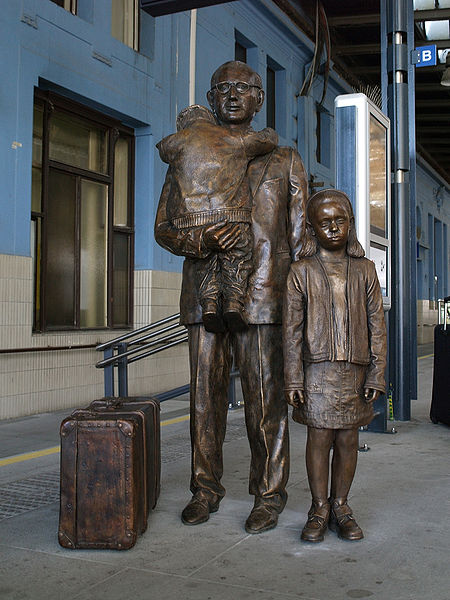
Nicholas Winton saved the lives of many Jewish children. His life is featured in the film One Life now showing in cinemas.

We all understand that fiction is fiction and that too often there are no happy endings. There is too much tragedy and that grieves us so. We live in the world where the strong rule over the weak, and where the weak, if they survive at all, continue to suffer. If only there could be a happy ending to all the unhappy endings.

And so we pray – for those who are poor, those who are sick, those in prison, those who are vulnerable. In our prayers we are looking for consolation for those for whom we pray. We are with Simeon whose eyes were fixed on the consolation of Israel, and we are with Anna in her conversations with those looking for the redemption of Jerusalem. We are with them looking for the happy ending for all those who have been wronged and for all those suffering in the state of things today.

We will do all in our power to help those who need our help. We will fight for better lives, happier endings. We gather our energies to make sure that the vulnerable do survive. We know they deserve their happy-ever-after and we will do all in our power to stop those who don’t care for the way it ends for them, the heartless beasts, the wolves, the tyrants.

Israel was suffering from heartless beasts. They were prey to wolves. Tyrants ruled them. They had a history of exile, persecution, oppression – a vast accumulation of trauma and tragedy. Simeon felt that. Anna felt that. And all those Anna spoke amongst felt that. That is why they were looking for the redemption of Jerusalem – a very different ending to the ignominious end which seemed to be their destiny.

Simeon knows there is a happy ending. He has seen it with his own eyes. He has held it in his arms. He has embraced the ending which will see many “fall” and many “raised”. The poor will be blessed. They will rise up. The beasts will be slain. This is the consolation of weak, occupied, isolated Israel. The consolation of Israel is the survival of the least, the last and the lost. The consolation of Israel is the humiliation of the beastly strong. The consolation of Israel is the child. The consolation of Israel is the vulnerability God takes to heart.

Not everyone knows that the Christmas season is a 40 day season in the liturgical year, just like Advent was and Lent is. The Christmas story ends with the presentation of Jesus in the temple. There is a Feast on February 2nd to celebrate this ending. That is the 40th day which churches keep on the Sunday before feb 2nd if they don’t keep weekday festivals. Our gospel reading is the reading for that 40th day.

There are many twists and turns in the Christmas story. There is the danger Mary is in by getting pregnant outside of marriage, there is the discomfort of the journey, there not being any room for them in Bethlehem, the threat to Jesus’ life from Herod, having to take flight to Egypt as refugees. All this is part of the story, let alone the battle between light and dark. There is a happy ending. Simeon finds the consolation Israel was searching for and Anna names their redeemer.

Musicals were playing in the background when I was finishing this sermon. The earworm was Love changes everything. It is love that changes everything. It is love that gives Charles Darwin and ourselves a happy ending. The happy ending is not the survival of the fittest. 

The happy ending is the unhappy ending for the villains (often the fittest, strongest, riches and most powerful). The happy ending is the survival of the people God loves – those so easily lost and so often last and least.

Luke 2:22-40
When the time came for their purification according to the law of Moses, they brought him up to Jerusalem to present him to the Lord (as it is written in the law of the Lord, ‘Every firstborn male shall be designated as holy to the Lord”), and they offered a sacrifice according to what is stated in the law of the Lord, ‘a pair of turtle-doves or two young pigeons.’

Now there was a man in Jerusalem whose name was Simeon; this man was righteous and devout, looking forward to the consolation of Israel, and the Holy Spirit rested on him. It had been revealed to him by the Holy Spirit that he would not see death before he had seen the Lord’s Messiah. Guided by the Spirit, Simeon came into the temple; and when the parents brought in the child Jesus, to do for him what was customary under the law, Simeon took him in his arms and praised God, saying,
“Master, now you are dismissing your servant in peace,
according to your word;
for my eyes have seen your salvation,
which you have prepared in the presence of all peoples,
a light for revelation to the Gentiles
and for glory to your people Israel.’

And the child’s father and mother were amazed at what was being said about him. Then Simeon blessed them and said to his mother Mary, ‘This child is destined for the falling and the rising of many in Israel, and to be a sign that will be opposed so the inner thoughts of many will be revealed – and a sword will pierce your own heart too.’

There was also a prophet, Anna the daughter of Phanuel, of the tribe of Asher. She was of a great age, having lived with her husband for seven years after her marriage, and then as a widow to the age of eighty-four. She never left the temple but worshipped there with fasting and prayer night and day. At that moment she came, and began to praise God and to speak about the child to all who were looking for the redemption of Jerusalem.

When they had finished everything required by the law of the Lord, they returned to Galilee, to their own town of Nazareth. The child grew and became strong, filled with wisdom; and the favour of God was upon him.

>Holocaust Memorial Day

>I have just been watching Nicholas Winton’s story on Channel 5. What a remarkable man – saving 669 children from Prague and the Nazis in the months leading up the war. The link to the programme is here

I have already done a post about him. Apparently he is not much in favour of Holocaust Memorial Day, saying that we don’t learn from the past – and that it is more important to develop ethics. He wants the world to be aware of other ethnic cleansings – interestingly they are included in this trailer of Untold Stories from the Holocaust Memorial Trust.

The Winton Train


Wow. The Winton Train arrives at Liverpool Street Station today – with passengers rescued from Prague 70 years ago – the train will be met by the person who masterminded the rescue – Nicholas Winton (pictured). Nicholas Winton is 100 years old.


Altogether he managed to rescue 669 children transporting them by train from Prague to Lon don. Most of them were Jewish children who otherwise would have become victims of the holocaust. They have become known as the Winton Children – and that family of 669 has now become a family of 5000. This was part of the Kindertransport rescue mission which began a few days after Kristallnacht (1938) when some British Jewish leaders petitioned the Prime Minister, Neville Chamberlain, to accept unaccompanied Jewish children from Europe to protect them from Nazism. Six million Jews were killed in the holocaust. A quarter of them were children.

Dagmar Simova is one of the Winton Children on the train. Her response to the question of what it felt like to be once again being on a train from Prague is on the Winton Train Project’s blog: “My mother, father and grandfather came to the station with me. We all wept. This time my husband and daughter came to see me off. When we waved, suddenly it struck me. I was looking at them, but again I saw those three.”

Nicholas Winton never mentioned anything about this. It only became known 50 years later when his wife, Elizabeth, came across some papers when she was cleaning out their attic.

People like Nicholas Winton are honoured in a memorial park in Prague called the Orchard of Saviours. It celebrates all who helped Jewish children at great cost to themselves. Four types of apple trees have been planted and the refurbished fountain has been named after Sir Nicholas Winton.

The Winton Train Project hopes to despatch another Winton Train with young people and their artworks inspired by goodness bound for other European cities, and that it become a tradition to commemorate the resilient determination of people to believe in goodness and actively take part in a common future.