Citizens of heaven behind enemy lines

A reflection for the 2nd Sunday of Lent on the readings, Psalm 27, Philippians 3:17-4:1 and Luke 13:31-end

If we were to get a tattoo, and if we were to choose from the texts of today’s readings, I wonder what you would choose? These are some of the words that are held at the heart of the church. I am sure many have tattooed over scars of harm and hurt some of the verses we’ve heard today. What are the words you would inscribe on your skin because you want to take them to heart?

It is the second Sunday in this season we have been given for repentance,
It’s time to look at ourselves,
to change our minds
and reimagine ourselves as children of God
and behave, as citizens of heaven.

It’s a time to look at ourselves,
not so much to remind ourselves that,
in the words of the psalmist,
we are fearfully and wonderfully made,
but to wonder at ourselves,

at the habits of our hearts and minds,
to ask ourselves why we are inclined to do this and that,
and when we do this or that,
whose side are we on?

Are we on the side of God,
are we on the side of the angels?
Or, are we on the side of those our scriptures
so loudly call out as enemies?

What are we like
when we are tired.
when we are hungry,
when we have too little to do,
when we have too much to do,
when we are in a confrontation,
when we are facing criticism,
when we are struggling with our finances,
or our health,
when we look at ourselves in the mirror,
when we’re alone
or when we are with certain others?
What are our responses?
What’s our inclination?

Are we inclined to be anxious,
or hateful,
or judgemental,
or selfish,
or proud?
Why? How?
How come so many voices got into our heads
to incline us to self-doubt?
Where did they come from?

What are the habits of our hearts?
What is our natural inclination?
Why? How?

What has spoiled us?
Who has spoiled us?
Why did they spoil us?
How did they spoil us?
What is spoiling us?
What is spoiling our lives?

Can we change?
Can we be born again, reimagining ourselves behaving differently?
Can we be saved from our harmful habits of our hearts and minds?
Can we lean another way?
Are we bound to be the way we are,
and to think the way we do?

These are urgent questions.
They’re getting more urgent by the minute
in these mean times which are so mean to those God puts first,
those who are last, the first victims
of our carelessness, pride and selfishness.

These are urgent questions,
more urgent by the minute
as we get older and our habits
more ingrained

We made a decision at some point in our lives to turn to Christ,
to be on his side and to be sided by him.
We are on his side. He’s on our side.
Side by side we go through our lives 

just as Jesus called it,
as sheep amongst wolves.

The deacon has the doubtful privilege of sending us out,
telling us to go in peace
to love and serve the Lord
wherever we go.

In the name of Christ, we go,
just as in the name of Christ
the deacon sends us
as sheep amongst wolves,
citizens of heaven
operating behind enemy lines.

Our scriptures today remind us of the enemy fire,
their stones pounding the prophets to death.
The Psalmist knows enemies amongst the wicked surround us to make trouble amongst us,
to make war against us, to spoil our life.

We feed each other with the news of enemies
(often neglecting those dark psychological forces within us)
and the devastation of their atrocities,
yet somehow we miss the heat of their fire,
the tragedy in their enemy power
preventing us from caring enough.

Only this week we heard how young children are becoming addicted to vaping. This is just one example of the powers that overwhelm us. How dare anyone put our children in harm’s way with the risks of nicotine addiction, risks to brain development, to concentration, to learning and to their overall wellbeing? These are just some of the enemies our children have to face – and need to be sheltered from.

This is our life, surrounded by enemies,
enemies around us and enemies within us,
forces within us inclining us more to fear and anxiety,
to competitiveness and spite,
to live more selfishly
to ignore the cries of the poor.


Our citizenship is in heaven.
Please note the present tense.
Our citizenship is in heaven.
It’s not “will be in heaven”,
our citizenship IS in heaven
and it is only the enemies of the people
who want to rob the present of its heaven.

We are citizens of heaven
and we live our lives behind enemy lines.

In Lent, we journey to Jerusalem with Jesus.
Jesus stays in the city, behind enemy lines.
He cries for the state of the city and what it does to people.
His cry is one of lament and longing.
He laments the killings and the stonings,
the violence and the injustice
and longs to provide shelter for those made vulnerable.

Where is our shelter?
Where is the shelter that Jesus longed for?
Where is the shelter we can join the psalmist in
in our days of trouble when we are surrounded
by enemy forces undermining us?

Here is my shelter. The Lord is my light and salvation,
proclaims the psalmist.
The Lord is the strength of my life,
of whom then shall I be afraid?

He has been my helper.
In all the days of my trouble
He has had me in his shelter.

Here is our shelter.
Look around, not at the walls, but at the people who love us,
in whom we have trust.
Within our hearing is the sound of heaven, the call of God and the love of Jesus,
in the hearing of our scripture,
in the talk that makes for peace
in the prayers which voice the longings
of citizens of heaven.

This is where we need to be to recover if ever we are going to be more than we are ever inclined to be by the enemy forcing us to hatreds, anxiety and despair.

The Lord is here, his Spirit is with us.
We are under the shelter of his wings.
Under his shelter, all the forces behind
the  I COULDN’T HELP ITS lose their power.

When we pray to our Lord in heaven,
who is so different from our everyday lords,
our overlords, warlords, empire builders and media moguls,
when we pray to our Lord God, the psalmist joins us,
the psalmist who knows the Lord his helper,
helping us, when,
because of the odds against us,
we just couldn’t help it,
helping us to change to be true citizens of heaven.

Will we put our hands together to pray?

3455167464_f04814b6a6_b

Every morning I, David, pray with Jews,
my brothers, my sisters. Their scripture
fallen into my hands, fills my mind,
names me. I take their prayers,
the longing of their psalms,
I hear their pain, share their dreams,
my amen I join to theirs.

And I regret every morning
I can’t pray with more distant relatives,
my brothers, my sisters, children of Hagar.
A step too far. What are their longings,
what are their dreams?
I pray, that as I pray, they pray,
with me, for me, amen.


The photo is by mrehan, found at https://www.flickr.com/photos/mrehan00/3455167464

Psalms and Their Wretched Authors and Readers

Foxes Book of Martyrs 1851I have been thinking increasingly that the Psalter has fallen into the wrong hands – into my hands, and that, in my hands,  those who Frantz Fanon referred to as The Wretched of the Earth have been betrayed
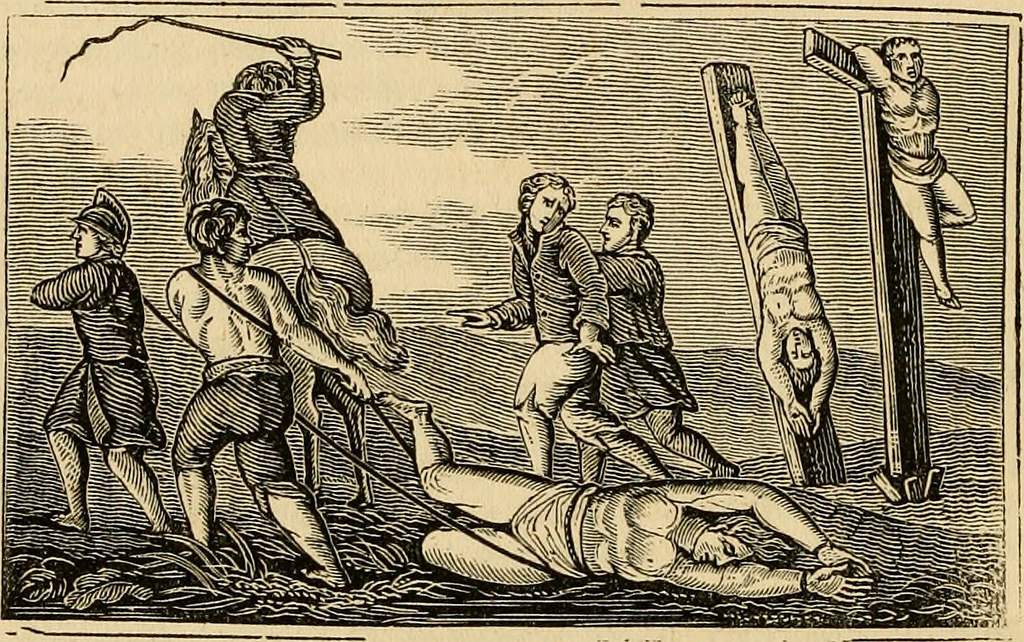
The psalmists (I’m assuming many, or at least several) describe the wretchedness of their lives. Take the psalm appointed for today (March 31st), Psalm 102 as an example. The psalmist talks about her/his crying and distress. S/he isn’t just downhearted, but is smitten-down-hearted. Her enemies rage at her all day and every day and have ganged up on her to bully her. S/he is alone, hungry and thirsty. This is how s/he pours out the wretchedness of her situation:

Hear my prayer, O Lord;
    let my cry come to you.
Do not hide your face from me
    on the day of my distress.
Incline your ear to me;
    answer me speedily on the day when I call.

For my days pass away like smoke,
    and my bones burn like a furnace.
My heart is stricken and withered like grass;
    I am too wasted to eat my bread.
Because of my loud groaning
    my bones cling to my skin.
I am like an owl of the wilderness,
    like a little owl of the waste places.
I lie awake;
    I am like a lonely bird on the housetop.
All day long my enemies taunt me;
    those who deride me use my name for a curse.
For I eat ashes like bread,
    and mingle tears with my drink,
10 because of your indignation and anger;
    for you have lifted me up and thrown me aside.
11 My days are like an evening shadow;
    I wither away like grass.

But this isn’t self-pity: the psalmist is just telling it like it is. There is no room for self-pity because the psalmist knows God and his history. He knows that he turns to the prayer of the destitute, that he hears the sighs of the prisoner. This is an uprising of prayer and outpouring of trust that her enemies will be short-lived while “the children of your servants shall continue, and their descendants shall be established in your sight”.

This is a prayer of the down-hearted and an act of defiance in the face of her enemies. It is but one page of a prayer book that comes from the hands of those who have fallen on hard times and belongs in their hands. I am sorry to have snatched it from them. I hope I don’t take their words from them, and that I might hear their lament and join their Amen.

This is how this prayer (Psalm 102) turns out, from hard pressed people to their God:

12 But you, O Lord, are enthroned for ever;

    your name endures to all generations.
13 You will rise up and have compassion on Zion,
    for it is time to favour it;
    the appointed time has come.
14 For your servants hold its stones dear,
    and have pity on its dust.
15 The nations will fear the name of the Lord,
    and all the kings of the earth your glory.
16 For the Lord will build up Zion;
    he will appear in his glory.
17 He will regard the prayer of the destitute,
    and will not despise their prayer.

18 Let this be recorded for a generation to come,
    so that a people yet unborn may praise the Lord:
19 that he looked down from his holy height,
    from heaven the Lord looked at the earth,
20 to hear the groans of the prisoners,
    to set free those who were doomed to die;
21 so that the name of the Lord may be declared in Zion,
    and his praise in Jerusalem,
22 when peoples gather together,
    and kingdoms, to worship the Lord.

23 He has broken my strength in mid-course;
    he has shortened my days.
24 ‘O my God,’ I say, ‘do not take me away
    at the mid-point of my life,
you whose years endure
    throughout all generations.’

25 Long ago you laid the foundation of the earth,
    and the heavens are the work of your hands.
26 They will perish, but you endure;
    they will all wear out like a garment.
You change them like clothing, and they pass away;
27     but you are the same, and your years have no end.
28 The children of your servants shall live secure;
    their offspring shall be established in your presence

The image is from The Book of Martyrs, John Foxe, 1516-1587, Goodrich, Charles, 1790-1862.

Take a look at this poor, wise man: reflecting on Ecclesiastes 9

img_0012
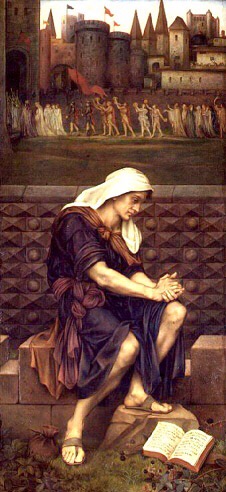
The Poor Man who Saved the City by Evelyn de Morgan (1901)

Like Qoheleth I am rather taken by the poor man in the city. It was a small city with only a few inhabitants. It was besieged but there was one man, a poor and wise man, who, by his wisdom delivered the city.

Not a lot of people know this man. He’s not someone I’ve ever noticed before, but he is there, highlighted in one of the less read books of the Old Testament, Ecclesiastes 9:14f. He doesn’t have a name. His story is told in not so many words:

There was a little city with few people in it. A great king came against it and besieged it, building great siegeworks against it. Now there was found in it a poor, wise man, and he by his wisdom delivered the city.

Like Qoheleth (the Teacher), I want to honour this man and the poor, wise men and women like him, who save their cities (our cities) from destruction by greed, speed and countless other destabilising and dehumanising forces. They are the salt of the earth, far removed from what we refer to as the typical “city gent”. We know he is not well-heeled and we know that he is care-worn (because his wisdom is forged from the attention and care he gives – and that is demanded of him in the challenge of just managing). These are the people we can turn to in times of trouble. They will hear us out, they will offer their wisdom. They become the heart (anagram of earth) of our communities and the springboards to trust and confidence.

But they are so often overlooked. This man reminds me of R.S.Thomas’s “friend”, Iago Prytherch – another man who would have gone unnoticed were it not for Thomas drawing him to our attention. Prytherch is down to earth, hard-working, more peasant than citizen, with an earthly wisdom. Thomas writes in Green Categories:

You never heard of Kant, did you Prytherch?
A strange man! What would he have said
Of your life here, free from the remote
War of antinomies: free also
From mind’s uncertainty faced with a world
Of its own making?
Here all is sure:
Things exist rooted in the flesh,
Stone, tree and flower. Even while you sleep
In your low room, the dark moor exerts
Its pressures on the timbers. Space and time
Are not the mathematics that your will
Imposes, but a green calendar
Your hearts observes; how else could you
Find your way home or know when to die
With the slow patience of the men who raised
This landmark in the moor’s deep tides?

His logic would have failed; your mind too.
Exposed suddenly to the cold wind
Of genius, faltered. Yet at night together
In your small garden, fenced from the wild moor’s
Constant aggression, you could have been at one
Sharing your faith over a star’s blue fire.

I don’t want to say that this man is Christ (because that might prevent us celebrating the ordinary people in ordinary places using their hard won wisdom for the welfare of the city), but I do want to say that man is Christ-like, and that Jesus too was poor and saves the city.

These are the people who are blessed. That is not an idle saying of Jesus (Luke 6:20). The blessing has substance and content, including wisdom that bears so much fruit. These are the people we hear praying in the Psalms. I think Isaiah is talking of a similar poor man in the city when he writes:

He will not cry or lift up his voice,
or make it heard in the street;
a bruised reed he will not break,
and a dimly burning wick he will not quench;
he will faithfully bring forth justice. (Isaiah 42:2f)

I want to remember that poor man and those men and women like him. Qoheleth writes, “No one remembered that poor man … the poor man’s wisdom is despised, and his words are not heeded.” He continues,

The quiet words of the wise are more to be heeded
than the shouting of a ruler among fools (Ecclesiastes 9:17)

But that is the world’s way – to be taken in by the vanities of the rich and powerful. We remember them (we name estates and prizes after them) and forget the poor (and the wisdom of their deep knowledge) – that’s if we ever notice them in the first place.

The Poor Man who Saved the City by Evelyn de Morgan is © De Morgan Collection, courtesy of the De Morgan Foundation, www.demorgan.org.uk