Saints and Stains – a sermon for All Saints Sunday

Some churches celebrate All Saints on the Sunday following All Saints Day (November 1st). Here’s a sermon for All Saints Day for our troubled times inspired by the gospel of the day is Matthew 5:1-12, itself a sermon for troubled times.

November 5th 2023

This is how to start a sermon.

How blessed are you who are poor in spirit, for yours is the kingdom of heaven.

There are two clauses in that first sentence – if you like, two lines. We could read between the lines “and those who aren’t aren’t” because Jesus is singling out communities and people who are poor in spirit. Theirs, and only theirs is the kingdom of heaven. 

So reading between the lines of that first beatitude we would have, “How blessed are you who are poor in spirit”, and then brackets (“and those who aren’t aren’t”). But then that doesn’t sound like the gospel until we add another line such as “but grace can change that”. 

I thought we would read the gospel again – reading between the lines. Could one side of the church say between the lines these five words: “and those who aren’t aren’t” with the other side of the church following on with the other five words: “but grace can change that”?

Let’s see how it translates:

  1. How blessed are you who are poor in spirit
  2. (and those who aren’t aren’t)
  3. (but grace can change that)
  4. for yours is the kingdom of heaven
  1. How blessed are the sorrowful and those who mourn
  2. (and those who aren’t aren’t)
  3. (but grace can change that)
  4. for you will be comforted.
  1. How blessed are you who are meek
  2. (and those who aren’t aren’t)
  3. (but grace can change that)
  4. You will inherit the earth
  1. How blessed are you who hunger and thirst after righteousness
  2. (and those who don’t aren’t)
  3. (but grace can change that)
  4. You will be filled
  1. How blessed are you who are merciful
  2. (and those who aren’t aren’t)
  3. (but grace can change that)
  4. Mercy will be shown to you
  1. How blessed are you whose hearts are pure
  2. (and those who aren’t aren’t)
  3. (but grace can change that)
  4. You will see God
  1. How blessed are you who are peacemakers
  2. (and those who aren’t aren’t)
  3. (but grace can change that)
  4. You are true children of God

……………….

The kingdom of heaven isn’t a heavenly space into which the poor in spirit move when they die. The kingdom of heaven isn’t so much a space as a rule. Theirs is the kingdom of heaven because they accept, follow and love the rule of heaven which puts the last first and the first last. They accept, follow and love the rule of heaven on earth.

The Beatitudes has been chosen by the church to celebrate this All Saints Sunday. Across the world, across denominational divides worshippers will be hearing this gospel. 

The passage tells us something important about the saints, and that is that life doesn’t look too good for those Jesus blessed. They were not squeaky clean. They were not like the unsullied in Game of Thrones. They were not untouched by what was going on around them. 

They were in the thick of it, suffering in the thick of it, hoping and praying in the thick of it. Jesus’ blessing comes in the thick of it. Blessed are those of you who mourn – those of you who are upset by the way things are, those who grieve for what’s been lost, those of you who are crying.

Those of you crying out for justice, who hunger and thirst for righteousness, those of you crying because of persecution. These people are in the thick of it, just as God’s kingdom people have always been in the thick of it, suffering trouble and troubled to their heart. 

God’s kingdom is not for the so-called innocent bystander or those who pass by on the other side – it’s for those who get involved in the politics of the gutter, both victims and helpers.

When we gather to hear Jesus’ preaching we join the crowd listening to his sermon begun with his blessings. There, on the mountain, is the throne of God, the majesty of God in the words of grace, blessing, encouragement and love. In Revelation  chapter 7 there is one who looks and marvels at the huge multitude of people around the throne of God. As this one looked he saw that there were people from every nation, from all tribes and peoples and languages. What they had in common was that they had all come through a great ordeal, they had come through the thick of it.

In my mind I gave this sermon the title of Saints and Stains. The author of Revelation sees the multitude robed in white – and that is the way we usually picture them in our stained glass – well dressed. The reality is very different. They’ve been through a great ordeal.They’ve been in the thick of it. They are blood stained, wounded. Their clothing is dishevelled and ripped. They’ve walked the refugee trails. They’ve cared for loved ones to their wit’s end. They’ve been bullied and taunted. They’ve been through great ordeals. What do we expect them to look like?

Here’s what St Paul says of himself and his travelling friends. “We are afflicted in every way, but not crushed; perplexed, but not driven to despair; persecuted, but not forsaken; struck down, but not destroyed… We do not lose heart. Even though our outer nature is wasting away our inner nature is being renewed day by day.” (2 Cor 4)

Not all of us face great ordeals but so many in the world are in the thick of it struggling to get food, keep warm, find rest in the midst of war, famine, flight, poverty, prejudice and health issues. Life is difficult. The challenge and call is about how we live in the thick of it and how we help and care. 

Those first hearers of Jesus’ preaching heard their blessing in their troubled times, in their troubled hearts, while they were in the thick of it, as ones going through great ordeals. How blessed are you who show mercy. How blessed are you who make peace. In the thick of it there is Jesus’ blessing. In the ordeals of the here and now, not pie in the sky when you die, there is the blessing of Jesus who himself is in the thick of it – (who, incidentally, on the throne of God, with a mock crown of thorns pressed on his head by crucifiers until his blood poured looks remarkably like the ram or lamb caught in the thicket as the sacrifice God provides in the story of Abraham and Isaac and the suffering servant pictured by Isaiah).

It was in the thick of it that Jesus knew his own blessing. It is in the thick of it that Jesus’ blessing has been heard down the ages.

A friend’s suggestion was for all of us to identify people who fit these blessings we call the beatitudes. For example, who would we single out as those in the thick of things who hunger and thirst after righteousness? ………….. These people would be our communion of saints.

We can take that further. Not only naming the poor in spirit, the mournful, the persecuted, but also joining Jesus in their blessing, growing our appreciation, our encouragement and our love for the work they do and the way they are, as well as appreciating, encouraging and loving them in the state they are in, in the thick of great ordeals. What would it be to be a church broken and gracious, hearing and  knowing God’s blessing in the thick of things while all the time joining the prayer of others in their ordeals?
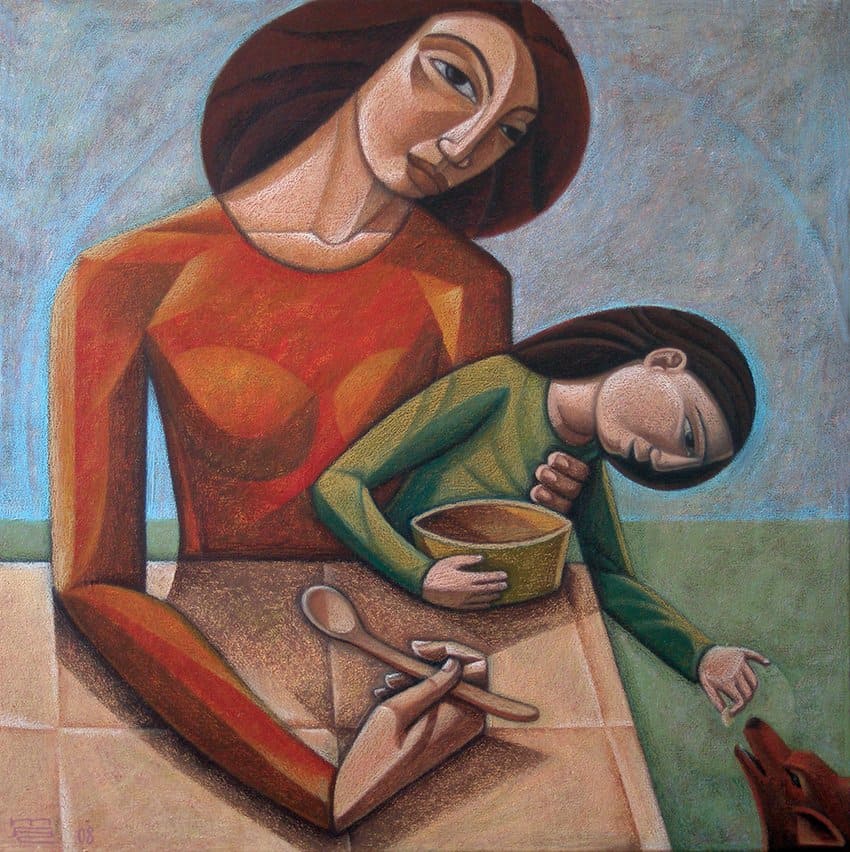
Blessing the small, the least, the last and all those suffering empire.

A sermon for Trinity 20A. I focus on Jesus takes a people bruised and battered by empires to a whole new realm. The readings are printed below. They were Isaiah 45:1-7 and Matthew 22:15-22. It was the emperor in each of the readings which first grabbed my attention.

October 22nd 2023

My Bible

These are the writings of a bruised and battered people who have lived through the worst of times.

This is the reading of a bruised and battered people.

This is their literature. They have treasured it. They have handed it on for the sake of other bruised and battered people.

As always our scriptures are brought to us by a troubled people. It is a troubled people, inspired in the Spirit of God who have chosen the scriptures we inherit and hand on. It is a troubled people who have treasured them and bottled them for us because they have been a a very present help in times of trouble.

They are a people who have had all kinds of suffering inflicted upon them by dominating empires, from slavery in the hands of the Egyptian empire, to destruction of their institutions, to exile, persecution and occupation by the Assyrian, Babylonian, Greek and Roman empires. Their imperial domination, at various times, took their labour, their homes, their institutions, their land, their networks, their lives. Our scriptures give us the very best trauma literature and survival resources. 

For those dominated by powers which are not their own there is always the question, “how do we get through this?”

This morning’s readings, brought to us by a traumatised people feature two emperors. In the red corner we have Cyrus whose Persian empire survived a mere 7 years in the 6th century BC. He is the golden boy amongst emperors. He shows us that it is possible for those rich in power to enter the kingdom of heaven by allowing God to take his hand (and arms) to dismantle empire and repair its damage. He is called the Lord’s anointed in our reading from Isaiah – provides a happy and short interlude.

In the blue corner we have the unnamed Caesar, the Roman emperor. 

The question the unlikely alliance of Herodians and Pharisees ask Jesus is a trick question. The answer Jesus gives isn’t a simple “pay your taxes”. It’s a trick answer. Pay Caesar what is his. What is his? What is rightfully the emperor’s in a land which he has taken from others. It’s a trick question with a trick answer. Underlying both is that harder question of how do we live with this overwhelming, stifling foreign power?

When we read our scriptures we are always bumping into emperors and hearing of the troubles and damage that they bring. That is the context.

I don’t know whether you will agree with this assessment of our own context – that most of us have shared the benefits and privileges of empire, that we might feel uneasy in the aftermath of empire, uncomfortable about what we might have taken from others and unsure about how we begin to repair the damage. 

Empire is always our context. They are built all around us. We may be one of their builders. The superpowers operate imperial models. There are global empires like Amazon and Google (and who should they pay taxes to?) There are the media empires and their hidden persuaders with their bots affecting our habits and views. These are large empires. There are other empires operating the other side of the law – the drug cartels with their barons, the warlords, people traffickers, as well as the little empire builders we see around us. Mr Big always brings favours to some and trouble to many. He is always self serving.

This is our context. And this is the context for Jesus’ teaching about a kingdom and way of life so radically different from the ways of empire. Jesus was tempted by the ways of empire – world domination, stunts and political popularity were not going to be his way. He saw the devil in them.

Instead he helped his followers explore a different realm – a realm in which there is no domination and only amazing grace. To these troubled people Jesus offered an alternative vision of hope. He opens up a kingdom in which everything is small and vulnerable rather than mighty and impregnable.

He casts around for images that we will all understand. To what shall I liken the kingdom of heaven?  To people so often belittled by empires, to people who can so easily be lost or disappeared, to a people whose lives are hidden and voice unheard he likens the kingdom to things that are hardly noticed and that can so easily disappear. Like the mustard seed, the smallest of all seeds. Like the leaven folded into the loaf. Like the scattering of seed.

He trains our eye on the birds of the air and the lilies of the field and says there is no glory in empire, nothing like the glory of the lilies of the field. To those who have little, he shows what can be done with little – feeding 4000, feeding 5000.

He turns the world’s rule upside down by saying to those used to coming last that the rule of his kingdom is that the last come first and the first come last. He turns the world upside down by putting children central to the kingdom of heaven, the qualification for entry being that we have to become small and just like a child.

We love to remember that the son of God came to us as smaller than a child, a baby. The teaching he shares is his learning to be a child. In John’s gospel, Jesus teaches that we have to be born again, to seize the opportunity of a second chance of being children. 

In that gospel Jesus is just a ray of light that shines in overwhelming darkness, the word of God in edgeways. The words that come to mind when we think of God’s kingdom – if we have learned anything from Jesus – is small and vulnerable.

Maybe it is only as I have retired from the church’s institutions and put some distance between myself and the systems and thinking which mimic the ways of empires and powers, that I have seen, as if for the first time, that the kingdom of heaven is only to be understood in things small, hidden and vulnerable, and that the kingdom of heaven is for those who are the last and least chosen in the kingdoms of this world – for the hidden and vulnerable, and for those who are prepared to make themselves small for the sake of the kingdom.

I have noticed this particularly in this year’s successive gospel readings from Matthew.

At the beginning of his gospel Matthew gives us a name for Jesus, Emmanuel. That name means “God with us”. At the end of his gospel he gives us a promise to remember. “I am with you always, to the end of the age.” He shows the battered, bruised and bloodied people the battered, bruised and bloodied face of Jesus – joined with them in their suffering – and he shares Jesus’s blessing of them.

How blessed are you who are poor in spirit – yours is the kingdom of heaven.

How blessed are you who mourn – you will be comforted.

How blessed are you who are meek – the earth will be yours.

How blessed are those of you who hunger and thirst for righteousness. You will be well satisfied.

How blessed are you who are merciful. Mercy will be shown to you as to no other.

How blessed are the pure in heart. You will see God in the smallest and most vulnerable.

How blessed are those of you who are persecuted. Yours is the kingdom of heaven.

This is the blessing of a bruised and battered community. Today we join them in reading their scripture, in their prayer, in their struggles, in their blessing and in the kingdom prepared for them.

Isaiah 45:1-7

Thus says the Lord to his anointed, to Cyrus,
whose right hand I have grasped
to subdue nations before him
and strip kings of their robes,
to open doors before him –
and the gates shall not be closed:
I will go before you
and level the mountains,
I will break in pieces the doors of bronze
and cut through the bars of iron,
I will give you the treasures of darkness
and riches hidden in secret places,
so that you may know that it is I, the Lord,
the God of Israel, who call you by your name.
For the sake of my servant Jacob,
and Israel my chosen,
I call you by your name,
I surname you, though you do not know me.
I am the Lord, and there is no other;
besides me there is no god.
I arm you, though you do not know me,
so that they may know, from the rising of the sun and from the west, that there is none besides me;
I am the Lord, and there is no other.
I form light and create darkness,
I make weal and create woe;
I the Lord do all these things.

Matthew 22:15-22

Then the Pharisees went and plotted to entrap him in what he said. So they sent their disciples to him, along with the Herodians, saying, “Teacher, we know that you are sincere, and teach the way of God in accordance with truth, and show deference to no one; for you do not regard people with partiality. Tell us then, what you think. Is it lawful to pay taxes to the emperor, or not?” But Jesus, aware of their malice, said, “why are you putting me to the test, you hypocrites? Show me the coin used for the tax.” And they brought him a denarius. Then he said to them, “Whose head is this, and whose title?” They answered, “The emperor’s”. Then he said to them, “Give therefore to the emperor the things that are the emperor’s, and to God the things that are God’s.” When they heard this they were amazed, and they left him and went away.

Crumbs, the Canaanite woman is a faith leader!

11th Sunday after Trinity

It’s the Canaanite woman who catches the eye of the church on the 11th Sunday after Trinity (A). “Crumbs!” was what I said when I read the story from Matthew 15 as if for the first time. So Crumbs remains the title for this reflection/sermon.

Crumbs

On the one hand there’s the bread from the feeding of the 5000 (12 baskets worth) and on the other hand there’s the bread from the feeding of the 4000 (7 baskets worth) and between there are the crumbs that are more than enough for the Canaanite woman in this morning’s gospel. 

Today’s gospel, showing the growing tension between Jesus and the Pharisees and the great faith of the Canaanite woman is sandwiched between the feeding of the 5000 and the feeding of the 4000.

“Woman, great is your faith” is what Jesus finally notices about the Canaanite woman the disciples wanted to silence, send away and have nothing to do with. She may have only been a dog in the pecking order but she knew that she would be satisfied with the crumbs that fell from the table. Great is her faith in any crumb that falls from the hand of Jesus.

In contrast the disciples thought that they would never have enough to feed the five thousand (as well as women and children) or the four thousand (as well as women and children). They say before the feeding of the 5000: “We have nothing here but five loaves and two fish”. And before the feeding of the 4000 they want to know “where are we to get enough bread in the desert to feed so great a crowd?” Jesus had to show them. They would never have believed that there would be 12 baskets left over from feeding 5000, or 7 baskets left over from feeding 4000.

I dare say that most of us fall into the same boat as those first disciples. Common sense is enough to know that five loaves and two fish are never going to be enough for 5000, and seven loaves and few small fish are never going to be enough for 4000. Can we ever believe that so little can go so far?

We perhaps have little faith in such miracles.

In the same boat, when the storm was blowing a gale, Jesus notes the “small faith” of his disciples. “Why are you afraid, you of little faith?” (Matthew 8:26).  Seemingly they had such little faith in him that they thought they were all going to drown together. It almost seems as if this is what Jesus called his disciples; “You of little faith”.

In the sermon on the mount, Jesus said “if God so clothes the grass of the field, which is alive today and tomorrow is thrown into the oven, will he not much more clothe you – you of little faith?” (Matthew 6:30)

When Peter realised he wasn’t walking on water Jesus reaching out to rescue him said, “You of little faith, why did you doubt?”

When the disciples were worried that they had forgotten to take bread with them Jesus said, “You of little faith, why are you talking about having no bread?” (Matthew 16:8)

You might expect those first disciples to have great faith but they remain the ones of little faith. They have “little faith” and are slow to understand. In today’s gospel Jesus asks Peter, “Are you still without understanding?

As for the religious leaders, it would be reasonable to expect that they would have great faith. These are the religious leaders of Israel we are talking about. But they have no faith in Jesus at all. “Blind guides” and “hypocrites” is what Jesus calls them. Their concern was the keeping of rules – all 613 of them were to be kept at any cost. They were offended by Jesus’ attitude toward washing hands before eating and were more concerned about what came out of people’s bottoms than mouths. (If everyone had to wash their hands before eating then the 5000, the 4000 (plus women and children) would have remained starving. The feeding would have been impossible.)

The only faith the Pharisees had was in a god who demanded obedience and required people to do x, y and z and follow every letter of the law. They had no faith in a gracious God. They looked for offences. Tragically there are still religious leaders who have no faith in a gracious God and who are looking for offences. They too are blind guides and hypocrites. And they are frightening.

Jesus had to go a long way to find great faith. He had to leave Israel. He left that place and went away to the district of Tyre and Sidon. Tyre and Sidon are a long way out. They’re in what is now known as Lebanon. They were beyond the pale. Jesus probably went there with his disciples to get away from the pressure building from the Pharisees – he was wanting some space.

And then this Canaanite woman came to him.
She knew precisely who he was and she knew exactly what he could do.
He was the Lord and son of David.
He was the one who would show her mercy.
He was the one to help her daughter.

But she was a woman.
She was a foreign woman, a despised Canaanite.

And she shouted.

The disciples wanted Jesus to send her away.
They didn’t want to hear anything from her. 

What a good job Jesus resisted, because otherwise he would never have discovered her great faith. 

And nor would we.

It was only through what some people now call “radical listening” that Jesus found what he probably wasn’t expecting to find. Radical listening is a discipline which allows the other person their say and hearing. The discipline involves removing our personal biases which bias us to listen to the people we are most used to hearing, and like hearing from. It’s about giving the mic to those who are often silenced and taking it away from those who jealously guard it.

Jesus allowed her the mic, and Matthew’s gospel provides the amplifier, amplifying her “great faith”. This Canaanite woman was a faith leader for Jesus and for Matthew. I wonder why she hasn’t remained so. Her “great faith” is what Jesus was working towards for his disciples as he continued to teach them about the way of faith and the graciousness of God.

Her “great faith” is such a contrast to those “of little faith” and those who had no faith in Jesus. She echoes the prophetic voice which insists that no faith is to be found where it is expected – for example, in the Temple, or the religious leaders, the Pharisees and scribes and the keepers of tradition. No “great faith” is to be found in Israel. Only some “little faith” – which little faith is carefully nurtured by Jesus.

Great faith is found elsewhere, where it is not expected, beyond the pale, in foreign bodies. It is found through radical listening which shushes our biases so that we hear the voice of others (perhaps for the first time), their stories, their journeys, their faith. We might be outraged like the disciples (those of little faith). That woman did SHOUT, but people need to shout if they’re not being heard, particularly when they so need help. They often need to get their rage out, which may come across as outrageous. 

At our moment in history it is refugees who are shouting and struggling to be heard. It is the planet which is shouting, struggling to be heard – their claims being too easily dismissed as outrageous, their voices being too easily silenced. We need to be disciplined to hear those made to suffer in silence.

The Canaanite woman, our great faith leader, is key to the door that opens up mission everywhere. Matthew lets his gospel rest with the great commission to go and make disciples of people everywhere, baptising them in the name of the Father, the Son and the Holy Spirit, and opening the way of faith to them. 

The mission of God has always been a mission to overcome boundaries. We’ve heard that this morning from our reading from the prophet Isaiah in the promise to bring all the foreigners who join themselves to the Lord to the holy mountain, to make them joyful in the house of prayer, which will be forever known as a house of prayer for all people, says the one who gathers those cast out by Israel.

The story of the Canaanite woman is sandwiched between the feeding of the 5000 and the feeding of the 4000, between the feeding of the 5000 tired, radical listeners and the crowd of 4000 including the lame, maimed, blind and mute on whom Jesus had compassion.
She was prepared to eat the crumbs which fell from the table.
In communion we join her, her great faith.
In communion we join her to the 5000 and the 4000.
In communion we join her great faith even with the little faith we may have in the gracious God Jesus is showing us.

Isaiah 56:1, 6-8
Thus says the Lord:
maintain justice, and do what is right,
for soon my salvation will come,
And my deliverance be revealed.
And the foreigners who join themselves to the Lord,
to minister to him, to love the name of the Lord,
and to be his servants,
all who keep the sabbath and do not profane it,
and hold fast my covenant –
these I will bring to my holy mountain,
and make them joyful in my house of prayer;
their burnt-offerings and their sacrifices
will be accepted on my altar;
for my house shall be called a house of prayer
for all peoples.
This says the Lord God,
who gathers the outcasts of Israel,
I will gather others to them
besides those already gathered.

Matthew 15:10-20, 21-28

Then he called the crowd to him and said to them, ‘Listen and understand. It is not what goes into the mouth that defiles a person, but it is what comes out the mouth that defiles.’ Then the disciples approached and said to him, ‘Do you know that the Pharisees took offence when they heard what you said?’ He answered, ‘Every plant that my heavenly Father has not planted will be uprooted. Let them alone; they are blind guides of the blind. And if one blind person guides another, both will fall into a pit.’ 
But Peter said to him, ‘Explain this parable to us.’
Then he said, ‘Are you still without understanding? Do you not see that whatever goes into the mouth enters the stomach, and goes into the sewer? But what comes out of the mouth proceeds from the heart, and this is what defiles. For out of the mouth come evil intentions, murder, adultery, fornication, theft, false witness, slander. These are what defile a person, but to eat with unwashed hands does not defile.’

Jesus left that place and went away to the district of Tyre and Sidon.
Just then a Canaanite woman from that region came out and started shouting, ‘Have mercy on me, Lord, Son of David, my daughter is tormented by a demon.’ But he did not answer her at all. And his disciples came and urged him, saying, ‘Send her away, for she keeps shouting after us.’ He answered, ‘I was sent only to the lost sheep of Israel.’ But she came and knelt before him, saying, ‘Lord, help me.’ He answered, ‘It is not fair to take the children’s food and throw it to the dogs.’ She said, ‘Yes, Lord, yet even the dogs eat the crumbs that fall from their master’s table.’ Then Jesus answered her, ‘Woman, great is your faith! Let it be done for you as you wish.’ And her daughter was healed instantly.

Image credit: Michael Cook, “Crumbs of Love” http://www.hallowed-art.co.uk/twelve-mysteries-2/

Mission that ends ends: preaching from Ascension to Pentecost

This is a sermon preached at Holy Trinity, Leamington for Easter 7(A), the Sunday between Ascension and Pentecost. (I am hoping it will be the first in a series of reflections inspired by readings from the Book of Acts.)

The text is Acts 1:6-14.

When we were finding our way round, when we moved to Leamington nearly two years ago, people kept telling us, “you don’t want to go to Coventry”. 

Apologies to those of you who live in Coventry. Never mind. People will be flocking to Coventry if they beat Luton in the play off final next Saturday, possibly taking the place of my team in the Premier League.

It was a punishment to be “sent to Coventry*. Being sent to Coventry meant people turned their back on you, refused to talk to you, shunned you. 

The origin of the sentence probably dates back to the 1640’s to the English Civil War. Royalist troops captured in Birmingham were taken as prisoners to Coventry which was a parliamentarian stronghold. They were not received warmly by the locals. That’s what happened when they were sent to Coventry.

Samaria from this morning’s reading is the Coventry of its day. “You don’t want to go to Samaria” would have been the equivalent for the Jewish people who found a way round Samaria rather than going through it. Part of the power of the parable of the Good Samaritan is that the hero is a Samaritan and that there was a Samaritan that could be called good.

But Jesus puts Samaria on the mission map, along with everywhere else that was considered off limits.

According to Luke, these are the last words of Jesus before his ascension: You will receive power when the Holy Spirit comes on you; and you will be my witnesses in Jerusalem, and in all Judea and Samaria, and to the ends of the earth.

Yes – to Samaria, and to the ends of the earth!

Before this, the disciples ask Jesus this question: Lord, is this the time when you will restore the kingdom to Israel? Jesus refuses to give a direct answer. It was an old question, reflecting the old troubles of nationalism brought on by too narrow a view of God’s love. 

Instead of a direct answer to their question, Jesus gives them his last word: a promise of power as witnesses, not just in Jerusalem and Judea, but even in Samaria, and to the ends of the earth.

These last words of Jesus are the first words in the beginning of the church’s missionary journey, a journey which takes us further that we could ever imagine, and a journey which undermines any boundaries which prevent God’s love reaching where God desires, to the ends of the earth.

To the ends of the earth – that is beyond the boundaries, the borders and margins of our current imaginations, undermining any attachment to nationalism, undermining the certainties and conservatism of our belief systems. Guy Garvey of Elbow sings (in Come On, Blue), love transcends anything that ever ends. Love transcends anything that ever ends, including the ends, limits, boundaries set by our imaginations and culture. 

Jesus’s words, to the ends of the earth, would be far too one-dimensional if we were only to think geographically about the extent of God’s mission, as if the first disciples had a map of the world at their disposal.

To the ends of the earth is about love’s reach. Think sociologically, think psychologically, not just geographically, think musically, think any way you can – to the ends of the earth, as far as your eye can see, and further – that is where the love of God goes, that is where the love of God comes again and again.

Think psychologically about the ends of the earth, those who are on the very edge, those in the darkest places, those in self harm’s way, those bombarded with cruel internal voices – this is where God’s love goes.

Think as peacemakers – or, better, live as peacemakers. Who have we made enemies? This is where God’s love takes us.

Think socio-economically about the ends of the earth. Who are in the margins? Who’s all at sea unable to make safety on land? To the ends of the earth – encompassing all ages, including children and young people (and it was good to hear about our partnership with Thrive from Ryan last Sunday), including those in their dying days. To the ends of the earth – encompassing enemies, strangers and those we’ve thought beyond the pale. Think the extent from cradle to grave, from prison cell to hospice bed, from palace to hovel, this is where God’s love goes.

To the ends of the earth is the scope of God’s love and the measure of God’s desire. Love isn’t just for Israel but for everyone in God’s creation. Love reaches far beyond our borders and boundaries, undermining those borders and boundaries, challenging wherever we draw the line between who’s ruled in and who’s ruled out, who’s right and who’s wrong.

The Book of Acts is often described as a book of beginnings. Our reading comes from the beginning of this book of beginnings. They are Jesus’ last words which become the first words of mission. To the ends of the earth – anything less doesn’t do justice to the desire and power of God. These are Jesus’ last words which last till the end of time, to the ends of the earth.

Acts reports the early days of mission, on the troubles Jesus’ followers got into on this journey. In the beginnings of this mission Luke shows us all the old certainties being cast to the wind, to the violent wind of Pentecost. He excitedly shows us people of all sorts being joined by the Holy Spirit, their differences and disputes being resolved by the wisdom and love which constitute God’s mission. 

He shows us what these first words of mission means as he spotlights the boundaries undermined by God’s mission and those affected by them. These include boundaries of gender, sexuality, ethnicity, class and religion.

Love still struggles against the same borders and boundaries we see beginning to be undermined in Acts, which is why I suggest these days of our lives are still the first days of mission. 

This is the beginning where we have to cast our old certainties to the wind, one of the old certainties being that we aren’t fit for such a tall order of mission. Who am I for such a thing? We are bound by the voices which say we’re not good enough, we’re not clever enough and we know we’re not confident enough.

BUT. Luke tells the story of two men in white who ask the disciples, “why do you stand here looking at the sky”. The disciples had seen Jesus ascend, they’d seen him go. But they kept on looking where he’d gone, where he was no more. The two men in white redirect the gaze of the church. They’re saying, don’t look where he’s disappeared, look for where he comes again.

It’s seeing where he comes again which encourages us and heartens us. 

It is when we see him coming again as we break bread together, as we listen for his word in preaching, teaching and prayer, as we see the wonderful work of reconciliation that we become inspired for the joy of mission, and joined by

the Spirit who makes herself known as the strengthener, the encourager and the comforter, empowering us to reach beyond our comfort zone.

We never know how we are going to be turned out. There isn’t one way of joining mission. There’s no stereotype. 

Paraphrasing Paul, there’s a whole variety of gifts, there’s a whole variety of services, there’s a whole range of activities in the mission of God so some of us will turn out to be wise counsellors, others will become healers, others will have gifts for administration, some will become great encouragers, some will become teachers, or nurses, or the sort of heartening person we are always delighted to meet on our streets, or the shy person who thinks deeply and critically about the way things are. 

When praying in God’s mission none of us ever knows who we are going to turn out to be.

Going back to Coventry. The night of November 14th/15th 1940 must have seemed like the end of the world as 30,000 incendiary bombs were dropped on Coventry, destroying 43,000 homes, 71 factories, the city centre, 2 hospitals, 2 churches, killing 560 people and injuring over 1000 more. 

The Provost of the ruined cathedral, Richard Howard, witnessed Jesus’ words as he chalked his words Father, forgive them on the Cathedral’s sanctuary walls. 

He can’t have known how that would turn out to open up a whole ministry of reconciliation with what happened in Coventry as its capital. Nor could he have known that his words, (Jesus’ words) would be the first words of a missionary journey that has taken the Coventry Cross of Nails to the ends of the earth, to so many situations of conflict.

In those days, the days of prayer between Ascension and Pentecost, the disciples, the men and women gathered together, didn’t know how they were going to be turned out, and how their mission would turn out. Neither did Provost Howard. Neither do we as we wait and pray, with our eyes trained not on where Jesus has disappeared, but on where he comes again in the triumphs of love as well as our falls from grace.

Acts 1:6-14
So when they had come together, they asked him, “Lord, is this the time when you will restore the kingdom to Israel?” He replied, “It is not for you to know the times or periods that the Father has set by his own authority. But you will receive power when the Holy Spirit has come upon you, and you will be my witnesses in Jerusalem, in all Judea and Samaria, and to the ends of the earth.” When he had said this, as they were watching, he was lifted up, and a cloud took him out of their sight. 10 While he was going and they were gazing up toward heaven, suddenly two men in white robes stood by them. 11 They said, “Men of Galilee, why do you stand looking up toward heaven? This Jesus, who has been taken up from you into heaven, will come in the same way as you saw him go into heaven.”
12 Then they returned to Jerusalem from the mount called Olivet, which is near Jerusalem, a Sabbath day’s journey away. 13 When they had entered the city, they went to the room upstairs where they were staying: Peter, and John, and James, and Andrew, Philip and Thomas, Bartholomew and Matthew, James son of Alphaeus, and Simon the Zealot, and Judas son of[a] James. 14 All these were constantly devoting themselves to prayer, together with certain women, including Mary the mother of Jesus, as well as his brothers.

Note: Acts 1:1-11 is read in churches on Ascension Day and Acts 1:6-14 is read on the 7th Sunday of Easter (Year A)