A Call to Worship and Defiance

A sermon for Trinity Sunday.

I love preaching that brings Scripture to life and that brings Scripture back to life, and I hope you do too. I begin this way as a reminder that when we open scripture together we are not just reading words from the past; we are bringing it back to life. What matters today is what happens to us when we worship God.

I take us back to the words of Mary, and the words Jesus would have heard her sing, and the song which has become a heritage track for Christians down the ages: 

My soul does magnify the Lord, and my spirit rejoices in God my Saviour,
for he has seen the lowliness of his handmaiden.
He that is mighty has magnified me and holy is his name.
He has shown strength with his arm, scattering the proud in the imagination of their hearts.
He has put down the mighty from their seat and has lifted up the humble and meek.
He has filled the hungry with good things and sent the rich away empty.

When we worship, we join Mary – and every other worshipper – in magnifying the Lord, until the name of God takes on a rich texture full of the meaning of life.

There are those who take the name of God in vain—using it without meaning, without reverence, without love. “Jesus Christ” is what they sday when they hit their thumb with the hammer. “God Almighty” – but not to worship, only to swear.

But when we magnify the name of God in worship, we are not just saying it louder—we are seeing it deeper. And what comes into view is the mystery at the heart of God: not a solitary ruler, but a communion of persons—Father, Son, and Holy Spirit.

When we worship God, we magnify God until we see God in three persons: Father, Son and Holy Spirit, perfectly united in love and purpose – a community of love giving everything for the sake of the world. —a community revealing the nature of relationships and the purpose of love and being alive for others.

What the magnification reveals to the worshipper remains hidden to those who never stop to magnify: the relational depth of God, the joy of divine communion, the living mystery of Father, Son, and Spirit, woven into the very fabric of creation.

When we join this worshiping community we join in this magnifying – seeing more, knowing deeper, loving wider.
We don’t change the size of God but through magnifying we begin to see God in the smallest things: in the still, small voice of calm; in the broken bread; in the least, the last, the lost.

The magnification of the Lord is an act of defiance.

When we magnify the Lord, when we consider the heavens, the work of his fingers, when we realise that we are the ones sought after by God, when we know our place in the created order – no more than a little lower than the angels, then we realise our responsibility for all creatures: animals, birds, fish and the very state of our oceans.

We are responsible for the state of things.
And when things fall apart, it’s not because God has forgotten us- but because we have forgotten who we are.
Made a little lower than the angels, yes – but crowned with glory and honour, and called to care.

There is a call to worship, to give worth to God, to magnify the Lord.
It is a call to wake ourselves to the beauty of a God who is Father, Son and Spirit, Creator, Wisdom and Breath of life.

Worship is a defiance of our worst selves and a remembrance of our true vocation: the call of God which crowns us with glory and honour and calls us beloved.

And it is an act of defiance against those who disrupt and spoil the very nature of human being, being human – those who abuse and neglect their neighbour and their responsibility for all that God has made.

Our worship is defiance.
According to the Psalmist, even the praise that comes from the mouths of babes at the breast becomes part of the stronghold of God –
the strong hold of God on the world – against the enemy and the forces of chaos and destruction.

And our worship is God’s creation.
Our worship would be empty, foolish and mis-directed were it not for the fact of God’s majesty – if not for the fact that there is something – Someone – worthy of magnification. Our worship is a consequence of the worth of God, when we magnify the Lord.

That’s Psalm 8: awe and vocation, majesty and meaning.

But now we listen for another voice—one that calls not from the stars, but from the street where the paths meet.
In Proverbs 8, Wisdom raises her voice.
She calls out at the crossroads, beside the gates, where life happens. And her voice is not new.

She was there from the beginning—before the mountains were shaped, before the depth of the oceans was established.

Wisdom is the voice of God’s delight—
the artisan at the Creator’s side, rejoicing always, delighting in the world, delighting in us.

Christians have long heard here the echo of the Son, the Word through whom all things were made.
And the Spirit – Hovering, present, giving breath.

This is the dance of Proverbs 8: not a cold blueprint for the universe, but a joyful choreography of divine relationship.
This is Trinity: not abstract doctrine, but the lived heartbeat of God – Creator, Word, and Breath in motion, in joy, in love.

Wisdom’s call is a call to worship.
This has always been her call, from the very beginning, when the world came to be – because as soon as the world came to be, there was the need to defy our worst selves, to resist the enemies of God,
and to magnify God until we see God –
not as remote, above the heavens, pie in the sky –
but as here and now, a stronghold of love, poured out from the whole being of God.

And so, like Mary,
our souls magnify the Lord.
Not because we make God larger,
but because in worship, we finally see.
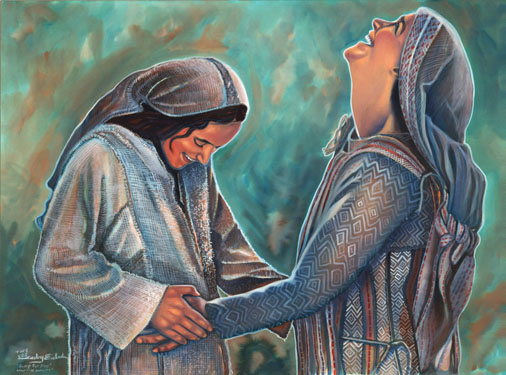
Egged on by Mary and Elizabeth, here I go again

Here I go again, egged on by Elizabeth, Mary and Micah – a reflection for Advent 4C. I don’t seem able to help myself. I can’t stop preaching that small is so beautiful, thanks to God who raises the lowly, graces the dis-graced and scatters the proud. Maybe it’s because I’ve been helping small churches this year.

Jump for Joy by Corby Eisbacher reproduced with permission

In these Sundays of Advent we come face to face with the faith of Israel. It is not the faith of all Israel. If everyone agreed in their faith Jesus would not have had to face such opposition. The faith we come face to face with in Advent is the faith that has been passed down the generations in our scriptures, and lived out by so many. The faith of Israel is about what we expect and what we live for.

It’s a faith which celebrates God’s opposition to the proud and Gods’ favour for those who are lowly, humble and poor in spirit.

So we have today’s readings, from the prophet Micah (5:2-5a) and Luke (1:39-55).

But first, a diversion. 

When the wise men went looking for the one born king of the Jews they stupidly went about it the wrong way. They went looking in Jerusalem. They did not know the rule of the kingdom of God that the first come last and the last come first. The capital wouldn’t cradle the Messiah. In fact, the capital did nothing other than scoff and plot against the one born king of the Jews. Their satnav took them to Jerusalem, nine miles wide of the mark, the cross on the map where Jesus was born.

It was the chief priests and scribes that directed Herod’s attention to Bethlehem as the place where the ruler to shepherd Israel would be born. It was Herod who sent the wise men to Bethlehem to search for the child.

That’s probably the way most of us would go. You could be excused for expecting to find what you’re looking for in the capital, the seat of power.

But the faith of Israel knows different, Micah expresses that prophetic faith, implicitly warning us not to look for leadership in the usual places but to expect the one to rule in Israel to come from one of the little clans of Judah, one of the little clans of Jews, even from Bethlehem of Ephrathah.

Ephrathah is the old name for Bethlehem. It means fruitfulness and Bethlehem means the house of bread. It was the place of fruitfulness that Micah directs us to – not to Jerusalem. The thing about fruitfulness is its abundance but the abundance is the fruit of tiny seed, scattered by the fall and the wind and pollinated by the humble bee. 

The faith of Israel is found in the tiny, the lowly and the humble. This is the faith that follows the rule of the kingdom of God.

We know where Jesus was born, but we don’t know where John was. All we know is that Mary set out to a “judean town in the hill country”, to Zechariah’s house, to greet her cousin Elizabeth. Luke doesn’t tell us the town’s name, but it sounds like it was a place off the beaten track and follows the rule that the kingdom of God is hidden in small places, in the smallest of clans and in the most barren of landscapes.

It is in these places that God grows a kingdom. From the smallest of clans, from the dust of the earth, from the least and the last God works wonders. This is the faith of Israel. This is the faith of Israel which even now leaves many Jews horrified by what is being done in the name of Israel as it uses its military might. Those Jews who are horrified need our prayers as they protest and resist what is going on. The faith in Israel they see in Netanyahu is not the faith of Israel they treasure in their scripture.

The faith in Israel that has stood the test of time is, in the words of the epistle of James (4:6) that God scatters the proud, but gives grace to the humble.

Elizabeth and Mary come together in our gospel reading. There aren’t many readings where we listen to women talking together. Together they represent the truth that God gives grace to the humble. It is written loud and clear in their body language. Their joy is undeniable.

Luke describes how both Zechariah and Elizabeth were both “getting on in years” (1:7) and that theirs was a childless marriage. In those days that was the woman’s fault and that explains the “disgrace” she felt among her people even though she had lived a blameless life. Now with the promise of a son Elizabeth knows God’s favour for the dis-graced. In her pregnant body God’s favour for the dis-graced, humiliated and humble is told yet again. Elizabeth looks at her body, feels her baby and says, “this is what the Lord has done for me when he looked favourably on me and took away the disgrace I have endured among my people.” (1:25).

Then Luke has us look at Mary’s body through the eyes of Elizabeth and we hear her praise. It comes from the heart of Israel’s songbook about how her soul magnifies the Lord. Mary calls herself a lowly woman. That was no mere figure of speech. Her lowliness wasn’t her mental attitude. It was  that she truly was a poor woman. She occupied a place of poverty and powerlessness in her society. She rejoices in the favour God has shown to her, the great things he had done for her, the way he lifts up the lowly and fills the hungry with good things, while all the time opposing the proud and powerful, scattering the proud and bringing down the powerful from their thrones.

This was the faith of Israel that Mary was repeating. This was the song Jesus heard when he was growing up: Mary magnifying the Lord, praising God for his favour for the lowly.

This is the faith of Israel. This is the faith of Jesus that we hear time and again in his preaching. This is the faith we follow, not taking the foolish way of the wise men to the powerhouses, but feeling our way to find God’s favour in the insignificant, humiliated, disgraced, lowly, poor and powerless.

Inasmuch as he did for Mary and Elizabeth he does for all his people. He lifts up the lowly. He gives grace to the disgraced, scattering the arrogant and proud and the disgraceful.

This is the faith of Israel. This is the faith of Mary and Elizabeth. This is the faith of Jesus. This is our faith, the faith of the church, though sometimes you’d hardly know it infected as we are with the imperial spirit which wants to see us bigger than we are. God grows a kingdom and works wonders from the smallest of clans, from the dust of the earth, from the least. That is the reason the lowly and humble rejoice and the proud and arrogant just scoff.

Note: The artwork is by Corby Eisbacher and reproduced with her permission. Prints are available from her www.artbycorby.etsy.com

The readings:

Micah 5:2-5a
But you, O Bethlehem of Ephrathah, who are one of the little clans of Judah, from you shall come forth for me one who is to rule in Israel, whose origin is from of old, from ancient days. Therefore he shall give them up until the time when she who is in labor has brought forth; then the rest of his kindred shall return to the people of Israel. And he shall stand and feed his flock in the strength of the Lord, in the majesty of the name of the Lord his God. And they shall live secure, for now he shall be great to the ends of the earth; and he shall be the one of peace. If the Assyrians come into our land and tread upon our soil, we will raise against them seven shepherds and eight installed as rulers.

Luke 1:39-55
39In those days Mary set out and went with haste to a Judean town in the hill country, 40where she entered the house of Zechariah and greeted Elizabeth. 41When Elizabeth heard Mary’s greeting, the child leaped in her womb. And Elizabeth was filled with the Holy Spirit 42and exclaimed with a loud cry, “Blessed are you among women, and blessed is the fruit of your womb. 43And why has this happened to me, that the mother of my Lord comes to me? 44For as soon as I heard the sound of your greeting, the child in my womb leaped for joy. 45And blessed is she who believed that there would be a fulfillment of what was spoken to her by the Lord.” 46And Mary said, “My soul magnifies the Lord, 47and my spirit rejoices in God my Savior, 48for he has looked with favor on the lowliness of his servant. Surely, from now on all generations will call me blessed; 49for the Mighty One has done great things for me, and holy is his name. 50His mercy is for those who fear him from generation to generation. 51He has shown strength with his arm; he has scattered the proud in the thoughts of their hearts. 52He has brought down the powerful from their thrones, and lifted up the lowly; 53he has filled the hungry with good things, and sent the rich away empty. 54He has helped his servant Israel, in remembrance of his mercy, 55according to the promise he made to our ancestors, to Abraham and to his descendants forever.”

An uprising – the mustard seed and the seed growing secretly

Here’s a sermon for the 3rd Sunday after Trinity focusing on Jesus’s parables of the seed growing secretly and the mustard seed. They speak of uprisings and encouragement, perseverance and patience.

June 16th 2024

Our scriptures are the creation of a bruised and battered people, treasured and passed on by bruised and battered people for the sake of other bruised and battered people. It is a troubled people who have chosen the scriptures we inherit, and who have handed them on.

I keep saying this to remind myself whose these scriptures are and to remind myself to read the scriptures from that point of view.

Today’s gospel features a couple of parables used by Mark to end a sermon by Jesus. The sermon is given from a boat, to a crowd of people on the shore.

Their place on the shore is significant. Jesus and the crowd are from poor peasant communities, subsistence farming communities pushed to the edge by the taxation policies of the temple and Roman authorities. They were clinging on to life in any way they could. Jesus is one of them. 

His sermon was  particularly for them, the least and the frequently lost in the kingdoms of the world. Appropriately, for an audience of the least Jesus uses what is the least to make his points. Today, he picks a seed that grows secretly, and a mustard seed, “the smallest of all seeds”, which amazingly grows to be the “greatest of all shrubs” – and that picks up the prophecy of Ezekiel in our first reading. 

Ezekiel points us to a “lofty tree”.
In his mind it stands for empire and the highness and might of emperors and kings and all those who problematically lord it over others.
Ezekiel sees God cutting a sprig from the lofty top and planting it on a high mountain so that it produces boughs, fruit and shelter for all kinds of bird.
He calls this a “noble” tree rather than a “lofty tree”.
What makes the lofty tree is its highness, whereas the nobility of the noble tree rests in the shelter it gives.

Jesus is the sower.

He sowed seeds in his preaching – seeds of faith, hope and love – seeds of imagination which would grow in the hearts and minds of those poor enough in spirit to have the ears to hear and the eyes to see Jesus’ meaning of love in these parables. 

They will have loved his talk of the seeds for him highlighting the smallest of things as being full of life. They will have known that about themselves though generations of occupation, foreign rule and religious oppression will have eaten at their self belief.

Jesus takes two seeds. That in itself reveals so much about the kingdom of God, namely that the rule of God focuses on the smallest of things, the miniscule, on the least. When did you last hear an emperor, or a Mr Big, or a gang leader wondering about the smallest and least in creation?

Jesus casts the mustard seed as the smallest seed, which grows to become the greatest of shrubs giving shelter, shade and blessing to all the birds of the air. His hearers will have loved that. This is what can become of us is what Jesus is leading them to imagine. This is what can happen to the least of us. The least of us can become the most hospitable. The least of us can be the shelter, shade and blessing for so much and so many.

These are parables for the poor in spirit, for the weary, for the belittled.

They encourage us to believe
life will change for the better for the least, the lost and the last –
that the little, least, lost are great in the eyes of God and come first in his kingdom,

They remind us that the seeds of the kingdom are already embedded in the world
by Jesus the sower,
in our own paths and ways
a seed in edgeways

And those seeds have a life of their own.
We don’t know the effect of them – and we can’t control the effects of a kind word, or affirming gesture.

And they make small beautiful.

Small is beautiful in the eyes of the one who puts the least, the lost and last first.
We don’t need to lie
about how little we are
or what little we have
when Jesus sees the kingdom in a seed.

These parable have always encouraged the church,
particularly encouraging us these days
when the church is struggling,
when you’re feeling like there is so much to do
with fewer and fewer people – in a vacancy as well
we can love being small,
being the unlikely seed of the kingdom,
for ever unsure how it’s going to turn out,
just going day to day
with our small seed of faith
our small seed of hope
and our small seed of love,
sprigs cut from the high and mighty,
cut down to size and carefully planted
to be noble in the kingdom.

These parables encourage us to persevere with patience,
to carry on scattering seed in our small ways along the paths of our lives,
never put off by the idea of a harvest we will never see,
to carry on with those small things
that come naturally to those with a joyful heart:
a smile,
a touch,
a word of welcome,
small kindnesses
in all our ways
scattered like seed.

There was a song Jesus heard at home. He’d heard his Mum singing it. We know it as the Magnificat. It goes like this:

Her song praises the work of God showing mercy on those that fear him from generation to generation, scattering the proud in their conceit, casting down the mighty from their thrones, lifting up the lowly, filling the hungry with good things, sending the rich away empty.

This is the song that seeded Jesus’ imagination.

It is no wonder that he turns to the smallest in his preaching, to seeds to show us faith, hope and love. The seed growing secretly and the mustard seed represent an uprising – an uprising of the least, the tired and the broken.

Mark 4:26-34
He also said, ‘The kingdom of God is as if someone would scatter seed on the ground, and would sleep and rise night and day, and the seed would sprout and grow, he does not know how. The earth produces of itself, first the stalk, then the head, then the full grain in the head. But when the grain is ripe, at once he goes in with his sickle, because the harvest has come.’
He also said, ‘With what can we compare the kingdom of God, or what parable will we use for it? It is like a mustard seed, which when sown upon the ground, is the smallest of all the seeds on earth; yet when it is sown it grows up and becomes the greatest of all shrubs, and puts forth large branches, so that the birds of the air can make nests in its shade.’
With many such parables he spoke the word of to them, as they were able to hear it; he did not speak to them except in parables, but he explained everything in private to his disciples.

Ezekiel 17:22-end
Thus says the Lord God:
I myself will take a sprig
from the lofty top of a cedar;
I will set it out,
I will greek a tender one
from the topmost of its young twigs;
I myself will plant it
on a high and lofty mountain.
On the mountain height of Israel
I will plant it
in order that it may produce boughs and bear fruit,
and become a noble cedar.
Under it every kind of bird will live;
in the shade of its branches will nest
winged creatures of every kind.
All the trees of the field shall know
that I am the Lord.
I bring low the high tree,
I make high the low tree;
I dry up the green tree
and make the dry tree flourish.
I the Lord have spoken;
I will accomplish it.

Mary’s words in our prayer for Christian Unity

Here’s the bones of a sermon for two village churches for the Week of Prayer for Christian Unity 2024. The gospel text is John 2:1-11 in which Mary makes her voice heard. Women have had far less “say” through the Christian centuries, and even now – a sure sign that there is no unity in Christian community.

This week is the Week of Prayer for Christian Unity. It always begins on the 18th January, the date when we celebrate what God did with Saul, converting him from a zealous persecutor of Jesus’ followers, into someone who came to love them as his brothers and sisters.

It has been a special 8eightday period pf prayer each year since 1908 – co-ordinated by the World Council of Churches – the idea being that we pray “for the unity of the Church as Christ wills it, and in accordance with the means he wills” (Paul Couturier)

Our first call in our prayer for Christian unity is to lament that the lack of Christian unity. Christians remains divided on so many things. Churches remain divided. We rejoice when there is reconciliation, when we find the way to work together, but divisions run deep, hurting the body of Christ. 

In the past our focus for prayer may have been the relationship between the denominations and those prayers have borne fruit. Or our hearts and minds may have gone to the troubles in Northern Ireland, as prayer for the Catholic and Protestant communities there.

But, here and now, what does disunity look like andfeel like to us? What is our experience of disunity? Materials for this year’s Week of Prayer have been gathered by an ecumenical group from Burkina Faso. They have invited us to join with them in a process of self-reflection as they consider what it means to love our neighbour in the midst of a security crsis.

We may be less vulnerable to acts of mass violence than in Burkina Faso, but many here live with the memory and/or threat of serious violence centred on issues of identity and belonging. There are also groups within communities who feel particularly vulnerable to violence. For them, prayers for Christian unity become urgent – that we discover the unity Christ wills in accordance with the means he wills.

There is no unity
as long as people are not free to be themselves,

as long as people are disrespected, or disabled or silenced by people more powerful than them,
as long as there are victims of abuse and the injustice inflicted on them has not been righted,
as long as people are frozen out, talked down, talked down to
because of who they are
because of the colour of their skin, because of their gender,
because they’re women,
because of their age (too young, too old),
because they’re gay, or haven’t had the right education
or because they are caught up in historic conflicts and they’re bound to one side or the other,
because of who we are.

Differences don’t have to lead to conflict and division. Differences can be the cause of great rejoicing. They are also the places where love grows.

There will always be differences. Our scriptures open with God celebrating difference in the creation stories with the creation of all sorts of life. He creates relationships by making man and woman. He loves what he has done. God doesn’t iron out differences.

We have a choice. We can love our differences, or we can hate our differences. When we hate our differences we can feel threatened, we can seek to control and manipulate, we can hide the truth of the other and finish up sowing seeds of division.

When we love our differences we rejoice in the gifts of others, we will see our differences as a blessing (even when there is disagreements among us). We will love that the world has so many different points of view, that there are so many different ways to understand things, that there is so much to learn, so much to discover.

Some of our media would have us afraid of our differences, as would the gossip on the street. Sometimes we have to put our hands over our ears on radio phone-in and instead tell ourselves what we hear from scripture as the heart of vocation – “do not be afraid”.

Day by day we make this choice, loving our differences, or hating our differences and thereby creating divisions and seeing life break apart.

One of the great divisions within society and within the church is the difference between men and women, the different ways they’ve been treated. We see this in the politics of the church – about who can speak, teach or lead. We see it in our scriptures. Men play a far more prominent role. They are more powerful and they have a lot more to say. 

Yet, in spite of all the patriarchy, it is Mary’s voice that we hear in today’s gospel. She doesn’t say much, but what she does say is truly significant.

She says to Jesus, “they have no wine” and to the stewards, “do whatever he tells you”. “They have no wine” and “do whatever he tells you”. Just nine words!

It would have been no surprise that the wine ran out. Cana was just as poor a village as nearby Nazareth. The farming families there struggled to make a living while at the same time they were being heavily taxed – the Temple tax, tribute to the Roman emperor, and the tax they had to pay to Herod for his various vanity projects. This was a community of poor people.

Mary’s four words, “They have no wine” addressed to Jesus is as a prayer – a prayer trusting the one she is speaking to to be the one to answer the embarrassment of the poor hospitality which was all they could afford.

Mary can lead our prayer. We can follow her in spelling out to Jesus what concerns us. The lack of wine may not be our concern, but we may make similar prayers, such as “They have no food”, “They have no justice”, “they have no room”, “they have no one to care for them” – and her words “do whatever he tells you” becomes the answer to the prayer.

As we pray for Christian unity, as we note any temptation to hate our differences, and our inclination to demean those who disagree with us, we can make our prayer “There is no unity, there is only difference and division”. As we work our way through a PCC meeting, or face up to any resentment we may feel about how we have been treated by others we can follow Mary’s prayer, “there is no agreement”, or “there is no love”.

When we pray for Christian unity, we turn to Jesus and offer ourselves as the answer to the prayer of the church. There may be no unity, but we turn to the one we know to work wonders with difference, who loves difference. Paul sums it up: In Christ, there is neither Jew nor Gentil, neither slave nor free, nor is there male and female, for we are all one in Christ. These are the wonders God works in our differences. 

Luke describes the church in his Book of Acts. In the beginning he shows Jesus’ friends and followers all together in the room, men and women, devoting themselves to prayer, describing how the Spirit came on them inspiring them to speak in such a way that everyone was able to understand them in spite of their differences of nationality, ethnicity, gender and age. And then trhoughout Acts Luke continues to amaze his readers with the sheer diversity of the earliest church. There are men and women, strangers and foreigners, slaves, prisoners (and their guards), Jews and Gentiles, eunuchs. God loves the differences and builds his church from them.

The stewards in today’s gospel did precisely what Jesus told them to do. They filled six huge jars with water which turned to wine, far better than the first wine, the poor wine, the wine of the poor which is never enough. This water ran out as wine, as the wine which never ran out. The jars each held 20 – 30 gallons.. Just imaging – 120-180 gallons of wine – more than enough for this poor Galilee community to drink, make merry and celebrate the wedding feast. More than enough for the disciples to see his glory. More than enough for the church down the centuries to carry on drinking in the way that he told us to – drinking the cup of salvation.

In the midst of conflict and disagreement dare we trust ourselves to turn to Christ to love our difference? Dare we hope for as much as those wedding guests at Cana? Where there is no peace dare we hope for more than enough peace, peace beyond human understanding? Where there is no love dare we hope for so much love to make friends out of enemies and to build community with our differences as another sign of God’s glory?

John 2:1-11
On the third day there was a wedding in Cana of Galilee, and the mother of Jesus was there. Jesus and his disciples had also been invited to the wedding. When the wine gave out, the mother of Jesus said to him, ‘They have no wine.’ And Jesus said to her, ‘Woman, what concern is that to you and to me? My hour has not yet come.’ His mother said to the servants, ‘Do whatever he tells you.’ Now standing there were six stone water-jars for the Jewish rites of purification, each holding twenty or thirty gallons. Jesus said to them, ‘Fill the jars with water.’ And they filled them up to the brim. He said to them, ‘Now draw some out, and take it to the chief steward.’ So they took it. When the steward tasted the water that had become wine, and did not know where it came from (though the servants who had drawn the water knew), the steward called the bridegroom and said to him, ‘Everyone serves the good wine first, and then the inferior wine after the guests have become drunk. But you have kept the good wine until now.’ Jesus did this, the first of his signs, in Cana of Galilee, and revealed his glory; and his disciples believed in him.

Taking the unsweetened Christmas story into our resolutions

This sermon was prepared for the first Sunday after Christmas when I suspect many are tired of Christmas and want to get back to normal. We have to hope we don’t – go back to normal, that is – because then the “lowly” and demeaned are left out as normal. It is to them, the likes of the shepherds and Mary and Joseph, that the glory of God takes us. The gospel text is Luke 2:15-21.

This week, the danger is that life will get back to normal, that we will go back to our old ways, to the old gods which hold our thoughts, and that this coming year, 2024 will be just like any other year with its low expectations and vague hopes for world peace, a lottery win a nice holiday and just getting by.

But if we go back to normal won’t Mary’s pain have been in vain? Time turns on Jesus’s birth. There was a time for us “before Christ”, and there is time after his birth, a new time, the time when we know God’s favour – the day of the Lord, the years anno domini – the time that will surely never be the same again.

I suspect that those who will be glad to “get back to normal”, relieved it’s all over will have imbibed too much sugar or tried to do too much.

How much sugar we take with our Christmas is a good question. The way most people know the Christmas story is through sugar-coated carols and cards. Christmas can get so sweetened that we have difficulty getting the real flavour of Christmas as presented, unsweetened, by the gospel writers, Matthew, Luke and John.

There’s usually a “free from” aisle in our supermarkets these days. I suggest that we keep this aisle in church as a free from aisle. Free from sugar and syrup so that we can get into the meaning of Jesus’ birth. Luke, Matthew and John didn’t tell these stories lightly or sweetly. They tell them deeply, from the depths of a whole community’s memory and experience. And they tell their stories darkly – there is a dark reality to all the elements of their stories. We need to feel their weight, not their lightness. We need to feel their weight to grow in worship, resilience and love for the lowly and the stranger.

Our gospel this morning begins after the angel left the shepherds. An angel had appeared to them, and the glory of the Lord shone around them. The angel brought good news to them that was to cause great joy for all people. A child, wrapped in cloth, lying in an improvised cot was the sign. The great company of the heavenly host join the angel and the shepherds. They praise God for the news singing at the top of their voices, “Glory to God in the highest heaven, and on earth peace to those on whom his favour rests”.

This morning’s gospel begins with the shepherds deciding to go to Bethlehem to see for themselves what God had made known to them. They went with haste and found Mary and Joseph and the child lying in the manger. They made known what they’d been told about the child. Their hearers were amazed and Mary treasured their words and pondered them in her heart.

With Mary we treasure their words and ponder them in the heart of the church. But, please, no sugar because if we put sugar in we miss the point that Luke is here making as he paints the picture of those on whom God’s favour rests, around whom God’s glory shines and through whom, and for whom, God chooses the way of saving the world that is lost.

God’s glory shines around the shepherds. These were men who lived out in the fields, on the wasteland around Bethlehem on land which was no good for anything else than grazing sheep. They were there in all weathers, warding off wolves and thieves, working nights, protecting the lives of their sheep, their livelihood – doing the work which was to inspire Jesus’s own self understanding of being the good shepherd. They were an underclass, living rough. Around them the glory of God shines. The press release of the birth isn’t carefully planned for maximum impact in the corridors of power, but is focused in the isolation of these shepherds.

The sweetened versions of the Christmas story, the sweetened Nativity, can never convey the darkness and will always shy away from the poverty. It is the unsweetened versions, given to us by the gospel writers which shows us where God’s favour rests – around the shepherds, on Joseph (a poor artisan carpenter in an obscure village) and Mary – a young girl whose song of praise Jesus will have heard growing up. In her song, the song we know as Magnificat she praises God for looking “with favour on the lowliness of his servant”.

Lowly is the collective noun for those who have been demeaned. The word lowliness is used throughout the Bible to denote misery, pain, persecution and oppression. In our unsweetened version of Jesus’ birth story, Mary embodies the experience of her people, the Jews – their whole history threaded with misery, pain, persecution and oppression. She knew God’s favour rests there, with her people – and those who have joined Mary have come to realise he favours all like her, all those in misery, pain, persecution and oppression. The glory of God is all about them – Mary, Joseph, the shepherds – and all the lowly who make up the extended holy family, and those who want to relate to them as relatives. The love of God is for them – to turn life round in their favour.

Poet W H Auden puts these words into the mouths of the shepherds in his Christmas Oratario For the Time Being:

We never left the place where we were born,
Have only lived one day, but every day

Have walked a thousand miles yet only worn
The grass between our work and home away.

Lonely we were though never left alone.
The solitude familiar to the poor
Is feeling that the family next door,
The way it talks, eats, dresses, loves, and hates,
Is indistinguishable from one’s own.

Tonight for the first time the prison gates
Have opened.
Music and sudden light
Have interrupted our routine tonight,
And swept the filth of habits from our hearts.
O here and now our endless journey starts.

We’ve come to the end of the year, the end of the Christmas holidays is in sight. We may be relieved it’s all over – we have, after all, consumed far too much sugar. 

But, let’s not go back to normal. 

Let’s join the shepherds just as their endless journey starts when they find a baby wrapped in cloths, lying in a manger – the sure sign that starts us off. 

Let’s join Mary treasuring the words of the angels and pondering their words in our hearts. 

Let’s join those who are demeaned, those who are lowly. 

Let’s make our resolutions for the new year, for new time, a resolution everyday undergirded with daily prayer to join with them; those who suffer misery, pain, persecution and oppression.

Renowned black preacher and theologian Howard Thurman has this to say:

When the song of the angels is stilled,
When the star in the sky is gone,
When the kings and princes are home,
When the shepherds are back with their flock,
The work of Christmas begins:
To find the lost,
To heal the broken,
To feed the hungry,
To release the prisoner,
To rebuild the nations,
To bring peace among people,
To make music in the heart.

How about that for our new year’s resolution? How about that as resolution for the rest of our lives? That is coming alive in the unsweetened story of Jesus’s birth and being part of God’s favour and glory.

The gospel of the day – Luke 2:15-21

When the angels had left them and gone into heaven, the shepherds said to one another, ‘Let us go now to Bethlehem and see this thing that has taken place, which the Lord has made known to us.’

So they went with haste and found Mary and Joseph, and the child lying in the manger. When they saw this, they made known what had been told them about this child; and all who heard it were amazed at what the shepherds told them. But Mary treasured all these words and pondered them in her heart. The shepherds returned, glorifying and praising God for all they had heard and seen, as it had been told them.

After eight days had passed, it was time to circumcise the child; and he was called Jesus, the name given by the angel before he was conceived in the womb.

Setting Mary free to be herself – listening to her song

This is something for the 3rd Sunday of Advent, Gaudete Sunday, in a country church in Warwickshire dedicated to Mary, I have focused on Mary’s Magnificat.

Have any of you been put on a pedestal?

I can imagine it’s hard and you can be brought to earth with a bang. You’re not allowed to be yourself, always having to be what others want you to be.

The church hasn’t done Mary any favours. Above all women she has been put on a pedestal for so long that we’ve forgotten what she was really like. It’s what men have done to her over the centuries.

This morning I want us to listen to her song.

My aim in preparing this sermon is that you and I get a better idea of who Mary was. This, I believe will help us into the Christmas gospel and will help us better understand the son who spent most of his life with her in their village and home of Nazareth.

As a church dedicated to Mary, I suggest we dedicate ourselves to her liberation so that she can be herself, rather than what we have made her over the centuries, whether we have devoted ourselves to her as within the catholic traditions if the church, or whether we have been critical of such devotions, as within the protestant traditions.

When we look at her, what do we see? What we see is what people have made of her over the years. We see all the images laid on top of one another as she has been used for this or that purpose. 

She has become stereotyped. She comes to us well dressed in her blue flowing gown looking like a beauty queen. She usually has pale skin, blue eyes. She looks peaceful. She looks heavenly. She’s usually on her own, surrounded by quiet. She has her hands together, eyes closed, praying. Often her setting is the architecture of a palace. She is often reading. And in all of this there is no sign of trouble. There is no sound of her song and no sign of her joy. There isn’t much sign that she has done anything at all. 

But the gospels give us a very different view of Mary.

She was a woman of history. She was Mary, Mary of Nazareth, a small village of about 300 people off the beaten track to the sophisticated nearby city of Sepphoris. This was the village people scoffed at – “can anything good come out of Nazareth?” 

Archaelogists there have pieced together a picture of rural poverty, with people living in one and two roomed houses clustered around courtyards shared with extended families with shared cooking facilities. They’ve found no signs of any wealth. 

This was a small peasant community. Mary was married to the village carpenter. This wouldn’t have been a small business as we know them. He wouldn’t have had the status we give to small businesses. He would have been an artisan, the class below the peasants, earning less than the peasants and serving their needs. They probably would have had a small plot of land for growing food to eke out a living. They would have made their own clothes from their sheep.

They were poor. They were taxed three times. They paid 10% to the Temple. They paid tribute to the Roman emperor. And then they also had to pay tax to fund the vanity projects of Herod, such as the building of nearby Sepphoris, the equivalent of our HS2.

They would have been very poor, barely scraping a living together. Many of them would have been in debt to the wealthy and would have their land taken off them. Resentments grew and  there were frequent rumblings of revolt. Many days they would have gone hungry.

Life didn’t treat any of them gently.

It takes a village to raise a child. That village raised Mary and Jesus, Jewish babies having to grow up very quickly. Their village meetings would have dwelt on the different ways their people had suffered in Egypt, in persecution, in exile and the way that God had graced these suffering servants. She picks up the song of Hannah and makes it her song.

My soul does magnify the Lord, she sings. “My spirit rejoices in God my Saviour for he has looked with favour on the lowliness of his servant. The Mighty One has done great things for me. His mercy is on those who fear him. He has shown strength with his arm, he has scattered the proud in the thoughts of their hearts. He has brought down the powerful from their thrones and lifted up the lowly. He has filled the hungry with good things and sent the rich away empty.”

This isn’t the song of the woman we have put on the pedestal for so long. This is the song of a woman who lives with the day to day challenge of survival. It’s a song Jesus will have heard from his mother and from the scriptures shared in their village meetings. This isn’t a song of the docile, or of those who take things lying down. This is the song of those who rejoice that the proud are scattered, the powerful dethroned and the rich sent away empty. 

This is the song which prompted one artist to portray Mary in the style of Russian communist posters, muscular, all boiler suited and booted.

You are a church dedicated to Mary. Can I suggest that we all try to get to know her better and that we talk about her more? Can you let her be herself rather than forcing her to be somebody she isn’t?

As we get to know her better we will know better where God plants his seed and where the baby Jesus grew, side by side with his mother as he joined her in her prayer, magnifying the Lord and praying for their daily bread and the forgiveness of their debts, joining her and watching her in the household tasks, digging the soil, planting seeds, baking bread – funding his imagination for sharing with those who followed him the images of the kingdom of the one he magnified in the song of his mother.

I am indebted to my Advent reading – to the work of Elizabeth A Johnson, in her book Truly our Sister: a Theology of Mary in the Communion of Saints

Magnificat

My soul proclaims the greatness of the Lord,
my spirit rejoices in God mySaviour;
he has looked with favour on his lowly servant.

From this day all generations will call me blessed;
the Almighty has done great things for me
and holy is his name.

He has mercy on those who fear him,
from generation to generation.

He has shown strength with his arm
and has scattered the proud in their conceit,

Casting down the mighty from their thrones
and lifting up the lowly.

He has filled the hungry with good things
and sent the rich away empty.

He has come to the aid of his servant Israel,
to remember his promise of mercy,

The promise made to our ancestors,
to Abraham and his children for ever.

Nativity – He Qi

He Qi is a Chinese artist who spent the years of the Cultural Revolution painting pictures of Mao Tse Tung in the day time as an alternative to forced labour, and in the evening painting pictures of the Madonna inspired by his fascination with Raphael’s Madonna and Child.

He Qi’s Nativity is typical of his work in terms of colour and vibrancy. His painting resembles stained glass and always feel they have an element of fun. In this picture you can see the sheep virtually dancing in response to the angels. Listening is an important element of this piece. Of course, the sheep stand for all those who know the Lord as their shepherd.

The light in this Nativity comes from heaven and is far more intense than the light any of us can hold. The light Joseph holds is dim compared to the light that Mary holds. – but then Joseph is fading from the picture with his work well and faithfully done.

Mary is pictured in the pink. Normally Mary is dressed in blue, but here He Qi picks up pink as a symbol of marriage and shows Mary as the archetype of the church who holds and treasures Jesus. Jesus is offering a red apple to Mary and the church. This is a reference to the Garden of Eden signifying Jesus as a new Adam and Mary and the church as a new Eve. This is new creation.

The apple is blood red to indicate the nature of God’s offering. Is there also an ambiguity in the shape of the apple? Is it also heart shaped to indicate that this is the new heart promised by God to his disheartened people (Ezekiel 36)?

This is the Nativity. Christus natus est. This is Christmas. Happy Christmas.