God’s work in broken community

Reflecting on Paul’s call to order and Jesus’ manifesto in the readings for the day, 1 Corinthians 12:12-31a and Luke 4:14-21 for the 3rd Sunday of Epiphany (C) for two small congregations in a lively/lovely group of parishes in rural Warwickshire. This post includes a video of Bishop Mariann Edgar Budde discussing her sermon that made headlines following President Trump’s inauguration service.

January 26th 2025

First of all, a note. I normally get round the problem of God’s pronoun by  using the name of God instead of a pronoun.  But, here, I am going to need a pronoun. There are many objections to using “he/him” because the name God is then linked with power, privilege and patriarchy – and the language we use about God needs to set God free from such associations, particularly in these days of right wing nationalism popularised by men such as Trump, Putin, Musk and Netanyahu. So, for this sermon, when I need to resort to God’s pronouns it will be she/her. I hope you will understand why.

In a world where God’s name is often associated with power, control, and patriarchy, using ‘she/her’ reminds us that God transcends these human limitations and works to free us from systems that seek to dehumanize and divide. It is not an attempt to redefine God’s essence but to challenge our projections of power. Forever God gathers the lost, gives strength to those who are weak, and honour to those who have been shamed and ashamed.

In the midst of controversy Paul has this to say to the troubled, disjointed community of Corinth. “We were all baptised by one Spirit so as to form one body – whether Jews or Gentiles, slave or free”. Here was a community facing all sorts of problems with all sorts of differences. Paul reminds them what God does in the middle of such a community. She brings us together to form one body from the splinters and divisions. She gathers us from far and wide and makes of us one body whatever the differences between us.

Paul stands in the middle of the conflict and witnesses to what God does. He reminds the community of the abundance of God’s gifts and the value and diversity of each and every one of them for the purpose of community building and reconciliation, reminding the body around him that every member needs every other body to fully function. 

Perhaps Paul remembered the prophecy in the valley of dry bones – a valley of untold war crimes from which the bones of those killed were left out in the scorching sun for the wild animals to pick the meat from. The sound from this valley overshadowed in death was the noise of a disjointed people overwhelmed by tragedy. “Our bones are dried up, our hope is lost” is what they said. (Ezekiel 37:11). Those bones speak of a people abandoned, dehumanised and rendered invisible. In that valley Ezekiel was made to tell the truth about what God does, how she undoes the shame by breathing life into the very bones of a community destroyed, dismembered and left to rot.


This is what God does. Even as we walk through the valley of the shadow of death, God brings us together. From the four corners of the world, Jews and Gentiles, slave and free, God brings us together in love in spite of differences between us. The Spirit that breathes life into the valley of dry bones is the same Spirit Paul saw at work amongst the Corinthians and is the same Spirit that unites us as the body of Christ, knitting us together from the corners of the world, and overcoming shame, division, and death itself.

You see, God remembers us. She remembers bodies that are broken, whether that be in the valley of dry bones, or the valley overshadowed by death, or communities torn asunder. 

Remembering for God isn’t simply a case of casting her mind back, as we would usually remember. God’s remember is always a re-creation, a bringing back together of what’s become disjointed and scattered, and making whole what has become broken. God’s remembering is a literal re-membering of the body, the remaking of community through the gifts of her Spirit.

This is, if you like, another creation story – the coming together of a people through the creativity of God’s Spirit. The Spirit remembers us as one body – connecting toe bone to foot bone to ankle bone to leg bone to knee bone to thigh bone.

So Paul reminds the broken body around him that God has remembered them. God has remembered their broken body. “God has placed the parts in the body, every one of them” – just as she wanted them to be.

He goes on: “God has put the body together so that there should be no division in the body.” This is what God does and this is why God does it. God knits us together in love to be a strong body, a resilient body, a withstanding body, a body that can stand, even in the valley overshadowed by death.

This is what God does. She puts the body together.  

And this is what she does as a rule. She gives “greater honour to the parts that lacked it”. The rule of God is always to put the last and the least first. Here we see that rule being followed again with greater honour given to the parts that lacked it so that those parts which seemed weaker become indispensable and those parts thought less honourable are treated with special honour. This is how God remembers her people. This is what God builds a body for.

This is not just a spiritual gathering; this is a body meant for action. To be bound together by the Spirit is to be called into the work of justice, to bring good news to the poor, freedom to the prisoners, sight to the blind and liberation to the oppressed. This is the body God is building: a body that stands in stark contrast to the systems of division, hatred and shame that continue to pull our bodies apart.

We are the body God is building – here today listening to the body God prepared for us, listening to Jesus as he finds the body’s purpose revealed through the prophet Isiaiah to read to his fellow villagers in their synagogue in Nazareth.

The Spirit of the Lord is on me, because he has anointed me to proclaim good news to the poor. He has sent me to proclaim freedom for prisoners, and recovery of sight for the blind, to set the oppressed free, to proclaim the year of the Lord’s favour. 

Mariann Budde is a member of the body of Christ, gifted to be Bishop of Washington, president within a community God has brought together. It was her responsibility to preach at the prayer service in her cathedral. She preached the only way she could appealing to President Trump for mercy for those afraid because of the policies of the incoming president – those who are gay, lesbian or trans, and immigrants being targeted for deportation. Trump should not have been surprised by her appeal. She was only embodying the very work of the body of Christ. In a time when power is often wielded by shame and divide, the body of Christ cries out on behalf of the oppressed, the disempowered and broken. This is the DNA of the body of Christ. This is all God brings us together for. This is what we are gifted for. We can do no other.

Closing prayer

God of unity, you breathe life into us and call us to be one body in Christ. We thank you for the gifts you’ve placed within each of us, and we ask that you strengthen us as a community, that we may bear witness to your love. We pray for healing where there is division, for hope where there is despair, and for courage to stand with the broken and the oppressed. May your Spirit unite us in justice, peace, and compassion. In Jesus’ name, we pray. Amen.

Finding Unity in January’s Gloom

2nd Sunday of Epiphany (C) – part of the Week of Prayer for Christian Unity. The readings for the day are 1 Corinthians 12:1-11 and John 2:1-11.
January 18th 2025

How’s your January going?

I’ve heard January described as “one long Monday”.

Dare I ask, how are the new year’s resolutions going? Are you keeping them, have you lapsed or have you forgotten what they even were?

We’re quite self-centred in our resolutions aren’t we? They tend to be centred on what we are going to do for ourselves and on our own. We tend to set the resolutions on our own. On our own we tend to set personal goals without deeper reflection on the greater needs around us. Our resolutions can be shockingly disconnected from our shared reality, such as the climate crisis, the migration crisis and the cost of living crisis.

And we make the resolutions at the time of the year we’re in the worst shape to keep them, in the gloom of January, when we’re often under the weather, whether the “weather” be the worst cold of the year, or whether “the weather” be our personal health, suffering flu or the worst cold of the year. Our resolutions are fragile. Our resolutions, if they could choose, would appreciate a February start, not a January one!

Tomorrow is Blue Monday, supposedly the most depressing day of the year. I wonder whether the likely failure of our resolution is a factor in this, alongside the cold, the credit card bills, the dark nights etc etc.

Our Sunday worship is our opportunity to reorientate ourselves in these days of darkness. The season of Epiphany takes us through January to February 2nd and gives us one epiphany after another, to help us to find our way and strengthen our resolve. There is one revelation after another.

Last Sunday it was the voice of revelation from the heavens when Jesus was baptised. Today it’s the changing of the water into wine and Mary’s instruction to the stewards to do what Jesus tells them that is the revelation. John writes: “What Jesus did here in Cana of Galilee was the first of the signs through which he revealed his glory.” These signs are revelations of God’s glory in the world – a new way of seeing and being in the world.

And, in our reading from Paul’s letter to the Corinthians, all the gifts of the Spirit to a troubled community are a manifestation of the Holy Spirit of God working through that community for the common good. “There are different kinds of service but the same Lord. There are different kinds of working, but in all of them and in everyone it is the same God [we see] at work”.

Paul sets out his reason for writing to the Corinthians (in 1:10). His purpose was “to appeal to you, brothers and sisters, by the name of our Lord Jesus Christ, that all of you be in agreement and that there be no divisions among you, but that you be united in the same mind and the same purpose. Paul’s appeal for unity isn’t just a call for believers to find agreement, but for them to see beyond their own individual desires and divisions. 

The gifts of the Spirit Paul talks about are not meant to isolate or empower individuals but to strengthen the body of Christ. The gifts of the Spirit are for the common good. Paul’s list reminds us that unity is not about sameness, but about recognising and celebrating the diversity of God’s work in us. Seeing that is a revelation of God’s glory in the church. Not seeing that reveals God’s powerlessness, even in the church where Jesus is supposedly lord.

Yesterday marked the beginning of the Week of Prayer for Christian Unity, a week of prayer when we pray that we will pray along with Jesus for all who believe in him that they (we) may be one and that they (we) “may be brought to complete unity”. That was Jesus’s prayer that we are called to join this week in particular. It’s a prayer to withstand our horrible histories and to find resolutions to all that divides us. It’s not a prayer for doctrinal unity but is a practical commitment to reconciliation and understanding. The prayer for unity which we are called to join Jesus in is prayer for the kind of unity which reveals God’s love to the world, a unity which transcends the personal, political, racial and denominational divisions of our horrible histories.

Jesus knew that then, when his prayer for unity was answered that that would be epiphany and revelation. “Then the world will know that you sent me and have loved them even as you have loved me.” (John 17:20-23)

The Roman Catholic Church are keeping 2025 as a Jubilee year. It sounds notes of joy and jubilation in our calendar. Every 25th year is kept in jubilee picking up on Jubilees referred to in Leviticus when the 50th year became a time for putting the economy right. Indentured servants were released from servitude, debts were forgiven and everyone was returned to their property. Imagine the jubilation!

This 2025 Jubilee was proclaimed in the papal bull, the title of which translates as “Hope does not disappoint”.  The motto for the year is “Pilgrims of Hope”. That is to be their resolution. Jubilee begins with the opening of the doors of the basilica in the Vatican. On Christmas Eve, Pope Francis knocked on the holy door of St Peter’s basilica. The door was swung open and Francis rolled through in his wheelchair.. There are four such doors in the Vatican. On the Feast of Stephen, December 26th, a fifth door was opened. This was the door of the prison in Rebibbia in Rome and this was intended to serve as a symbol “inviting all prisoners to look to the future with hope and a renewed sense of confidence”. In other words, this was another epiphany – a revelation of how the prisoners, and ourselves, can see ourselves and one another differently because of the glory of God in the world.

I have included their logo of the Jubilee on the sheet of readings. The four figures come from all corners of the world. They represent all people that on earth do dwell. They embrace each other as they hold on to the cross which anchors them in hope as they (we) navigate rough seas as pilgrims of hope.

Is this an image we can take with us into this special week of prayer and even, with fresh resolution, into the rest of the year? How will we embody the unity which Jesus prayed for? How can we be signs of his love? How can we resolve our differences and conflicts? How can we align ourselves with God’s greater purpose? It won’t be in our own strength. None of us are resolute enough for that. To change the world God’s Spirit wants to work through us, strengthening our resolve to do his will.

Star-Gazing: The Magic of the Magi’s Journey

I resorted to verse for this sermon to celebrate Epiphany and highlight the Magi. It was prepared for a small congregation which has heard too much from me over recent weeks. I don’t know – maybe verse is worse! The gospel for the day is Matthew 2:1-12

They’re not like us

They’re not like us
those wise men three.
We’ve flattened them out, 
to two dimensional processors
across our Christmas cards.

That’s how we know them
those wise men three.
We’ve called them wise,
with balls of men
who’ve travelled so far.

But we don’t know that
they were three, or wise,
or even men. We don’t know
what else they carried,
or even what they wore.

The text doesn’t say
this and doesn’t say that.
This is what we’ve made them
camel-backed men
who’ve travelled so far.

Magi from the East
is all Matthew called them.
Let that name stick
to conjure up images
that make us like them

even though we travel
a different way,
from the west,
with the sun on our face
for the dawn of new day.

We too come as outsiders,
foreigners finding a way
from one place to another
along so many different paths,
some scarcely travelled.


How we got here
is quite the story
each one needs to tell.
Some by way of suffering,
others carried from cradle,

or a spirit making us friends
rather than strangers
carried away by grace
on waves of compassion,
or there was a word we heard.

Some have come the easy way.
Others have have found it
hard to find, picking out ways,
far more dangerous ways,
in small boats on giant seas.

We’ve walked from different places.
Some from disaster zones
of brokenness and treachery,
devastated by war, through the valley
overshadowed by death.

Some have come quickly,
a snap decision to put things down,
to run. Yet others
have slowly taken their time,
taking that long way round.

How did we all get here?
What were the paths we took?
What was the help along the way?
Who showed us where to look?
What wonder draws us together?

The Magi headed straight.
The highway was their way
to Jerusalem
to those in the know,
the priests, the teachers and king.

Little did they know.
They pointed another way
spying  for Herod amongst the least
in little Bethlehem of Judea.
Just follow the star.

And here’s how we see them,
bowed down, on their knees,
their treasure opened,
a feast of thanks, all gold,
frankincense and myrrh.

Worshipping we see them.
Are we bowed down, overjoyed?
Are we not also
worshippers like Magi,
so called by Matthew?

Magi believe in magic.
They major in magic
and the wisdom of magic
which knows both its wonder
and the malevolence of magic,

the devilish tricks, lies
misinformation, false promises
the charms of cruel calculation.
This too is magic; dark arts
masked in malevolence.

But there’s a light
that shines in darkness
that makes us wonder the magic.
“Where did that come from?
How did that happen?”

That’s magic. Then
there’s the babies
Herod would destroy.
Have you seen how babies
light up worn-out faces?

That’s the magic we love,
the power that changes the world
turns the world around
and makes all things new.
That’s the magic to die for.

Then there’s ourselves:
how we got here to worship
the one who works magic
to make of us one,
like Magi we come

following a star.
It’s hard to believe
the magic which makes
so much of so little,
like a baby or even Bethlehem

or in the magic
that breaks the rules
and scatters the proud
raising the poor, the lowly,
always putting the last first.

There’s the magic
that spreads a table
and invites enemies around
to eat together to step
their way from hostility.

Magic even works in the dream
of sleep. Heed the warning.
Do not go back to Herod!
Always resist his charming ways,
the manipulation of greed and fear.

Forever choose another way,
the better way, the best way
the way that humbly builds peace
the way home found
in wonder, love and praise.

This is the challenge,
to stay the Magi way,
star-gazing like children.
Twinkle, twinkle little star
how we wonder what you are.

A star of wonder, a star so bright,
all gas and dust, perfectly balanced
in the gravity of a gracious God
who will stop at nothing
to make majesty of so little.

How did we get here?
What star of wonder called us
to bow our spirit to worship,
at a manger, an altar
reserved for Magi like us?

Endnote:

This week, as we face the decisions and distractions of daily life, let’s commit to keeping our eyes on the star – the light that calls us to humility, to peace, to worship. Whether in moments of joy or sorrow, may we follow the light that leads us home.

Acknowledgement:
For the first time I submitted the sermon draft to AI (ChatGPT) for feedback. I was bowled over by its better intelligence and the constructiveness of the feedback which encouraged me to continue with the experiment of preaching in verse. The endnote is taken from the feedback.

Wherever is Jesus? Where in the world is Jesus? Where on earth is he? Questions for the search team

A reflection on the loss of Jesus for the first Sunday of Christmas (year C). The gospel is from Luke 2:41-end when Joseph and Mary lost Jesus.

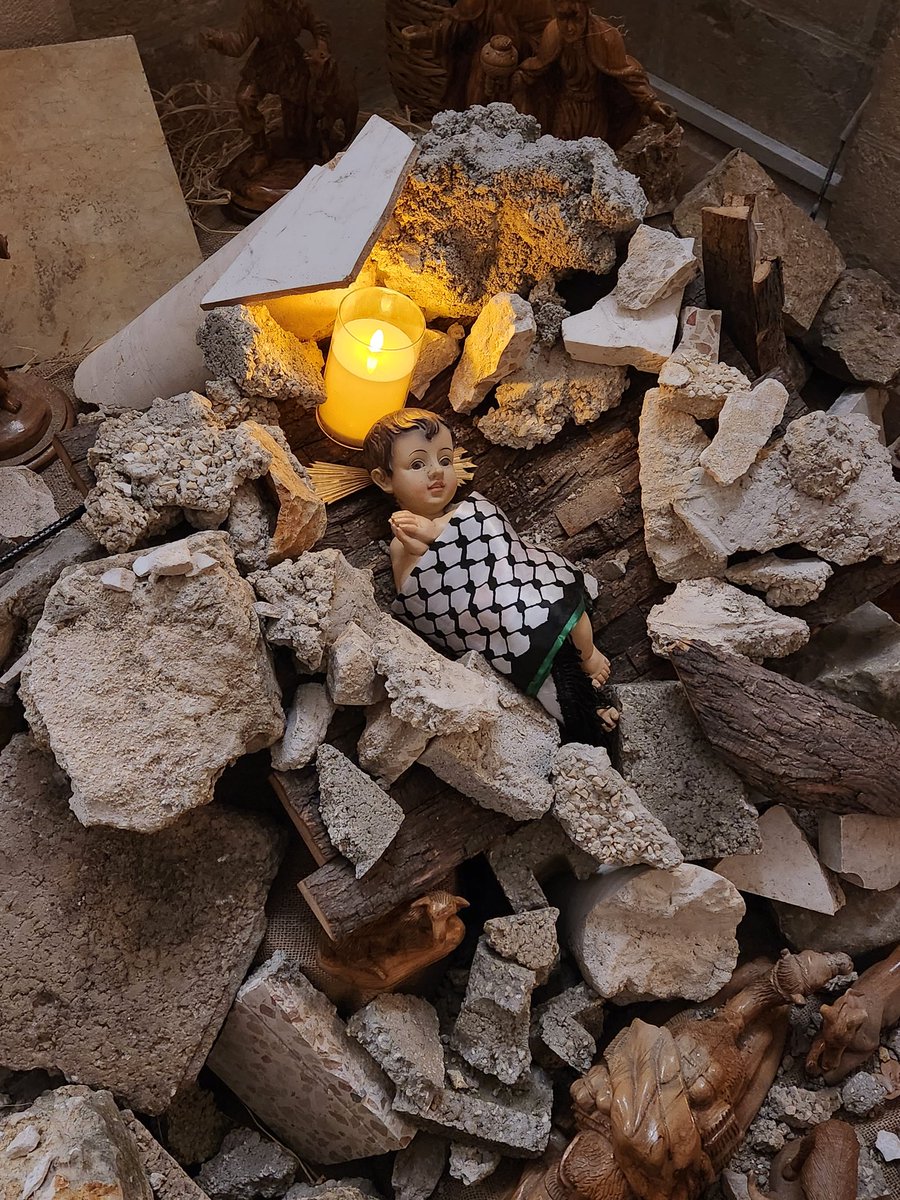
Crèche, December 2023, Evangelical Lutheran Christmas Church, Bethlehem. Photo: Munther Isaac

Today is the 1st Sunday of Christmas. Christmas is far from over as we revel in its meaning for us. Tradition has given us the 12 days of Christmas. Today is the 5th day.

What did my love give me on the 5th day? I’m sure someone will sing the answer.

What’s that all about? Maybe we can guess the significance of the 4 calling birds, the 3 French hens, the 2 turtle doves, and the partridge in the pear tree. Can we?

But what are those 5 gold rings, the four calling birds, the three French hens, the two turtle doves and the partridge in a pear tree?

We see the five rings flying on the Olympic flags, bringing separated nations to play games to bring the world together. Five gold rings, each one representing a continent, all of them representing the whole world. On this 5th day of Christmas, has my true love given me the whole world?

On this 5th day of Christmas our true love gives us this story of Jesus staying behind in Jerusalem and the worry he caused. It leaves us with the question “where in the world is Jesus?” “Where on earth is he?”

This story isn’t told in the other gospels. Luke uses the story to transition from the story of Jesus’ birth to the bigger story of Jesus’ ministry. Instead of staying with his parents for their journey home to Nazareth from the temple festival in Jerusalem Jesus stays behind.

The story gives us Jesus’ first words and they’re the words I suggest we focus on this morning – just in case we lose Jesus and struggle to find him.

We can perhaps all relate to the panic of losing someone in the crowd – so we can relate to what Mary and Joseph must have felt when they realised that Jesus was no longer with them. They thought he was walking back with their relatives or friends but he wasn’t to be found amongst them. They had to go back to Jerusalem to search for him. After three days they found him in the temple courts, among the teachers, listening to them and asking questions.

Remember, this is the beginning of Luke’s gospel. What’s at the beginning of the gospel should remind us of what’s at the end and fulfilment of the gospel, and vice versa. In the end there is another walk – from Jerusalem to Emmaus. Two people walking along the road, talking together about what had happened  – and joined by a third person who turns out to be Jesus. At the beginning of the gospel there were two walking together only because one had separated himself from them. In the fulfilment of the gospel there are three only because one had joined the two.

This is the gospel of Jesus being found in the gospel of the lost and found.

In both stories it takes three days to find Jesus, and three days is a hell of a long time to have lost someone. It was in the breaking of the bread that Jesus had become known to the two disciples in Emmaus. Subsequently he is found in his speech of just four words: “Peace be with you” (24:36) and recognised in his wounds. And this is where Jesus has been found in the church ever since: in the breaking of bread, wherever the greetings of peace are heard, and in the wounds he bravely bears These are the places to look for Jesus. This is where we find Jesus.

Now, that’s a lot to say about the end of his life, particularly as it’s the fifth day of Christmas and we’ve still got the nativity set up in our homes and minds. But already at Christmas we have a birth as well as a death and resurrection. One draws attention to the other in Luke’s telling of them.

Back to the beginning with Mary and Joseph being cross with Jesus. “Son, why have you treated us like this?” And Jesus’s reply to them, “Why were you searching for me? Didn’t you know I had to be in my Father’s house?” These are Jesus’ first words in the gospel of Luke. “Didn’t you know I had to be in my Father’s house?” But they didn’t know what he was saying to them.

This is the question I hope stays with us on this 5th day of Christmas, as we leave one secular year behind and are about to enter another – with fresh resolution to find Jesus wherever he may be – with a commitment to finding him and following him.
Where do we find Jesus?
Where do we find Jesus when we’ve lost him?
Where do we find Jesus when he’s stayed behind?
Why does he stay behind rather than going with us?

Mary and Joseph didn’t understand Jesus’ question. Luke tells us they didn’t understand what he was saying to them. Translators have struggled to capture Jesus’ meaning and have offered an alternative in the footnotes of the NIV – Did you not know I had to be about my Father’s business? But they thought he was in the family business – carpenters for the poor families of Nazareth – Joseph & Son.

But we don’t read the question “did you not know I had to be about my Father’s business? “. We read “Didn’t you know I had to be in my Father’s house?” The question is important because it is a question about where in the world Jesus can be found.

The translation in my Father’s house doesn’t quite seem right. Firstly it suggests the place Jesus can be found is so limited, and secondly it suggests Jesus can be found in a building and that leads us to churchianity rather than Christianity – with church buildings and the institution of church being the place to find Jesus when we know there are so many who love Jesus who’ve not joined a church.

Does this work as a question of Jesus for all his followers, for those who’ve lost him and those looking for him? “Did you not know you’d find me in what my Father is building?” Or, “did you not know you’d find me in whatever my Father is building?” Is that the guiding question? Is that the question to guide our search? As we build our resolution for the New Year, is that the clue to intensify our search for Jesus in what his father, our father, is building?

A couple of chapters further on in Luke’s gospel we come to what is called The Nazareth Manifesto when Jesus read in the synagogue in Nazareth from Isaiah the words, “The Spirit of the Lord is upon me to bring good news to the poor. He has sent me to proclaim release to the captives and recovery of sight to the blind, to let the oppressed go free.” He commented afterwards, “Today this scripture has been fulfilled in your hearing.”

The word manifesto  means showing. Here is Jesus showing what he is about. He is about his father’s business. He is in whatever his father is building. It is on that building site we will find him.

They’ve built a shrine for Jesus in Bethlehem. It shows baby Jesus lying in a pile of rubble in the devastation of his people while Mary, Joseph, the shepherds, the wise men and ourselves search for him. It’s on the side of the altar at Bethlehem’s Lutheran Church. The pastor there, Munther Isaac, a prominent Palestinian peacemaker says that he wants the world to know that is what Christmas looks like in Palestine these days.

Where in the world is Jesus? Where on earth is he? These questions going through the minds of Mary and Joseph go through our minds too.

This is where to find Jesus, in the devastation, wherever there is oppression and suffering, captivity and blindness. 

He’s in the news – in the good news for the poor.
He’s in the sharing of bread.
He’s in the making of peace.
He’s among the wounded.
That is where to find him.

We need look no further.

What glory grows in the dark – a reflection for Christmas night

What glory grows in the dark

This holy night we make friends with the darkness that surrounds us and the darkness that is within us. Tonight, dear friends, we celebrate the light that shines in the darkness and the glory that grows in the dark.

Hello darkness, my old friend

I’ve come to talk with you again

Because a vision softly creeping

Left its seeds while I was sleeping

This might be the only time in the year when we come together to worship in the dark. 

Perhaps, when we were children we needed the light left on on the landing because of our fear of the dark. We grow out of that. We are right to continue to be afraid of the dark – the dark deeds of others, those who hide in the dark to harm us, and even our own dark thoughts which can easily bring us down. 

But we are among the people Isaiah refers to in our first reading, who have walked in darkness who have seen a great light, we have lived in a land of deep darkness and on us light has shone.

This is what tonight is all about. This holy night helps us make friends with darkness. Hello darkness, my old friend. We’ve come to talk with you again.

There’s a lovely quote I came across. “There is a reason the sky gets dark at night. We were not meant to see everything all the time. We were meant to rest and trust even in the darkness” (Morgan Harper Nichols).

The very first verses of our scriptures explains that in the beginning there was only darkness until God made light. He saw that the light was good and then separated the light from the darkness so that we could have day-time and night-time.

There’s always been night time and the night time gives us the opportunity not to have to see everything all the time, time to rest our eyes and trust even in the darkness. The rest and trust is something we grow into.

On this holy night we celebrate that Christ was formed in darkness – in the darkness of Mary’s womb. We all have this in common. We were all formed in the darkness of the womb. We all begin with darkness.

Hello darkness, my old friend. We’ve come to talk with you again.

Darkness is not only physical but also metaphorical. It’s a word we use to describe hopelessness, depression, grief where the darkness is not limited to night time, but stretches into days, then weeks, then into life-times. People talk of the dark night of the soul. 

The prophet, Micah, was speaking metaphorically when he said “the people who walked in darkness have seen a great light”. He knows their darkness – the yoke of their burden, the bar across their shoulders, the rod of their oppressor, the boots of the tramping warriors – and for them the darkness is lit by the child to be named “Wonderful Counsellor, Mighty God, Everlasting Father, Prince of Peace”, and the promise that his authority will continually grow until there is endless peace upheld with justice and righteousness.

This holy night we celebrate that joy and glory are found in the darkness of night. We’ve read in tonight’s gospel – of the good news of great joy brought to the shepherds by an angel in their night watch, looking after the sheep in the darkness. The only light in the night was the glory of the Lord that shone around them. That is the light that shines in the darkness.

What glory grows in the dark!

The light that shines in the darkness makes the night hospitable and makes possible a reconciliation with our old friend Darkness. Jesus is born in our darkness and he lives in his darkness. Darkness is a place we can stay awhile. We don’t need to make light of our troubles and those who are troubled around us. Too often we are afraid to get involved and keep the other at arm’s length, or walk by on the other side. But the glory that grows in darkness encourages our hearts, not making light of their troubles, but being a very present help. 

Don’t rush the end of Christmas. Christmas is only just beginning, here in this night. There are twelve days of Christmas. The day we are just about to enter is Day ONE. We have plenty of time to dwell on the Christ child, to let his authority grow and glow in our lives. We have time to speak with darkness, our old friend, while the glory of the Lord shines all around.