So you want to be a sheep then: sermon notes for Christ the King (Sunday and church)

Sermon – Nov 23rd 2014

Christ the King, Birkenhead.

Christ the King Sunday

So you want to be a sheep, do you?

Do you remember PE at school – when teams were picked. “Pick me”. We prayed didn’t we that we wouldn’t be the last person chosen. There are two teams in today’s gospel (Matthew 25:31-end). On the one hand there are Sheep, and there are Goats on the other. The Sheep are the winning team, the Goats are the losers – although the team looks anything other than a winning team.  The Sheep are promoted by the Son of Man – they have a podium position. The Goats are relegated and put out of business.

Who do we want to play for: the Sheep or the Goats?

But then, there are good sheep and bad sheep, according to our OT reading (Ezekiel 34:11-16, 20-24). Ezekiel explains how we can tell them apart when he talks about God’s way of judging them apart. The fat sheep are accused of being violent, abusive and non-caring within their community, pushing their way around. “You pushed”, God says. “You pushed with flank and shoulder. You butted at all the weak animals with all your horns until you got your own way and had it all for yourself. You scattered them far and wide.”

Ezekiel is one of the “lean sheep”, pushed around, butted and scattered – forced into exile.

His complaint rings true through all ages. There always seem to be people who behave like this, like bad sheep. Back then, Ezekiel’s people have been scattered far and wide in a way that reminds us of what happens in our world today, when so many people are dislodged from their families, forced to flee their homes, communities, work and livelihood.

For Ezekiel and his fellow exiles, the problem has been poor leadership (the leaders are referred to as shepherds). The leaders have only been interested in themselves, feeding themselves at the expense of the people, failing to provide any welfare or benefit system. The sick were ignored. The injured were ignored – and the leaders ruled with a rod of iron. That is why the people were scattered. Ezekiel and his fellow exiles had no choice. They had to go. That is largely the case today as well. The villagers under attack by Islamic State have no choice but to flee. The victims of domestic violence who pluck up the courage to leave their situation say “we had no choice, we had to get out”, and others who can’t leave also say “we had no choice, there was nowhere to go.”

Life should have been uncomplicated for them. They should have led settled lives in straightforward communities, in close contact with parents, grandparents and grandchildren. Instead their lives were disrupted.

The calamity of weak and/or violent leadership catches up with people so quickly, at all levels of our lives. It’s the national tragedies which catch our eye in the news – but the tragedies are lived out small in our workplaces, in the playground (bullying) and in our homes (we are used to hearing about domestic abuse, elder abuse and child abuse). The victims are the lean sheep, pushed around, butted, battered, scattered, unfairly and cruelly treated.

We know what happens to them:

to the children who are neglected, who go unheard, who deserve better.

  • Some of our children are treated so badly – maybe their parents caring only for themselves in the manner of the bad shepherds that Ezekiel riles against. Some of the children manage to run away – scatter – and we all know that there are many adults preying on vulnerable youngsters. Why should they be denied a home? Why should they be denied safety? Why should they be denied care? These lambs deserve the care of a good shepherd – by their very nature. Any different and the natural order of things is turned upside down.
  • to those who become refugees, clinging desparately to their identities, crossing boundaries into lives where they’re still not wanted forced to do work which really was beneath their dignity. The skills of doctors being wasted as they become cleaners. Fully trained nurses having to take any job they could find – zero hours contracts. The dream is somewhere safe to escape to – somewhere you’ll be wanted for what you can offer, but then discover that you’re fenced in from making the border crossing. Some become desparate – casting out to sea with a vague hope that they might make it, but fearful of other wild creatures who lurk in the deep

There is a charity called Eaves which runs the Poppy Project. They report Ellie’s story (which I didn’t use in the sermon):

When Ellie, 32, describes the first part of her life, she races through the disturbing details in a neutral tone; the problems she experienced as a child and a young woman are not what makes her angry. She grew up in a slum outside Kampala in Uganda. She was sent to live with another family when she was seven and sexually abused by the head of the household; when she turned 15, she was forced to marry him. He was violent, so when a neighbour offered to help her escape to a new life abroad, she agreed.

She was taken by plane to the UK with a group of six other women. Ellie thought that she was going to work as a cleaner, but on the day she arrived, she was driven to the home of a white man who told her she would have to work as a prostitute to pay back her debts for the passport and air travel. For two years she was locked in a house with the other women, and periodically driven to customers’ homes.

She only escaped when a sympathetic client gave her £60 and explained how to get to London. In London, she met a man who allowed her to stay with him, but who quickly began to ask for sex in exchange for shelter. One night when he was violently abusive, she called the police.

This is the moment, in a life story of unmitigated misfortune, when you might expect that things would begin to improve. However, it marked the beginning of a new wave of difficulty, and this is where she begins to get angry. She was taken to hospital, but not treated; later the police took her to a police station, where she was fingerprinted and told she had no visa. Since she had only been given a passport to hold for a few seconds when she passed border control at the airport, she knew nothing about visas.

“They were asking each other: ‘Did she come here legally or illegally?’ The way they were talking was very intimidating. They didn’t ask about the attack. They were more interested in why I was staying in the country without a visa.” The man who hit her was not arrested, but she was taken to Yarl’s Wood detention centre. “I’d never been in detention before. It felt like a prison: being locked up, eating your food at certain times, sleeping at certain times. Most of the time you can’t go outside; you can barely see daylight.”

The other inmates laughed at her when they found out she had called the police, and told her she was stupid to have expected them to help her. She was quickly put on suicide watch because she told staff that she would kill herself rather than be deported back to a country where she would be in danger from her husband and her traffickers. “They wouldn’t let me buy tinned food in case I took the tin and cut myself; they watched me while I showered in case I hanged myself,” she says. For a while she regretted having escaped from her trafficker, and thought returning to her existence as a sex slave might be preferable.

It was only when she was in Yarl’s Wood that she realised she had been trafficked. “So many of the women I met in detention had been trafficked. I don’t think the police who interviewed me knew about trafficking. They were more interested in catching someone for being an illegal migrant than in helping someone who has called for help. All they were talking about was deporting me,” she says.

It was only when a sympathetic guard suggested that she put her name down for legal aid that she was put in touch with Eaves. Her asylum claim on the grounds of trafficking was rejected initially, but with Eaves’ help, this was overturned.

She wishes there was greater awareness of trafficking throughout the system. If border staff had been on the lookout for people-trafficking when she arrived in the UK, she would have been prevented from coming into the country. “If they had stopped me on the border, I would have been so much happier; I wouldn’t have done all the bad things that I was made to do. But I came here and I was turned into a prostitute.”

She is calm when we speak; very articulate and very angry about what has happened to her. “Putting trafficked people in prison – that is the worst part of it. You have gone through bad times, and then you find yourself in detention, told you are going to be deported back to the traffickers. That man is still there and he is still bringing in women. That’s why I’m so upset.”

Pushed around, butted, battered and scattered. In exile with a longing for the care of something like a good shepherd.

Tuesday is White Ribbon Day – a day for men to pledge to “never commit, condone or remain silent or remain silent about men’s violence against women” – tantamount to a commitment to playing a proper part in home, family and community.

Good sheep don’t push their way round. Good sheep aren’t selfish. Good sheep aren’t frightening.

Good sheep have good shepherds who they follow. The people of God have had many shepherds. Some have been good, many of them have been bad (Ezekiel is speaking from experience). Ezekiel looks forward to the time when the bad shepherd has had his day, looking forward to the time of good shepherding when the scattered sheep will be gathered in good grazing land.

Jesus shows himself as the good shepherd. It is how he describes himself as the good shepherd, and that is why he is interested in the sheep. His place is with them, not with the goats. At times, at the worst of times, his sheep look awful – and no wonder, because they are the ones pushed around, butted and scattered. They are hungry, thirsty, naked and sick. They are strangers and prisoners. Good sheep who have responded to the shepherd’s call.

If we are sheep, how do we play our part amongst them? Do we act big or play gentle? Are we one of them, or are we acting the goat?

Acknowledgements:

Jesus is a very disruptive influence: a sermon on Matthew 10:34

Notes for a sermon for Ashton Hayes for June 22nd 2014

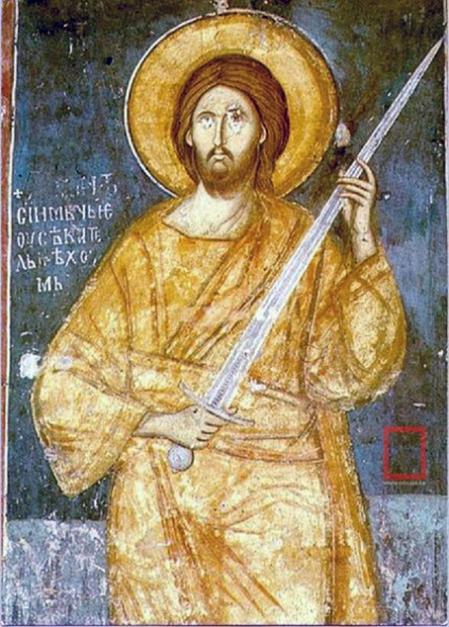
Fresco in the "Visoci Decani" in  Kosovo
Fresco in the “Visoci Decani” in Kosovo

Text: “Do not think that I have come to bring peace to the earth: I have not come to bring peace, but a sword.” (Matthew 10:34)

Teachers are busy writing school reports. Here’s Jesus’ report from the autumn term:

  • Resistant materials – A – excellent in woodwork section, and obviously well supported by the help and stimulation he gets at home.
  • Maths – F – Lacks basics. Keeps muttering about “Three in One” and “I and the Father are one”.
  • Graphic communications – D – Prefers to draw with a stick in the sand than to use pencil and paper.
  • Physical Education – D- Jesus has been a troublemaker. He refuses instruction in swimming, and is surprised that he sinks when he tries to walk on the water.
  • Overall – it saddens us to say that Jesus is a disruptive influence in the class. He flouts uniform regulations by turning up in sandals. He chooses his friends unwisely.

Another report was found by Monty Python.

Pupil’s name: God

  • Biology – 28% – weak, thinks he knows it all. Constantly rude about Darwin.
  • Domestic Science – 54% – a useful cook, the pillar of salt will come in handy for a long time.
  • Games – will not row, hates games and once parted the waters of the swimming pool during a match against the old boys which was both unsporting and dangerous. He can still do press ups.
  • Progress and conduct: “I am afraid that I am severely disappointed in God’s work. He has shown no interest in rugger, asked to be excused prayers and moves in a mysterious way. His attentions to the carpentry teacher’s fiancée caused her to leave a term early, and there are several nasty rumours flying around.

There is no getting round the fact that Jesus is a disruptive influence. As he says himself in today’s gospel reading: “I didn’t come to bring peace. I  came to bring a sword.” (Matt 10:34)

Here’s trouble and an affront that we overlook at our peril. This is challenging behaviour.

His mother was no better. Her song (from Luke’s songbook and gospel), Luke 1:46-55, aka Magnificat, was banned for many years. The authorities in British ruled India, and in 1980’s Guatemala and Argentina banned the words from being read out loud because they were too revolutionary.

Mary knew that Jesus was not good news for everyone. For every blessing that she sang there was an answering curse on those who thought they had it all. She sang of the one who looks with favour on the lowly, and who scatters those who are proud in their innermost thoughts, the one who lifts up the lowly, but brings down rulers from their thrones, who fills the hungry with good things, but sends the rich away empty.

Woe betide us if we become proud, rich and powerful. According to her song, we will be scattered, brought down and sent away empty.

Mary too is disruptive and dangerous for the authorities. It is no wonder that she is silenced by the authorities from time to time. Jesus takes after his mother and father. Blame the parents, if you like.

50 years ago, this weekend, three young men went to investigate a church that had been burnt out. The church was Mount Zion Methodist Church in Neshoba County in Mississippi. This was a building that was being used to register black voters in the States in what was called Freedom Summer, 50 years ago, in 1964 in the civil rights movement.

The state authorities were bitterly opposed to the voter registration campaign, believing that blacks shouldn’t be able to vote. You can feel the authorities bristling with the arrival of these three men: Michael Schwermer, James Chaney and Andrew Goodman. The authorities were sheltering the culprits of the chapel burning. Their crime was about to be exposed by these men who had come to disrupt their peace.

Deputy Sherriff Cecil Price followed the men as they drove back to their home in Lauderdale County. He intercepted them just on the county line and ordered them into his car. He then drove them to a deserted piece of land where they were met by two cars full of Ku Klux Klan members. They beat, shot and killed the three men, 50 years ago this weekend, June 21st 1964.

The lives of the three are commemorated in a stained glass window in the chapel of Cornell University. Their faith is celebrated in the words of the gospel song made famous by Pete Seeger and Joan Baez – “we shall overcome”.

Are they martyrs for us? Or were they disruptive and dangerous? What do we think? Are we on the side of the Klansmen, or the poor of the earth?

Those three didn’t bring peace. Neither did they bring a sword. They brought beatings, shootings, burnings and violence. They didn’t bring those things themselves. They brought those things on themselves. They engaged the powers and suffered their might.

Does this help us to understand what Jesus said when he said, “I didn’t come to bring peace, I came to bring a sword”? In the cold light of day these words strike us as difficult. They challenge us and disrupt us. The more we burn with passion, the hotter we get under the collar, the more our hearts burn within us, the more understandable they become.

What good is gentle Jesus, meek and mild in a world that is crying out for disruption? The prophet Jeremiah complains about the false prophets who claim that there is peace when there is no peace. (Jer 6:14)

No, Jesus comes with a sword. He is disruptive and he is divisive. The authorities expected him to go one way, and he went the other – to the lost, the last and the least. His words were salvation to some, but offensive to others.

The words of Mary’s song provide commentary on Jesus as well as his father: he looked with favour on the lowly, and scattered those who are proud in their innermost thoughts, lifting up the lowly, while bringing down rulers from their thrones, filling the hungry with good things, while sending the rich away empty.

He never used the sword.

The sword is metaphorical. It is an effect. The sword is what happens as a consequence of his love. People turn on one another and on him. Even families and friends turn against each other. He is disruptive and unsettling for us all.

He didn’t bring a sword but he brought a sword on himself. The political and religious authorities got him in the end. Jesus never drew a sword – he loved through the challenge and disruption. And he told his followers to put their sword away, as we recall from the incident in the Garden of Gethsemane. (Matt 26:51ff)

When Jesus said “I haven’t come to bring peace, but a sword” he was preparing his followers for mission, so that they might be disruptive in a world crying out for disruption. He was preparing them for a dangerous mission which could bring disruption, persecution and even death.

What is true of Jesus is true of the church.

Just some times we have to stand against the crowd – like those who were conscientious objectors in the war 100 years ago, like those who protest when they see injustice being done, like when we side with the scapegoat, the sick, the prisoner, the stranger.

It just might be that we have to stand alone – our friends may desert us, our families may turn on us, we may lose our cherished place in the community.

We stand for love and we overcome evil with good. We can’t pretend there is peace where there is none. We haven’t come to bring peace, but a possible sword on ourselves.

So I wonder what it will say on my final report. Will it say that I have been a troublemaker? Will it say that my behaviour has been challenging? Will it say that I have been disruptive for the sake of those who suffer in the way things are?

Or will it say, “he was just nice”? What good is that, only being nice? Being nice just doesn’t cut it does it?

References:

Thanks to http://www.pleacher.com/forwards/forwards/jcreport.html for Jesus’ school report.
Thanks to http://www.churchinacircle.com/2013/12/29/marys-subversive-song/ for the ideas about Mary’s subversive song.

Leaving us for good – a sermon for Ascension Day

Notes for a sermon preached at Holy Trinity, Gee Cross.

Introduction

Our two readings come from the end of Luke’s Gospel and the beginning of the Book of Acts. (Acts 1:1-11 and Luke 24:44-53)

Luke ends his Part One and begins his Part Two with a celebration of Jesus’ Ascension.

At first glance it looks like these two volumes are addressed to a particular person called Theophilus.  But Theophilus is a strange name. Translated, it means “God lover” – which leaves us with a question. Are these two books addressed to one person called Theophilus, or to all “God lovers”, including ourselves?

And the story of the Ascension is one that causes us all sorts of difficulties. It’s a story that stretches the dimensions of our lives, where earth and heaven connect – a tall story that is difficult to fathom.

40 days and nights have passed since Easter Day (40 days and nights!). Those 40 days were packed with Jesus’s appearances and his talk of the kingdom of God. The 40 days  end with this – a blessing, a promise and a withdrawal as Jesus was carried into heaven, carried out of the sight of the disciples on a cloud.

So what?

Flight paths

It seems like only yesterday that we were landing at Heathrow after visiting our son and his girlfriend in the Philippines. It is actually 40 days and nights – we landed on Easter Day, having been on a plane for 17 hours. The flight path reads like a where’s where of the world’s trouble spots.

Bosnia, Beirut, Bangkok, Iraq, Pakistan, Vietnam, Cambodia etc etc – flying into Manila, regarded as the second most dangerous city in the world.

How weird was it? Flying 38000 feet in the airspace above those trouble spots, with all their tensions, sufferings, betrayals, poverty and uncertainty, as if they weren’t there. We were flying over deep divides and no go areas as if they didn’t exist. We were like birds flying over reality and missing all that counts in human life. It was as if we were travelling in a totally different dimension.

(Another example would be our city’s flyovers)

For the last 40 days and nights it has been back to earth with a bang!

Which, I suspect is where we belong. We are, after all, Adam – humans made from the earth, to walk the earth, with our feet of clay. And for that, we believe that God loves us – and we may believe that is where God wants us to be – down to earth, earthy and earthed.  That seems to be the message that Luke is leaving us “God lovers” as he describes Jesus’s goodbye to his disciples, as he leaves them us to be “witnesses … to the ends of the earth”.

Grounded as birds without wings

I don’t know whether any of you have read Birds without Wings by Louis de Bernieres. I’ll try to describe the story without giving anything away for any of you who want to read it.

The story is set in innocence at the turn of the 20th century in a town called Eskibahce in south-western modern-day Turkey, then a part of the waning Ottoman Empire. The village potter, Iskander, a Muslim, makes clay bird whistles for his son, Abdul, and his Christian friend, Nico. Their whistles make different bird song. One is a blackbird, and the other is a robin. They take on the nicknames of their birdsong – Blackbird and Robin.

They are birds who fly over the hills overlooking their town. They play at flying, but, of course they can only fly in their imagination.

Reality soon becomes quite different, as the population of the town gets caught in events. They find themselves caught in the tensions between Greek nationalism and Turkish nationalism which destroyed the fabric of the town. The boys are of course, birds without wings, and they are caught up in the violence of the conflict. There is no way that they can fly over their divisions. They are earthy and they are earthed – and they suffer the consequences of down to earth historical realities. Such realities can only be overcome by living through them.

We all have flights of fancy, don’t we? But at the end of the day there is no escaping the day to day challenges of our lives. We cannot rise above them, but have to engage with them. We can’t ignore them, because that would be irresponsible and careless.  We have to live with our circumstances, and through the events of our lives.

That is what Jesus leaves us to do. That is what Jesus leaves us for.

Left behind for good

The picture that Luke paints for us is a farewell scene, which might remind of us other partings, and snapshots of farewell greetings with the waving of hands, the dabbing of tears, the heartache and the parting words.

Jesus is saying goodbye to his friends, but this goodbye scene is so different. It is not tinged in sadness, but explodes with joy, because Jesus’ parting words are full of promise. The promise is that the disciples, the God lovers, would receive power when the Holy Spirit comes upon them. That promise must have helped them to look forward with hope instead of looking backwards with sadness. The gift of the Holy Spirit transforms all our partings and farewells since that good bye described by Luke and celebrated by us today on this Ascension Day. The gift of the Holy Spirit is a blessing for all those who mourn. It is the help we need to live through what seems to be the dead ends of our lives. It is the comfort to ….. It is the strength to overcome.

The disciples were indeed left behind, but left with joy “continually in the temple blessing God”. They were left behind for good.

The good they were left behind for was surely to live through their lives as witnesses, in a way that God’s blessing shone through. Their lives weren’t easy. They faced hardships, imprisonment, persecution and death. They were hard pressed on every side, but they lived through those times.

The good they were left behind for was to convey the spirit of Jesus, to bring good news to the poor, to proclaim release to prisoners, to help the blind to see and to let the oppressed go free. (Luke 4:18f)

The good they were left behind for was to live through all of this, to keep their feet to the ground, to take the long walk through difficulties to freedom, down to earth, with feet of clay.

Like those God lovers, we have the same blessing – treasure in clay, earthenware pots. Is the challenge that Luke addressing to his dear readers just this: to be down to earth witnesses for all the earth by living through the tensions and challenges of our lives.

Have we been left behind for good? Has the church been left behind for good?

But this isn’t saddening. There is no reason to lose heart because of it.

This is the great farewell. This is the goodbye that gives all goodbyes hope and joy. This is the goodbye which spells out its meaning. “God be with you”, his spirit is with us.

Therefore, we go. We go in peace to love and serve the Lord, realising that it is now up to us.

Adapting a prayer of St Teresa of Avila:

Christ has no body but us,
no hands, no feet on earth but ours.
Ours are the eyes with which he looks
compassion on this world,
ours are the feet with which he walks to do good,
ours are the hands, with which he blesses all the world.
Ours are the hands, ours are the feet,
ours are the eyes, we are his body.
Christ has no body now but us,
no hands, no feet on earth but us,
Ours are the eyes with which he looks
compassion on this world.
Christ has no body now on earth but us.

We are left behind for good, with his blessing and spirit.

Cerezo Barredo’s weekly gospel illustration

Thomas’s Twin – a sermon for Easter 2A

Sermon notes for Easter 2A for St Alban’s, Broadheath. Again, it could be said better, and I hope it will be. I share it anyway. The Gospel reading is John 20:19-31

Who likes ants?

We are told to learn from the ants. Proverbs 6:6 – “Go to the ant, you sluggard: consider its ways and be wise.”

It’s true. We can learn a lot about community and industry from ants. We can also learn that if they get lost they die. When ants get lost, they follow a simple rule. The rule is to follow the ant in front. But they don’t know that the ant in front of them is only following the ant in front of him. They finish up going round and round in circles, blindly following the one in front until …. They die.

There is a famous example of this deathmill from the Guyana jungle. The ants were just going round in circles – it was a trail of ants which just kept marching in a column 400 yards long (the length of a running track). It took them 2 days to complete a circuit. On and on till they died from exhaustion.

Consider its ways, and be wise. What do we learn from the ant? We learn the importance of thinking for ourselves. We learn the importance of seeing for ourselves.

“Seeing is believing.” That’s what we say, isn’t it?

“We have seen the Lord” is what the disciples say in today’s gospel reading. “We believe”. “We have seen the Lord” is what the disciples say to Thomas, who wasn’t there to see and believe. He is the odd one out.

He was in the wrong place at the wrong time and missed seeing Jesus.

Seeing is believing is the theme of John’s gospel. Time and again John refers to the disciples “coming to see”. The frequency increases as we move to the end of John’s gospel.

  • Mary Magdalen came to the tomb and saw that the stone had been removed,
  • Peter and the beloved disciple ran to the tomb and saw the linen wrappings lying there. They went into the tomb, and saw and believed.
  • Mary Magdalen told the disciples that she had seen the Lord.
  • Mary Magdalen, Peter, the beloved disciples come to see the Lord.
  • And then, that same evening of the day of resurrection, the disciples “see the Lord” – apart from Thomas. Where was he? What was he doing?

Seeing is believing.

But if seeing is believing, what about those who are not there to see, like Thomas?

And what about those who can’t see? What about those who not even Specsavers can save?

This was a problem for a friend of mine who became blind. He was troubled about all that the Gospels say about “seeing” and “believing”, and about “light” (good) and “darkness” (bad). How could he believe when he couldn’t see? How could he be saved when he had been cast into outer darkness?

Do you see his problem?

He worked it out in the end, eventually realising that there are other ways of seeing. He called it “whole body seeing” and wrote the story of his blindness and his later whole body seeing in a book called Touching the Rock.

This is how he discovered his “whole body seeing” (WBS for short). He was staying at Iona. He had been told about the altar there by people who had described it to him. Then he saw it for himself. This is what he wrote:

 “After several nights, I discovered the main altar.

I had been told about this, and I easily recognised it from the description. It was a single block of marble.

Finding one corner, I ran my fingers along the edge, only to find that I could not reach the other.

I worked my way along the front and was amazed at its size.

The front was carved with hard, cold letters. They stood out baldly, but I could not be bothered reading.

The top was as smooth as silk, but how far back did it go?

I stretched my arms out over it but could not reach the back. This was incredible.

It must have a back somewhere. Pushing myself upon to it, my feet hanging out over the front, I could reach the back. I did this again and again, measuring it with my body, till at last I began to have some idea of its proportions. It was bigger than me and much older.

There were several places on the polished surface which were marked with a long, rather irregular indentations, not cracks, but imperfections of some kind.

Could it have been dropped? These marks felt like the result of impact. The contrast between the rough depressions and the huge polished areas was extra ordinary.

Here was the work of people, grinding this thing, smoothing it to an almost greasy, slightly dusty finish which went slippery when I licked it. Here were these abrasions, something more primitive, the naked heart of the rock.”

When I read that I just went WOW. He had seen things which would not have been noticed by the casual observer with her naked eye. With his whole body seeing he had found things there which I am sure he’d be telling others about over breakfast the next day. “Come and see” he’d have been telling everyone.

I mention this because I think there is something in today’s gospel about the importance of seeing things for ourselves. When we see things for ourselves we are not seeing through other people’s eyes. We are not conforming to their vision, and we are seeing things that nobody else sees.

This brings us to the beauty of Thomas who is the focus of our gospel reading.

Thomas is a disciple who captures our imagination, isn’t he? That’s shown in the number of Thomases there are. (How many here are called Thomas, or have a Thomas in their family?)

Two of our children have Thomas in their names, after their grandfather.

We often talk about “doubting Thomas” and then refer to him as typical of us, who are often “doubters” like him.

I’m not sure that this is helpful. Thomas is actually someone who sees and believes, but in a different way. Isn’t that a more helpful way to remember Thomas?

Thomas sees things differently. This is brought out in the gospel. He wants to see through his hands and fingers. He uses his body. He doesn’t just see with his eyes. He inspects. He uses his senses and his sense. He sees with feeling. He sees from the heart.

That is the way that Thomas comes to see.

He puts his hand into Jesus’ wounds. He reaches beyond first impressions. And then he sees. He feels the love in those scars and jumps to his joyful conclusion that he is seeing our Lord and our God. This is the staggering realisation which comes from seeing from the heart, which comes from seeing with feeling, which comes from his insistence that he should see things for himself.

Thomas is not the doubter. He is one who was willing to see.


Thomas is a twin. That is how he is introduced in the gospel. “Thomas the twin”. We don’t know whether Thomas had a twin brother or sister. IT’s more likely that “twin” was Thomas’s nickname because the meaning of the name Thomas is “twin”. But if Thomas had a twin, who might it be?

That  might have been a question that entertained John’s community. “If Thomas is the twin, who is his twin brother or sister?”

They could have played with that question and wondered “is that me?”

We can play with the same question. If Thomas is like us in his doubting, can we be like him in his seeing and believing? How much like him can we be? Can we be his twin brother or sister in the way that we are so much like him in wanting to see Jesus from the heart?


Jesus made many “resurrection” appearances – or should I say that Jesus makes many “resurrection” appearances. John admits that there are so many ways that Jesus showed himself and supposed that “if every one of them were written down the world itself could not contain the books that would be written.” Jesus wants us to see him for ourselves. He wants us to be witnesses.

Mary Magdalen, Peter, the disciple (disciples?) Jesus loves/loved, Thomas and ourselves come to see in their different ways. Together we are a body of believers who through our whole body seeing see things differently.

It is in such company that Jesus shows himself so that we might see life differently – with compassion that is able to feel for scars and wounds, and with the hope that love is stronger than death.

It is in such company that Jesus shows himself to us so that we might follow him in a way of life that is life giving, instead of blindly following others till, like the ants, we drop from exhaustion.

the quote is from Touching the Rock by John Hull
I found the picture of Still Doubting at Mattseyeshaveseen – with some interesting reflection.

A Romero celebration in Alsager

Sermon preached at the lovely reordered St Mary’s Alsager for the meeting of Congleton Deanery Synod. It commemorates Archbishop Oscar Romero. It could have been said better – but I share it anyway.

27 bishops wrote to the Daily Mirror a couple of weeks ago complaining about the Government’s welfare reforms. They pointed out that recent cuts have forced tens of thousands of people into a painful choice of “heat or eat” and reminded us that half a million people visited a food bank last year, and 5.5 people were admitted to hospital with malnutrition.

The letter caused a minor stir. Why? Was it because the bishops were dabbling in politics? Was it that they chose the Mirror rather than the Times? Was it because they knew what was lamentable and lament?

The letter raises the question of the place of church in society. What is this place?

Is it at the centre of things? Hopefully the answer to that is “yes”, so long as that means the “heart of the community”, as opposed to wanting to look big.

Is its place to be on the side, on the edge? Hopefully the answer to that question is “yes”, if by yes we are meaning that we are on the side of those who are overlooked – those who are overlooked because of their poverty, because they don’t fit in, because they are shied away.

On this day 34 years ago Archbishop Oscar Romero was shot dead while celebrating Mass. He was Archbishop of San Salvador, Archbishop of a church which took the people of El Salvador to heart, a church which had been edged out by a violent government, a church which was on the side of the landless poor. He spoke out on their behalf and became known as the Voice of the Voiceless. His voice became stronger. People packed into the Cathedral to hear him. They listened to him on the Archdiocese’s radio station. And then he was silenced, by a gun fired from the doorway of the chapel in a cancer hospital as he celebrated Mass.

He was the third bishop to have been murdered in the sanctuary. Bishop Stanislaus of Krakow was killed in 1079 (for scolding the Polish king for his sins), Thomas Becket was killed in 1170 for defending the Church’s rights and freedoms. Oscar Romero was killed in 1977 as an outspoken opponent of injustice and defender of the poor.

Oscar Romero, other martyrs, other ministers, remind us what these spaces are for. They are spaces where we become occupied with God and by God. They are spaces where we occupy ourselves with what occupies God – spaces for the sinner (rather than the righteous), for Lazarus (not the rich man Dives, or the celebrity Divas), for those whose cries are heard by God (and ignored by others). It is the poor, who, according to Romero, “are the ones who tell us what the world is and what service the church must offer to the world.”

We need to safeguard these spaces of blessing and salvation, where truth is told and lives are rebuilt. They are dangerous, countercultural breathing spaces in which lives are lost for the sake of gaining the kingdom.

Romero said this in one of his sermons: “An accommodating church that seeks prestige without the pain of the cross is not the authentic church of Jesus Christ.”

This is the Jesus who comforts his followers in the face of the hatred of the world. He reminded followers then, as he reminds us in this evening’s gospel, that the world didn’t love him, but hated him. “If they persecute me, they will persecute you.” But “if you belonged to the world, the world would love you as its own.” Going the way of the world is not following Jesus’ way. That’s not the way Jesus had in mind when he calls people to follow him.

There has been a lot of ink spilt about the identity of the “beloved disciple” in John’s gospel. Was it John Zebedee, Lazarus, Thomas, Nathanael, John the Elder, or even Paul? Or, was it none of these people? Whoever it was had a special place in Jesus’ life. That place is stated as “the place nearby” at the cross (John 19:25), and “reclining next to him” (13:23).

The beloved disciple is the one who “leant back against Jesus”. He is the one who had the physical contact. He is the one who was at Jesus’ side. 

Who is the beloved disciple? Is it you? Is it me?

The beloved disciple is THERE, just there (indicating heart/shoulder). The beloved disciple is at the side of Jesus, and because of that SEES and understands what the others couldn’t. That closeness means that he/she is able to hear the whisper of Jesus. (13:23).

Oscar Romero was at that place. He could see, understand and articulate the truth of what was happening. He was able to name the injustice and the suffering.

The place is the “kolpos” or “bosom” of Jesus.

There is one other use of the word “kolpos” in the gospel, and that is at 1:18, where it is Jesus who is described as being at his Father’s bosom, or “close to the Father’s heart”.

The beloved disciple is the one who is at the heart of Jesus, who is close to the Father’s heart, who hears what occupies Jesus’ heart – who sees and hears as Jesus hears.

That is the space we are called to be in as beloved disciples.

It’s the space Oscar Romero occupied as he celebrated Mass in the chapel of a cancer hospital (a place at the edge and on the edge of life). His place was close to the Father’s heart, occupied with what occupies God.

In that most dangerous of places he was shot – a life given for the sake of the kingdom.

A prayer to finish with, from Oscar Romero:

“Let us be today’s Christians. Let us not take fright at the boldness of today’s church. With Christ’s light let us illuminate even the most hideous caverns of the human person: torture, jail, plunder, want, chronic illness. The oppressed must be saved, not with a revolutionary salvation, in mere human fashion, but with the holy revolution of the Son of Man.”

Here’s a sermon preached by ++Rowan Williams on the 30th anniversary of Romero’s assassination.

Maggi Dawn has posted a prayer closely associated with Oscar Romero.

Lazarus Sunday

israel-125year-old-man-laughing
laughter of a 125 year old Israeli.
Source unknown.

Lazarus’s laughter brought a challenge to yesterday’s sermon (April 10th 2011). “Doesn’t God only laugh at the wicked?” was my tight-lipped challenger’s question.

According to the Lazarus’s post-mortem report I had picked up from Eugene O’Neill’s play, Lazarus LAUGHED. Lazarus had replied to his sisters’ question about what life was like after death by saying that God’s laughter resounded round heaven. Lazarus too in his post-mortem life could only laugh. That is how he came out of the tomb, with laughter welling up from his whole being.

I thought. Maybe God does laugh at the wicked (though I think he probably takes them more seriously than that), but I am sure he laughs along with the righteous (sorry, theological correction – those he has made righteous).

Two points intrigued me with the Lazarus’s story.

Firstly – it’s what’s in a name. Lazarus isn’t a name you hear much about – would his nickname be Laz-y (we often shorten names to the first syllable and then add a “y”). If we pronounce it Lazzy, his friends would be members of the Lazzy band. Lazarus means “God helps”. He’s from a village called Bethany. Bethany means “house of affliction”. So the story of “Lazarus in Bethany” is the story of “God helps in the house of affliction”.

Secondly, Lazarus stands for all of us. Laz ‘R’ Us. We can’t establish Lazarus’s cause of death for his post-mortem report from John’s gospel (11:1-45). But we know what causes ours – pick any from poverty, abuse, disease, anger, anxiety. We all get  bound up with these, with deadlines, with expectations of others. They all suck the life from us. When Jesus called “Lazarus, come out” he is calling us out of our bind, so that we can have post-mortem life. (How that phrase “coming out” has gained new liberative meaning in recent decades!) No longer bound by his ego, no longer with death on the horizon, Lazarus stands for all of us.

God helps Lazar/us in the house of affliction to laughter and life. When Lazarus laughs, he laughs with all who enjoy post-mortem life, whose date of death is not some time in the future, but a moment in the past.

I was struck by the beauty of this Lazarus blessing by Jan Richardson from her beautifully Painted Prayerbook.

The secret
of this blessing
is that it is written
on the back
of what binds you.

To read
this blessing,
you must take hold
of the end
of what
confines you,
must begin to tug
at the edge
of what wraps
you round.

It may take long
and long
for its length
to fall away,
for the words
of this blessing
to unwind
in folds
about your feet.

By then
you will no longer
need them.

By then this blessing
will have pressed itself
into your waking flesh,
will have passed
into your bones,
will have traveled
every vein

until it comes to rest
inside the chambers
of your heart
that beats to
the rhythm
of benediction

and the cadence
of release.