God whispers
the disciple Jesus loves
hears
her ear to God’s heart
an angelic relay
to those busy
elsewhere
out of earshot
Category: spirituality
A message from Oscar Romero
Embed from Getty Images
Today marks the anniversary of Archbishop Oscar Romero’s martyrdom. He was shot dead on March 24th 1980 when celebrating Mass in the cancer hospital where he lived. This is from one of his sermons:
Those who have listened to me here in church on Sundays
with sincerity,
without prejudices,
without hatred,
without ill will,
without intending to defend indefensible interests,
those who have listened to me here cannot say
I am giving political or subversive sermons.
All that is simply slander.
You are listening to me at this moment,
and I am saying what I have always said.
What I want to say here in the cathedral pulpit
is what the church is,
and in the name of the church
I want to support what is good,
applaud it,
encourage it,
console the victims of atrocities, of injustices,
and also with courage
disclose the atrocities,
the tortures,
the disappearance of prisoners,
the social injustice.
This is not engaging in politics;
this is building up the church
and carrying out the church’s duty
as imposed by the church’s identity
My conscience is undisturbed,
and I call on all of you:
Let us build up the true church!
Sermon preached on September 10th 1978, from Oscar Romero: the Violence of Love
Love and knowledge embrace one another
Sam Wells suggests that it is very hard to believe “that if someone truly knows you, they will truly understand and love you.”
That is because of the sense of shame that we feel.
Sam Wells is reflecting on Psalm 139 which begins with the words “You have searched me and known me.” He points out that we make knowing and loving enemies of one another. God, on the other hand unites them.
The separation of knowing and loving is an everyday experience for us. Lovers of Coronation Street are seeing that played out through the interplay between Phelan, Gary and Owen. Phelan “knows” Gary was prepared to leave him for dead, and uses that knowledge vindictively for his profit.
Jesus also knew that people were prepared to leave him for dead, but his knowledge is full of love, just as his love is full of knowledge. That love showed itself in Jesus’ absolute passion to forgive those responsible for his suffering.
With us, knowing and loving are separate, and there’s always the fear that if someone really knew us, they’d have a power over us that they could use to hurt us, or that they’d see through us and cease to love us. But God’s knowing is different. God’s knowing and loving are indistinguishable. There’s never a moment when God knows but doesn’t love, or loves but doesn’t know. That is the gospel we can hardly begin to imagine. God wholly knows because God wholly loves; and God wholly loves even though God wholly knows.
from Learning to Dream Again p24
Love on the rocks
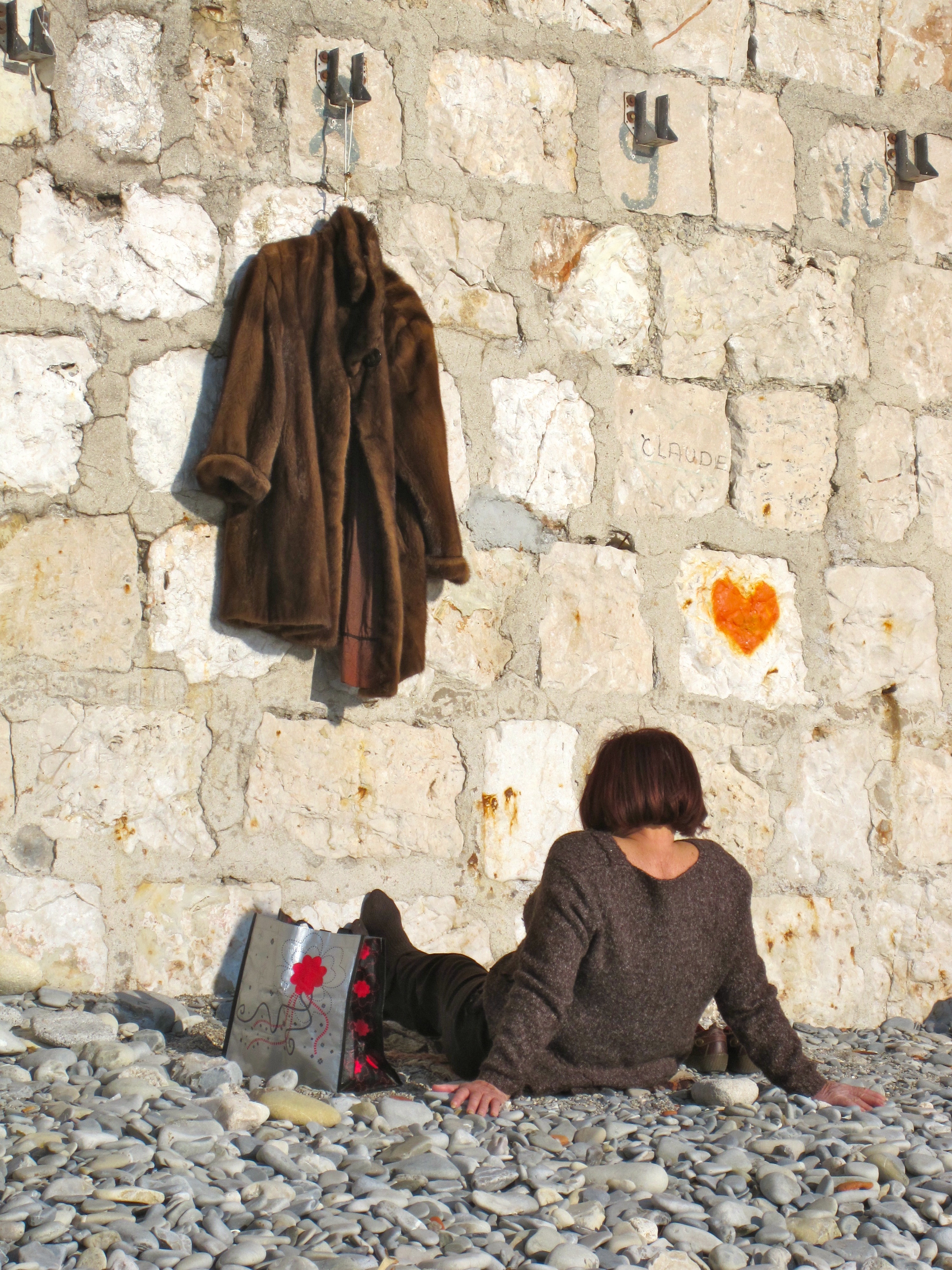
I couldn’t resist taking this photo when on Nice beach for St Valentine’s Day ’12. I don’t know the woman. She never noticed me taking the photo and my lovely wife was sunbathing further along the beach.
St Valentine’s Day was perhaps popularised by Geoffrey Chaucer in the late 14th century, though, according to this blog post, the Valentine’s Day may refer to May 3rd, the feast day of the wrong Valentine, Valentine of Genoa. Legend has it that Valentine, Bishop of Rome, was imprisoned and executed for performing weddings for soldiers (they were forbidden) and for ministering to Christians (they were persecuted). While in prison he is supposed to have healed the jailer’s daughter, and gave a letter to her on the day he was executed signed with “Your Valentine”. He is said to have given heart shapes cut from parchment to the soldiers to remind them of their loves and vows.
The heart is used as a measure for our dealings with one another. The measure isn’t beats per minute, but a blood-red thermometer with hard-heartedness being the coldest, and the soft-hearted being at the top of the human scale.
Many live with the dire consequences of hard-heartedness. There is an ancient promise for the sake of the loveless victims of hard-heartedness in which God promises a heart transplant. The people will have a change of heart when their heart of stone will be replaced by a “heart of flesh”. “A new heart I will give you, and a new spirit I will put within you; and I will remove from your body the heart of stone and give you a heart of flesh.” (Ezekiel 36:26)
Hearts of stone can never be broken. They have to be removed. The transplants don’t come with any guarantees. They are soft. They are made to be responsive to the feelings of others. They are made to be sensitive. They are made for moving. They are made for love. They are made to be broken. (There is a beautiful Blessing for the Broken-hearted by Jan Richardson)
Too many of us have been hurt, and too many of us have heeded the advice “don’t be soft”. We can become hard to know and we can be hard on others. Our responsiveness, flexibility and ability to change can be non-existent. We stop listening and we stop learning. Our cause isn’t lost in that condition. Many hearts have been changed though history by tender hearted care and by brave hearts such as Nelson Mandela. The sexualisation of Valentine’s Day may prevent us remembering all those people and moments that might have heartened us. But the extent to which we have been touched and softened by them will affect our loveliness and our eagerness to be a true lover.
A friend who was a high school teacher was a real advocate of the “unlovely” young people. She said that they had been hardened into it, and that “they’d be lovely if they were loved”.
You smell – and I’m not being rude

My wife (her name is Jeanette, not Kate, and she has a rather fine nose) has suddenly got her sense of taste and smell back after a senseless four or five years. She tried many things over the years, including many returns to the House on the Top of Great Orme for their lemon meringue pie (that worked once). Her senses have been restored just when she had given up trying. She is now going round sniffing things (Comfort fabric conditioner is a favourite) and is enjoying the tastes of food. It’s like coming to life again. I am delighted for her.
Our senses of taste and smell are often overlooked. There are no words that I am aware of which describe the taste-less and smell-less state. Blindness and deafness describe severe visual and hearing impairment, but there is no equivalent words to describe the impairment of the other senses. Maybe that is because blindness and deafness affect lives in a far more critical way, whereas the senses of taste and smell are pleasures. The pleasure is usually taken for granted, and our senses are often dulled because we don’t really appreciate the senses we have been given.
The Smell Report suggests that western civilisation has devalued the sense of smell in a tendency to compare and rank the senses. The sense of smell won the wooden spoon in the Sense Games, while the gold medal went to the gift of sight. Long noses and nosiness are not welcome here. “You smell” is a common playground insult, whereas “you see” isn’t.
The Smell Report points our noses at other cultures. For example, in some Arab countries breathing on people as you speak to them is a sign of friendship and goodwill – and denying someone your breath and smell is a shameful sign that you don’e want to get involved with them.
The Onge people of the Andaman Islands tell the time by smell. They have a calendar based on the odours of the flowers that bloom at different times of the year. Their greeting is not “How are you?”, but “Konyune onorange-tanka?” which means “How is your nose?”. Sometimes people respond by saying “I am heavy with odour”, at which the greeter, to be polite, must inhale deeply to remove some of the surplus. At other times the greeter may need to blow heavily on the person she is greeting if that person is a bit short of odour energy.
Ivan Illich discovered that smell is not something to be sneezed at when he was in Peru. It was pointed out to him that there was a connection between nose and heart, smell and affection that he had not made. In his address The Cultivation of Conspiracy, Illich recalls:
“I was in Peru in the mid-1950s, on my way to meet Carlos, who welcomed me to his modest hut for the third time. But to get to the shack, I had to cross the Rimac, the open cloaca of Lima. The thought of sleeping for a week in this miasma almost made me retch. That evening, with a shock, I suddenly realised what Carlos had been telling me all along, “Ivan, don’t kid yourself; don’t imagine you can be friends with people you can’t smell.” That one jolt unplugged my nose; it enabled me to dip into the aura of Carlos’s house, and allowed me to merge the atmosphere I brought along into the ambience of his home.”
Illich refers to the old German adage “Ich kann Dich gut riechen” (“I can smell you well”) which goes with another German saying “Ich kann Dich leiden” (” I can suffer you well”).
We mustn’t look down our noses at the sense of smell, or taste. And if you think that’s cheesy you might be interested in Giles Milton’s book, Edward Trencom’s Nose: a novel of history, dark intrigue and cheese. Milton has a nose for history. Trencom, and his predecessors, has a remarkable nose, just for cheese.
PS Big Nose Kate didn’t have a big nose. She was just nosy. She was Doc Holiday’s girlfriend. The photo is by TLfromAZ
A resolution: notes for a sermon for the 2nd Sunday of Christmas

Notes for a sermon for January 5th 2014 at St Alban’s, Offerton – John 1:1-18
Note: this is the first time some of the congregation will have seen each other this new year.
Ask about resolutions made? (And broken) Find some out.
And ask for people to pray for each other that they might keep their resolve.
Mine is to “notice more” and to “welcome each day”.
It’s never too late to make a resolution.
We don’t reserve resolutions for New Year’s Eve do we?
Making resolutions is an everyday activity. Each year has its critical moments during which we make resolutions. (And we should be helping each other to keep those resolutions for as long as they need to be kept).
I have been wondering what a congregational resolution might look like.
Many of our resolutions are money oriented aren’t they, like “making ends meet”. I am sure that many of you make such resolutions, and I am sure that many of your PCC resolutions are along those lines. You might also have resolutions in place regarding your GAP goals. And you need to help each other to keep those resolutions.
I am wondering whether we would like to make a fresh resolution in the light of this morning’s gospel. The resolution is “let’s see”. Can I explain?
John’s gospel begins in a way that none of the others do.
John doesn’t introduce the themes of his gospel with reference to the nativity of Jesus. Instead, John sets the scene (no pun) by referring to darkness and light.
His point is that the world and our times are overwhelmed in darkness and that Jesus is the light that shines in that darkness.
The light helps us to see even when we are living through dark times.
That’s how John sets the scene for his gospel.
The darkness is so dark that some can’t even see the darkness.
God causes his light to shine in that darkness. That’s the good news.
Having introduced that theme John then goes on to provide examples of specific instances when the light did shine in the darkness, when people saw and realised, when the penny dropped.
That’s why I suggest that a good resolution for you as a congregation is “LET’S SEE” – and I hope that you will pray for one another that you may keep that resolution and that you may help one another to see.
John’s gospel is littered with invitations to come and see.
He said to two of John the Baptist’s disciples, “Come and see”.
You can almost hear them talking to one another, “shall we?”, “shalln’t we?” finally resolving “yes, let’s see.” (1:39)
Philip found Nathanael and urged him to “come and see”.
“Come and see what we have found”. He had found him about whom Moses and the prophets wrote, Jesus, son of Joseph from Nazareth”. (1:46)
And then there was the woman Jesus met at the well at Samaria. She went to the city and called out “come and see a man who told me everything I have ever done! He cannot be the Messiah, can he?” And they left the city with the resolution to go and see. (4:29)
The disciples that Jesus loves (the beloved disciples), according to John, are the ones who accept the invitation – the ones who come to see him as the light, the resurrection and the life.
Our gospel for this morning mentions “seeing”, or, “not seeing” – because of the darkness.
The word became flesh and dwelt among us, and we have beheld/seen his glory. (1:14)
No one has ever seen God. It is God the only Son, who is close to the Father’s heart, who has made him known. (1:18)
No one had seen God. But Jesus has made him known. We can see God in and through Jesus because he is the very image of God – he is the spit of his father. In Jesus we have the opportunity to see God.
Do you fancy making a resolution this morning to go alongside those others you have made in your lives?
Do you want to see?
In dark times in your relationships, in dark times in your work, in dark times in your families, in dark times in your faith, in dark times as a congregation, in dark times in your health, do you want to see?
At times when you feel trapped, do you want to see a way forward?
We try to cover our darkness don’t we?
We make up a face that hides the cracks.
We give the impression that we know where we’re going.
We smile and present a brave face to the world.
We hide our dark thoughts.
We pretend we are all sunshine and light.
But this does not help us to SEE. We hide our darkness by using artificial light.
If we hide our darkness, if we pretend everything is hunky-dory we are not going to see the true light which God causes to shine among us, through Jesus, through his saints and through one another.
(If we think everything is hunky-dory, we see nothing. We are blind fools).
We have to be honest about our dark times and our dark thoughts.
A lady I know, Jan Richardson, has recently lost her husband.
He died after what should have been fairly routine surgery at the beginning of December.
She is an artist who keeps a blog called the Painted Prayerbook.
Most weeks she produces an image to accompany the Sunday readings and writes a blessing which she posts on her blog.
I’m going to read her latest blessing, written for Epiphany, written in the light (or, rather, the darkness) of her husband’s death, and written in the light of herself being blessed through those who shared their darkness “by entering into days of waiting and nights of long vigil.” It begins with the words that reflect that darkness. “This blessing hardly knows what to say …” It is called:
This Brightness That You Bear
A Blessing for My Family
This blessing
hardly knows what to say,
speechless as it is
not simply
from grief
but from the gratitude
that has come with it—
the thankfulness that sits
among the sorrow
and can barely begin
to tell you
what it means
not to be alone.
This blessing
knows the distances
you crossed
in person
in prayer
to enter into
days of waiting,
nights of long vigil.
It knows the paths
you traveled
to be here
in the dark.
Even in the shadows
this blessing
sees more than it can say
and has simply
come to show you
the light
that you have given
not to return it
to you
not to reflect it
back to you
but only to ask you
to open your eyes
and see
the grace of it,
the gift that shinesin this brightness
that you bear.
Let’s see.
Is that a resolution you want to make in the light of John’s gospel and in the light of Jesus?
Is that something you want to help others do?
Is that something you want to resolve to do as a church and congregation?
Is this a blessing you want to bear in your lives for those who share the darkness with us?
Shall we help one another to see? Is that a resolution worth keeping?
Christ the King – some sermon notes
Here are some notes for a sermon for the Feast of Christ the King, for the people of Christ the King, Birkenhead, for Sunday 24th November 2013
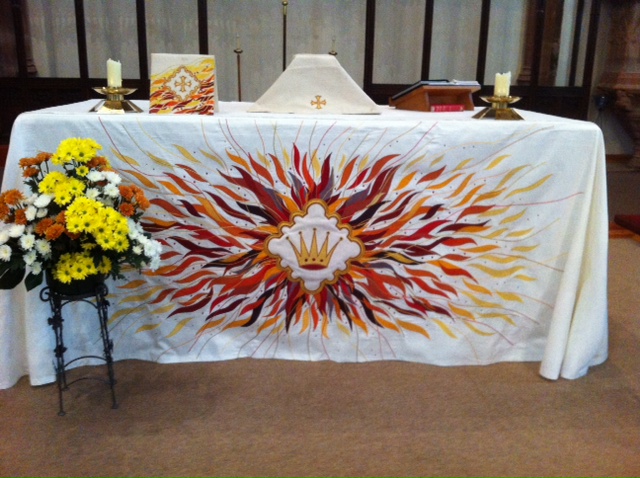
Today is the Festival of Christ the King.
The feast of Christ the King was announced by Pope Pius XI in 1925 at the time when fascism was growing across Europe, including here in England. It was thought that there should be special emphasis and celebration that Christ is King. It was a political choice. It was intended as a political opposition and challenge to those who were imposing themselves and their grand designs – the Mussolinis and Hitlers.
The Festival of Christ the King comes on the last Sunday of the liturgical year – and next Sunday is the start of a new one.
The Christian year culminates in this assertion that Christ is King, as if through our worship, our reflections, our prayers and our readings we have come to the realization afresh that Jesus Christ is, for us, the King, and as if we want to be subject to his just and gentle rule, and that we prefer to be part of his kingdom than any other Kingdom, “United” or not.
Of course, this day has a particular significance for you. Your church has the lovely dedication of “Christ the King”. You are the church of Christ the King. You stand, sit and kneel realizing that Christ is King, subverting the tyranny of tyrants and representing the hope of those who are their victims – that they will be delivered – that there is another horizon of freedom as opposed to their awful and fearful horizons.
The introduction of the festival of Christ the King was a political act to oppose the growing power of the fascists in Europe. As the Church of Christ the King we are all called to be a political act. The church is political – we must never overlook that, and you, whose focus is on Christ the King, have a particular vocation to live that.
We have a king who rides a donkey. Have you ever sung that?
Our king, who rides into town on a donkey, contrasts and contradicts the power of the Roman emperor who arrives in town with all the cavalry and military trimmings. The Roman Emperor arrives in power to impress his power and to keep people down. Our king comes into town dishevelled and on a donkey. It’s a joke and a mockery of the superpowers who parade their strengths in their great squares. For Jesus, power is not for parading. Jesus has no need to impress, he is not like the leaders who ask “do I look big in this?”. The donkey was political act and political choice. He could have, as the story of the temptations show us, exercised his power very differently.
When it comes to horsepower God chooses the donkey. His intent was not to keep people down, but to bring them together as a kingdom of heaven, as a kingdom of God.
God and his people have always challenged the unjust rulers. That opposition goes back as far as to the times of Pharoah, from whose unjust rule God liberated his people through Moses. The opposition includes opposition to fascist tyranny and reaching to today, to the warlords, the drug barons, the local tyrant and the playground bully.
In the Old Testament we hear the voice of the prophets opposing the kings when they mislead Israel, and when their rule becomes unjust and corrupt. For example, Amos denounces those who have built “stone houses” off the backs of the poor. He says “there are those who oppress the innocent and take bribes and deprive the poor of justice in the courts”.
Similarly, in our reading from Jeremiah (23:1-6), the prophet condemns the misleading leaders of his day, the shepherds who lead the people astray, who have scattered the flock and driven them apart, who have not attended to their needs and have only looked after Number One. He reports “The days are surely coming, says the LORD, when I will raise up for David a righteous branch, and he shall reign as king and deal wisely, and shall execute justice and righteousness in the land. In his days Judah will be saved and Israel will live in safety.”
There are leaders and kings in the Old Testament who were more interested in themselves than their subjects. The prophets rail against them. That is politics. And it is compassion for those who are neglected by the rulers.
This is what we stand and kneel for. We stand to welcome Christ as our king, to assent to the rule of heaven. We kneel to pray for the coming of the kingdom, on earth as in heaven. This is a political act.

I don’t know how well people of Birkenhead know this building, and that it is named “Christ the King”. That dedication is relatively recent, isn’t it? Until 1990 the church was dedicated to St Anne. Why choose “Christ the King” for the dedication? It is a choice with political connotations. The naming was a political act that favours the poor and challenges the tyrannies of the community.
Christ the King as a building isn’t obvious. There is no spire dominating the landscape. You have been saddled with a spire, but as spires go it is quite unassuming. You have to look to find it. It’s not on the main drag. It is tucked into its community.
That seems quite appropriate to me. You don’t have to look big and impressive. You are a people tucked into your communities to share in the just and gentle rule of Christ, to exercise the responsibility we all share as the subjects of the kingdom of God – the responsibility to bring people together on the side of justice – to be trusted not to put people down, or let people down.
Christ as King isn’t obvious either, is he? He doesn’t force himself on us. He doesn’t stamp his authority everywhere. Our gospel reading reminds us of his rejection by crucifixion. He is the love that was promised by Jeremiah and longed for by so many. He is tucked into community, as the good shepherd, for bringing scattered and opposed people together, not for putting people down or letting people down as self-serving leaders do.
Other references include the painting Cast our Crowns by Jim Janknegt, the book God and Empire by John Dominic Crossan and Matthew 20:25
The problem with effectiveness
We have become obsessed with effectiveness which, according to Parker Palmer, means that we take on smaller tasks. For the bigger tasks, like love, mercy and peace we need a different measure. That measure is faithfulness.
From effectiveness to faithfulness from Center for Courage & Renewal on Vimeo.
The words that wake us – a sermon on Isaiah 50:4

A sermon preached at Mattins at Chester Cathedral on October 13th 2013.
The Lord God has given me the tongue of a teacher (or, of one who is taught), that I may know how to sustain the weary with a word.
Morning by morning he wakens – wakens my ear to listen as those who are taught. Isaiah 50:4f
What are the words that waken us?
What are the words that weaken us?
To what extent do the words that waken us make us?
To what extent do the words that wake us break us?
What are the words that wake us?
I asked some Fb friends, and got loads of replies:
They ranged from the relatively mundane (but still wonderful)
“Do you want a cup of tea?”
to the “This is the day that the Lord has made”
there were those who said that they woke to the sound of silence.
Anna says that it isn’t really words that wake us so much as noises, events, images, light etc. To which jenny replied that it isn’t so much the words, as the tone of voice that wakes us
My friends didn’t think anyone used Rise and Shine any more. A bit old fashioned they thought. Though it strikes me as a good Christian wake up call with its associations with the Lazarus story. Perhaps it’s too upbeat and cheerful when waking from slumber.
The words that wake us have the power to make us or break us. The words pounded through the bedroom door – “you’ve got 10 minutes to get dressed and be on that bus”. What effect do they have on the day and family relationships?
Those who are haunted by fear and those who are anxious about the future have other words that wake them up – not just at the crack of dawn, but repeatedly through the night.
Words spring to mind when we are anxious, excited or depressed.
The words that wake the mother struggling to make ends meet are words of panic. What are the words that wake the child who is being bullied.
Words have power.
Words weigh heavy.They shape the way in which we see ourselves and others. Dismissive put downs can affect us for decades. Careless labeling of others mean that we misjudge others.
Many of the words we pick up from a world that is indifferent or hostile to us are so powerful that we come to believe them.
Be careful how you speak to your children. One day it will be their inner voice . Peggy O’Mara
We have to take care about what we say. Particularly with our first words of the day, or the first words of a conversation. An email reply comes across well with an opening response of “it’s good to hear from you”. Macdonalds aren’t far off the mark when their “servers” bless those they have served with “have a good day” – to which the correct response (probably not often said) is “and also with you”.
Malcolm Guite, a priest-poet, asks the questions in his poem “what if …..” Some lines:
“What if every word we say,
never ends or fades away?
What if not a word is lost,
what if every word we cast
cruel, cunning, cold accurst,
every word we cut and paste
echoes to us from the past,
fares and finds us
first and last
haunts and hunts us down?
What if each polite evasion,
every word of defamation,
insults made by implication,
querulous prevarication,
compromise in convocation,
propaganda for the nation
false or flattering persuasion,
blackmail and manipulation,
simulated desperation
grows to such reverberation
that it shakes our own foundation,
shakes and brings us down?
We must weigh our words carefully. The words that wake us are the words that make us and the words that break us.
The prophet, in our first reading, has the tongue of one who is taught. I suggest that it is not the “tongue of a teacher” as translated in our reading, but the “tongue of one who is taught” … by God – given by God so that he would know how to sustain the weary with a word. (Isaiah 50:4)
The words that wake the prophet are the words that make him. The words that wake him are the words of God.It is because God speaks and the prophet listens that the prophet becomes as one who is taught, as one who can sustain the weary with a word. The prophet says, “Morning by morning he wakens my ear to listen as those who are taught.”
The Bible often refers to the voice of God not being heard. There are various reasons for God’s word not being heard. They include God’s own silence, but also there are times when God’s word is not heard because it is not listened to.
Here we meet with the prophet whose ears woke every morning to the word of God. We can perhaps feel the intimacy between God and the prophet as the prophet feels the breath of God on his ear as he whispers him awake morning by morning.
What are the words that wake us?
There is no shortage to the words that wake us. Newspaper headlines, breakfast TV, advertising – these are the hidden persuaders who know that the words that wake us are the words that shape us, and they want to shape us to their own ends.
The prophet shows us an alternative. His ears are awakened by the whispered word of God, a word which brings blessing to him and the weary.
There are many people who have this discipline of listening to God before first light. It is a discipline shared by very many faith communities.
But our prayer, whether it be morning or evening, can be full of our own words, with God not being able to get a word in edgeways. We can say our prayers without hearing a word from God.
Hearing the word of God requires discipline and attentiveness.
We can choose the words. The words of God can be words of Jesus, words of the angels, words of scripture inspired by the Holy Spirit, words spoken through the prophets. God has spoken many words. They have been repeated down the ages and brought many to life. They have wakened many morning by morning, and hearing them has signified the end of night and the break of day. We can choose the words and we can let the words choose us.
All the words of God are summed up in the one Word, Jesus. All the words of God can be translated as love. “Love is his word” is how hymnwriter Luke Connaughton puts it. All the words of God are for the weary, the lost, the last and the least. They are timed for the dead of night, the ending of darkness and the first light of day.
If it is true that the words that wake us, make us, then is it true that if we allow the words of God to waken our ears morning by morning, we too will have the tongue of one who is taught?
Do the words by which God wakes us make us a blessing to those around us who are weary and those who are oppressed and abused by words and deeds that break them?
What if every word we say never ends or fades away?
What are the words that wake us? What words wake us, make us and break us? These are the questions rattling round my mind today.
Malcolm Guite has a sobering reflection on words in which he reflects on the shadow side of language – he has called it “What if …” (You can hear Malcolm’s reading here). He prefaces his poem with these words from Matthew’s Gospel:
“But I say unto you, that every idle word that men shall speak, they shall give account thereof in the day of judgement. For by thy words thou shalt be justified, and by thy words thou shalt be condemned.” Matthew 12:36-37
What if every word we say
Never ends or fades away,
Gathers volume gathers weigh,
Drums and dins us with dismay
Surges on some dreadful day
When we cannot get away
Whelms us till we drown?
What if not a word is lost,
What if every word we cast
Cruel, cunning, cold, accurst,
Every word we cut and paste
Echoes to us from the past
Fares and finds us first and last
Haunts and hunts us down?
What if every murmuration,
Every otiose oration
Every oath and imprecation,
Insidious insinuation,
Every blogger’s aberration,
Every facebook fabrication
Every twittered titivation,
Unexamined asservation
Idiotic iteration,
Every facile explanation,
Drags us to the ground?
What if each polite evasion
Every word of defamation,
Insults made by implication,
Querulous prevarication,
Compromise in convocation,
Propaganda for the nation
False or flattering peruasion,
Blackmail and manipulation
Simulated desparation
Grows to such reverberation
That it shakes our own foundation,
Shakes and brings us down?
Better that some words be lost,
Better that they should not last,
Tongues of fire and violence.
O Word through whom the world is blessed,
Word in whom all words are graced,
Do not bring us to the test,
Give our clamant voices rest,
And the rest is silence.
Malcolm has a new book of poetry being published this month – The Singing Bowl.
 Grits and Grains