Leaving childhood: Holy Innocents Day

Massacre of the Innocents by Fra Angelico

Today is Holy Innocents Day, when we are called to remember childhood how children have been slaughtered. The focus is on the baby boys Herod slaughtered in Bethlehem at the time of Jesus, but also embraces the children slaughtered throughout history.

Jesus teaches that “unless you change and become like children, you will never enter the kingdom of heaven.” (Matthew 18) This prompts the question about what childhood is. Is it something about vulnerability, dependence, naively and learning. Jesus added the word “humility”. “Whoever becomes humble like this child is the greatest in the kingdom of heaven.”

And then we grow out of childhood, spending a lot of our time bigging ourselves up, taking ourselves out of reach of that kingdom Jesus spoke about.

I am reading organisations don’t tweet, people do by Euan Semple? He seems to suggest that the qualities that make for childhood are the qualities that are needed for leaders and organisations to be successful as he talks about vulnerability and humility in these terms:

“Being open about your failings isn’t everyone’s cup of tea and wouldn’t be acceptable in every workplace, but just a little more openness about your failings in front of your staff might be just be the best way to improve your working relationships. Being seen not to know, and being willing to ask for help, can be the best way to make other people feel valued. It also signals to them that it is OK not to know everything all the time. This creates the sort of culture where people are willing to open up and share what they know to everyone’s mutual benefit.”

Christ the King – some sermon notes

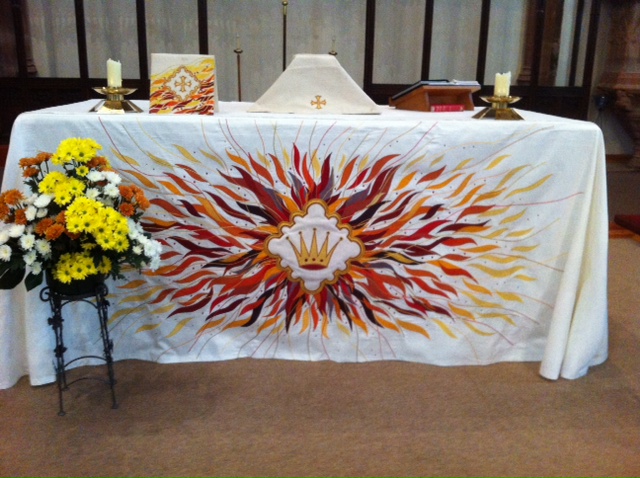
Here are some notes for a sermon for the Feast of Christ the King, for the people of Christ the King, Birkenhead, for Sunday 24th November 2013

Christ the King

Today is the Festival of Christ the King.

The feast of Christ the King was announced by Pope Pius XI in 1925 at the time when fascism was growing across Europe, including here in England. It was thought that there should be special emphasis and celebration that Christ is King. It was a political choice. It was intended as a political opposition and challenge to those who were imposing themselves and their grand designs – the Mussolinis and Hitlers.

The Festival of Christ the King comes on the last Sunday of the liturgical year – and next Sunday is the start of a new one.

The Christian year culminates in this assertion that Christ is King, as if  through our worship, our reflections, our prayers and our readings we have come to the realization afresh that Jesus Christ is, for us, the King, and as if we want to be subject to his just and gentle rule, and that we prefer to be part of his kingdom than any other Kingdom, “United” or not.

Of course, this day has a particular significance for you. Your church has the lovely dedication of “Christ the King”. You are the church of Christ the King. You stand, sit and kneel realizing that Christ is King, subverting the tyranny of tyrants and representing the hope of those who are their victims – that they will be delivered – that there is another horizon of freedom as opposed to their awful and fearful horizons.

The introduction of the festival of Christ the King was a political act to oppose the growing power of the fascists in Europe. As the Church of Christ the King we are all called to be a political act. The church is political – we must never overlook that, and you, whose focus is on Christ the King, have a particular vocation to live that.

We have a king who rides a donkey. Have you ever sung that?

Our king, who rides into town on a donkey, contrasts and contradicts the power of the Roman emperor who arrives in town with all the cavalry and military trimmings. The Roman Emperor arrives in power to impress his power and to keep people down. Our king comes into town dishevelled and on a donkey. It’s a joke and a mockery of the superpowers who parade their strengths in their great squares. For Jesus, power is not for parading. Jesus has no need to impress, he is not like the leaders who ask “do I look big in this?”. The donkey was political act and political choice. He could have, as the story of the temptations show us, exercised his power very differently.

When it comes to horsepower God chooses the donkey. His intent was not to keep people down, but to bring them together as a kingdom of heaven, as a kingdom of God.

God and his people have always challenged the unjust rulers. That opposition goes back as far as to the times of Pharoah, from whose unjust rule God liberated his people through Moses. The opposition includes opposition to fascist tyranny and reaching to today, to the warlords, the drug barons, the local tyrant and the playground bully.

In the Old Testament we hear the voice of the prophets opposing the kings when they mislead Israel, and when their rule becomes unjust and corrupt.  For example, Amos denounces those who have built “stone houses” off the backs of the poor. He says “there are those who oppress the innocent and take bribes and deprive the poor of justice in the courts”.

Similarly, in our reading from Jeremiah (23:1-6), the prophet condemns the misleading leaders of his day, the shepherds who lead the people astray, who have scattered the flock and driven them apart, who have not attended to their needs and have only looked after Number One. He reports “The days are surely coming, says the LORD, when I will raise up for David a righteous branch, and he shall reign as king and deal wisely, and shall execute justice and righteousness in the land. In his days Judah will be saved and Israel will live in safety.”

There are leaders and kings in the Old Testament who were more interested in themselves than their subjects. The prophets rail against them. That is politics. And it is compassion for those who are neglected by the rulers.

This is what we stand and kneel for. We stand to welcome Christ as our king, to assent to the rule of heaven. We kneel to pray for the coming of the kingdom, on earth as in heaven. This is a political act.

Christ_the_King,_Birkenhead_(4)

I don’t know how well people of Birkenhead know this building, and that it is named “Christ the King”.  That dedication is relatively recent, isn’t it? Until 1990 the church was dedicated to St Anne. Why choose “Christ the King” for the dedication? It is a choice with political connotations. The naming was a political act that favours the poor and challenges the tyrannies of the community.

Christ the King as a building isn’t obvious. There is no spire dominating the landscape. You have been saddled with a spire, but as spires go it is quite unassuming. You have to look to find it. It’s not on the main drag. It is tucked into its community.

That seems quite appropriate to me. You don’t have to look big and impressive. You are a people tucked into your communities to share in the just and gentle rule of Christ, to exercise the responsibility we all share as the subjects of the kingdom of God – the responsibility to bring people together on the side of justice – to be trusted not to put people down, or let people down.

Christ as King isn’t obvious either, is he? He doesn’t force himself on us. He doesn’t stamp his authority everywhere. Our gospel reading reminds us of his rejection by crucifixion. He is the love that was promised by Jeremiah and longed for by so many. He is tucked into community, as the good shepherd, for bringing scattered and opposed people together, not for putting people down or letting people down as self-serving leaders do.

Other references include the painting Cast our Crowns by Jim Janknegt, the book God and Empire by John Dominic Crossan and Matthew 20:25

Russell Brand tastes revolution in the Watford Gap

Russell Brand is always worth listening to. He is passionate and outraged. He is intelligent, and, he admits to being “fucked up and naive”. He gave voice to his outrage in an interview with Jeremy Paxman on Newsnight. Simon Kelner described the scene in the Independant. “On one side was a rather effete figure with an unruly beard who found it hard to take anything seriously, and on the other side was Russell Brand.”

Since then Russell Brand has been reflecting on developments since that interview. They are published in today’s Guardian. He is passionate about change and connects with the new movements such as Occupy. He writes of his commitment:

Well I am naïve and I have fucked up but I tell you something else. I believe in change. I don’t mind getting my hands dirty because my hands are dirty already. I don’t mind giving my life to this because I’m only alive because of the compassion and love of others. Men and women strong enough to defy this system and live according to higher laws.

He has seen the Apocalypse:

The less privileged among us are already living in the apocalypse, the thousands of street sleepers in our country, the refugees and the exploited underclass across our planet daily confront what we would regard as the end of the world. No money, no home, no friends, no support, no hand of friendship reaching out, just acculturated and inculcated condemnation.

and he has glimpsed the revolution at the Watford Gap:

One night late at the Watford Gap I got chatting to a couple of squaddies, one Para, one Marine, we talked a bit about family and politics, I invited them to a show. Then we were joined by three Muslim women, all hijabbed up. For a few perfect minutes in the strip lit inertia of this place, that was nowhere in particular but uniquely Britain, I felt how plausible and beautiful The Revolution could be. We just chatted.

The words that wake us – a sermon on Isaiah 50:4

Words that wake us

A sermon preached at Mattins at Chester Cathedral on October 13th 2013.

The Lord God has given me the tongue of a teacher (or, of one who is taught), that I may know how to sustain the weary with a word.

Morning by morning he wakens – wakens my ear to listen as those who are taught. Isaiah 50:4f

What are the words that waken us?

What are the words that weaken us?

To what extent do the words that waken us make us?

To what extent do the words that wake us break us?


What are the words that wake us?

I asked some Fb friends, and got loads of replies:

They ranged from the relatively mundane (but still wonderful)

“Do you want a cup of tea?”

to the “This is the day that the Lord has made”

there were those who said that they woke to the sound of silence.

Anna says that it isn’t really words that wake us so much as noises, events, images, light etc. To which jenny replied that it isn’t so much the words, as the tone of voice that wakes us

My friends didn’t think anyone used Rise and Shine any more. A bit old fashioned they thought. Though it strikes me as a good Christian wake up call with its associations with the Lazarus story. Perhaps it’s too upbeat and cheerful when waking from slumber.

The words that wake us have the power to make us or break us. The words pounded through the bedroom door – “you’ve got 10 minutes to get dressed and be on that bus”. What effect do they have on the day and family relationships?

Those who are haunted by fear and those who are anxious about the future have other words that wake them up – not just at the crack of dawn, but repeatedly through the night.

Words spring to mind when we are anxious, excited or depressed.

The words that wake the mother struggling to make ends meet are words of panic. What are the words that wake the child who is being bullied.

Words have power.

Words weigh heavy.They shape the way in which we see ourselves and others. Dismissive put downs can affect us for decades. Careless labeling of others mean that we misjudge others.

Many of the words we pick up from a world that is indifferent or hostile to us are so powerful that we come to believe them.

Be careful how you speak to your children. One day it will be their inner voice . Peggy O’Mara

We have to take care about what we say. Particularly with our first words of the day, or the first words of a conversation. An email reply comes across well with an opening response of “it’s good to hear from you”. Macdonalds aren’t far off the mark when their “servers” bless those they have served with “have a good day” – to which the correct response (probably not often said) is “and also with you”.

Malcolm Guite, a priest-poet, asks the questions in his poem “what if …..” Some lines:

“What if every word we say,
never ends or fades away?

What if not a word is lost,
what if every word we cast
cruel, cunning, cold accurst,
every word we cut and paste
echoes to us from the past,
fares and finds us
first and last
haunts and hunts us down?

What if each polite evasion,
every word of defamation,
insults made by implication,
querulous prevarication,
compromise in convocation,
propaganda for the nation
false or flattering persuasion,
blackmail and manipulation,
simulated desperation
grows to such reverberation
that it shakes our own foundation,
shakes and brings us down?

We must weigh our words carefully. The words that wake us are the words that make us and the words that break us.

The prophet, in our first reading, has the tongue of one who is taught. I suggest that it is not the “tongue of a teacher” as translated in our reading, but the “tongue of one who is taught” … by God – given by God so that he would know how to sustain the weary with a word. (Isaiah 50:4)

The words that wake the prophet are the words that make him. The words that wake him are the words of God.It is because God speaks and the prophet listens that the prophet becomes as one who is taught, as one who can sustain the weary with a word. The prophet says, “Morning by morning he wakens my ear to listen as those who are taught.”

The Bible often refers to the voice of God not being heard. There are various reasons for God’s word not being heard. They include God’s own silence, but also there are times when God’s word is not heard because it is not listened to.

Here we meet with the prophet whose ears woke every morning to the word of God.  We can perhaps feel the intimacy between God and the prophet as the prophet feels the breath of God on his ear as he whispers him awake morning by morning.

What are the words that wake us?

There is no shortage to the words that wake us. Newspaper headlines, breakfast TV, advertising – these are the hidden persuaders who know that the words that wake us are the words that shape us, and they want to shape us to their own ends.

The prophet shows us an alternative. His ears are awakened by the whispered word of God, a word which brings blessing to him and the weary.

There are many people who have this discipline of listening to God before first light. It is a discipline shared by very many faith communities.

But our prayer, whether it be morning or evening, can be full of our own words, with God not being able to get a word in edgeways. We can say our prayers without hearing a word from God.

Hearing the word of God requires discipline and attentiveness.

We can choose the words. The words of God can be words of Jesus, words of the angels, words of scripture inspired by the Holy Spirit, words spoken through the prophets. God has spoken many words. They have been repeated down the ages and brought many to life. They have wakened many morning by morning, and hearing them has signified the end of night and the break of day. We can choose the words and we can let the words choose us.

All the words of God are summed up in the one Word, Jesus. All the words of God can be translated as love. “Love is his word” is how hymnwriter Luke Connaughton puts it. All the words of God are for the weary, the lost, the last and the least. They are timed for the dead of night, the ending of darkness and the first light of day.

If it is true that the words that wake us, make us, then is it true that if we allow the words of God to waken our ears morning by morning, we too will have the tongue of one who is taught?

Do the words by which God wakes us make us a blessing to those around us who are weary and those who are oppressed and abused by words and deeds that break them?

What if every word we say never ends or fades away?

What are the words that wake us? What words wake us, make us and break us? These are the questions rattling round my mind today.

Malcolm Guite has a sobering reflection on words in which he reflects on the shadow side of language – he has called it “What if …” (You can hear Malcolm’s reading here). He prefaces his poem with these words from Matthew’s Gospel:

But I say unto you, that every idle word that men shall speak, they shall give account thereof in the day of judgement. For by thy words thou shalt be justified, and by thy words thou shalt be condemned.” Matthew 12:36-37

What if every word we say
Never ends or fades away,
Gathers volume gathers weigh,
Drums and dins us with dismay
Surges on some dreadful day
When we cannot get away
Whelms us till we drown?

What if not a word is lost,
What if every word we cast
Cruel, cunning, cold, accurst,
Every word we cut and paste
Echoes to us from the past
Fares and finds us first and last
Haunts and hunts us down?

What if every murmuration,
Every otiose oration
Every oath and imprecation,
Insidious insinuation,
Every blogger’s aberration,
Every facebook fabrication
Every twittered titivation,
Unexamined asservation
Idiotic iteration,
Every facile explanation,
Drags us to the ground?

What if each polite evasion
Every word of defamation,
Insults made by implication,
Querulous prevarication,
Compromise in convocation,
Propaganda for the nation
False or flattering peruasion,
Blackmail and manipulation
Simulated desparation
Grows to such reverberation
That it shakes our own foundation,
Shakes and brings us down?

Better that some words be lost,
Better that they should not last,
Tongues of fire and violence.
O Word through whom the world is blessed,
Word in whom all words are graced,
Do not bring us to the test,
Give our clamant voices rest,
And the rest is silence.

Malcolm has a new book of poetry being published this month – The Singing Bowl.

Thinking Leadership with Dee Hock and Meg Wheatley

“True leaders are those who epitomise the general sense of the community – who symbolise, legitimise and strengthen behaviour in accordance with the sense of the community – who enable its conscious, shared values and beliefs to emerge, expand and be transmitted from generation to generation.”

Dee Hock in Birth of the Chaordic Age

Meg Wheatley, from a perspective of “new science” (quantum rather than Newtonian) sums up what leaders are for:

“People need a lot from their leaders. They need information, access, resources, trust and follow-through. Leaders are necessary to foster experimentation, to help create connections across the organisation, to feed the system with rich information from multiple sources.”