Jesus always has time for conversation. He has animated conversation with the Samaritan woman at the well, and the man born blind, anyone he meets. He will eat, drink and pass time with everyone: prostitutes, the hated tax collectors, religious leaders, lepers. God’s word became flesh – not, initially, in sermons proclaimed from pulpits, in learned books of theology, but in human conversation.
Timothy Radcliffe: Why go to Church? (p53)
Writing
At its best the sensation of writing is that of any unmerited grace. It is handed to you but only if you look for it. You search, you break your heart, your back, your brain and then – and only then – it is handed to you. From the corner of yur eye you can see motion. Something is moving the air and headed your way.
from the Writing Life by Annie Dillard (p75)
The learned man said
to the almond tree:
Speak to me of God.
And the almond tree blossomed.
Anonymous poem on a poster in the Abbey of Sylvanes, translated by David McAndrew and quoted by Timothy Radcliffe in Why go the Church.
>Psalm 78
>He remembered that they were but flesh ………… so the Psalmist (Psalm 78:39) explains the mercy of God and how God excuses the calamities of human history and human nature. Time and again God rescues his people, but repeatedly the people forget God and become so utterly absorbed in their own needs. But “we are but just flesh”.
This is immensely liberating – the realisation by God that we are just flesh. Who else, or what else, could we be? If we were anything else we too would be gods, and as gods, perfect. Perfection is not an option for us – and the imperfections (and the wrong doing) are the occasions for God’s love of us, and our love for each other. Is it right to think that we are loved only because we are imperfect? If we were perfect we wouldn’t be loved as much as worshipped – and we all discover sooner or later that those who are worshipped and given hero status – soon come tumbling from their perch and their feet of clay smash when they come down to earth. Similalry millions of lives are ruined by those who think themselves “gods” with their divine rights.
However, those who know God’s love for them – in spite of the shortcomings of being fleshly – seem to raise their game as a response to the lover. They become sanctified – or as the saying goes, “those who are loved become lovely – those who aren’t become unlovely”.

>Psalm 78
>He remembered that they were but flesh ………… so the Psalmist (Psalm 78:39) explains the mercy of God and how God excuses the calamities of human history and human nature. Time and again God rescues his people, but repeatedly the people forget God and become so utterly absorbed in their own needs. But “we are but just flesh”.
This is immensely liberating – the realisation by God that we are just flesh. Who else, or what else, could we be? If we were anything else we too would be gods, and as gods, perfect. Perfection is not an option for us – and the imperfections (and the wrong doing) are the occasions for God’s love of us, and our love for each other. Is it right to think that we are loved only because we are imperfect? If we were perfect we wouldn’t be loved as much as worshipped – and we all discover sooner or later that those who are worshipped and given hero status – soon come tumbling from their perch and their feet of clay smash when they come down to earth. Similalry millions of lives are ruined by those who think themselves “gods” with their divine rights.
However, those who know God’s love for them – in spite of the shortcomings of being fleshly – seem to raise their game as a response to the lover. They become sanctified – or as the saying goes, “those who are loved become lovely – those who aren’t become unlovely”.

Ash Wednesday

According to our Eucharistic (thanksgiving prayer) today is the day when we are led “into the desert of repentance that through a pilgrimage of prayer and discipline we may grow in grace and learn to be your (God’s) people once again.” The Imposition of Ashes reminds us “that we are dust, and to dust we shall return”. On the face of it Ash Wednesday sounds pretty miserable – but wait a minute, for words by Herbert McCabe quoted by Timothy Radcliffe in “Why go to Church“:
If we go to confession, it is not to plead for forgiveness from God. It is to thank him for it … When God forgives our sins, he is not changiing his mind about us. He is changing our minds about him. He does not change; his mind is never anything but loving; he is love.” (from God, Christ and Us)
I came across this brilliant poem thanks to Jenee Woodard’s wonderful work with the Textweek website.
Marked by Ashes
Ruler of the Night, Guarantor of the day . . .
This day — a gift from you.
This day — like none other you have ever given, or we have ever received.
This Wednesday dazzles us with gift and newness and possibility.
This Wednesday burdens us with the tasks of the day, for we are already halfway home
halfway back to committees and memos,
halfway back to calls and appointments,
halfway on to next Sunday,
halfway back, half frazzled, half expectant,
half turned toward you, half rather not.This Wednesday is a long way from Ash Wednesday,
but all our Wednesdays are marked by ashes —
we begin this day with that taste of ash in our mouth:
of failed hope and broken promises,
of forgotten children and frightened women,
we ourselves are ashes to ashes, dust to dust;
we can taste our mortality as we roll the ash around on our tongues.We are able to ponder our ashness with
some confidence, only because our every Wednesday of ashes
anticipates your Easter victory over that dry, flaky taste of death.On this Wednesday, we submit our ashen way to you —
you Easter parade of newness.
Before the sun sets, take our Wednesday and Easter us,
Easter us to joy and energy and courage and freedom;
Easter us that we may be fearless for your truth.
Come here and Easter our Wednesday with
mercy and justice and peace and generosity.We pray as we wait for the Risen One who comes soon.
Walter Brueggemann (b. 1933)

Ash Wednesday
According to our Eucharistic (thanksgiving prayer) today is the day when we are led “into the desert of repentance that through a pilgrimage of prayer and discipline we may grow in grace and learn to be your (God’s) people once again.” The Imposition of Ashes reminds us “that we are dust, and to dust we shall return”. On the face of it Ash Wednesday sounds pretty miserable – but wait a minute, for words by Herbert McCabe quoted by Timothy Radcliffe in “Why go to Church“:
If we go to confession, it is not to plead for forgiveness from God. It is to thank him for it … When God forgives our sins, he is not changiing his mind about us. He is changing our minds about him. He does not change; his mind is never anything but loving; he is love.” (from God, Christ and Us)
I came across this brilliant poem thanks to Jenee Woodard’s wonderful work with the Textweek website.
Marked by Ashes
Ruler of the Night, Guarantor of the day . . .
This day — a gift from you.
This day — like none other you have ever given, or we have ever received.
This Wednesday dazzles us with gift and newness and possibility.
This Wednesday burdens us with the tasks of the day, for we are already halfway home
halfway back to committees and memos,
halfway back to calls and appointments,
halfway on to next Sunday,
halfway back, half frazzled, half expectant,
half turned toward you, half rather not.This Wednesday is a long way from Ash Wednesday,
but all our Wednesdays are marked by ashes —
we begin this day with that taste of ash in our mouth:
of failed hope and broken promises,
of forgotten children and frightened women,
we ourselves are ashes to ashes, dust to dust;
we can taste our mortality as we roll the ash around on our tongues.We are able to ponder our ashness with
some confidence, only because our every Wednesday of ashes
anticipates your Easter victory over that dry, flaky taste of death.On this Wednesday, we submit our ashen way to you —
you Easter parade of newness.
Before the sun sets, take our Wednesday and Easter us,
Easter us to joy and energy and courage and freedom;
Easter us that we may be fearless for your truth.
Come here and Easter our Wednesday with
mercy and justice and peace and generosity.We pray as we wait for the Risen One who comes soon.
Walter Brueggemann (b. 1933)

Slow is Beautiful
>
John Cage wrote a piece of music called “As Slow as Possible” in 1985. He didn’t give instructions about how long it should ask but envisaged it lasting 30 minutes. It is being played on a church organ in Halberstadt, Germany – and the piece is lasting 639 years! The concert began in 2001 and will end in 2640. The note changed last week and the next change is on July 5th 2010. Several people have made noted in their diary to remind themselves to be there for this notable change.
This is a fascinating project. It depends on orchestrating the different generations. In a world shaped by Jeremy Clarkson, speed and power – at a time when the desire to earn a fast buck has undermined our financial systems like never before – the concert invites us to entertain the idea that “slow is beautiful”. We’re used to thinking about colour setting the tone for a room – but here a note is setting the tone for 18 months at a time. What if it’s a discord? What if it’s spooky? What will that do to the room? Here’s the score and today’s sound!
I’m coming to the end of a chapter of my life before beginning something new. After 15 years in one place means a change of note, or a change of key is long overdue. But it makes me think – maybe I’ve added one note, or two notes to the symphony lived by our parish community. There has been the odd discord and the occasional harmonising, and in the long course of history that recognises us as a grain of sand, one note is perhaps enough to raise the tone.

>Assisted Dying
> The story of Dr Anne Turner was written up by Frank McGuinness and screened on BBC last night. It was an amazingly powerful piece of drama starring Julie Walters as Dr Anne Turner. It was timed to coincide with the anniversary of Dr Turner’s assisted dying – January 24th 2006 – not to coincide with the eve of a parliamentary debate on the subject.
Anne Turner was diagnosed with an incurable brain disease progressive supranuclear palsy (PSP). The symptoms were her loss of control emotionally and physically – and we watched with horror as the symptoms developed – violent emotions, inability to swallow and we were allowed an insight into her decision making process in which she decided to end her life while she still had the power of speech to say “enough”.
An added dimension to the drama was the exploration of the effect it had on Anne’s three children who had already watched their father reduced to a shadow of himself through a similar degenerative disease. The children represented the opposition to “assisted dying” as a principle. They, and her friend Clare, called her decision “cruel” and “selfish” – and movingly we watched as Anne’s children embraced Anne and her decision with a compassion that knew the possible cost of prosecution.
In other contexts I assist with theological reflection on similar (though not so extreme) cases. I am often confronted with “thou shalt not kill” from the 10 Commandments as an automatic default position, but attention to Dr Turner’s predicament means such orthodoxy comes across as heartless. Many people have appalling degenerative disease. We would hope that all of them are assisted in their living and dying by first class care from medics and family. Anne Turner’s case is a painful reminder that for a very small number of people their situation is unbearable and that Dignitas and a Short Stay in Switzerland represents a small loophole of light. Leniency in prosecuting those like Anne’s children, Edward, Sophie and Jessica, who exploit that loophole is the right and compassionate response.
How should we respond to last night’s “case study”? It would seem that the general response should be to reassert the “sanctity of life” and renew our commitment to first class palliative care to improve the qulaity of life for sufferers and to make their situations “bearable”. It has to remain the case that our giving of life is good but our taking of life is wrong and that this is a rule which should not be undermined. But in the hard specifics of a case such as this orthodoxy seems to lose heart.
Dr Turner was advocating a change in law to help people like herself. Hers is just one voice amplified by BBC and Frank McGuinness. (As it should be!) But there are other voices like that of Jane Campbell who is Chair of the Equality and Human Rights Commission. Her take is that any change in the law in relation to disabled or terminally ill people would be open to abuse and would just reinforce the view that their lives are worth less than others.
“We are all subject to society’s views of disability and serious illness – that it’s terrible and negative – when actually the reality is our lives are no more tragic than a lot of people in society who for whatever reason don’t do so well in life,”
The prospect a change in law is resisted by doctors and faith leaders and within Parliament has resulted in the formation of an All Party Parliamentary Group on Dying Well which aims to “to work for the resources, information and levels of care which are necessary for everyone in this country to have a comfortable natural death, and which enable the process of dying to be undertaken with the dignity and respect that each individual deserves.”
 “End-of-life decisions, which are taken every day by doctors, shouldn’t be confused with ending-life decisions, which are against the law” says palliative care physician Baroness Finlay.

>Postman Chris
>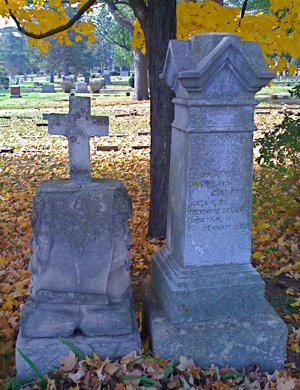 Editing our parish magazine is a job I could do without – I’m not the sort of person who likes to devote hours to any one task. To make the job more satisfying I introduce a bit of impishness like copying this photo of some grave humour taken by Scott P Richert.
Part of the impishness was to inaugurate the monthly Editor’s Award. Past winners have included Tarvin Environment Group (“best new group” and “group with most promise”, to Jenny Wardle for capturing the essence of prayer in a bouquet, and a collective award for all those who are dis-regarded in their communities in spite of the integrity and service (“our communities would be much the porrer without them”)
 This month’s award is for “cheerfulness” and is awarded to our village postman, Chris. I stopped him so I could take a photo of him and explained the reason. He was seriously (and cheerfully) overwhelmed – and shocked! I wonder why. Is it because he doesn’t regard himself as any different to anyone else? Is it because we rarely show appreciation? Is it because we are not used to prizing such qualities?


