Tag: Advent
Ero Cras
The Antiphons are one of the cool features of Advent prayer as Christians look forward to the coming of the Kingdom of God. There are seven Antiphons. They all begin with “O”, which is then followed by a title or attribute of Christ. There is one antiphon for each day of the week from December 17th. The Christian faith is spelled out in the initials of the Latin titles in the antiphons. Each title is drawn from Isaiah’s prophecy. Here’s the list (thank you wikipedia), together with reference to Isaiah:
- December 17th: O Sapientia (O Wisdom) – Isaiah 11:2f; 28:29
- December 18th: O Adonai (O Lord) – Isaiah 11:4-5; 33:22
- December 19th: O Radix Jesse (O Root of Jesse) – Isaiah 11:1 and 10
- December 20th: O Clavis David (O Key of David) – Isaiah 22:22, 9:7 and 42:7
- December 21st: O Oriens (O Dayspring) – Isaiah 9:2
- December 22nd: O Rex Gentium (O King of the nations) – Isaiah 9:6 ; 2:4
- December 23rd: O Emmanuel (O God who is with us) – Isaiah :14
The initials read backwards from the 7th to the 1st antiphon. They spell out ERO CRAS which means “Tomorrow, I will be there.” This faith in tomorrow is borne out of the compassionate response to the realities of the present tense/tensions which are rightly seen as lamentable. Richard Beck, in an Advent meditation, describes Advent as “sort of like a lament. Advent is being the slave in Egypt, sitting with the experience of exile. Advent is about looking for God and hoping for God in a situation where God’s promises are outstanding and yet to be fulfilled.” In a world where everything is “now”, we sometimes lose patience and sight of the fact that now was never intended to be the time, when our churches were to be full, when kingdom was to come in all its fullness. Now is a time of exile, a time of alienation, a time for not being at home in the world, a time of waiting for tomorrow, a time of lament, a time for hope.
Enya captures the spirit of waiting and the hope of tomorrow as she sings the 7th of the antiphons – part of the hymn O come, O come Emmanuel .which paraphrases the seven antiphons.
You may be interested to read about the long now.
>h.r.l. – his royal lowliness
>
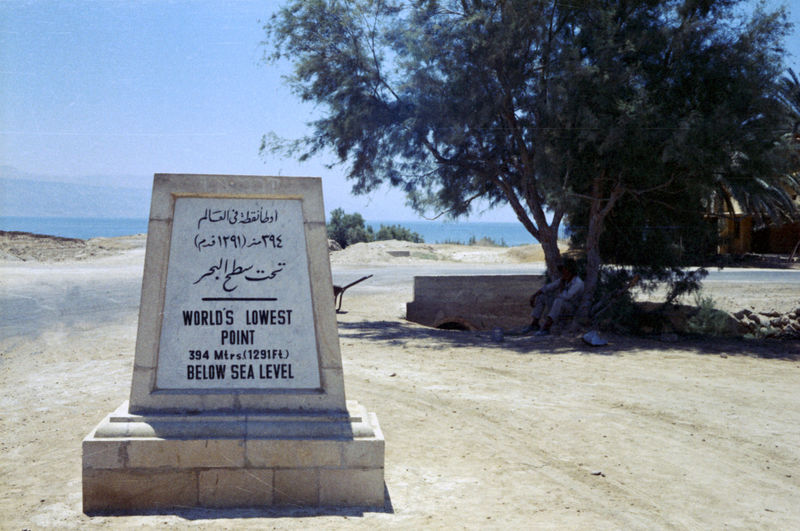 |
| this stone marks the lowest point on earth |
Jesus starts at the bottom – and stays there.
Ten days ago we were rounding off the church’s year by celebrating Christ the King – it has to remain a private awards ceremony because so many in the world choose to disagree – and Jesus would never impose himself. He’s King only to those who want him as such. Humility is his middle name.
We start the new year with clues that it is not “Highness” to describe his position, but low(li)ness. It is his royal lowliness (no capitals please) that according to the Advent hymn O come, o come Emmanuel “from depths of hell thy people save”. Jesus’s ministry begins at the lowest point on the surface of the earth – in the River Jordan. His life proceeds along the same low level of altitude – the wrong side of the fault line – to his death on the cross.
Jude Simpson has a wonderful Advent Reflection called Broken Open which takes us along this low line. She traces Jesus’s movements through the lowest points of people’s lives.

>between hope and optimism
>

Between optimism and hope there is a huge credibility gap. Optimism can be foolish or a realistic prediction based on evidence. Is life getting any better? There are grounds for both optimism and pessimism depending on your point of view – but a well rounded maturity would find it difficult to call one way or another because the evidence is so complex. The folly of liberal optimism shows itself in the advent of Holocaust and economic meltdown. The only ground for optimism seems to be forgetfulness – when we forget our history and our nature: or arrogance, when we think of ourselves superior to either.
Optimism trusts human progress. The opposite of optimism isn’t pessimism but hope. Miroslav Volf (in Against the Tide: love in a time of petty dreams and persisting enmities) reminds his readers of Moltmann’s wonderful work on helping us to think about “hope”. Moltmann distinguished between two ways in which the future is related to us. There are two Latin words for “future” – futurum and adventus. “Future in the sense of futurum developes out of the past and present inasmuch as these hold within themselves the potentiality of becoming and are “pregnant with future”.” But future, expressed as adventus is the future “that comes not form the realm of what is or what was, but from the realm of what is not yet, from outside, from God.”
Advent is about the future that bursts in on our darkness. There is nothing in the data of our existence that gives us grounds for optimism. It is just faith. There is no optimism in W H Auden’s Christmas Oratorio “For the Time Being”. There is no sense of “what shall we get for Christmas?” that we have to endure in the commercialised Christmas. How could there be? Auden was writing in the 40’s where the overwhelming “grinning evidence” is that the “Pilgrim Way has led to the Abyss”. There is only one option left for us “who must die”. Auden writes:
We who must die demand a miracle.
How could the Eternal do a temporal act,
the Infinite become a finite fact?
Nothing can save us that is possible:
We who must die, demand a miracle.
And Volf writes:
“Every year in the Advent season we read the prophet Isaiah: “The people who wlaked in darkness haveseen a great light; those who lived in a land of deep darkness – on them light has shined.” (Isaiah 9:2) This is what Christmas is all about – something radically new that cannot be gernerated out of the conditions of this world. It does not emerge. It comes…. God promises it”

The Kingdom
>I have listened to two sermons from +Robert Atwell in two days. Today I get a day off!The first sermon was at the induction of friend Kathy Kirby as Vicar of St Paul’s Macclesfield. Kathy is a special person who is immensely generous in her appreciation of others. She will offer a very special ministry of affirmation and encouragement. The second sermon was to our Committee for Ministry in which he quoted “the Kingdom” by R.S.Thomas:
It’s a long way off but inside it
There are quite different things going on:
Festivals at which the poor man
Is king and the consumptive is
Healed; mirrors in which the blind look
At themselves and love looks at them
Back; and industry is for mending
The bent bones and the minds fractured
By life. It’s a long way off, but to get
There takes no time and admission
Is free, if you purge yourself
Of desire, and present yourself with
Your need only and the simple offering
Of your faith, green as a leaf.
R.S. Thomas, Collected Poems 1945-1990
I am playing round with ideas on supervision at the moment. Where many minds are bent on specifying, my mind is bent on generalising. I am told that if supervision becomes too general it loses its meaning. I counter that if supervision is too specific it doesn’t mean so much. If the kingdom is “mirrors in which the blind look at themselves and love looks at them back” I dare the word to bear such meaning and defy those who say I go too far.

Twelfth Night
 Today is Epiphany – January 6th. Twelfth Night – down with that tree and away with that tinsel. Highlight of the season has been reading The First Christmas by Marcus Borg and Dominic Crossan. This has given spiritual direction for this wonderful season. Borg and Crossan describe the birth stories of Matthew and Luke’s gospels as “parabolic overtures” for their whole gospel of joy and conflict – personal and political.
Today, Epiphany, focus is on the story of the visit of the Magi who travel one road and then return by another road. The road they travel is to the palace of Jerusalem. Of course, they would go that way. The way of the worldy wise is to the palace and the court. They discover how wrong they are. In Breugemann’s phrase, they finish “9 miles wide”, and discover their journey’s end (and their beginning – TS Eliot) to be not at the court of Herod but in the outbuildings of an inn in Bethlehem. Their return “by another road” signifies repentance – a change of mind – demanded by the Jesus of the Gospel. “They no longer walked the same path, but followed another way.”
Messrs Borg and Crossan wonder whether I am “like the Magi who follow the light and refuse to comply with the ruler’s plot to destroy it.” Or whether I am like Herod “filled with fear and willing to use whatever means necessary to maintain power, even violence and slaughter.” Am I among those “who yearn for the coming of the kingdom of justice and peace, who seek peace through justice”, or am I among those “advocates of imperial theology who seek peace through victory?”
Borg and Crossan refer to the three tenses of Christmas. Past, present and future – as retold by Charles Dickens in the Christmas Carol. Of the future tense they refer to three different understandings:
One is called “interventionist eschatology” – in which only God can bring about the new world.
The second is called “participatory eschatology” in which we are to participate with God in bringing about the world promised by Christmas.
The third involves letting go of eschatology altogether in which Christian hope is not about the transformation of this world.
Only the second is affirmed by Borg and Crossan – thankfully. “We who have seen the star and heard the angels sing are called to participate in the new birth and new world proclaimed by these stories.” They quote Augustine’s aphorism: “God without us will not; we without God cannot.”

Mothers of God
We are all meant to be mothers of God. What good is it to me if this eternal birth of the divine Son takes place unceasingly but does not take place within myself? And, what good is it to me if Mary is full of grace if I am not also full of grace? What good is it to me for the Creator to give birth to his Son if I do not also give birth to him in my time and my culture? Then, then, is the fullness of time: When the Son of God is begotten in us.
Meister Eckhart (14th century)
Mary’s YES
“According to ancient Christian writers, God waits for Mary’s yes; creation waits; Adam and Eve wait, the dead in the underworld wait; the angels wait; and so do we. With Mary’s yes, hope is enlivened and history is changed. There is an unimaginable future for all people, a future that comes from God. All nations assemble in justice, compassion and gratitude. Salvation is created among us, and the fate of history is altered by a godly presence. This salvation resides in the hearts of those who believe in the gift and who stay awake eagerly to know it is coming. With David we await it, with the nations we long for it, and with Mary we behold it.”
Dianne Bergant
Why are we waiting?
>I’m trying to keep Christmas out of Advent – but here’s the world’s first Beach Hut Advent Calendar where Christmas is very much part of Advent.
Advent is a time of waiting and hope. The trouble is that we forget that it’s the Kingdom of God we are waiting for and not Christmas. And it’s a long wait because God takes his time. The reading yesterday was one that I had never really taken in before.
Do not forget this one thing, dear friends: With the Lord a day is like a thousand years, and a thousand years are like a day. The Lord is not slow in keeping his promise, as some understand slowness. He is patient with you, not wanting anyone to perish, but everyone to come to repentance. (2 Peter 3:8)
God’s not going to take any short cuts. If he did he would undermine his merciful nature and break his promise to his people. For the mean time he gives us his Spirit to encourage, strengthen and comfort us – to give good time in the bad times of waiting for wrongs to be righted and for kingdom come.

Advent and the adult Christ
It is an adult Christ that the community encounters during the Advent and Christmas cycles of Sunday and feasts: a Risen Lord who invites sinful people to become the church. Christmas does not ask us to pretend we were back in Bethlehem, kneeling before a crib; it asks us to recognize that the wood of the crib became the wood of the cross.
—Nathan Mitchel, quoted in, LITURGY WITH STYLE AND GRACE by Gabe Huck and Gerald T. Chinchar. (Archdiocese of Chicago, Liturgy Training Publications, 1998, page 97. Paper, ISBN 1-56854-186-4 in Preachers’ Exchange

 Grits and Grains