Seeing the wounds Jesus shows us

A sermon for the 2nd Sunday of Easter – Year C for two small churches. The gospel for the day is John 20:19-end.
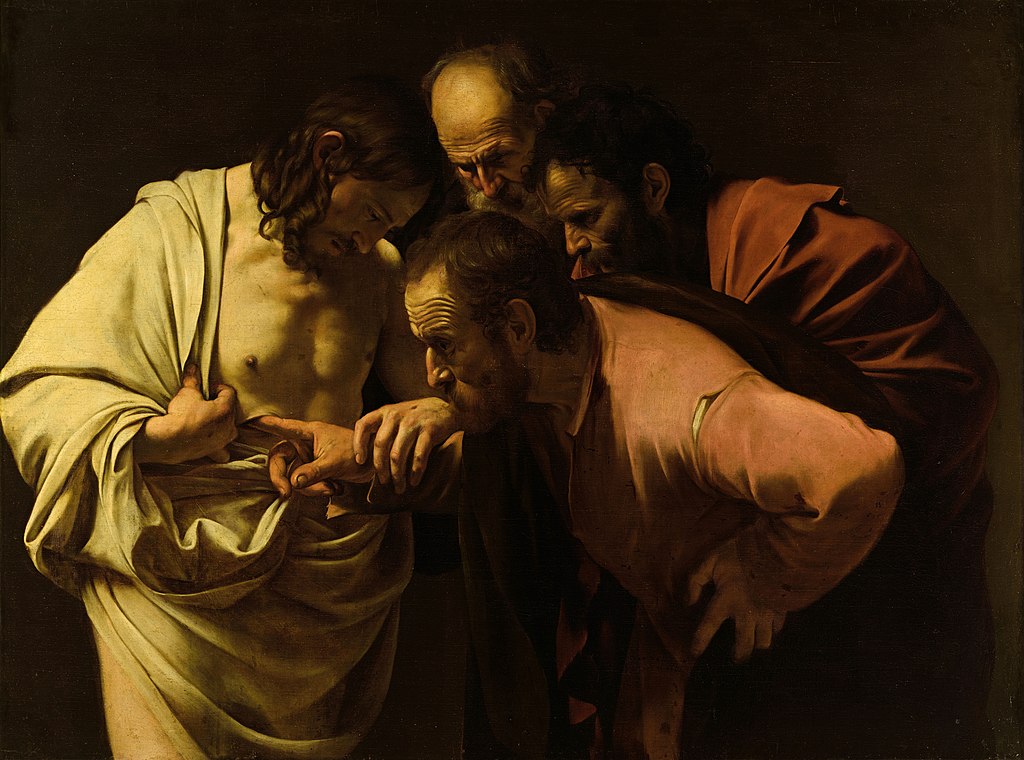
The Incredulity of St Thomas by Caravaggio – or should it be called Jesus showing Thomas his wounds?

I love preaching that brings Scripture to life—and that brings Scripture back to life.

That’s a line I’m going to repeat each week to remind us that every time we open Scripture together we are bringing it back to life.

This morning we return to John’s Gospel, still caught up in the wonder of that first Easter day (John 20:19-end). It’s a story only he tells.

John himself brings scripture back to life.
Particularly we see the influence of the creation story from the 1st chapter of our scriptures.
We can see that in the way that he tells us the time.
On the evening of that first day of the week.
It’s like last week’s gospel reading which began: Early on the first day of the week, while it was still dark. (John 20:1)
We are still on that first day which was like the first day of creation, when, according to Genesis 1:2, earth was a formless void and darkness covered the face of the deep.
That’s the time in today’s gospel. It was the first day of the week, and it was evening.
In other words, darkness was forming.
Taking our cue from Genesis, John’s readers can expect God’s wonders on this new day of creation.

Thomas wasn’t with the disciples when Jesus came on that first day, the day of resurrection.
It was the other disciples who had to let him know that they had seen the Lord.
Thomas told them that he would never believe “unless I see the nail marks in his hands and put my finger where the nails were, and put my hand into his side”.
It is this I suggest we focus on in our worship today.

Thomas is the patron saint of those who are blind because seeing wasn’t enough for him.
He needed to examine Jesus’s wounds by touching them and feeling them.
And the wonderful thing on that second Sunday, the first day of the week following, was that Jesus came and stood among them again and showed Thomas his wounds.
He welcomed his touch. He guided his hand. He let him explore his body.
Thomas is the patron saint of those who struggle to believe what they can’t see—or even what they can.
He shows us that resurrection faith isn’t just about seeing.
Sometimes it’s about touching, questioning and wrestling with God.

Jesus showed Thomas his scars. He wants his disciples to see them.


In the Last Supper, he took a loaf of bread and he broke it.
He wanted them to see his body in the brokenness of the bread.
“Take, this is my body,” he said. (Mark 14:22).
Then he gave them a cup for all of them to drink from.
In that cup he wanted them to see his blood.
“This is my blood of the covenant poured out for many.”
Even before he was wounded he wanted to show his disciples the wounds he was going to suffer.
And in today’s gospel, in one of his resurrection appearances, he invites Thomas to have a look at those wounds – to examine, inspect and see with his hands as well as his eye.

Thomas recognises Jesus through his wounds, just as Jesus wanted him to.
And this is how we come to know Jesus.
Just as Thomas encountered the risen Christ in his wounds, so too we encounter him today in the bread and wine of the Eucharist.
Every Communion we have with Jesus we have this invitation to examine the wounds of Jesus. Every time the bread is broken we are invited to see the brokenness of the body of Christ and to feel that brokenness in our mouths.
Every time we take this cup we are invited to taste the blood of Christ shed for us.

What is it that Jesus showed Thomas?
What did he want his disciples to see?
What does he want us to see when he shows us his wounds, when he invites us to see his body and his blood?

The first things we see are the wounds to his hands and feet where the nails were driven into his body by the hammer blows of empire.
Then, if he turns we see the wounds of the whipping scored into his back for being the scourge of empire and religion.
Then we see the scars on his head where they pressed the crown of thorns and added insult to injury, to press home the point that this “pretender” was nothing.

The rule of the kingdom of God is that the last, the lost and the least come first and those who are first in the kingdoms of this world come last.
The rule of the kingdom of God turns the rules of the world upside down.

In the wounds of Jesus, his disciples see a man who embodies that rule of the kingdom of God. In the brokenness of his body, in the bloodshed, we see a man the religious and political capital tried to reduce to nothing.
The plots against him and his crucifixion were intended to humiliate him and his followers – to make them least, last and lost – GONE for ever.

The problem for them was that the rule of the kingdom of God puts the least, last and lost – those lost and broken by the ways of the world – first.
When Jesus stood among his disciples, first without Thomas, then with him, he was the living proof of the fundamental rule of the kingdom of God.
Here was the humiliated, crucified and killed one.
You can’t get more “least, last and lost” than that.
Here he was, “the first fruits of those who have died”, Christ raised from the dead (1 Corinthians 15:20).

This is what Jesus showed Thomas –
the scars are the living proof of the rule of the kingdom of God.
Jesus stood among them as living proof of the rule he’d always followed,
that puts the last first and the first last.
Here is the one they put last made first.
This is what Thomas saw. This is what he said:
“My Lord, my God” – the rule of the kingdom of God realised in those few words.
“My Lord and my God” – Jesus comes first for Thomas.

So Jesus stands among us still, not with condemnation, but with scars.
What do we see? What difference does it make? Does Jesus come first?

Jesus doesn’t shame Thomas for his questions. He meets him in them.
He doesn’t rush belief. He invites it — gently, patiently, personally.

And he does the same with us.
To all who doubt, who ache, who long to see and touch and know — he says,
“Here I am. Peace be with you.”

He doesn’t hide his wounds. He offers them.
He lets us trace the pain and the mystery of a love that suffers with us and for us.
And in that wounded, risen body, we find our hope.

This morning, he says again:
“This is my body. This is my blood.”
This is how I choose to be known.
Look closely. Taste carefully.
And, if you are among the broken,
do not be afraid.

Thomas’s Twin – a sermon for Easter 2A

Sermon notes for Easter 2A for St Alban’s, Broadheath. Again, it could be said better, and I hope it will be. I share it anyway. The Gospel reading is John 20:19-31

Who likes ants?

We are told to learn from the ants. Proverbs 6:6 – “Go to the ant, you sluggard: consider its ways and be wise.”

It’s true. We can learn a lot about community and industry from ants. We can also learn that if they get lost they die. When ants get lost, they follow a simple rule. The rule is to follow the ant in front. But they don’t know that the ant in front of them is only following the ant in front of him. They finish up going round and round in circles, blindly following the one in front until …. They die.

There is a famous example of this deathmill from the Guyana jungle. The ants were just going round in circles – it was a trail of ants which just kept marching in a column 400 yards long (the length of a running track). It took them 2 days to complete a circuit. On and on till they died from exhaustion.

Consider its ways, and be wise. What do we learn from the ant? We learn the importance of thinking for ourselves. We learn the importance of seeing for ourselves.

“Seeing is believing.” That’s what we say, isn’t it?

“We have seen the Lord” is what the disciples say in today’s gospel reading. “We believe”. “We have seen the Lord” is what the disciples say to Thomas, who wasn’t there to see and believe. He is the odd one out.

He was in the wrong place at the wrong time and missed seeing Jesus.

Seeing is believing is the theme of John’s gospel. Time and again John refers to the disciples “coming to see”. The frequency increases as we move to the end of John’s gospel.

  • Mary Magdalen came to the tomb and saw that the stone had been removed,
  • Peter and the beloved disciple ran to the tomb and saw the linen wrappings lying there. They went into the tomb, and saw and believed.
  • Mary Magdalen told the disciples that she had seen the Lord.
  • Mary Magdalen, Peter, the beloved disciples come to see the Lord.
  • And then, that same evening of the day of resurrection, the disciples “see the Lord” – apart from Thomas. Where was he? What was he doing?

Seeing is believing.

But if seeing is believing, what about those who are not there to see, like Thomas?

And what about those who can’t see? What about those who not even Specsavers can save?

This was a problem for a friend of mine who became blind. He was troubled about all that the Gospels say about “seeing” and “believing”, and about “light” (good) and “darkness” (bad). How could he believe when he couldn’t see? How could he be saved when he had been cast into outer darkness?

Do you see his problem?

He worked it out in the end, eventually realising that there are other ways of seeing. He called it “whole body seeing” and wrote the story of his blindness and his later whole body seeing in a book called Touching the Rock.

This is how he discovered his “whole body seeing” (WBS for short). He was staying at Iona. He had been told about the altar there by people who had described it to him. Then he saw it for himself. This is what he wrote:

 “After several nights, I discovered the main altar.

I had been told about this, and I easily recognised it from the description. It was a single block of marble.

Finding one corner, I ran my fingers along the edge, only to find that I could not reach the other.

I worked my way along the front and was amazed at its size.

The front was carved with hard, cold letters. They stood out baldly, but I could not be bothered reading.

The top was as smooth as silk, but how far back did it go?

I stretched my arms out over it but could not reach the back. This was incredible.

It must have a back somewhere. Pushing myself upon to it, my feet hanging out over the front, I could reach the back. I did this again and again, measuring it with my body, till at last I began to have some idea of its proportions. It was bigger than me and much older.

There were several places on the polished surface which were marked with a long, rather irregular indentations, not cracks, but imperfections of some kind.

Could it have been dropped? These marks felt like the result of impact. The contrast between the rough depressions and the huge polished areas was extra ordinary.

Here was the work of people, grinding this thing, smoothing it to an almost greasy, slightly dusty finish which went slippery when I licked it. Here were these abrasions, something more primitive, the naked heart of the rock.”

When I read that I just went WOW. He had seen things which would not have been noticed by the casual observer with her naked eye. With his whole body seeing he had found things there which I am sure he’d be telling others about over breakfast the next day. “Come and see” he’d have been telling everyone.

I mention this because I think there is something in today’s gospel about the importance of seeing things for ourselves. When we see things for ourselves we are not seeing through other people’s eyes. We are not conforming to their vision, and we are seeing things that nobody else sees.

This brings us to the beauty of Thomas who is the focus of our gospel reading.

Thomas is a disciple who captures our imagination, isn’t he? That’s shown in the number of Thomases there are. (How many here are called Thomas, or have a Thomas in their family?)

Two of our children have Thomas in their names, after their grandfather.

We often talk about “doubting Thomas” and then refer to him as typical of us, who are often “doubters” like him.

I’m not sure that this is helpful. Thomas is actually someone who sees and believes, but in a different way. Isn’t that a more helpful way to remember Thomas?

Thomas sees things differently. This is brought out in the gospel. He wants to see through his hands and fingers. He uses his body. He doesn’t just see with his eyes. He inspects. He uses his senses and his sense. He sees with feeling. He sees from the heart.

That is the way that Thomas comes to see.

He puts his hand into Jesus’ wounds. He reaches beyond first impressions. And then he sees. He feels the love in those scars and jumps to his joyful conclusion that he is seeing our Lord and our God. This is the staggering realisation which comes from seeing from the heart, which comes from seeing with feeling, which comes from his insistence that he should see things for himself.

Thomas is not the doubter. He is one who was willing to see.


Thomas is a twin. That is how he is introduced in the gospel. “Thomas the twin”. We don’t know whether Thomas had a twin brother or sister. IT’s more likely that “twin” was Thomas’s nickname because the meaning of the name Thomas is “twin”. But if Thomas had a twin, who might it be?

That  might have been a question that entertained John’s community. “If Thomas is the twin, who is his twin brother or sister?”

They could have played with that question and wondered “is that me?”

We can play with the same question. If Thomas is like us in his doubting, can we be like him in his seeing and believing? How much like him can we be? Can we be his twin brother or sister in the way that we are so much like him in wanting to see Jesus from the heart?


Jesus made many “resurrection” appearances – or should I say that Jesus makes many “resurrection” appearances. John admits that there are so many ways that Jesus showed himself and supposed that “if every one of them were written down the world itself could not contain the books that would be written.” Jesus wants us to see him for ourselves. He wants us to be witnesses.

Mary Magdalen, Peter, the disciple (disciples?) Jesus loves/loved, Thomas and ourselves come to see in their different ways. Together we are a body of believers who through our whole body seeing see things differently.

It is in such company that Jesus shows himself so that we might see life differently – with compassion that is able to feel for scars and wounds, and with the hope that love is stronger than death.

It is in such company that Jesus shows himself to us so that we might follow him in a way of life that is life giving, instead of blindly following others till, like the ants, we drop from exhaustion.

the quote is from Touching the Rock by John Hull
I found the picture of Still Doubting at Mattseyeshaveseen – with some interesting reflection.