The fig tree and the landlord

A reflection for the 3rd Sunday in Lent (Year C) focusing on the parable of the fig tree. The readings for the day are Isaiah 55:1-9 and Luke 13:1-9

The gospel writers give us two parables of Jesus featuring fig trees. He may have used more. The two we’ve got teach different lessons. In one, the fig tree is cursed. In the other the fig tree is spared. The fig tree (featured in Mark 11:12-14, 20-25 and Matthew 21:18-22) is cursed by Jesus for not bearing fruit. In the other, from Luke’s gospel, the parable which is our good news for today, the fruitless fig tree is given a time of grace. 

Our other reading from Isaiah (55:1-9) culminates with these words of the Lord: “my thoughts are not your thoughts, neither are your ways my ways”.

How are we going to bring these two passages of scripture together and bring them to life today?

“My thoughts are not your thoughts, neither are your ways my ways.” A good question for us to be asking is “How?” How do my ways differ from the Lord’s ways? How does our thinking differ? These are good questions for self-examination, particularly during Lent which is a season given us for repentance, for changing our minds, attitudes and behaviour.

There is a distinction drawn. “My ways are not your ways …..”

The distinction is graphically illustrated by Jesus in today’s parable. It’s our Lord telling a story about another lord, a landlord – and we can read between those few lines of the parable the thought of the Lord: “my thoughts are not your thoughts, neither are your ways my ways. As the heavens are higher than the earth, so are my ways higher than your ways and my thoughts than your thoughts.”

Let’s look at the difference between one lord and the other and try to unpack a parable which takes up so little page room that it is easy to skate over it. But small is beautiful and less is more – such is the rule of God’s kingdom.

The difference is in their respective responses to fruitlessness, and their different relationships to the fig tree.

The owner of the vineyard, the landlord, had a fig tree growing in the vineyard.
He keeps coming back to the vineyard to see if there were any figs on the tree.
Time and time again he did this.
For three years he kept checking up, and then he ran out of patience.
Cut it down, he said.

Here is a man with authority who can say to his servant, do this, do that.
He gives the orders. He doesn’t dirty his own hands.
His servant is the one who took care of the vineyard.
He is the one who does the work.
If there’s cutting down to be done, he’s the one who will do it – the owner isn’t going to get involved in that dirty work.

So, here the picture is building up of this landowner-boss, who comes from time to time to check up on his investments, to check up on his interests.
His interest is what matters to him.
It’s all about him.
It’s his vineyard, but he’s away from it most of the time.
His is a remote control. He’s distant and disconnected.
It’s his fig tree, and it’ll be his profit if the fig tree were to give a fig.

We won’t blame the landowner.
We won’t call him wicked.
His behaviour is normal.
This is what happens in the real world.
His order makes perfect sense to our thinking.

Of course, we are not surprised that the landlord wants to cut the plant down.
We know that is the way of the world governed by money, profit and vested interests.
We are seeing that in our current economic crisis with cuts to welfare.
The way of the world is to cut down the fruitless and profitable, so that the fruitless and unprofitable make way for something that will be productive.
The ways of the world measure us in productivity and fruitfulness.
The less productive and fruitful we are the more vulnerable we become to cuts.

But is this the only way? Must fruitlessness always be met with destruction and condemnation?

There’s the landlord. 

Now let’s explore how different the one who actually took care of the vineyard.
We need to make a judgement between them otherwise Jesus has told the parable in vain.

In the words from our Isaiah passage we can play the question whether the thoughts of the caretaker are the same as the thoughts of the landlord.
Do they think the same?
Are the ways of the caretaker higher than the landlord?
Is his thinking higher than the thinking fo the landlord – “as the heavens are higher than the earth”?

The one who took care of the vineyard is the caretaker.
He is the one who is always there, working the vineyard day to day, spending his time and energy, rooted in the earth and tied up with the vines, the figs and all the challenges they face.
He’s the one who takes care of the vineyard for the landlord who takes care of his pocket.

(If you want to play with words again, our word care, originates from the Old English caru and cearu (meaning “sorrow, anxiety, grief”), ultimately stemming from the Proto-Germani karo (meaning lament, sorrow) and potentially tracing back to a Proto-Indo-European root meaning “to cry out, shout”. Just ask Google!

The word cure came to us through French after the Norman Conquest, and ultimately derives from the Latin word cura, meaning care.

The caretaker, the one who takes care of the vineyard, is the curator.
I’m labouring this point because you are in your vacancy of praying for a new priest – someone the Book of Common Prayer calls curate who will have the cure of souls in these parishes, a curate who will spend her/his time and energy in the day to day care for the vineyard round here,
someone who will join you in caring for those around you,
someone who will sorrow and grieve with you for how things are for those who are hurt and suffer the cuts of those who don’t care so much,
someone who will join you in lament, crying out and shouting about pain, injustice and suffering,
someone like the caretaker in Jesus’ parable who speaks up for the doomed fig tree,

someone who knows better ways for the world, someone who will think differently to the world …

Through the caretaker’s pleas we see the heart of our Lord Jesus.
Where the world rushes to judgement, Jesus intercedes for grace.
Here’s the difference between the landlord and our Lord.
The reason Jesus was sent into the world was to save us, not condemn us.
God is slow to condemn – with God there is always the period of grace, another season for the caretaker to do his work.

So, which lord will we follow?
Will we stand with the landlord in judgement, or with the caretaker in mercy?

Jesus wants us to follow him.
He wants us to join him to save the world
He wants our ways of thinking and our patterns of behaviour to be passionate in our care during this hard won season of grace.

If we follow Christ we will see the fruits of his patience.
We will see lives restored and hope rekindled,
and after the season is done, the caretaker, our Lord will say to the landlords:
“See this, the fruit of your planting, the harvest of this season of grace.
See the compassion, see the harvest.”

Eucharistic community – is it the bearing we’re wearing? Sermon notes Trinity 9B

Notes for a sermon for the saints at St Wilfred Grappenhall – August 2nd 2015 (Proper 13B, Ordinary 18B, Trinity 9)

The text: Ephesians 4:1-16

We all have one letter in our hands – it’s a part of a letter with a prison stamp, which seems to be addressed not just to people in one place, Ephesus, but to all places at all times. This fragment is intriguing because of the wonderfully motivating language, but because it touches on the behaviour of saints. It’s a letter to saints about how saints behave. In the letter WE are called saints so it’s a letter about how we behave.

My sermon is playing for time – time for us to dwell on this fragment – time to gather round three hearths within the fragment. Please feel free to wander round this in your own way at any point, but for those who want to stay with me I start with a question that, for some reason kept bugging me while I was reading this letter. The question is, “Why did the guest have to leave the party?” It’s a question posed by the story from Matthew’s gospel (chapter 22).

I’ve got an email here which might remind you of that story. It’s one of those “complaining” emails.

It begins:

“Hi King”, (isn’t it strange how we don’t use “dear” so much in emails? Does it mean that people are now less dear and precious to us in the days of bulk correspondence?) – anyway, the email goes on:

“I feel I have to complain to you about the way you treated me at the party you organised. First of all, thank you for the invitation. I had thought that I would have been invited to one of your earlier parties because of the work I have done in the community. Anyway, I did manage to rearrange my diary so that I could join you in the palace.

“I was shaken when your flunkies grabbed me and escorted me from the party. I can’t see what I did wrong. They said it was because of what I was wearing, but the invitation did say that the dress code was informal, and other people were wearing t-shirts and shorts as well.

“What’s made matters worse is the media coverage. The headlines are awful and everywhere, and the film showing me weeping and gnashing my teeth has gone viral on youtube. You have made me a laughing stock. It has been so damaging, embarrassing and disrespectful. I demand an immediate apology.

“And one more thing. I don’t know who did the seating plan, but I can’t understand why I wasn’t at one of the top tables. You don’t seem to realise who I am.

Yours, humiliated,
Frank Lee Speaking.”

I’ve got the king’s reply:

“May I speak to you frankly? I do this in love.

I felt honoured that you accepted my invitation, and that you made the time to come (many didn’t – which explains why there were so many people there who you’d probably only seen begging at the city gate). It wasn’t the clothes you wore (I rather liked that t-shirt you wore). No, it was the bearing that you were wearing. You were upsetting the party and upstaging the guests. You were resentful, argumentative and arrogant. You had to go.

I am sorry that you felt embarrassed. That was never my intention. I hope you understand.

Love

Rex X”

Welcome to the party.

As Christians we enjoy ourselves. We use the language of party – a eucharistic language. Sunday by Sunday there is eucharist, celebration, wine, good company, gifts, song and a party Spirit. It’s not a party to be missed for the food – the bread that gives life to the world.

The party spirit of the worshipping community is captured by describing it as “Eucharistic community”. I want to share three hearths with you – the three hearths take us to the heart of what a eucharistic community is – what the party is about.

First:

At the heart of our eucharistic community is our “thank yous”. A eucharistic community meeting is full of thank-yous – count the “thanks” in the liturgy, in our prayers, in our scriptures, in our interactions. We are awash with thanksgiving. Thank you, thank you, thank you. The eucharistic community is raised in appreciation and thanksgiving – indeed, that is the very meaning of the word eucharist.

Alice Walker, author of The Color Purple, says that “Thank you” is the best prayer that anyone could say. She says that she gets to say that prayer a lot: “thank you expresses extreme gratitude, humility and understanding.” Is that our prayer?

Ephesians talks of “thank yous”. Here’s how The Message translates another verse (5:4) in the letter: “Though some tongues just love the taste of gossip, those who follow Jesus have better uses for language than that. Don’t talk dirty or sill. That kind of talk doesn’t fit our style. Thanksgiving is our dialect.” Thanksgiving is our dialect.

Positive psychologists are also talking about the importance of gratitude and thankfulness as a transformative and converting behaviour…..

Second:

In the depths of Eucharistic language there is gifting – and that is the basis of our gratitude and thankfulness. It is how “eucharist” is spelled. CHARIS comes in the middle of that word. “Charis” is left when you peel away the “eu” and the “t” from the beginning and end of “eucharist”. “Charis” is the heart of “eucharist”. “Charis” means “gift” and “grace”. We have words that are recognisably derived from CHARIS, for example “charity”, “charism” and “charismatic”.

Someone who wears a charm bracelet wraps gifts around her wrist (– a charm arm) – celebrating charming life, an acknowledgement of being charmed and a vocation to be charming, generous and gracious. Grace is the word that is used in the “thank you” letter addressed to the Ephesians. “Each of us was given grace according to the measure of Christ’s gift.”

I wonder if the wedding guest was told to leave because he had no charm.

According to our reading, there are two groups of people within a Eucharistic community. One group is made up of saints, the other group is made up of apostles (they are advocates), prophets (they speak from the heart of God to the heart of the people), evangelists (they are angels with only have good news to share), pastors (they shepherd) and teachers (guess what they do). Those are charisms that form a ministry team – and you can bet that some people here are part of a team like that – the beginnings of a team of people who are gifted and charmed to help this other group of saints, so that all of us are equipped for ministry until we find the unity that God has in store for us. All of us are charmed and gifted – but some are charmed and gifted to help the rest of us – be saints.

The gifts God gives can only be valued by a Eucharistic community. They are gifts of ministry for the sake of the saints who live for the sake of the world. That’s the party spirit.

Third:

The third hearth of a Eucharistic community is that we are communities in formation.

We are still growing up, with growing pains which show in our joints and the way we join each other. Our relationships are always less than perfect. Outsiders often call us hypocrites because we so often don’t walk the talk.

We often forget that we are still growing, that we have so much to learn, that we are building one another up. We often speak the truth to one another (try to teach one another a lesson) forgetting that the responsibility within the Eucharistic community is to speak the truth in love. That is the party spirit.

I wonder if the wedding guest had to leave because he only spoke the truth, or because he was a know-all, not humble enough to realise that he had so much to learn. Paul said, “we must no longer be children … but speaking the truth in love, must grow up in every way into him who is the head, into Christ ..”

I wonder if it was something about the guest’s bearing. Was it the bearing he was wearing? I wonder whether it is something about the church’s bearing which, in some quarters, has become branded as toxic. Thanksgiving isn’t always what hits people in the eyes. it’s not always obvious that we see ourselves only as children, only as “growing up”. Nor is it always apparent that we are thankful party people, or that we are always charming and blessing.

Each place needs a community of thanksgiving, a community which is intentionally growing up, and a community which is charming and blessing, so that the ways of the world can be changed, so that so that life can be different, so that those who walk through the valley of the shadow of death may find hope, and may find a welcome at the table where all their hungers are satisfied, so that they may share the bread of life.

(The drawing is by Cerezo Barredo, part of series of illustrations for the Revised Common Lectionary – this one is of the parable of the wedding feast (Matthew 22).

The Bishop of Digne and dropping keys for prisoners

The Bishop of Digne

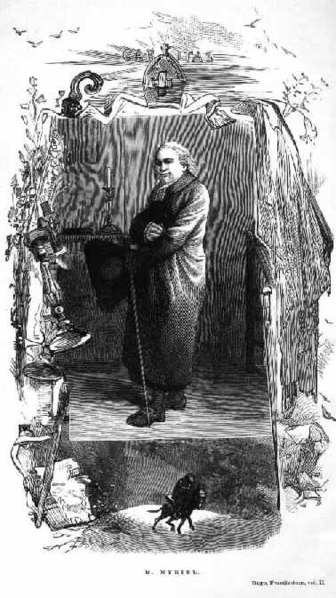
The Bishop of Digne is a key character of Les MiserablesHe is the one who offers Jean Valjean refuge, who treats him as an “honoured guest” and a shelter from the rules which allows Valjean to change his mind to the question which echoes through the story: the question of “who am I?” Valjean, or, rather, Prisoner 24601 conforms to type when he abuses the hospitality. He runs off with the silver and is captured by the law enforcers. They deliver Prisoner 24601 to the Bishop. The Bishop seizes the moment (what had he done to be prepared to react with such imaginative compassion?) and lyingly claims he had given the silver to Valjean, dismisses the police, commending them for their duty, and gives Valjean his chance.

Digne is in south-eastern France. I don’t know whether the name Digne had significance for Victor Hugo, but surely some association with dignity was intended. We might say that the Bishop of Digne was a steward (another word for “bishop”) of Dignity. The Bishop is only a marginal character but according to Theresa Malcolm “he is the soul of the novel, he who sowed love where there was hatred, light where there was darkness”. Bishop Myriel (as was the name of the then Bishop of Digne) was also known as “Monseigneur Bienvenu” for his spirit of generosity and welcome.

Victor Hugo dwells on the character of the Bishop of Digne at great length. He describes how he moved out of his episcopal palace so that it could be used as a hospital. He describes how he gave 90% of his stipend to charity, and how he simply lived for the poor. He spent his life for them matching deed to word. He spent time with prisoners. Hugo described how Myriel went with one prisoner, standing side by side with him on the scaffold, having spent the previous day with him, sharing with him “the best truths, which are also the most simple. He was father, brother, friend; he was bishop only to bless.” It was through such a lifestyle that people came to refer to the Bishop as “Monseigneur Bienvenu” – a bishop most welcome and welcoming.

This key character brings freedom. He unlocks Valjean’s soul and “gives him back his life”. Fourteenth century poet Hafiz comments on such great people who “drop keys all night long”:

The small person
builds cages for everyone
he
sees.

Instead, the sage,
who needs to duck his head,
when the moon is low
can be found dropping keys, all night long
for the beautiful
rowdy,
prisoners.

Valjean sums his situation up with these words:

For I had come to hate this world
This world which had always hated me
Take an eye for an eye!
Turn your heart into stone!
This is all I have lived for!
This is all I have known!
One word from him and I’d be back
Beneath the lash, upon the rack
Instead he offers me my freedom,
I feel my shame inside me like a knife
He told me that I have a soul,
How does he know?
What spirit came to move my life?
Is there another way to go?
I am reaching, but I fall
And the night is closing in
And I stare into the void
To the whirlpool of my sin
I’ll escape now from the world
From the world of Jean Valjean
Jean Valjean is nothing now
Another story must begin!

The engraving by Gustave Brion shows the Bishop of Digne – prepared for the first edition of Victor Hugo’s Les Miserables in 1886.

About Grace

Do we know what it means to be struck by grace?

It does not mean that we suddenly believe that God exists, or that Jesus is the Saviour, or that the Bible contains the truth. Grace strikes us when we are in great pain and restlessness.

It strikes us when we walk through the dark valley of a meaningless and empty life. It strikes us when we feel that our separation is deeper than usual . . . It strikes us when our disgust for our own being, our indifference, our weakness, our hostility, and our lack of direction and composure have become intolerable to us. It strikes us when, year after year, the longed-for perfection of life does not appear, when the old compulsions reign within us as they have for decades, when despair destroys all joy and courage.

Paul Tillich.

quoted by Holloway, Richard (2012-03-01). Leaving Alexandria: A Memoir of Faith and Doubt (Kindle Locations 1668-1674). Canongate Books. Kindle Edition.