Doula dos and dupes …. and ministry

Doula (L) with newborn and mother.jpg
Doula (L) with newborn and mother” by TheLawleys – http://www.flickr.com/photos/lawley/2056696634. Licensed under CC BY 2.0 via Wikimedia Commons.

What do clergy do? Well, the joke goes that they work on Sundays. And they joke when someone thoughtlessly asks “what are you doing for Christmas”. Whatever they do puts clergy on top of the pile when it comes to job satisfaction.

What do clergy do, especially when it looks like nothing? That’s the title of an excellent book on ministry by Emma Percy that leaves the impression that clergy should actually find it difficult to answer the question, “what do clergy do?” It’s a reminder, for Emma, of what many mothers ask at the end of a busy day – “What have I done all day?” They don’t see the answer themselves. In fact, they have done a lot but it feels like nothing.

What does a doula do? That was a man question on Radio 5 yesterday as Nicky Campbell asked a doula from Somerset what she did. She found it difficult to answer. She tried. “A doula does a whole range of things”, she said. “She is just there”, she said. She is there for the family, helping women to have the birth they want. I got the impression that a doula can’t narrow their job to one thing, or the other, or the many – but only the every thing that is needed. And Nicky Campbell asked, “what does a doula do in the birthing room?” “Well” she said. “Sometimes I do nothing, or knit and drink tea, sometimes I give massage for 15 hours at a time – whatever is needed.”

And that is what a doula does. And that is what a minister does. And that is what anyone does who respects the life-giving power of another. Here’s how another doula explains that a doula is “somebody on the journey who will be there for you no matter what”. “Rather Christ-like” is what I have to say, and, rather overwhelmed with the obsession with leadership talk as I am, I’d also want to say that it’s a view of ministry in which leadership talk is laid to rest in wisdom and helpfulness.

The word “doula” originates in the ancient Greek word δούλη which is the feminine form of “slave”. The doula is non-technical, non-medical – her only qualification is her experience as a woman and her willingness to share her practical wisdom.

Shiphrah (her name means “brightness”) and Puah (her name means “splendid”) are outstanding women who get a mention in Exodus 1:15-20. They are really doulas, although they are known as midwives who trick the Pharoah and resist his final solution to the Hebrew problem. He ordered them to kill the boy babies but Shiphrah and Puah have a reverence for life and carry on their work of bringing life into the world. They show themselves as wise women and they show the Pharoah up as totally stupid. Ackerman writes that rather than cower before the most powerful man on earth they “defend themselves with straight faces against Pharoah’s charge of insubordination. Their lives are at stake, and yet their sly comparison between the vigorous Hebrew women and the pampered Egyptians comes through as totally credible to the ‘wise’ king: ‘Oh yes, of course, that would be a problem, wouldn’t it?’ There is a great relish in this uneven conflict between the effete elite and the crude, but shrewd, vital, and resourceful, oppressed. The king fails to realise that not only is he being deceived, but he is also being mocked.”

That’s what doulas can do. That’s what ministers can do – but never just that.

People gatherers

Feeding the 5000 by Eularia Clarke

Some people are just good at gathering people together. They call on people and the people come. This seems to be what leaders can do – or, rather, are those people who can gather us together our leaders? People gatherers have an attraction and an authority. Whether we call a meeting or throw a party, we are acting as people with authority, people able to call on others. Most people can grow that authority, usually by the attractive way that they gather people. Conversely, we have all been in gatherings which have been so carelessly organised that we have said “never again”. There’s usually a reason why “nobody came”.

Neighbours Table tells the story of a people gatherer. In an interview with Tammy Helfrich (available as podcast), Sarah Harmeyer talks about her recent life as a “people gatherer”. She adopts a word for the year. Word of the Year 2011 was “community” which brought a vision for inviting 500 people to her table during the year. At the point of the interview, she is nearing 1500 for the 3 year period on a budget of $75 per month. She started with an invitation to a “pot luck” delivered to her neighbours. Her father made a table to seat 20 – 91 came. She suggests that people are waiting to be invited, that whole neighbourhoods are waiting for such catalysts for change, for people to step forward.

Her “manners” can guide us all. “Plan ahead to be present with people”, develop a culture of mutual respect, interest and listening, introduce people to one another by saying what you love about them – all that makes for a good time gathering. So, pause for thought. Why do we call people together? Are they just instruments to our ambition, pawns in our little games? Are we prepared for them? What is our interest in their offering? Do we know them? Do we love them?

There is always a reason why “people come flocking”.

PS People gatherers are the image of God who gathers people like a shepherd, making of them a nation and a church. Eularia Clarke’s picture of the feeding of the 5000 is a celebration of God as “people-gatherer”, recalling the feeding of the multitude. The painting is part of the Methodist Modern Art Collection, © TMCP, and is used with their permission.

Visions, leaders and ants – feeling my way

If army ants are wandering around and they get lost, they start to follow a simple rule: Just do what the ant in front of you does. The ants eventually end up in a circle. There’s this famous example of one that was 1,200 feet long and lasted for two days; the ants just kept marching around and around in a circle until they died.

James Surowiecki in The Wisdom of Crowds

We learn a lot from ants. “Go to the ant, you sluggard; consider its ways and be wise.”  (Proverbs 6:6). The death mill of the ants remind us of another biblical truth, that “where there is no vision the people perish.” (Proverbs 29:18). Helen Keller remarked that “the most pathetic person in the world is someone who has sight but no vision.”

The lesson we learn from the ants is that blindly following our leader is no guarantee of better times. We might just be going round in circles. The person in front of us might not have a clue where we are heading. Call him/her a leader? I don’t think so. But in bad times we will look round for the people we think can get us out of the mess. We will not always search out the same person. Someone who can get us through a forest of emotions may not be the same person to get us through deep water.

We talk about vision in leadership as if there is only one vision to be had, and as if there is only one person to have it. But we don’t have a single vision, we have visions. Some of those visions are immediately relevant, but other visions will only be useful once we have got over the hill we are currently climbing, for which we are depending on someone else who can help pace our climb and who can help us envisage cresting the hill. A community will thrive on the visions of its visionaries, not on the vision or hallucinations of its appointed leader.

Intelligent living means picking up information from the data around us. Where have you been? What have you seen? What have you found? Why do we see what we see? Why do we see it that way? These questions of curiosity shape what we see into something wiser. Vision is 360 degrees, and arises from looking all around us. My own work is supporting ministers in their parish ministries. Looking all around is so important for them if they are to be numbered among the visionaries (and leaders) of their communities. They have to look behind them to be aware of how they have arrived at their current position and to appreciate the journeys made by the people who make up their communities. They have to look round them to listen to the visions of those around them and the longings they represent. And they have to look forward with all these horizons in their mind’s eye to try to discern their foci.

David Runcorn underlines the importance of looking backwards in a sermon he preached at Lee Abbey. He comments that the best pastoral counsellors have learned to be “careful historians”.  We all live in and from our history and none of us can leave our past behind. He said: “The need for understanding and healing of memories; to be reconciled to people, events and hurts there, remains one of the most commonly expressed needs. It is also vividly illustrated through the experience of asylum seekers and victims of abuse or torture in our time. Before they can embrace any kind of new life they must find a way of recovering their past from the horrors they have endured. What is not remembered cannot be healed.”

There are many histories, longings and visions in a community. Vision needs to be celebrated as a complex process. It should not be reduced to a leadership task but should be allowed to develop as the height of intelligence.

What we learn from the ants is the importance of independence. According to Surowiecki “independent individuals are more likely to have new information rather than the same old data everyone is familiar with. The smartest groups are made up of people with diverse perspectives who are able to stay independent of each other. Independence doesn’t imply rationality or impartiality, though. You can be biased and irrational, but as long as you’re independent, you don’t make the group any dumber.”

Oppressed communities have leaders and views imposed on them, but when we are free we are able to choose the leaders who will help us. Those choices aren’t based on position and status. Instead we turn to those who have deep knowledge and understanding of where we are. They are our wise guides. In their hands we feel safe. They will help us find our way.

Thinking Leadership with Dee Hock and Meg Wheatley

“True leaders are those who epitomise the general sense of the community – who symbolise, legitimise and strengthen behaviour in accordance with the sense of the community – who enable its conscious, shared values and beliefs to emerge, expand and be transmitted from generation to generation.”

Dee Hock in Birth of the Chaordic Age

Meg Wheatley, from a perspective of “new science” (quantum rather than Newtonian) sums up what leaders are for:

“People need a lot from their leaders. They need information, access, resources, trust and follow-through. Leaders are necessary to foster experimentation, to help create connections across the organisation, to feed the system with rich information from multiple sources.”

In chaotic times

TU ES PETRUS!!!

I know that leaders today are faced with enormous challenges, most of them not of their own doing. As times grow more chaotic, as people question the meaning (and meaninglessness) of this life, people are clamouring for their leaders to save and rescue them…. People press their leaders to do anything to end the uncertainty, to make things better, to create stability. Even leaders who would never want to become dictators, those devoted to servant leadership, walk into this trap. They want to help, so they exert more control over the disorder. They try to create safety, to insulate people from the realities of change. They try to give answers to dilemnas that have no answers.

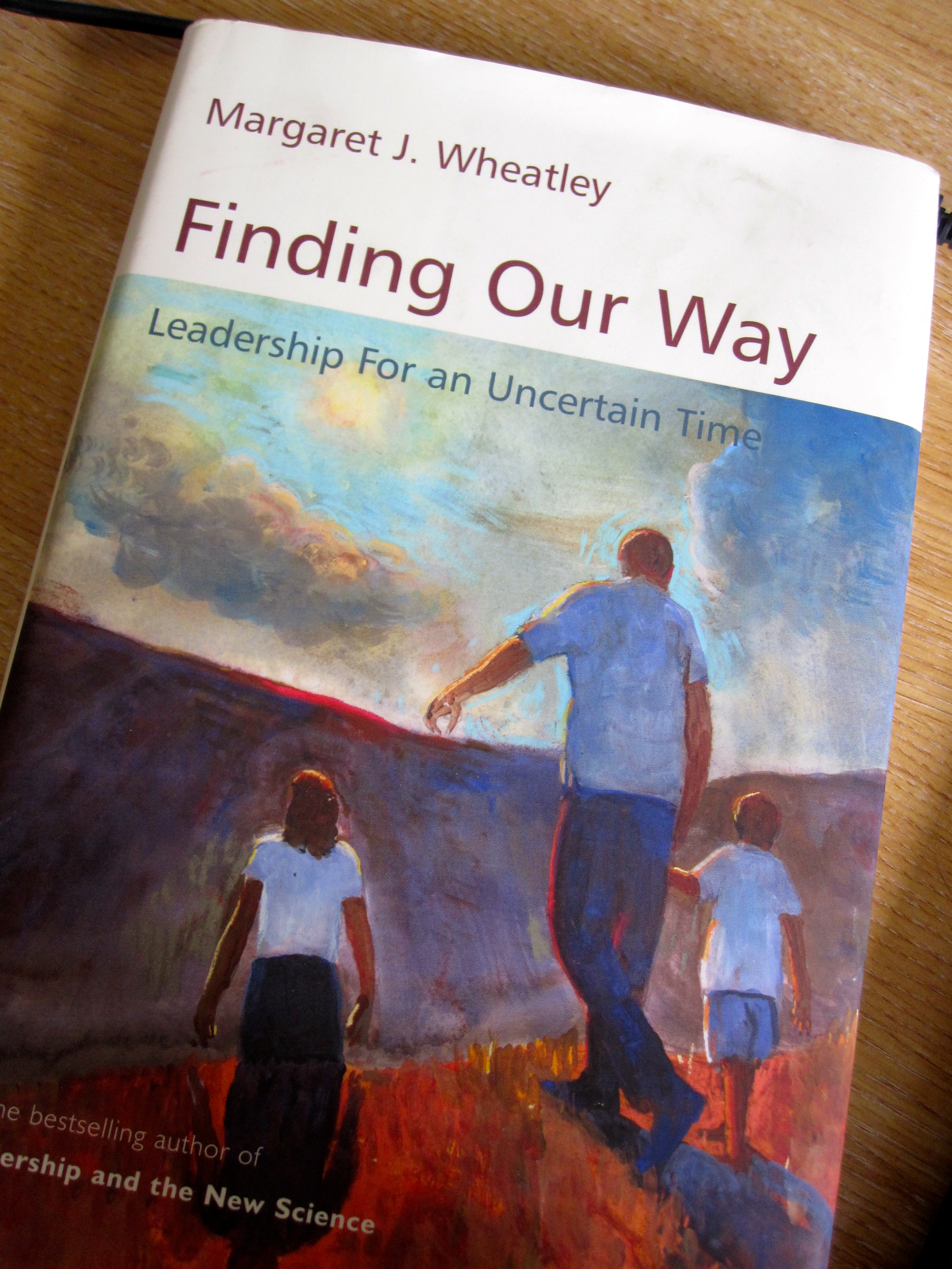
Today is the inauguration of Pope Francis’s papacy. We pray for him. This quote on the temptations and spirituality of leadership in times of chaos (all times) is from Meg Wheatley’s Finding our Way. It struck me as helpful on a day when many will be thinking through issues of leadership.

Cardinals

Seeing red is a turn on for male primates according to a recent survey. The survey suggests that men are more turned on by women in red and that although men like to think that they respond to women “in a thoughtful and sophisticated manner, it appears that at least to some degree their preferences and predilections are, in a word, primitive”. Well!

Elisabeth Schussler Fiorenza playfully argues in Discipleship of Equals that if all the bishops are going to be men, all the cardinals should be women. What would happen to the bishops if they were seeing red? Fiorenza quotes from an article by Congo, Goodwin and Smith called “We Are Catholics and We Are Feminists”:

Perhaps we should wear red. red to acknowledge courage. Red to acknowledge that we are angry. Red to acknowledge that we are passionate. Red to acknowledge that we are sexual and like our sisters of herstory are still officially barred from the sanctuary because we menstruate. red to acknowledge the blood that flows from us with each birth, with each abortion, with each battering and with each assault …

For now, we pray for the election of a Pope who can build leadership which is holy and humble of heart so that bridges can be built and mended. Our Daily Prayer today contains this prayer as response to Psalm 79:

When faith is scorned
and love grows cold,
then, God of hosts, rebuild your Church
on lives of thankfulness and patient prayer;
through Jesus Christ your eternal Son.

The Monday morning question

The whole globe is shook up, so what are you going to do when things are falling apart?

You’re either going to become more fundamentalist and try to hold things together, or you’re going to forsake the old ambitions and goals and live life as an experiment, making it up as you go along.

Perma Chödrön as quoted by Meg Wheatley in Finding our Way

Leaders in the new story

Leaders who live in the new story help us understand ourselves differently by the way they lead. They trust our humanness, they welcome the surprises we bring to them; they are curious about our differences; they delight in our inventiveness; they nurture us; they connect us. They trust that we can create wisely and well, that we seek the best interests of our organisation and our community, that we want to bring more good into the world.

… What we ask of the tellers of the new story is their voice and their courage. We do not need them to create a massive training programme, a global approach, a dramatic style. We only need them to speak to us when we are with them. we need them to break their silence and share their ideas of the world as they have come to know it.

Meg Wheatley in Finding our Way (p.30)

Thank you to friend Helen Scarisbrick for drawing this to my attention.

Lousy leaders

Dan Rockwell has posted a list on what makes lousy leaders.

Lousy leaders:

  1. Need to know more than others.
  2. Can’t explore for fear of being wrong.
  3. Won’t ask obvious questions for fear of looking dumb.
  4. Need their egos stroked.
  5. Wonder who’s out to get them.
  6. Fear high performers; they need the spotlight.
  7. Struggle to collaborate.
  8. Won’t change their minds.
  9. Feel isolated and alone.
  10. Sacrifice long-term success for short-term profits.

Lousy leaders can’t serve others because they serve themselves.

I call them “mis-leading”, and that is the point Vicki Davis makes in her list of 10 terrible traits of lousy leaders.