A Call to Worship and Defiance

A sermon for Trinity Sunday.

I love preaching that brings Scripture to life and that brings Scripture back to life, and I hope you do too. I begin this way as a reminder that when we open scripture together we are not just reading words from the past; we are bringing it back to life. What matters today is what happens to us when we worship God.

I take us back to the words of Mary, and the words Jesus would have heard her sing, and the song which has become a heritage track for Christians down the ages: 

My soul does magnify the Lord, and my spirit rejoices in God my Saviour,
for he has seen the lowliness of his handmaiden.
He that is mighty has magnified me and holy is his name.
He has shown strength with his arm, scattering the proud in the imagination of their hearts.
He has put down the mighty from their seat and has lifted up the humble and meek.
He has filled the hungry with good things and sent the rich away empty.

When we worship, we join Mary – and every other worshipper – in magnifying the Lord, until the name of God takes on a rich texture full of the meaning of life.

There are those who take the name of God in vain—using it without meaning, without reverence, without love. “Jesus Christ” is what they sday when they hit their thumb with the hammer. “God Almighty” – but not to worship, only to swear.

But when we magnify the name of God in worship, we are not just saying it louder—we are seeing it deeper. And what comes into view is the mystery at the heart of God: not a solitary ruler, but a communion of persons—Father, Son, and Holy Spirit.

When we worship God, we magnify God until we see God in three persons: Father, Son and Holy Spirit, perfectly united in love and purpose – a community of love giving everything for the sake of the world. —a community revealing the nature of relationships and the purpose of love and being alive for others.

What the magnification reveals to the worshipper remains hidden to those who never stop to magnify: the relational depth of God, the joy of divine communion, the living mystery of Father, Son, and Spirit, woven into the very fabric of creation.

When we join this worshiping community we join in this magnifying – seeing more, knowing deeper, loving wider.
We don’t change the size of God but through magnifying we begin to see God in the smallest things: in the still, small voice of calm; in the broken bread; in the least, the last, the lost.

The magnification of the Lord is an act of defiance.

When we magnify the Lord, when we consider the heavens, the work of his fingers, when we realise that we are the ones sought after by God, when we know our place in the created order – no more than a little lower than the angels, then we realise our responsibility for all creatures: animals, birds, fish and the very state of our oceans.

We are responsible for the state of things.
And when things fall apart, it’s not because God has forgotten us- but because we have forgotten who we are.
Made a little lower than the angels, yes – but crowned with glory and honour, and called to care.

There is a call to worship, to give worth to God, to magnify the Lord.
It is a call to wake ourselves to the beauty of a God who is Father, Son and Spirit, Creator, Wisdom and Breath of life.

Worship is a defiance of our worst selves and a remembrance of our true vocation: the call of God which crowns us with glory and honour and calls us beloved.

And it is an act of defiance against those who disrupt and spoil the very nature of human being, being human – those who abuse and neglect their neighbour and their responsibility for all that God has made.

Our worship is defiance.
According to the Psalmist, even the praise that comes from the mouths of babes at the breast becomes part of the stronghold of God –
the strong hold of God on the world – against the enemy and the forces of chaos and destruction.

And our worship is God’s creation.
Our worship would be empty, foolish and mis-directed were it not for the fact of God’s majesty – if not for the fact that there is something – Someone – worthy of magnification. Our worship is a consequence of the worth of God, when we magnify the Lord.

That’s Psalm 8: awe and vocation, majesty and meaning.

But now we listen for another voice—one that calls not from the stars, but from the street where the paths meet.
In Proverbs 8, Wisdom raises her voice.
She calls out at the crossroads, beside the gates, where life happens. And her voice is not new.

She was there from the beginning—before the mountains were shaped, before the depth of the oceans was established.

Wisdom is the voice of God’s delight—
the artisan at the Creator’s side, rejoicing always, delighting in the world, delighting in us.

Christians have long heard here the echo of the Son, the Word through whom all things were made.
And the Spirit – Hovering, present, giving breath.

This is the dance of Proverbs 8: not a cold blueprint for the universe, but a joyful choreography of divine relationship.
This is Trinity: not abstract doctrine, but the lived heartbeat of God – Creator, Word, and Breath in motion, in joy, in love.

Wisdom’s call is a call to worship.
This has always been her call, from the very beginning, when the world came to be – because as soon as the world came to be, there was the need to defy our worst selves, to resist the enemies of God,
and to magnify God until we see God –
not as remote, above the heavens, pie in the sky –
but as here and now, a stronghold of love, poured out from the whole being of God.

And so, like Mary,
our souls magnify the Lord.
Not because we make God larger,
but because in worship, we finally see.

The blessing of being alongsides

A reflection on Psalm 1 and Luke 6:17-26 for two small congregations in a group of parishes in vacancy.
The 3rd Sunday before Lent – Year C

In last week’s gospel (Luke 5:1-11) crowds surrounded Jesus so much that to find space for himself Jesus needed to get into a boat on the lake as crowds gathered around Him to hear His teachings.

We have another crowd in today’s gospel (Luke 6:17-26). There’s a large crowd of his disciples (including the twelve he called “apostles”), and “a great number of people from all over Judea, from Jerusalem, from the coastal region around Tyre and Sidon” who had come to hear him and be healed of their diseases.

In the context of safeguarding we need to note that Luke has underlined where Jesus was in relation to the crowd. He is not “high up”, over others. 

In the boat on the lake he would have been lower than his hearers. 

And in today’s gospel Luke paints a different picture to Matthew’s Sermon on the Mount. Luke has them all on a level place – Jesus on the level with all the people. 

In this, and so many other ways, Luke is wanting to show how Jesus stands in relation to others – never overbearing, never patronising, always side by side – as typified by walking incognito with disciples to Emmaus. 

There is no distance between Jesus and the people. He was there with them, eye to eye, shoulder to shoulder, side by side, valuing relationship over hierarchy.

That’s the position you’re hoping to fill, isn’t it? You’re hoping for a priest who will ask your permission to come alongside, as your helper. It’s probably also the position we long to be ourselves, alongside others with others alongside us.

None of us are ever safe when people look down on us, and nobody is safe from us as long we look down on them. Jesus’ physical positioning in relation to others guarantees safety. He is the good shepherd.

That’s how Jesus positioned himself, alongside us, always on the side of those he blesses. What is our position? Where do we stand?

The psalmist points to those who take a very different position. They “walk in the counsel of the wicked”, “linger in the way of sinners” and join “the assembly of the scornful”. They’re condemned. They won’t stand the judgement of the law of the Lord or stand in the “congregation of the righteous”.

There is another way. That is the way of Jesus and all those who delight in the law of the Lord, meditating on his law day and night. They’re the ones blessed and the psalmist sees them like trees “planted by streams of water, bearing fruit in due season”.

There is a clear choice: the way of the wicked, or the way of the Lord. It’s either blessings or curse.

I had to go to a two column format to get our two readings on one sheet of paper. But in so doing I have shown the pairings: 

Blessed are all you who are poor, but woe to you who are rich
Blessed are you who hunger now, but woe to you who are well fed now
Blessed are you who weep now, but woe to you who laugh now
Blessed are you when people hate you, exclude you and insult you, and woe to you when everyone speaks well of you

This is the law of the Lord. This is Jesus’ teaching. This is the law of the Lord according to Luke who has already given us Mary’s song celebrating the ways of God in scattering the proud, toppling rulers from their thrones, raising the humble and humiliated, filling the hungry with good things and sending the rich empty away. This is the law of the Lord. (Luke 1:46-53).

This is the law of the Lord brought to us by Luke who has already told us how Jesus preached in the synagogue about the law of the Lord being good news for the poor: freedom for prisoners, recovery of sight for the blind and liberation for the oppressed. (Luke 4:18-19).

This is the law of the Lord our scriptures describe as blessed. This is the law that delights the blessed but which the wicked, the sinners and the scornful scorn. This is the law that those who are blessed think on day and night, according to Psalm 1.

They are like a tree planted by streams of water, bearing fruit in due season, with leaves that do not wither.

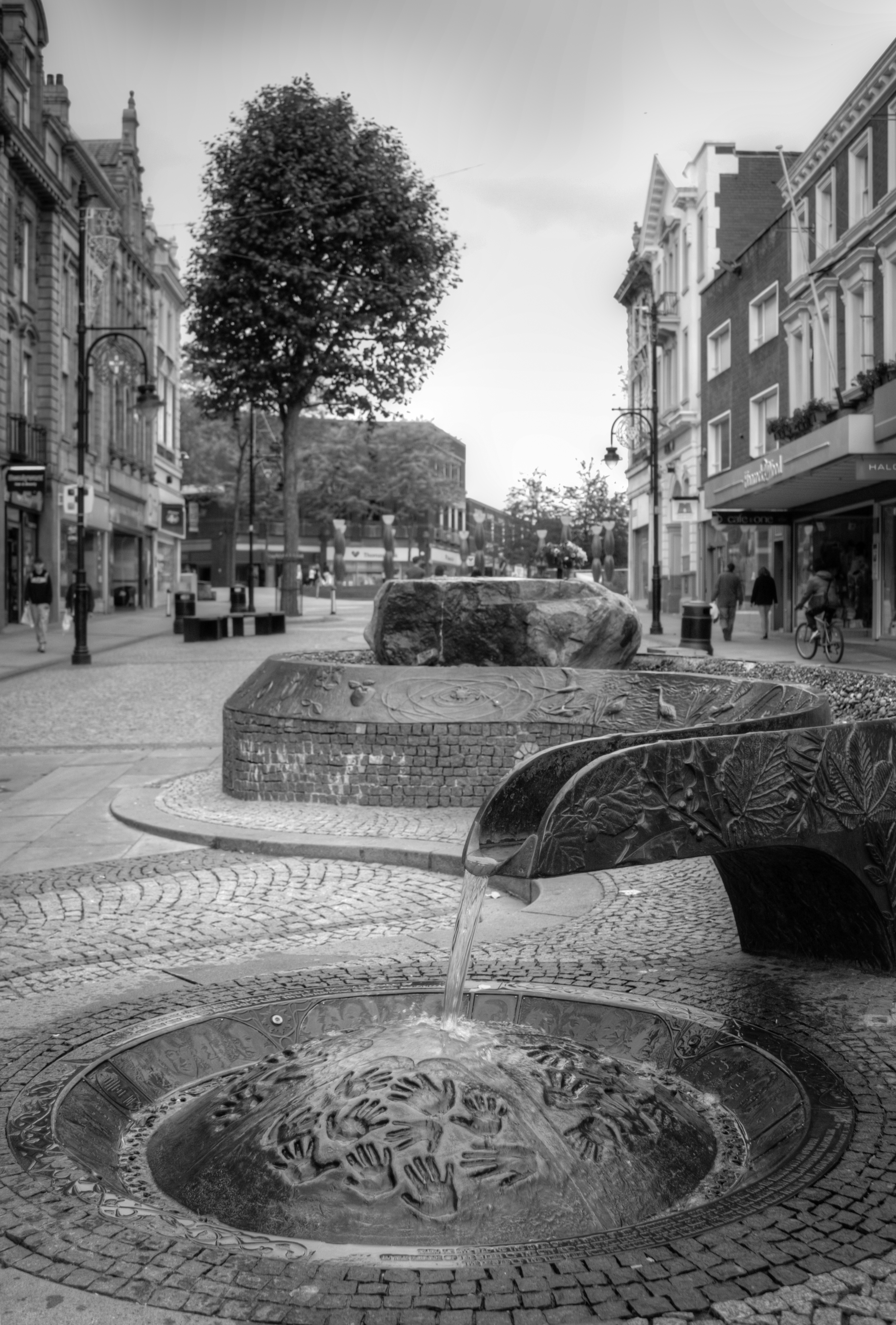
When I read that verse this week my mind went to a sculpture called The River of Life which runs down the main shopping street in Warrington. The sculpture was built by Warrington Council after two bombs were detonated by the IRA, killing 3 year old Johnathan Ball and 12 year old Tim Parry and injuring 56 others. It was the day before Mothering Sunday, March 20th, 1993.

The city council turned to a sculptor to discuss a memorial. Stephen Broadbent was the sculptor. He saw that the street was not just physically broken, but spiritually broken as well. He wanted to design something that would be “a symbol of renewal and faith in the power of the human spirit to triumph over adversity and to invest the future with hope.”

His inspiration was the image of the river of life in Revelation 22.
The angel showed me the river of the water of life, as clear as crystal, flowing out from the throne of God and of the Lamb down the middle of the great street of the city. On each side of the river stood the tree of life, bearing twelve crops of fruit, yielding its fruit every month. And the leaves of the tree are here for the healing of the nations.

And so it is. Now, flowing down that street is the River of Life  he made and on either side of the streaming water are trees, one for each month, each bearing fruits of the Spirit for the healing of the nations, for all times and seasons.

And so it is in Psalm 1 where the blessed are like a tree planted by streams of water bearing fruit in due season. I wonder that Stephen Broadbent himself is one of those trees, planted by the stream of tragedy and violence, leaving blessings of hope and healing through the season of trauma and grief.

I’ve seen photocards with these verses from Psalm 1. In them the stream is picturesque with sunlight reflecting from its gentle flow. The psalm doesn’t say the water is safe. 

The stream may be dangerous, fast flowing floodwater, a tidal wave, or deep or toxic. 

Or with a stretch of the imagination, the waters could be the waters that have to break for us to be born or baptised. 

Or the stream and the metaphor may be a metaphor for life.

Does the law of the Lord raise up people who delight in the law that there should be people by all the rough waters of life, that there should be lifesavers of healing, hope and blessing bearing fruit for all seasons of difficulty and danger?

It’s worth visiting that sculpture in Warrington. It’s on Bridge Street. It was always Bridge Street. The street hasn’t been renamed because of the sculpture and its intention to bridge the awful violence that tore people’s lives apart.

And here we are. The Bridges Group of Parishes – so called because of the bridges of the villages that make up the group of parishes. And the bridges are there to bridge the waterways that cut through the landscape.

We’ve reflected on Jesus’ position in relation to the crowds that streamed to him. We’ve reflected on the Psalmist’s position on those who delight in the law of the Lord.
We’ve reflected on the sculptor’s position in relation to the trauma of a community.
What about our own position?

Are we bridge builders and lifesavers? Do we delight in the law of the Lord, meditating on his law day and night? Are we blessed as agents of blessing, healing and hope? Or are we a curse on the poor, the stranger, the refugee, and all those vulnerable to losing their life at sea because we take our cues from the scornful, lingering in the way of sinners, taking the counsel of sinners?

Where are we as the river of life flows through our lives? Are we bridgebuilders offering healing where there has been division, hope where there has been despair? Are we like trees that bear the fruits of God’s Spirit, the fruits of love, joy, peace, forbearance, kindness, goodness, faithfulness, gentleness and self-control (against which no other law can stand) (Galatians 5:22f)? 

What is our position in relation to those Jesus blesses? Are we on their side, or are we on the side condemned by Jesus, with those who’ve grown rich at the expense of the poor, those who have stuffed themselves while so many go hungry, those who can afford to laugh while the rest of the world is in bits, those who walk the corridors of powers and still exclude, insult and reject others?

For as long as we delight in the law of the Lord, for as long as we seek to understand it, we will be on the side of those in the roughest of waters.

Egged on by Mary and Elizabeth, here I go again

Here I go again, egged on by Elizabeth, Mary and Micah – a reflection for Advent 4C. I don’t seem able to help myself. I can’t stop preaching that small is so beautiful, thanks to God who raises the lowly, graces the dis-graced and scatters the proud. Maybe it’s because I’ve been helping small churches this year.

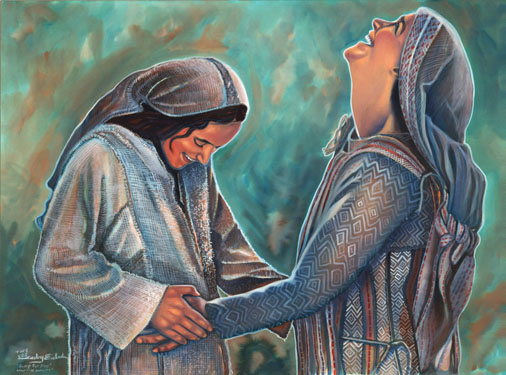
Jump for Joy by Corby Eisbacher reproduced with permission

In these Sundays of Advent we come face to face with the faith of Israel. It is not the faith of all Israel. If everyone agreed in their faith Jesus would not have had to face such opposition. The faith we come face to face with in Advent is the faith that has been passed down the generations in our scriptures, and lived out by so many. The faith of Israel is about what we expect and what we live for.

It’s a faith which celebrates God’s opposition to the proud and Gods’ favour for those who are lowly, humble and poor in spirit.

So we have today’s readings, from the prophet Micah (5:2-5a) and Luke (1:39-55).

But first, a diversion. 

When the wise men went looking for the one born king of the Jews they stupidly went about it the wrong way. They went looking in Jerusalem. They did not know the rule of the kingdom of God that the first come last and the last come first. The capital wouldn’t cradle the Messiah. In fact, the capital did nothing other than scoff and plot against the one born king of the Jews. Their satnav took them to Jerusalem, nine miles wide of the mark, the cross on the map where Jesus was born.

It was the chief priests and scribes that directed Herod’s attention to Bethlehem as the place where the ruler to shepherd Israel would be born. It was Herod who sent the wise men to Bethlehem to search for the child.

That’s probably the way most of us would go. You could be excused for expecting to find what you’re looking for in the capital, the seat of power.

But the faith of Israel knows different, Micah expresses that prophetic faith, implicitly warning us not to look for leadership in the usual places but to expect the one to rule in Israel to come from one of the little clans of Judah, one of the little clans of Jews, even from Bethlehem of Ephrathah.

Ephrathah is the old name for Bethlehem. It means fruitfulness and Bethlehem means the house of bread. It was the place of fruitfulness that Micah directs us to – not to Jerusalem. The thing about fruitfulness is its abundance but the abundance is the fruit of tiny seed, scattered by the fall and the wind and pollinated by the humble bee. 

The faith of Israel is found in the tiny, the lowly and the humble. This is the faith that follows the rule of the kingdom of God.

We know where Jesus was born, but we don’t know where John was. All we know is that Mary set out to a “judean town in the hill country”, to Zechariah’s house, to greet her cousin Elizabeth. Luke doesn’t tell us the town’s name, but it sounds like it was a place off the beaten track and follows the rule that the kingdom of God is hidden in small places, in the smallest of clans and in the most barren of landscapes.

It is in these places that God grows a kingdom. From the smallest of clans, from the dust of the earth, from the least and the last God works wonders. This is the faith of Israel. This is the faith of Israel which even now leaves many Jews horrified by what is being done in the name of Israel as it uses its military might. Those Jews who are horrified need our prayers as they protest and resist what is going on. The faith in Israel they see in Netanyahu is not the faith of Israel they treasure in their scripture.

The faith in Israel that has stood the test of time is, in the words of the epistle of James (4:6) that God scatters the proud, but gives grace to the humble.

Elizabeth and Mary come together in our gospel reading. There aren’t many readings where we listen to women talking together. Together they represent the truth that God gives grace to the humble. It is written loud and clear in their body language. Their joy is undeniable.

Luke describes how both Zechariah and Elizabeth were both “getting on in years” (1:7) and that theirs was a childless marriage. In those days that was the woman’s fault and that explains the “disgrace” she felt among her people even though she had lived a blameless life. Now with the promise of a son Elizabeth knows God’s favour for the dis-graced. In her pregnant body God’s favour for the dis-graced, humiliated and humble is told yet again. Elizabeth looks at her body, feels her baby and says, “this is what the Lord has done for me when he looked favourably on me and took away the disgrace I have endured among my people.” (1:25).

Then Luke has us look at Mary’s body through the eyes of Elizabeth and we hear her praise. It comes from the heart of Israel’s songbook about how her soul magnifies the Lord. Mary calls herself a lowly woman. That was no mere figure of speech. Her lowliness wasn’t her mental attitude. It was  that she truly was a poor woman. She occupied a place of poverty and powerlessness in her society. She rejoices in the favour God has shown to her, the great things he had done for her, the way he lifts up the lowly and fills the hungry with good things, while all the time opposing the proud and powerful, scattering the proud and bringing down the powerful from their thrones.

This was the faith of Israel that Mary was repeating. This was the song Jesus heard when he was growing up: Mary magnifying the Lord, praising God for his favour for the lowly.

This is the faith of Israel. This is the faith of Jesus that we hear time and again in his preaching. This is the faith we follow, not taking the foolish way of the wise men to the powerhouses, but feeling our way to find God’s favour in the insignificant, humiliated, disgraced, lowly, poor and powerless.

Inasmuch as he did for Mary and Elizabeth he does for all his people. He lifts up the lowly. He gives grace to the disgraced, scattering the arrogant and proud and the disgraceful.

This is the faith of Israel. This is the faith of Mary and Elizabeth. This is the faith of Jesus. This is our faith, the faith of the church, though sometimes you’d hardly know it infected as we are with the imperial spirit which wants to see us bigger than we are. God grows a kingdom and works wonders from the smallest of clans, from the dust of the earth, from the least. That is the reason the lowly and humble rejoice and the proud and arrogant just scoff.

Note: The artwork is by Corby Eisbacher and reproduced with her permission. Prints are available from her www.artbycorby.etsy.com

The readings:

Micah 5:2-5a
But you, O Bethlehem of Ephrathah, who are one of the little clans of Judah, from you shall come forth for me one who is to rule in Israel, whose origin is from of old, from ancient days. Therefore he shall give them up until the time when she who is in labor has brought forth; then the rest of his kindred shall return to the people of Israel. And he shall stand and feed his flock in the strength of the Lord, in the majesty of the name of the Lord his God. And they shall live secure, for now he shall be great to the ends of the earth; and he shall be the one of peace. If the Assyrians come into our land and tread upon our soil, we will raise against them seven shepherds and eight installed as rulers.

Luke 1:39-55
39In those days Mary set out and went with haste to a Judean town in the hill country, 40where she entered the house of Zechariah and greeted Elizabeth. 41When Elizabeth heard Mary’s greeting, the child leaped in her womb. And Elizabeth was filled with the Holy Spirit 42and exclaimed with a loud cry, “Blessed are you among women, and blessed is the fruit of your womb. 43And why has this happened to me, that the mother of my Lord comes to me? 44For as soon as I heard the sound of your greeting, the child in my womb leaped for joy. 45And blessed is she who believed that there would be a fulfillment of what was spoken to her by the Lord.” 46And Mary said, “My soul magnifies the Lord, 47and my spirit rejoices in God my Savior, 48for he has looked with favor on the lowliness of his servant. Surely, from now on all generations will call me blessed; 49for the Mighty One has done great things for me, and holy is his name. 50His mercy is for those who fear him from generation to generation. 51He has shown strength with his arm; he has scattered the proud in the thoughts of their hearts. 52He has brought down the powerful from their thrones, and lifted up the lowly; 53he has filled the hungry with good things, and sent the rich away empty. 54He has helped his servant Israel, in remembrance of his mercy, 55according to the promise he made to our ancestors, to Abraham and to his descendants forever.”

An uprising – the mustard seed and the seed growing secretly

Here’s a sermon for the 3rd Sunday after Trinity focusing on Jesus’s parables of the seed growing secretly and the mustard seed. They speak of uprisings and encouragement, perseverance and patience.

June 16th 2024

Our scriptures are the creation of a bruised and battered people, treasured and passed on by bruised and battered people for the sake of other bruised and battered people. It is a troubled people who have chosen the scriptures we inherit, and who have handed them on.

I keep saying this to remind myself whose these scriptures are and to remind myself to read the scriptures from that point of view.

Today’s gospel features a couple of parables used by Mark to end a sermon by Jesus. The sermon is given from a boat, to a crowd of people on the shore.

Their place on the shore is significant. Jesus and the crowd are from poor peasant communities, subsistence farming communities pushed to the edge by the taxation policies of the temple and Roman authorities. They were clinging on to life in any way they could. Jesus is one of them. 

His sermon was  particularly for them, the least and the frequently lost in the kingdoms of the world. Appropriately, for an audience of the least Jesus uses what is the least to make his points. Today, he picks a seed that grows secretly, and a mustard seed, “the smallest of all seeds”, which amazingly grows to be the “greatest of all shrubs” – and that picks up the prophecy of Ezekiel in our first reading. 

Ezekiel points us to a “lofty tree”.
In his mind it stands for empire and the highness and might of emperors and kings and all those who problematically lord it over others.
Ezekiel sees God cutting a sprig from the lofty top and planting it on a high mountain so that it produces boughs, fruit and shelter for all kinds of bird.
He calls this a “noble” tree rather than a “lofty tree”.
What makes the lofty tree is its highness, whereas the nobility of the noble tree rests in the shelter it gives.

Jesus is the sower.

He sowed seeds in his preaching – seeds of faith, hope and love – seeds of imagination which would grow in the hearts and minds of those poor enough in spirit to have the ears to hear and the eyes to see Jesus’ meaning of love in these parables. 

They will have loved his talk of the seeds for him highlighting the smallest of things as being full of life. They will have known that about themselves though generations of occupation, foreign rule and religious oppression will have eaten at their self belief.

Jesus takes two seeds. That in itself reveals so much about the kingdom of God, namely that the rule of God focuses on the smallest of things, the miniscule, on the least. When did you last hear an emperor, or a Mr Big, or a gang leader wondering about the smallest and least in creation?

Jesus casts the mustard seed as the smallest seed, which grows to become the greatest of shrubs giving shelter, shade and blessing to all the birds of the air. His hearers will have loved that. This is what can become of us is what Jesus is leading them to imagine. This is what can happen to the least of us. The least of us can become the most hospitable. The least of us can be the shelter, shade and blessing for so much and so many.

These are parables for the poor in spirit, for the weary, for the belittled.

They encourage us to believe
life will change for the better for the least, the lost and the last –
that the little, least, lost are great in the eyes of God and come first in his kingdom,

They remind us that the seeds of the kingdom are already embedded in the world
by Jesus the sower,
in our own paths and ways
a seed in edgeways

And those seeds have a life of their own.
We don’t know the effect of them – and we can’t control the effects of a kind word, or affirming gesture.

And they make small beautiful.

Small is beautiful in the eyes of the one who puts the least, the lost and last first.
We don’t need to lie
about how little we are
or what little we have
when Jesus sees the kingdom in a seed.

These parable have always encouraged the church,
particularly encouraging us these days
when the church is struggling,
when you’re feeling like there is so much to do
with fewer and fewer people – in a vacancy as well
we can love being small,
being the unlikely seed of the kingdom,
for ever unsure how it’s going to turn out,
just going day to day
with our small seed of faith
our small seed of hope
and our small seed of love,
sprigs cut from the high and mighty,
cut down to size and carefully planted
to be noble in the kingdom.

These parables encourage us to persevere with patience,
to carry on scattering seed in our small ways along the paths of our lives,
never put off by the idea of a harvest we will never see,
to carry on with those small things
that come naturally to those with a joyful heart:
a smile,
a touch,
a word of welcome,
small kindnesses
in all our ways
scattered like seed.

There was a song Jesus heard at home. He’d heard his Mum singing it. We know it as the Magnificat. It goes like this:

Her song praises the work of God showing mercy on those that fear him from generation to generation, scattering the proud in their conceit, casting down the mighty from their thrones, lifting up the lowly, filling the hungry with good things, sending the rich away empty.

This is the song that seeded Jesus’ imagination.

It is no wonder that he turns to the smallest in his preaching, to seeds to show us faith, hope and love. The seed growing secretly and the mustard seed represent an uprising – an uprising of the least, the tired and the broken.

Mark 4:26-34
He also said, ‘The kingdom of God is as if someone would scatter seed on the ground, and would sleep and rise night and day, and the seed would sprout and grow, he does not know how. The earth produces of itself, first the stalk, then the head, then the full grain in the head. But when the grain is ripe, at once he goes in with his sickle, because the harvest has come.’
He also said, ‘With what can we compare the kingdom of God, or what parable will we use for it? It is like a mustard seed, which when sown upon the ground, is the smallest of all the seeds on earth; yet when it is sown it grows up and becomes the greatest of all shrubs, and puts forth large branches, so that the birds of the air can make nests in its shade.’
With many such parables he spoke the word of to them, as they were able to hear it; he did not speak to them except in parables, but he explained everything in private to his disciples.

Ezekiel 17:22-end
Thus says the Lord God:
I myself will take a sprig
from the lofty top of a cedar;
I will set it out,
I will greek a tender one
from the topmost of its young twigs;
I myself will plant it
on a high and lofty mountain.
On the mountain height of Israel
I will plant it
in order that it may produce boughs and bear fruit,
and become a noble cedar.
Under it every kind of bird will live;
in the shade of its branches will nest
winged creatures of every kind.
All the trees of the field shall know
that I am the Lord.
I bring low the high tree,
I make high the low tree;
I dry up the green tree
and make the dry tree flourish.
I the Lord have spoken;
I will accomplish it.

Setting Mary free to be herself – listening to her song

This is something for the 3rd Sunday of Advent, Gaudete Sunday, in a country church in Warwickshire dedicated to Mary, I have focused on Mary’s Magnificat.

Have any of you been put on a pedestal?

I can imagine it’s hard and you can be brought to earth with a bang. You’re not allowed to be yourself, always having to be what others want you to be.

The church hasn’t done Mary any favours. Above all women she has been put on a pedestal for so long that we’ve forgotten what she was really like. It’s what men have done to her over the centuries.

This morning I want us to listen to her song.

My aim in preparing this sermon is that you and I get a better idea of who Mary was. This, I believe will help us into the Christmas gospel and will help us better understand the son who spent most of his life with her in their village and home of Nazareth.

As a church dedicated to Mary, I suggest we dedicate ourselves to her liberation so that she can be herself, rather than what we have made her over the centuries, whether we have devoted ourselves to her as within the catholic traditions if the church, or whether we have been critical of such devotions, as within the protestant traditions.

When we look at her, what do we see? What we see is what people have made of her over the years. We see all the images laid on top of one another as she has been used for this or that purpose. 

She has become stereotyped. She comes to us well dressed in her blue flowing gown looking like a beauty queen. She usually has pale skin, blue eyes. She looks peaceful. She looks heavenly. She’s usually on her own, surrounded by quiet. She has her hands together, eyes closed, praying. Often her setting is the architecture of a palace. She is often reading. And in all of this there is no sign of trouble. There is no sound of her song and no sign of her joy. There isn’t much sign that she has done anything at all. 

But the gospels give us a very different view of Mary.

She was a woman of history. She was Mary, Mary of Nazareth, a small village of about 300 people off the beaten track to the sophisticated nearby city of Sepphoris. This was the village people scoffed at – “can anything good come out of Nazareth?” 

Archaelogists there have pieced together a picture of rural poverty, with people living in one and two roomed houses clustered around courtyards shared with extended families with shared cooking facilities. They’ve found no signs of any wealth. 

This was a small peasant community. Mary was married to the village carpenter. This wouldn’t have been a small business as we know them. He wouldn’t have had the status we give to small businesses. He would have been an artisan, the class below the peasants, earning less than the peasants and serving their needs. They probably would have had a small plot of land for growing food to eke out a living. They would have made their own clothes from their sheep.

They were poor. They were taxed three times. They paid 10% to the Temple. They paid tribute to the Roman emperor. And then they also had to pay tax to fund the vanity projects of Herod, such as the building of nearby Sepphoris, the equivalent of our HS2.

They would have been very poor, barely scraping a living together. Many of them would have been in debt to the wealthy and would have their land taken off them. Resentments grew and  there were frequent rumblings of revolt. Many days they would have gone hungry.

Life didn’t treat any of them gently.

It takes a village to raise a child. That village raised Mary and Jesus, Jewish babies having to grow up very quickly. Their village meetings would have dwelt on the different ways their people had suffered in Egypt, in persecution, in exile and the way that God had graced these suffering servants. She picks up the song of Hannah and makes it her song.

My soul does magnify the Lord, she sings. “My spirit rejoices in God my Saviour for he has looked with favour on the lowliness of his servant. The Mighty One has done great things for me. His mercy is on those who fear him. He has shown strength with his arm, he has scattered the proud in the thoughts of their hearts. He has brought down the powerful from their thrones and lifted up the lowly. He has filled the hungry with good things and sent the rich away empty.”

This isn’t the song of the woman we have put on the pedestal for so long. This is the song of a woman who lives with the day to day challenge of survival. It’s a song Jesus will have heard from his mother and from the scriptures shared in their village meetings. This isn’t a song of the docile, or of those who take things lying down. This is the song of those who rejoice that the proud are scattered, the powerful dethroned and the rich sent away empty. 

This is the song which prompted one artist to portray Mary in the style of Russian communist posters, muscular, all boiler suited and booted.

You are a church dedicated to Mary. Can I suggest that we all try to get to know her better and that we talk about her more? Can you let her be herself rather than forcing her to be somebody she isn’t?

As we get to know her better we will know better where God plants his seed and where the baby Jesus grew, side by side with his mother as he joined her in her prayer, magnifying the Lord and praying for their daily bread and the forgiveness of their debts, joining her and watching her in the household tasks, digging the soil, planting seeds, baking bread – funding his imagination for sharing with those who followed him the images of the kingdom of the one he magnified in the song of his mother.

I am indebted to my Advent reading – to the work of Elizabeth A Johnson, in her book Truly our Sister: a Theology of Mary in the Communion of Saints

Magnificat

My soul proclaims the greatness of the Lord,
my spirit rejoices in God mySaviour;
he has looked with favour on his lowly servant.

From this day all generations will call me blessed;
the Almighty has done great things for me
and holy is his name.

He has mercy on those who fear him,
from generation to generation.

He has shown strength with his arm
and has scattered the proud in their conceit,

Casting down the mighty from their thrones
and lifting up the lowly.

He has filled the hungry with good things
and sent the rich away empty.

He has come to the aid of his servant Israel,
to remember his promise of mercy,

The promise made to our ancestors,
to Abraham and his children for ever.

Reading the Bible and learning from lessons – a sermon for Bible Sunday

October 29th 2023

The last Sunday after Trinity – also Bible Sunday. The readings for the day are printed below: Leviticus 19: 1-2, 15-18 and Matthew 22:34-end

Today is Bible Sunday. My aim in this sermon follows the words of our collect for Bible Sunday. We pray to God, who caused all holy scriptures to be written for our learning. My aim is to encourage you to confidently expect to learn from the Bible and that we can confidently expect to read, mark, learn and inwardly digest them.

My first point is simple. The Bible isn’t one book – seeing it as one book would make it daunting and off putting. It’s a library and a boxed set. For most of our centuries most of the readers of scripture have been people who couldn’t read or who didn’t like reading. They will only have heard scripture being read. They certainly would never have had their own copy of the book version. That only became possible with the invention of the printing press – until then you could buy a house for the cost of a Bible.

The Bible and Christianity isn’t for the clever. In Paul’s first letter to the Corinthians he reminds his brothers and sisters: “think of what you were when you were called. Not many of you were wise by human standards; not many were influential; not many were of noble birth. But God chose the foolish things of the world to shame the wise, God chose the weak things of the world to shame the strong”. (I Cor 1:26f).

It’s not about being clever, influential or posh. In fact, the clever, influential and posh are going to be the last people to “get” scripture. Hear Mary singing in her song we call the Magnificat of the rich (presumably the rich and clever) being turned empty away while he lifts up the humble and fills the hungry with good things. (Luke 1).

It’s not about being clever. It’s not the clever writing clever things for clever people. It’s people who share the experience of being bruised and battered helping those who are poor in spirit get through the experiences of being bruised and battered – and those who go to their aid. You don’t need a degree. Jesus didn’t teach in a university. He taught in the heart. 

And he taught in the heart of a people who were bruised and battered by centuries of bitter experience of empire. They’d been enslaved, persecuted, occupied, exiled, crucified. The conflict we are witnessing in Israel and Gaza has a long and complicated history and we do well to remember that Jesus taught at the heart of this history.

Those of us who read the Bible who have never known exile, persecution, poverty or who have never been at the wrong end of identity politics do well to remember that we are reading the scriptures of those who have. We read over their shoulders – at best, as their guests.

A large part of our scriptures is focused on Jesus – even a lot of the Old Testament is about Jesus, and the books of the Old Testament were Jesus’s scriptures with Psalms being his prayer book. Jesus is always understandable. He made it so. Even his enemies understood him and that is why they were so infuriated by him.

He was always casting around for images that would speak to people about his passion – his passion for the kingdom of heaven. He spoke of things his followers would know, of seeds and weeds, of leaven in loaves, of losing things and finding them again. He aimed to be understood.

The difficulty of following Jesus isn’t that he is hard to understand. The difficulty in following Jesus is facing the challenge of his teaching and accepting the cost. The response of those who want to hear Jesus has never been that they have felt mystified and lost, but have been amazed and felt found.

Today’s gospel (at least the first half) is typically simple and straightforward. A lawyer, a Pharisee, asks Jesus what the most important commandment is. (There are 613 commandments in the Old Testament.) It wasn’t hard for Jesus to choose because the answer was well known. It was what they were told to talk about at home, when they walked along the road, when they lay down and when they got up. They impressed it on their children. It was wrapped around their heads and hands and pinned to their doors, and it’s a verse from Deuteronomy: “You shall love the Lord your God with all your heart, and with all your soul, and with all your mind.” The lawyer gets a straightforward answer to a straightforward question, until …

Jesus adds a second which twists the meaning. Again he answers from scripture – it’s the other reading we have had, from Leviticus: “a second is like it” he says. “You shall love your neighbour as yourself.”

That’s not hard to understand is it? But it’s hard to put into practice isn’t it? The lawyer will have known where the reference came from and what the commandment spells out. We’ve heard it ourselves this morning (from our OT reading from Leviticus) what loving your neighbour means “you shall not render an unjust judgement; you shall not be partial to the poor or defer to the great: with justice you shall judge your neighbour. You shall not go around as a slanderer among your people, and you shall not profit by the blood of your neighbour.”

This is where it gets more difficult as we deal with culture and context that isn’t ours. It all needs translating for us so that each of us hears in our own language – which is God’s intention made plain at Pentecost when everyone heard the preaching of the apostles in their own language.

Scripture always raises questions and those questions are taken up by scripture itself in many cases. Jesus adds the second commandment about loving our neighbour to the first and then says everything, the whole law and the prophets, hang on these two. But then the question is raised (in Luke’s gospel) “but who is my neighbour?” How do we translate that?

Jesus translates for us by drawing a picture of a man, bruised and battered lying in a gutter. He takes three people by this helpless victim and asks which of them was the real neighbour. The answer we all know to be the one who stopped and so generously and tenderly helped. And that person turned out to be a Samaritan – who the Jews despised. Jesus gave that lawyer and all who have shared that story ever since, a new meaning, a new twist, a new challenge and new translation to the question of “who is my neighbour?” – something along the lines that you don’t really know who your neighbour is until you’re in trouble and that your neighbour can be a total stranger reaching across all sorts of barriers.

We might argue that Jesus’ parable of the Good Samaritan doesn’t have the same impact on us as it would have had on those who first heard it because they were Jewish people caught up in the prejudice against the Samaritans. 

We might also be tempted to think about who we are good neighbours to – who is going to receive our kindness and generosity. Our own national history tends to cast us as winners, generally not knowing exile, occupation or poverty, so our focus may be on the helper rather than the victim. So, we could tell the story differently – such as imagining you’re in the metaphorical gutter, bruised and battered, you don’t know where to turn. You have neighbours but they don’t know you and you don’t know them. They are no help. You have family, but they’re all busy with their own lives and they’ve mostly moved away. But there was one person who saved me – and here we full in the blanks. S/he was a ——- I’d never met them in my life. They were so brave. They never left my side. There was nothing that was too much trouble.

We never know who is going to come to our help do we? And we would turn none of them away would we? And we would be forever grateful to them wouldn’t we? And we would call them our neighbour, our good samaritan. In that one person we come to understand what it means to be a neighbour – and nothing less will do.

Jesus makes it easy for his followers to understand his teaching about the kingdom of heaven. He was hardly going to make it difficult was he? He’s a teacher who loves his followers, and his followers love him for his teaching.

For those whose heart is set on God’s kingdom the Bible is easy reading and those who are powerful, rich and clever according to the kingdoms of this world are always going to find our scriptures mystifying unless they have a change of heart.

I want to finish with a word for those who read our scriptures in our worship on Sundays.

First of all, do you realise that Jesus was also asked to read scripture in worship? You’re on the same rota. So much depends on the public reading of scripture. 

Our attitude to the Bible is shaped by the way the Bible is read in worship. Those of you who take on the role of readers are translating the text from the lectern into our hearts and minds. Every word counts and will carry its own resonance, so each word needs to be heard. 

It’s important to be as inclusive as possible for the sake of the hard of hearing and the sake of those easily distracted. It’s important that the language we use is as inclusive as possible – try not to use exclusive language. Yes, at one point, “men” and “brothers” may have been inclusive terms but they no longer are and exclusive language is offensive because we can do better if we care. Our call is to love our neighbours, not to unnecessarily offend or exclude them.

Our great translators have loved us with their efforts to bring God’s word alive. It cost some their lives. We owe a huge debt to our translators. Those who read in public worship are our translators. They need our prayer. I’ll ask them to stand while we pray for them.

Let us pray: 

Loving Lord, in Jesus you make plain your word,
we pray for our readers,
that you may give them boldness of spirit
to compensate for shyness and self-consciousness.
We pray that you will be with them in their preparations
that they may translate the word of the page to the heart of our communities
through love for our neighbours,
so that all of us come to help one another
to hear, read, mark and inwardly digest
your word of salvation.

Leviticus 19: 1-2, 15-18
The Lord spoke to Moses, saying:
Speak to all the congregation of the people of Israel and say to them; you shall be holy, for I the Lord your God am holy.
You shall not render an unjust judgement; you shall not be partial to the poor or defer to the great: with justice you shall judge your neighbour. You shall not go round as a slanderer among your people, and you shall not profit by the blood of your neighbour: I am the Lord.
You shall not hate in your heart anyone of your kin; you shall reprove your neighbour, or you will incur guilt yourself. You shall not take vengeance or bear a grudge against any of your people, but you shall love your neighbour as yourself: I am the Lord.

Matthew 22:34-end
When the Pharisees heard that he had silenced the Sadducees, they gathered together, and one of them, a lawyer, asked him a question to test him. ‘Teacher, which commandment in the law is the greatest?’ He said to him, “You shall love the Lord your God with all your heart, and with all your soul, and with all your mind.” This is the greatest and first commandment. And a second is like it: “You shall love your neighbour as yourself.” On these two commandments hang all the law and the prophets.’
Now while the Pharisees were gathered together, Jesus asked them this question: ‘What do you think of the Messiah? Whose son is he?’ They said to him, ‘The son of David’. He said to them, ‘How is it then that David by the Spirit calls him Lord, saying,
“The Lord said to my Lord,
‘Sit at my right hand,
until I put all your enemies under your feet’”?
If David thus calls him Lord, how can he be his son?’ No-one was able to give him an answer, nor from that day did anyone dare to ask him any more questions.

So late in the day – the parable of the labourers in the vineyard

So late in the day. This is a sermon on the parable of the labourers in the vineyard from Matthew 20:1-16 (text below). It’s for a small congregation in rural Warwickshire who only meet once a month and use the Book of Common Prayer for their worship. Interestingly there is a local landlord and the villagers are his tenants.

So late in the day I am realising how earth shattering Jesus’ teaching is, shaking us to our foundations. None more so than this parable of the labourers in the vineyard in which the time of the day is so important. It is late in the day.

Preparing this has shaken me up – me, now so long in the tooth and late in the day.

I am in my 70s. I’ve been preaching for 50 years. I am white, educated, male. I have been privileged, among the first chosen, and never short of work.

So, so, so late in the day I come to this parable and I am shaken to my core by Jesus’ teaching about the kingdom of heaven where the last come first and the first come last.

I realise that even so late in the day I have much work to do. At last I realise I am among the last. It has taken me so long.

The landowner in Jesus’s parable of the kingdom seems outrageously unfair and the labourers who have worked the longest hours are right to complain that they could have worked for just one hour for the same pay. They complain: “You have made us all equal”.

Imagine your local landowner doing something like that.

Now, remember the horrors of your school PE lessons when two people were chosen by the teacher to pick sides. You may have been one of the lucky ones to be amongst those picked first. You may have even been one of the gifted and talented privileged to choose the teams. Or you may have been the one picked last with your arm forlornly over your head the longest calling half-heartedly “pick me”. It was always humiliating to be amongst the last to be picked – to be one of the “also rans”.

We easily understood how those decisions and choices were made. Those who were “best” were chosen first because they were “winners”, or they had friends in high places. Those chosen last are the “losers”, who, because they are “losers” are the Billy-no-mates. If ever they complain they’re told to get over it, “life’s like that”, “get used to it”. Life isn’t fair, Everybody isn’t equal.

This parable uses the labour market as its backdrop. The labour market works pretty much the same way as teams are chosen in PE. The strong candidates, with their strong applications, with their right qualifications and their right experience are the ones chosen first. They’ve often been to the right schools and know the right people. Other candidates show their weaknesses and carry penalties such as their not-so-good education possibly because of the poverty of their childhood, or the way they talk, or look, or the colour of their skin, or their gender or their age. There will always be people who are chosen last, who might eventually be told that there is a little job they can do to help. That little job will keep the wolf from the door, but the gap between those who are chosen first (the well paid) and those chosen last (the poorly paid) gets wider and wider.

This is the economic order we live with in the kingdoms of this world. This is the rule: the first will be first and the last will be last.

In the parables treasured by the church, Jesus points us to a different kingdom – the kingdom of heaven. The kingdom of heaven is nothing like the kingdoms on earth because in the kingdom of heaven the rule is not that the first will be forever first and the last forever last. The rule of the kingdom of heaven puts the first last and the last first.

The landowner is strict in his instructions to the manager. He tells him to call the labourers and give them their pay. “Begin with the last, then go to the first.” This is how the last come to be first and the first come to be last. It is the deliberate choice of the landowner who, of course, is God.

Jesus’s teaching really does shake us to our foundations.

Here was something for them to really complain about – those complaining would have been those who were first – those who had lost out in the landowner’s deliberate discrimination in favour of those hired at last. It’s their complaint that makes them last. They complain “you have made us all equal”. That is a complaint against the landowner, against God and against the last. It’s a complaint that makes them unfit for the kingdom of heaven. Of course they will be last in that kingdom where the truth is that the first will be last and the last will be first.

It’s not the first time in Matthew’s gospel that we have heard that the first will be last and the last first. In the previous chapter (19:16-30), when Jesus is explaining to his followers how difficult it is for those who are rich to enter the kingdom of heaven (as hard as it is for a camel to climb through the eye of a needle!), he uses the same rule. “Many who are first will be last, and the last will be first.” And he says that this will happen “at the renewal of all things”.

What can we take from this?

The first thing is that there is hope for those who are last in the choices and power dynamics of the world and that they have every reason to fervently and faithfully pray for the “renewal of all things” because they are the first choice of God.

The second thing is that those who have been used to the privileges and power of being among the first have a choice to make. They (we?) can choose to complain or not complain. They (we?) can choose to join the complaints about the apparent injustice of the rule of the kingdom of heaven (which puts the last first), implying that they will have no part in such a rule or kingdom.

Or they (we?) can choose to celebrate with the last at the renewal of all things. They (we?) can help them (us?) to be first. They (we?) can take their side. Even so late in the day they (we?) can take the side of the refugee, the poor, the sick, the disabled, the weak, the voiceless, the excluded, the ridiculed, joining their prayer for the renewal of all things, joining God’s pleasure in those otherwise forgotten and often forsaken.

All of us have that choice to make – and we make that choice in our prayer. There are people who always come first in our way of thinking and there are people who always come last. If we pray as our Saviour taught us, for his kingdom to come on earth as it is in heaven, we will be praying for those who are the last or seldom chosen. When we make that choice we join Jesus and Mary in their prayer. 

Mary’s joy in God is captured in her song. Her soul rejoices that God has looked with favour on the lowliness of his servant, that he scatters the proud in the thoughts of their hearts, that he brings down the powerful from their thrones, lifting up the lowly, filling the hungry with good things and sending the rich away empty. (Luke 1:46-55)

These are the people Jesus has chosen to be uppermost in his mind. He names them in his teaching (Matthew 25: 31-46) in the parable of the sheep and the goats. Those chosen are the hungry, the thirsty, the stranger, the naked, the sick and the prisoner. These are the people who come first to Jesus and they are the ones who come first in the prayer of the church. Among them are those who want to join Jesus in his prayer for the renewal of all things.

It’s not that we don’t also pray for those who come first. We do pray for those who come first, our leaders. Our prayer for them is that the last will always be first for them, that everything will be for their sake. So we will pray this morning for King Charles and the government that their governance will be governed by the rule that the last come first and the first come last.

In the parable the landowner, the owner of all, gives very careful instructions to his “manager”. The instruction is: begin with the last then go to the first. The question for all those who hear the parable is CAN WE MANAGE THAT? Can we manage to do that and manage the complaints and grumbling that come our way for always beginning with those who come last in the kingdoms and empires on earth? It is, after all, teaching like this that crucified Jesus.

St John the Baptist, Lower Shuckburgh – September 24th 2023

Matthew 20:1-16
“For the kingdom of heaven is like a landowner who went out early in the morning to hire laborers for his vineyard. 2After agreeing with the laborers for the usual daily wage, he sent them into his vineyard. 3When he went out about nine o’clock, he saw others standing idle in the marketplace; 4and he said to them, ‘You also go into the vineyard, and I will pay you whatever is right.’ So they went. 5When he went out again about noon and about three o’clock, he did the same. 6And about five o’clock he went out and found others standing around; and he said to them, ‘Why are you standing here idle all day?’ 7They said to him, ‘Because no one has hired us.’ He said to them, ‘You also go into the vineyard.’ 8When evening came, the owner of the vineyard said to his manager, ‘Call the laborers and give them their pay, beginning with the last and then going to the first.’ 9When those hired about five o’clock came, each of them received the usual daily wage. 10Now when the first came, they thought they would receive more; but each of them also received the usual daily wage. 11And when they received it, they grumbled against the landowner, 12saying, ‘These last worked only one hour, and you have made them equal to us who have borne the burden of the day and the scorching heat.’ 13But he replied to one of them, ‘Friend, I am doing you no wrong; did you not agree with me for the usual daily wage? 14Take what belongs to you and go; I choose to give to this last the same as I give to you. 15Am I not allowed to do what I choose with what belongs to me? Or are you envious because I am generous?’ 16So the last will be first, and the first will be last.”

Jesus is a very disruptive influence: a sermon on Matthew 10:34

Notes for a sermon for Ashton Hayes for June 22nd 2014

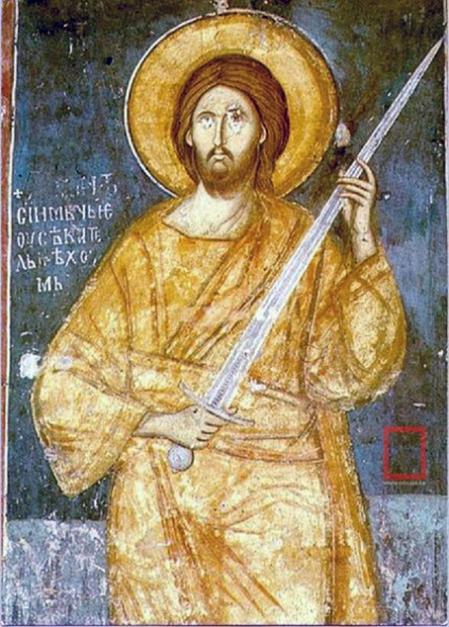
Fresco in the "Visoci Decani" in  Kosovo
Fresco in the “Visoci Decani” in Kosovo

Text: “Do not think that I have come to bring peace to the earth: I have not come to bring peace, but a sword.” (Matthew 10:34)

Teachers are busy writing school reports. Here’s Jesus’ report from the autumn term:

  • Resistant materials – A – excellent in woodwork section, and obviously well supported by the help and stimulation he gets at home.
  • Maths – F – Lacks basics. Keeps muttering about “Three in One” and “I and the Father are one”.
  • Graphic communications – D – Prefers to draw with a stick in the sand than to use pencil and paper.
  • Physical Education – D- Jesus has been a troublemaker. He refuses instruction in swimming, and is surprised that he sinks when he tries to walk on the water.
  • Overall – it saddens us to say that Jesus is a disruptive influence in the class. He flouts uniform regulations by turning up in sandals. He chooses his friends unwisely.

Another report was found by Monty Python.

Pupil’s name: God

  • Biology – 28% – weak, thinks he knows it all. Constantly rude about Darwin.
  • Domestic Science – 54% – a useful cook, the pillar of salt will come in handy for a long time.
  • Games – will not row, hates games and once parted the waters of the swimming pool during a match against the old boys which was both unsporting and dangerous. He can still do press ups.
  • Progress and conduct: “I am afraid that I am severely disappointed in God’s work. He has shown no interest in rugger, asked to be excused prayers and moves in a mysterious way. His attentions to the carpentry teacher’s fiancée caused her to leave a term early, and there are several nasty rumours flying around.

There is no getting round the fact that Jesus is a disruptive influence. As he says himself in today’s gospel reading: “I didn’t come to bring peace. I  came to bring a sword.” (Matt 10:34)

Here’s trouble and an affront that we overlook at our peril. This is challenging behaviour.

His mother was no better. Her song (from Luke’s songbook and gospel), Luke 1:46-55, aka Magnificat, was banned for many years. The authorities in British ruled India, and in 1980’s Guatemala and Argentina banned the words from being read out loud because they were too revolutionary.

Mary knew that Jesus was not good news for everyone. For every blessing that she sang there was an answering curse on those who thought they had it all. She sang of the one who looks with favour on the lowly, and who scatters those who are proud in their innermost thoughts, the one who lifts up the lowly, but brings down rulers from their thrones, who fills the hungry with good things, but sends the rich away empty.

Woe betide us if we become proud, rich and powerful. According to her song, we will be scattered, brought down and sent away empty.

Mary too is disruptive and dangerous for the authorities. It is no wonder that she is silenced by the authorities from time to time. Jesus takes after his mother and father. Blame the parents, if you like.

50 years ago, this weekend, three young men went to investigate a church that had been burnt out. The church was Mount Zion Methodist Church in Neshoba County in Mississippi. This was a building that was being used to register black voters in the States in what was called Freedom Summer, 50 years ago, in 1964 in the civil rights movement.

The state authorities were bitterly opposed to the voter registration campaign, believing that blacks shouldn’t be able to vote. You can feel the authorities bristling with the arrival of these three men: Michael Schwermer, James Chaney and Andrew Goodman. The authorities were sheltering the culprits of the chapel burning. Their crime was about to be exposed by these men who had come to disrupt their peace.

Deputy Sherriff Cecil Price followed the men as they drove back to their home in Lauderdale County. He intercepted them just on the county line and ordered them into his car. He then drove them to a deserted piece of land where they were met by two cars full of Ku Klux Klan members. They beat, shot and killed the three men, 50 years ago this weekend, June 21st 1964.

The lives of the three are commemorated in a stained glass window in the chapel of Cornell University. Their faith is celebrated in the words of the gospel song made famous by Pete Seeger and Joan Baez – “we shall overcome”.

Are they martyrs for us? Or were they disruptive and dangerous? What do we think? Are we on the side of the Klansmen, or the poor of the earth?

Those three didn’t bring peace. Neither did they bring a sword. They brought beatings, shootings, burnings and violence. They didn’t bring those things themselves. They brought those things on themselves. They engaged the powers and suffered their might.

Does this help us to understand what Jesus said when he said, “I didn’t come to bring peace, I came to bring a sword”? In the cold light of day these words strike us as difficult. They challenge us and disrupt us. The more we burn with passion, the hotter we get under the collar, the more our hearts burn within us, the more understandable they become.

What good is gentle Jesus, meek and mild in a world that is crying out for disruption? The prophet Jeremiah complains about the false prophets who claim that there is peace when there is no peace. (Jer 6:14)

No, Jesus comes with a sword. He is disruptive and he is divisive. The authorities expected him to go one way, and he went the other – to the lost, the last and the least. His words were salvation to some, but offensive to others.

The words of Mary’s song provide commentary on Jesus as well as his father: he looked with favour on the lowly, and scattered those who are proud in their innermost thoughts, lifting up the lowly, while bringing down rulers from their thrones, filling the hungry with good things, while sending the rich away empty.

He never used the sword.

The sword is metaphorical. It is an effect. The sword is what happens as a consequence of his love. People turn on one another and on him. Even families and friends turn against each other. He is disruptive and unsettling for us all.

He didn’t bring a sword but he brought a sword on himself. The political and religious authorities got him in the end. Jesus never drew a sword – he loved through the challenge and disruption. And he told his followers to put their sword away, as we recall from the incident in the Garden of Gethsemane. (Matt 26:51ff)

When Jesus said “I haven’t come to bring peace, but a sword” he was preparing his followers for mission, so that they might be disruptive in a world crying out for disruption. He was preparing them for a dangerous mission which could bring disruption, persecution and even death.

What is true of Jesus is true of the church.

Just some times we have to stand against the crowd – like those who were conscientious objectors in the war 100 years ago, like those who protest when they see injustice being done, like when we side with the scapegoat, the sick, the prisoner, the stranger.

It just might be that we have to stand alone – our friends may desert us, our families may turn on us, we may lose our cherished place in the community.

We stand for love and we overcome evil with good. We can’t pretend there is peace where there is none. We haven’t come to bring peace, but a possible sword on ourselves.

So I wonder what it will say on my final report. Will it say that I have been a troublemaker? Will it say that my behaviour has been challenging? Will it say that I have been disruptive for the sake of those who suffer in the way things are?

Or will it say, “he was just nice”? What good is that, only being nice? Being nice just doesn’t cut it does it?

References:

Thanks to http://www.pleacher.com/forwards/forwards/jcreport.html for Jesus’ school report.
Thanks to http://www.churchinacircle.com/2013/12/29/marys-subversive-song/ for the ideas about Mary’s subversive song.