What should we do? Everybody’s asking according to Luke

This sermon is for the 3rd Sunday in Advent (C) prompted by a question everyone seems to be asking in Luke. The question being what should we do? It’s prepared for two small churches I’m helping out in a vacancy. The gospel reading is Luke 3:7-18 (the text is at the end of the post).
December 15th 2024

What should we do? That question keeps cropping up.

Three times we hear that question in today’s reading. Luke pictures three audiences of John the Baptist. There’s the “the crowds”, there’s the “tax collectors” and there’s “the soldiers”. Each of those audiences ask the same question. “What should we do?”

Before being specific John had already told them to bear fruits worthy of repentance while also saying they couldn’t take their place in God’s kingdom for granted just because they had Abraham as their ancestor. They needed to repent.

“What should we do?” It’s a question which keeps cropping up in Luke/Acts. As well as the crowd, the tax collectors and the soldiers featured in today’s gospel, it’s a question asked by:

  • A lawyer asking “what must I do to inherit eternal life?” (Luke 10:25)
  • A rich man worrying about his abundant crops, “what should I do, for I have no place to store my crops?” (Luke 12:17)
  • An unscrupulous agent  getting sacked: “what will I do, now that my master is taking the position from me?” (Luke 16:3)
  • A rich ruler asking Jesus “what must I do to inherit eternal life?” (Luke 18:18)
  • The owner of the vineyard asks “what shall I do?” (Luke 20:13)
  • The Jews in Jerusalem for Pentecost asking the disciples “what shall we do?” (Acts 2:37)
  • A jailer asking Paul and Silas (what must I do to be saved?” (Acts 16:30)
  • Saul (aka Paul) asking Jesus “What am I to do Lord” (Acts 22:10)

I list these examples to highlight how important this question is to the people of God. The same question asked time and again through Luke/Acts: “What should I do?” And every time the answer comes back that they have to do things differently, and radically so. 

Significantly the question crops up at the beginning of both volumes of Luke’s work. It’s there in today’s gospel, and it’s there at the beginning of Acts. John the Baptist answers the question in the gospel. Peter answers the question in Acts.

John’s answer is that they should bear fruits worthy of repentance. Peter’s answer is that they should be baptised, and that day, 3,000 were, and they devoted themselves to the apostles’ teaching and fellowship. Luke comments: “all who believed were together and had all things in common; they would sell their possessions and goods and distribute the proceeds to all, as any had need.” In other words, here were people bearing fruits worthy of repentance.

I’m sure that Luke wanted this question to hang over all his readers. Why else would he keep repeating it? What should we do?

What should we do to count in the kingdom of God where the rule is to love God wholeheartedly, to love our neighbour as ourselves (whether we are like them or not) and to realise that those who come last in the ways of the world, and those who are counted least come first, and those usually first, come last?

Repentance means that we make a turn in our lives, that we turn ourselves round from self-ishness, self-satisfaction, self-absorption and self indulgence so that we see God and our neighbours face to face. Repentance means turning back, re-turning to where we started – loved by God from the beginning. Repentance means we change our ways and our minds with the result that we will do things very differently and see one another very differently.

I was saying last week that we might have focused so much on our forgiveness that we don’t see anything wrong with us. We might feel that we have done little wrong. But there are those we’ve wronged, those we’ve hurt, those we’ve taken advantage of, those we’ve demeaned and those we’ve neglected – and those who are frightened of us. Yes, the question is for us too. What are we to do?

I’ve looked at the three groups of people featured in today’s gospel. They have something in common. They are all potentially menacing, dangerous and harmful. The soldiers were obviously in a position where they could extort money by threats, could take backhanders and could blackmail people – and many probably did. Woe betide their vulnerable victims. John tells them to be satisfied with their wages and not to extort money from anyone by threats or false accusation.

The tax-collectors were obviously in a position where they could collect more in tax and make money for themselves at the expense of people who were reduced to poverty by the excessive triple tax demands of empire, state and temple. Woe betide you if you were on the wrong side of the tax-collector. Remember Zacchaeus. He admitted to Jesus that he’d wronged people – and in penitence offered to repay what he’d wrongly taken four times over. John tells the tax-collectors to collect no more than is their due.

Then there’s the crowd. How menacing is the crowd. How quickly can a crowd turn nasty by a single word, or a rumour? How toxic can groupthink be – how fearful it can be – and how demeaning and controlling the supposed crowd can be. You know when you’re told “everyone is saying”, “everyone thinks”, “everyone knows” that the virtual crowd has your back against the wall. Even when Christians say “Christians believe in x, y or z” when they know not all Christians do – that is crowd behaviour designed to intimidate and control others into conformity.

The crowd is the place to hide in. The crowd is what we follow so often. The crowd is what condemned Jesus – one day praising him and the next cursing him. The way John tells them to change is to be kind and generous: “whoever has two coats must share with anyone who has none; and whoever has food must do likewise”.

So, what should we do? What does repentance mean for us? It means we have to keep changing, changing our minds, our attitudes and our behaviours. And there is no place better to start than with our gospel reading.

We’ve noted how dangerous and harmful those three groups are – and why. The crowd, the tax-collectors, the soldiers were all people that those who come first in the kingdom of God – the last and the least – the most vulnerable are the most likely to be a major cause of their suffering. In other words, they were their enemies.

But watch what Luke does with them in the telling of his gospel. He shows that they’re not written off. He shows that they are capable of repentance. He shows them redeemed. They (at least some of them) come to be saved and become “true children of Abraham”. 

Here is one of the “enemy”.

Several soldiers feature in Luke’s writing. There was the centurion who asked Jesus for help whose faith, Jesus said, was like the faith he’d ever seen in Israel. It was one of the centurions at the crucifixion who stood out from the crowd  who praised God for Jesus believing “certainly this man was innocent.” (23:47) And right at the end of Luke’s work it was a soldier who stood up against his fellow soldiers to spare Paul’s life after their ship had run aground off the shores of Malta. (Acts 27:42, 43).

Here are some of the enemy.

Luke can even demonstrate the repentance of the crowd, those thousands who heard the word from Peter at Pentecost. They repented and produced fruits worthy of repentance. They devoted themselves to the apostles’ teaching and fellowship. They were united and held everything in common. They would sell their possessions and goods and share the proceeds as any had need.

Here was a crowd to love. And Luke comments that they had “the goodwill of all the people”. The gospel of Luke is so inclusive. There is good news especially for our enemies. 

For that very reason we need to change the way we see our enemies.

What shall we do?

Here’s something we can do.
Those who can harm us,
those who can exploit us,
do not condemn them
with our fearful judgement
(dangerous though those enemies are).

Instead, leave a window open
for the word of God
which from the beginning
spreads the table
even with my enemies present
so making all things possible.

Yes, we’ve been drilled
to hate our enemies,
but don’t let that fool us
or crowd our minds
so we can’t see
the possibility of change.

The word made flesh
suffered all his enemies
could throw at him.
Every stone became a prayer
as the word of God

came near for us to hear
that word “Repent” and change.
It’s our turn to turn Jesus’ way.
That’s what we can do this day
love the enemies that come our way
till some turn the kingdom way, the only way
to save ourselves from ourselves.

Luke 3.7-18
7   John said to the crowds that came out to be baptized by him, ‘You brood of vipers! Who warned you to flee from the wrath to come?
8  Bear fruits worthy of repentance. Do not begin to say to yourselves, “We have Abraham as our ancestor”; for I tell you, God is able from these stones to raise up children to Abraham.
9  Even now the axe is lying at the root of the trees; every tree therefore that does not bear good fruit is cut down and thrown into the fire.’
10   And the crowds asked him, ‘What then should we do?’
11  In reply he said to them, ‘Whoever has two coats must share with anyone who has none; and whoever has food must do likewise.’
12  Even tax-collectors came to be baptized, and they asked him, ‘Teacher, what should we do?’
13  He said to them, ‘Collect no more than the amount prescribed for you.’
14  Soldiers also asked him, ‘And we, what should we do?’ He said to them, ‘Do not extort money from anyone by threats or false accusation, and be satisfied with your wages.’
15   As the people were filled with expectation, and all were questioning in their hearts concerning John, whether he might be the Messiah,
16  John answered all of them by saying, ‘I baptize you with water; but one who is more powerful than I is coming; I am not worthy to untie the thong of his sandals. He will baptize you with the Holy Spirit and fire.
17  His winnowing-fork is in his hand, to clear his threshing-floor and to gather the wheat into his granary; but the chaff he will burn with unquenchable fire.’
18   So, with many other exhortations, he proclaimed the good news to the people.

With our ear to the ground – down to earth preaching for the Season of Creation

This sermon was written for the 3rd Sunday in the Season of Creation and is dedicated to Earth and those who suffer along with her. Genesis 2:4b-23 and Romans 8:19-23 were the chosen readings.

September 15th 2024

It’s not all about us. Sometimes it seems like it is, either about the congregation or about people in general. We may be forgiven for thinking its all about us. But it isn’t.

Psalm 148 calls the whole creation to praise the Lord – the sun and moon, the stars, sea monsters and the deeps, fire and hail, snow and frost, stormy wind, mountains and hills, fruit trees and cedars, wild animals and all cattle, creeping things and flying birds, kings of the earth, princes and rulers, young men and women, old and young together – let them all praise the Lord.

It’s not all about us. The whole creation is called to praise the Lord together. Its all about us being joined in praise together.

Today is the 3rd Sunday of the Season of Creation. This Season of Creation is a reminder of our joint vocation; that It’s not all about us, but is for the whole of God’s creation. It’s a reminder of our separation, egocentricity, selfishness and sin.

The Season of Creation is a relatively new variation to the liturgical year, dating back to 1989 when Patriarch Demetrios (of the Orthodox Church) invited all people of goodwill to dedicate September 1st as a special day of prayer for the preservation of the natural environment. It became an ecumenical project backed by the World Council of Churches, the Roman Catholic Church and the Anglican Communion and turned into a season beginning on September 1st and ending on the Feast of St Francis of Assisi – October 4th.

You will see that this sermon sticks out like a sore thumb from today’s liturgy. And we’ve changed the readings so that they fit the Season of Creation better than the ones we are supposed to be reading today. There is a lot of work to be done to develop theological and liturgical resources to respond to the crises we see all around us, and the cries which come from the heart of creation. It’s not something I’ve done before either – it’s all new to me – but I do feel a strong sense of vocation to make this start – including penance for our neglect of the subject.

We have to begin somewhere. Your Harvest festivals and Pet Services are something of a start and echo the faith of the psalmist in Psalm 148.

I suggest we begin by putting our ear to the ground. Hebrew is the language of most of our scriptures. Adamah is the Hebrew for ground/earth. Adam bears that image in his name. God planted a garden.

We may have the Monty Python question. What has the earth ever done for us?

It was from the ground of the garden that God grew “every tree that is pleasant to the sight and good for food” (Genesis 2:9). From the ground God formed every animal of the field and every bird of the air. (Genesis 2:19). From the dust of the earth God made humanity. There is no other way. Earth is the mother of all living creatures. Everything comes from the earth – except woman. The Genesis tradition has it that she was formed from the rib of the one born of earth.

Those who play with words will know that HEART is an anagram of EARTH. Earth is the heart of creation..

Aboriginal poet Mary Duroux laments:

My mother, my mother,
what have they done?
Crucified you
like the Only Son?
Murder committed
by mortal hand!
I weep, my mother,
my mother, the land. 

The primitive and aboriginal understanding of the elements of creation is that we are caretakers of them. But over the centuries earth has become an increasingly abused and exploited partner, subject to human violence and carelessness. 

We’ve denuded her. We’ve stripped her, scarred her and left her exposed to the elements. We have fought over her and left her covered with blood. We have dug into her and taken her jewels, mining her with human greed. Mine, mine, mine! People fighting over her coal, gold and diamonds, pulling her one way and another – land grabbing. She’s mine, mine, mine.

If we put our ear to the ground we will hear her deep sigh of suffering.

The story of the Fall in Genesis is also the story of Earth. God said ‘because you … have eaten of the tree which I commanded you ‘You shall not eat,’ cursed is the ground because of you’ The curse on the ground may strike us as grossly unjust. What has earth done wrong. But the story of the Fall tells the deep truth that earth is cursed because of us, because of our disobedience, because of our greed, because of our abusive behaviours. Earth bears her curse like so many mothers bear the curse brought on them by their children.

We live in the midst of beautiful countryside. We enjoy looking over it. Our ear to the ground may be deceived by the restfulness of this patch of earth. But don’t be deceived. I bet the politics of the land round here is as contested here as anywhere – planning permissions, boundary disputes – not to mention the ripping apart of the earth to make way for HS2. Earth is cursed because of us – and Earth hasn’t been given her say. The voice of Earth in pain has been suppressed – just as the voices of so many exploited and abused remain suppressed.

When we have our ear to the ground we hear the Earth. She has her say. It’s not a human voice. She screams and groans her own way – and many of her groans and screams will be joining the groans and screams of others. Very often people are suffering grave injustice in those places where Earth hurts. People are hurt most where Earth hurts most, and Earth is hurt most where people hurt most because of the extremes of injustice, poverty and war. Think Ukraine. Think Holy Land. Think fire and flood where Earth and human life are cursed together, crying and screaming together in their own ways.

The prophets of the Old Testament had their ear to the ground. Jeremiah understood her desolation and heard her mourning and crying. Isaiah sees Earth “languishing”. Joel hears the groaning of the animals after fire has devoured Earth’s pasture and burned all the trees of the field.

Paul has his ear to the ground in the passage we’ve listened to from his letter to the Romans. He knows that creation has been subjected to futility and that the whole creation has been groaning … not only creation but we ourselves, who have the fruits of the Spirit, groan inwardly. This Season of Creation takes us down to Earth. As the Earth groans, we groan as the Spirit of God groans within us to urgently pray for God’s kingdom to come on earth as it is in heaven.

Faith takes our ear to the ground. She keeps us down to earth. Humility is a word which finds its meaning from humus, the soil. The rule of God is that the humble are blessed. How blessed are the humble. They shall inherit the earth. (Matthew 5:5). In their care Earth will find her peace. Her curse will be lifted and with all the redeemed her voice will be full of praise.

Note: The poem by Mary Duroux appears in her collection Dirge for Hidden Art

Creation Day

September 1st is Creation Day – the first day of the Season of Creation which ends on October 4th, the Feast of St Francis of Assisi. Genesis 1 was the reading chosen for the creation Day liturgy at church in the heart of Warwickshire countryside.

September 1st 2024

I praise you, for I am fearfully and wonderfully made. (Psalm 139:14)

Who would want to deny that? Even at the extremes of suffering, even when human nature goes grievously wrong there is a sense that, even then, we are fearfully and wonderfully made.

And not just us. The fish of the sea, the birds of the air, even the crawling insects and the tiny seeds – all of them fearfully and wonderfully made.

We are fearfully and wonderfully made
say the people of God
in words that have reverberated
down the centuries
from the faith of the Psalmist
who echoed the words
of all those who see God
in their beginning
in one generation after another.

We are fearfully and wonderfully made
say the people of God
in words that reach
across the ages
from the very beginning
of all who see God
in the end
even in the bad times,
the mad times, the mean time.

Genesis chapter 1, verse 1. You can’t get more “beginning” than that. Genesis – the start of everything. Page 1 in our Bibles (even though this opening page of our scripture is far from the first to be written). There in the beginning is our sense of wonder, how everything came into being. This is no scientific account – how bored we would be by that. This is us – finding some order for the awesomeness of the world around us, and accounting for our wonder by putting God at the heart of everything there is.

This is the sensing by those fearfully and wonderfully made that God is the making of us. So fearfully and wonderfully made are we that nothing else can account for just how fearfully and wonderfully made we are.

There is a universal wonder in creation. We wonder “why?”, we wonder “how?” and we wonder “who?”. All people of goodwill share this sense of wonder. You have to be very insensitive, selfishly egotistical and cruel not to. And the people of God put God at the beginning seeing creation and creativity as wonderfully divine. We see God in our beginning, in a love that is never ending. We see God in the beginning – and we see God in the end, with his love in us and for us through all the time from beginning to end, in the time we call the “mean time” and the hard times.

Even in the meantime, in the darkest times we discover new things about life on earth – as we dig the garden, as we watch Life on Earth through the lens of David Attenborough and Chris Packham. We can never know enough. We are always learning, intrigued by the play of light and darkness, the stars, by the birds and the bees, all creatures, seeds, plants – and forever challenged with the sense of responsibility

The wonder we have is the beginning of faith and hope, the genesis of faith and hope, the generation of faith and hope which takes us through all our days, from the very first day of creation to the last when, in the words of Julian of Norwich, “all will be well and all manner of things shall be well”, when there will be peace beyond our understanding (Philippians 4:7), when mountains and hills will burst into song and the trees will clap their hands (Isaiah 55), when God’s kingdom comes on earth – as it is in heaven.

These verses from Genesis are pearls of wisdom and love, strung together by wonderful imagination. They put us at the heart of God’s creation, seeing us as the image of God. It was the sixth day of his work and the finishing touch of his creation. There was nothing more for God to do other than delight in his work. The next day he rested having put his work into the hands of his very image. 

In his image he made us – male and female he made us to be just like him in his love of creation and in his care for everything that is, subduing the forces of nature just as he had done in these 6 days of creation.

Today, September 1st, is being celebrated as Creation Day – a world day of prayer for creation. It’s been part of the Christian calendar for the last 35 years Patriarch Demetrios issued the first encyclical inviting all people of good will to dedicate September 1st as a special day of prayer for the preservation of the natural environment. The call was first taken up by Orthodox Christians. Then the World Council of Churches, the Roman Catholic Church and the Anglican Communion joined to develop an ecumenical initiative for a Season of Creation taking us from today (September 1st) to the Feast of St Francis of Assisi (October 4th).

These days, our love for creation has to take a new turn. Creation groans and demands the compassion which is the very likeness and image of God’s compassion. The seas are rising, coastlands eroding, communities are flooded and people are fleeing. The earth is burning fire while prosperous industrial nations choke the atmosphere with smoke. Species are becoming extinct as scientists fight for their lives. What we once saw we no longer see – and these were supposed to be the friends we loved and cared for.

Creation groans after decades of neglect, exploitation and abuse. It’s time we said sorry. It’s time we begged life on earth for forgiveness. It’s time we sought reconciliation. It’s time to start loving again. The whole of life was committed to the men and women God created in his likeness. None of all that life could do wrong. It was only us who could go wrong through our greed, self-interest and negligence. This Season of Creation is time for us to pray, to confess, to commit to what has been committed to us, and to reimagine the wonders of creation with God in all our beginnings.

The congregation is the point

I don’t think I have ever preached a sermon where the point has been the congregation before. The congregation seems to be the point of the readings set for the 8th Sunday after Trinity (year B). They are Jeremiah 23:1-6, Psalm 23, Ephesians 2:11-end and Mark 6:30-34, 53-end (text below). I’m covering a long term “vacancy” in a group of churches. I’m hoping these congregations will find encouragement here.

July 21st 2024

The point of today’s readings is the gathering after the scattering – the scattering of people. I don’t think I have ever preached a sermon where the point has been the congregation before, but that seems to be the point that links the readings appointed for today. All four: the reading from Jeremiah, the Psalm, the reading from Ephesians and the gospel reading from Mark – they all build the point. The congregation is the point. The gathering after the scattering is the point.

Never has there been so many people on the move as now. By the end of last year 1 person out of every 69 was forcibly displaced, having been forced to flee persecution, conflict, violence, human rights violations and events seriously disturbing public order. That is double the number of a decade ago.

I in 69. 

Last year the global refugee population increased by 7% to over 43 million people. 73% of them came from just 5 countries: Afghanistan, Syria, Venezuela, Ukraine and Sudan.

As well as those 43 million people another 63.3 million people who were forced to flee remain in their own countries. They are known as internally displaced people. Can you imagine this? Over 9 million people in Sudan, over 7 million people in Syria, 6.9 million people in Columbia, 6.3 million people in the Democratic Republic of the Congo and 4.5 million people in Yemen – all internally displaced, mostly due to conflict and violence, and some due to natural disasters.

1 in 69.

Every bomb dropped on a village or a housing block in Ukraine and Gaza displaces the families who live there. Every military push forces out those in its path.

I in 69 people displaced and scattered. Poet Warsan Shire, herself a British poet born to Somali parents in Kenya, begins her poem called Home with the lines:
No one leaves home unless
home is the mouth of a shark.

Home by Warsan Shire, read here by Sir Jonathan Pryce

1 in 69 people forcibly displaced – according to the United Nations High Commissioner for Refugees recent report on global trends. 1 in 69 – and it’s getting worse. 1 in 69 displaced and scattered because of the failure of governments to guarantee their peace and security.

This is the world we live in. Our scriptures reflect the same realities – the failure of government to secure peace and security. Our scriptures come from the heart of people displaced by persecution, oppression and exile – and those moved with compassion for them.

Jeremiah is one such person used to address the tragedy of his contemporaries being displaced in large number and scattered far and wide. Just as the UNHCR report puts the blame on the failure of governments to safeguard peace and security, so does Jeremiah all those centuries ago.

Woe to the shepherds who destroy and scatter the sheep of the pasture! Says the Lord. Shepherd was a term used to describe the king. Jeremiah’s “woe to the shepherds” is a judgement on the line of kings who have failed the people. 

In the previous chapter Jeremiah protests against the succession of rulers whose eyes and hearts have been set on “dishonest gain, for shedding innocent blood and for practising oppression and violence” (22:17) in contrast to the good king (Josiah) who “judged the cause of the poor and needy” (22:16). 

It was the failure of the rulers to “execute justice and deliver from the hand of the oppressor anyone who has been robbed” which resulted in the scattering of people. The promise in Jeremiah is to gather the scattered, the ones lost, to raise up shepherds who will shepherd them, so that they shall fear no longer, nor be dismayed, nor go missing.

Similarly, in our gospel reading, Jesus sees the crowd coming to him. (Is Mark here seeing the fulfilment of the promise of Jeremiah?) Mark writes that Jesus had compassion on the crowd because they were like sheep without a shepherd. 

The verses of today’s gospel immediately follows the beheading of John the Baptist in prison – the beheading of Jesus’s own cousin by Herod at the request of his dancing daughter and wife. Herod, as king, was supposed to shepherd the people, but left the people like sheep without a shepherd. Mark pictures Herod partying with his courtiers and the “leaders of Galilee” – the very ones who should have been keeping watch of the people. Another Partygate. Mark pictures Herod and his court getting fat at the expense of the poor. 

The lost and scattered, then as now, are always the victims of failed government, self-serving leaders (misleaders) and corrupt shepherds. The lost and scattered are always the people on whom God shows compassion, through the prophets, through Jesus and through the work of the Holy Spirit.

All we see in today’s gospel is people gathering and coming together around Jesus and the disciples. The intention was that Jesus and his disciples were going to find a deserted place so that they could get some rest. They went by boat. But they were spotted. Many saw them and recognised them, and they hurried on foot from the towns and got there before the boat landed. There were five thousand of them – an unimaginable number of people, like sheep without a shepherd.

Again, later, when they landed at Gennesaret in the second section of our gospel reading), people recognised Jesus and they rushed about that whole region and began to bring the sick on mats to wherever they heard he was.

Notice the rush people were in. Mark underlines their hurry. They rushed about that whole region bringing the sick to wherever he was. Wherever he went, into villages or cities or farms, they laid the sick in the market-places, and begged him that they might touch even the fringe of his cloak.

Jesus doesn’t let them go. He has compassion on them.
He heals them. He makes clean what the religious (mis)leaders had made unclean He restores them to their communities – no longer outcasts.

He feeds them – yes, the crowd in today’s gospel is the crowd he feeds with just the five loaves and two fish.
And he began to teach them many things.

Here is the good shepherd doing what good shepherds do: gathering the scattered, the least, the lost, the sick and helpless – making right the people the bad shepherds and corrupt leaders had wronged.

This is the point: the gathering after the scattering. The crowding together is the point. 

And here we are – gathered, a congregation.
How do we see ourselves?
Do we see ourselves as among those on whom Jesus has compassion?
Do we see ourselves as held together by his love?
Do we see that without our gathering we would (in the words of the epistle) remain as strangers and aliens, hopeless and far off?
Do we see that we are brought to this point “by the blood of Christ”? 
Do we see that we are citizens with the saints and members of the household of God?
Do we see ourselves built together spiritually as a dwelling-place for God?
Do we see that Jesus feeds us – even as we walk together through the valley overshadowed by death?
Do we see that Jesus has begun to teach us many things?
Do we see this as the rule of heaven, his will on earth, as it is in heaven?
Do we see ourselves as the lucky ones, even as the ones the world counted least, or last or even lost, who by amazing grace have become among the first gathering of Jesus?
Do we see ourselves being joined by others, including some of the many others who make up the 1 in 69 people currently on the move, without a shepherd?
Do we see this as our place of belonging – after all our longing?

Is this not home, where we belong – counted, fed, healed, restored?
Do we see our congregation as the point that proves Jeremiah’s promise, the gathering that justifies our faith in the Lord our shepherd?

Mark 6:30-34, 53-end

The apostles gathered around Jesus, and told him all that they had done and taught. He said to them, ‘Come away to a deserted place all by yourselves and rest a while’. For many were coming and going, and they had no leisure even to eat. And they went away in the boat to a deserted place by themselves. Now many saw them going and recognised them, and they hurried there on foot from all the towns and arrived ahead of them. As he went ashore, he saw a great crowd; and he had compassion for them, because they were like sheep without a shepherd; and he began to teach them many things.

When they had crossed over, they came to land at Gennesaret and moored the boat. When they got out of the boat, people at once recognised him, and rushed about that whole region and began to bring the sick on mats to wherever they heard he was. And wherever he went, into villages or cities or farms, they laid the sick in the market-places, and begged him that they might touch even the fringe of his cloak; and all who touched it were healed.

How do we pray?

My eyes were turned by the simplicity of Psalm 123, the psalm appointed for the 6th Sunday after Trinity (year B), prompting this brief exploration of how we pray.

Psalm 123

To you I lift up my eyes,
to you that are enthroned in the heavens.

As the eyes of the servants look to the hand of their master,
or the eyes of a maid to the hand of her mistress,

So our eyes wait upon the Lord our God,
until he have mercy upon us.

Have mercy upon us, O Lord, have mercy upon us,
for we have had more than enough of contempt.

Our soul has had more than enough of the scorn of the arrogant,
and of the contempt of the proud.

July 7th 2024

Can you smoke while you pray? No. Can you pray while you smoke? Of course you can. So goes one of the old jokes about prayer.

How do we pray? I googled “why we pray with our eyes closed”. The answer from Christian Stack Exchange: “For many, prayer is a private matter, an intercession between a person and another higher power. Closing your eyes as you do it is a way to block out distractions and focus on the conversation. Instead of using your eyes to communicate with others, you shut them and turn your thoughts inward.”

The psalm appointed for our worship today (Psalm 123) has been described as a “primer on prayer” (Richard Clifford) and as “one of the loveliest prayers in all of scripture, simple and direct, trusting and confident, spoken out of need and in much hope”. (Bellinger and Brueggemann)

The eyes of the prayer are very much open – and the prayer is very much a public matter.

How do we pray? Poet Naomi Shihab Nye explores Different Ways to Pray:

There was the method of kneeling,
a fine method, if you lived in a country
where stones were smooth.
The women dreamed wistfully of bleached courtyards,
hidden corners where knee fit rock.
Their prayers were weathered rib bones,
small calcium words uttered in sequence,
as if this shedding of syllables could somehow
fuse them to the sky.

There were the men who had been shepherds so long
they walked like sheep.
Under the olive trees, they raised their arms –
Hear us! We have pain on earth!
We have so much pain there is no place to store it!
But the olives bobbed peacefully
in fragrant buckets of vinegar and thyme.
At night the men ate heartily, flat bread and white cheese,
and were happy in spite of the pain,
because there was also happiness.

Some prized the pilgrimage,
wrapping themselves in new white linen
to ride buses across miles of vacant sand.
When they arrived at Mecca
they would circle the holy places,
on foot, many times,
they would bend to kiss the earth
and return, their lean faces housing mystery.

While for certain cousins and grandmothers
the pilgrimage occurred daily,
lugging water from the spring
or balancing the baskets of grapes.
These were the ones present at births,
humming quietly to perspiring mothers.
The ones stitching intricate needlework into children’s dresses,
forgetting how easily children soil clothes.

There were those who didn’t care about praying.
The young ones. The ones who had been to America.
They told the old ones, you are wasting your time.
  Time? – the old ones rayed for the young ones.
They prayed for Allah to mend their brains,
for the twig, the round moon,
to speak suddenly in a commanding tone.

And occasionally there would be one
who did none of this,
the old man Fowzi, for example, Fowzi the fool,
who beat everyone at dominoes,
insisted he spoke with God as he spoke with goats,
and was famous for his laugh.

How do we pray? As Jesus taught us so we pray. They’re the words that launch our prayer – “Our Father ……” But surely we want to join Jesus as he prayed. The book of Psalms was his prayer book as it is for all Jews as well as ourselves. The prayers of the Psalms came readily to Jesus’ lips, as we know from the time he was crucified when he directly used the words from Psalm 22. “My God, my God, why have you forsaken me” which, incidentally is a cry of trust, not a cry of abandonment. That prayer goes on:”All who see me mock at me, they make mouths at me, they shake their heads …… Dogs are all around me; a company of evildoers encircles me …… they divide my clothes among themselves and for my clothing they cast lots. But you, O Lord, be not far away! O my help, come quickly to my aid! Deliver my soul from the sword, my life from the power of the dog! Save me from the mouth of the lion!” The psalms and the tradition behind them is where Jesus and his fellow Jews got their prayers from.

Psalm 123 is one of a collection of psalms of ascent – prayer-songs of pilgrims on their way up to festivals in Jerusalem. It’s a personal prayer that becomes a shared prayer. It starts with “my eyes”. “To you I lift up my eyes” which becomes the eyes of the whole pilgrim community. Not “my eyes”, but “our eyes”. This is the prayer of a people matching stride for stride on their way to Jerusalem. Stride for stride, shoulder to shoulder – their eyes lifted to the one “enthroned in heaven, as the eyes of servants look to the hand of their master, or as the eyes of a maid to the hand of her mistress”.

Those of you who have dogs will know that look – as they wait for us to recognise their need, whether that is food, water or a walk. So the eyes of the pilgrims “wait”. They wait “until he have mercy on us”.

This is the manner of the prayer of the pilgrim community – the community who believes in God’s mercy and the people promised God’s blessing by Jesus: those who are poor, those poor in spirit, who mourn, who are meek, who hunger and thirst for righteousness, the merciful, the pure in heart, the peacemakers, the persecuted, the ones reviled and scorned – the “salt of the earth” (Matthew 5:1-13)

This is the prayer of those, who in their own words “have had more than enough”. They’ve had more than enough of contempt, more than enough of the scorn of the arrogant, of the contempt of the proud.

This is how we pray if we join Jesus – himself scorned by his own village and by the powers that be. We join Jesus as he joins others who have had enough, who have had enough of contempt, who have had enough of the scorn of the arrogant and of the contempt of the proud. The arrogant and the proud never look up. They don’t walk as part of the pilgrim community – because they don’t lift up their eyes to the one enthroned in the heavens. Their eyes look down. They look down their noses at the poor, the refugee, the unfit, the least, the lost and all those Jesus promises God’s blessing – the meek, the merciful, the persecuted, the scorned.

I don’t know about you but I’ve had more than enough. I’ve had more than enough of the scorn of the arrogant, I’ve had more than enough of the contempt of the proud. I’m ready to walk with them, stride for stride, shoulder to shoulder – our eyes looking up in hope and expectation to the one who answers our call for mercy, love and a new earth.

When we pray we lift up our eyes. Because of the hope that is in us, we refuse to be be downcast, with eyes cast down, self-defeated. We refuse to look down our noses – we defy the gaze of the proud who admire themselves and look down. 

We know the words of “we’ve had enough”. We’ve got the music of the psalms to articulate our prayer. Shall we answer the call to prayer, to join the prayer of Jesus who only joins the prayer of the scorned and those who seek mercy?

Are we going to join Fowzi in his prayer? Are we going to join his laugh? Remember, he’s the fool. Or, rather, he’s the one the proud call foolish. Like us, he’s had enough. He has had enough of the scorn of the arrogant. Shall we follow his eyes as he lifts them to the one enthroned in the heavens, fixed in his search for help and mercy – as the eyes of the servants look to the hand of their master, or the eyes of a maid to the hand of her mistress?

Note: Naomi Shihab Nye’s poem Different Ways to Pray is from Words Under Words: Selected Poems published in 1995.

Being Believed we Become Beloved – on seeing our wounds

A sermon for the 2nd Sunday of Easter for a lively congregation in a Warwickshire village. The gospel for the day is John 20:19-end (text below)

 ‘Unless I see the mark of the nails in his hands, and put my finger in the mark of the nails and my hand in his side, I will not believe.’ So says Thomas – who is not really “the doubter” but the scientist who needs to see the evidence.

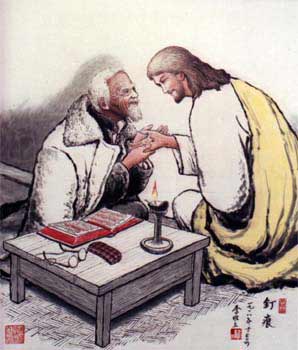
Nail Mark by Li Wei San.

Jesus showed him. He said: ‘Put your finger here and see my hands. Reach out your hand and put it in my side”. Normally we read Thomas’s response as a confession of faith – “My Lord and my God!” with a sense of joy. We could read it very differently – again with Thomas, the forensic scientist examining the body, probing Jesus, talking to to Jesus, as if a patient sufferer, while processing what he is seeing. “They did this to you?” “How deep that wound goes.” “This is what you put yourself through?” “You did this for me?” 

The realisation this examination evoked would have  a very different tone to the one we are used to. Read it differently. Instead of the tone of triumphant joy – as in “My Lord and my God” there may have been the tone of “Myyyyyy Looooord!” “Myyyyyyy God, what have they done to you?”

Thomas is the one who sees the wounds of Jesus, and the truth is in what he sees.

I want to explore what it is to see the wounds of others and our responses. It’s a growing question because there seems to be a battleground developing between those who want their wounds to be seen and those who very intentionally refuse to look, dismissing people for their whining. The battle has been fought down the ages, but is now being fought with a renewed intensity in the forefront of our politics.

The battle lines have been drawn between those who are “woke” and those who are “anti-woke”. The word “woke” made its way into our vocabulary through its usage in the African-American communities where it means staying “alert” to the wounds of racial discrimination. Its use spread through the Black Lives Matter movement and  the word was added to the Oxford English Dictionary in 2017. Being woke is being alert to the woundedness of others. But, most recently, woke has been turned into an offensive word and a term of abuse by those who are anti-woke who accuse the wounded and their sympathisers of being “snowflakes”.

“Unless I see your wounds” – that’s what this is about. The inspiration is Thomas and the wounds he sees, and the wounds Jesus carries. They take us to the heart of the battle.

Can we see one another’s wounds and the pain we bear. 

Can I see your wounds? Can I see how hurt you are? Can you tell us what hurts you?

We can only believe when we see the wounds and understand the back story to those wounds.

Gareth Malone has recently done a series where he put together a choir of eight singers to perform St John’s Passion by Johann Sebastian Bach. Some of you may have seen it. What made it so interesting was getting to know the eight people who formed their choir, hearing their stories and seeing their wounds. 

For example, a close relative of one of them, a niece, had been killed in a road traffic accident the previous week – and there Simon, her uncle, was there rehearsing, finding the rehearsing something that helped with the wounds.

Another of them, Joy, was one of the few who knew the passion story. She grew up in the church. Her wounds were wounds of rejection. She carried the scars of having been rejected by her parents when she was a baby, and then again felt rejected by her church at the age of 12 when it became clear to her that she was gay. (Incidentally, that has been thought to be an appropriate age for the Holy Spirit to confirm faith in a service of Confirmation.) Here we have a rejection, not a confirmation – with all the wounds and scarring that go with it. Her faith is still important to her. She was wearing a prominent cross of another rejected one.

Already, in two of them, we see their wounds. The wounds we were shown were fairly typical – the wounds of sudden loss and the wounds inflicted on some who are gay. It was only the surface we were touching. We obviously weren’t shown the complications which are personal to each wounding.

Bach himself was sore wounded. By the age of 10 he had lost both his parents. His first wife died after they’d been married 13 years. 12 of his 20 children died before they were 3. Research by John Eliot Gardiner reveals the violent, thuggish world of the young Bach. Gang warfare and bullying typified his schooling with inspection reports showing that boys were brutalised. They were “rowdy, subversive, thuggish, beer and wine loving, girl-chasing, breaking windows, brandishing daggers”. He missed 258 days of schooling in 3 years – kept at home, like many for fear of what went on in school. Do we understand his music more, do we see his musical score better for seeing the scarring and scale of his wounds?

Can we see the woundedness in others? The wounds of those who are gay. The wounds of those who have grown old and tired. The wounds of those who have had to fight through war. Can we see the woundedness of those who have had to flee – the refugee, the jilted. The wounds of those who are black those who are disabled. So many of their wounds have been inflicted by those who haven’t cared for them/us as they should

These wounds matter. The wounded don’t want to hide their wounds. Their wounds are who they are. Our wounds are who we are. They have made us who we are. As I said, it’s the Black Lives Matter movement which has encouraged wokeness. Members of the Black Lives Matter movement insist the wounds are part of who they are. Their history matters – their wounds matter.

With our own loved ones it is important to see their wounds. When a child is upset we want to know where it hurts. With a partner, we want to understand the story of their scars and the wounds they carry.

And all of us want to be believed for the stories we tell about ourselves, our battles, challenges and wounds. That is what is so important about a community like this. Our best chance of being believed is being amongst people who trust one another – who we can trust with our very lives – sheltered from the indifference and cynicism of those too wrapped up in themselves to see the gaping wounds so many have to hide because they fear they’d never be believed.

Some of our wounds are self-inflicted – maybe a relationship breakdown which was my fault, or the wounds may be the result of personal neglect, or the way we’ve misused our bodies. Our sense of shame covers up the wounds. 

Through prayer and encouragement
we may begin to open up
to the one who wants to see,
to the one who says “let me see”,
to the one we can trust
with the shame we are showing them,
to the one we trust will believe us,
even God who wants to see, to heal
what matters to us matters to him
what’s wounded us, wounded him,
crowned with agony.

It’s not “wokeness” that alerts us to the pain and wounds of others. It’s our passion for the other which we call compassion. We mustn’t let the anti-woke brigade prevent us seeing the pain and suffering of others. Not seeing why, how and what is hurting rubs salt into the wounds and isolates them from us.

When we are trusted enough for people to show themselves to us, and when we truly see them, we believe. Seeing is believing – and our hearts go out to those who have so trusted us to believe in them. They are believed and beloved. They are known.

Thomas said: “Unless I see the mark of the nails in his hands, and put my finger in the mark of the nails and my hand in his side, I will not believe.” Nor will we believe people unless we also see the marks of the nails, the cuts in their bodies, the scarring of their minds. Unless his/her/their/our nail marks are seen and his/her/their/our wounds felt he/she/they/we will not be believed and will not be beloved.

John 20:19-end

When it was evening on that day, the first day of the week, and the doors of the house where the disciples met were locked for fear of the Jews, Jesus came and stood among them and said, ‘Peace be with you.’ After he said this, he showed them his hands and his side. Then the disciples rejoiced when they saw the Lord. Jesus said to them again, ‘Peace be with you. As the Father has sent me, so I send you.’ When he had said this, he breathed on them and said to them, ‘Receive the Holy Spirit. If you forgive the sins of any, they are forgiven them; if you retain the sins of any, they are retained.’
But Thomas (who was called the Twin), one of the twelve, was not with them when Jesus came. So the other disciples told him, ‘We have seen the Lord’. But he said to them, ‘Unless I see the mark of the nails in his hands, and put my finger in the mark of the nails and my hand in his side, I will not believe.’
A week later the disciples were again in the house, and Thomas was with them. Although the doors were shut, Jesus came and stood among them and said, ‘Peace be with you.’ Then he said to Thomas, ‘Put your finger here and see my hands. Reach out your hand and put it in my side. Do not doubt but believe.’ Thomas answered him, ‘My Lord and my God!’ Jesus said to him, ‘Have you believed because you have seen me? Blessed are those who have not seen and yet have come to believe.’
Now Jesus did many other signs in the presence of his disciples, which are not written in this book. But these are written so that you may come to believe that Jesus is the Messiah, the Son of God, and that through believing you may have life in his name.

Inspired by love and anger – a sermon for Passion Sunday

A reflection on our own passion (or lack of passion) for Passion Sunday. The readings (Jeremiah 31:31-34 and John 12:20-33) are below. It’s St Patrick’s Day, 2024, and we’re in two churches in the heart of England, in rural Warwickshire. The quotes from Cole Arthur Riley are from her book, Black Liturgies.

Today is known as Passion Sunday. 

I have given this sermon a title – Inspired by love and anger. They are words of a hymn from two members of the Iona Community, John Bell and Graham Maule. (Hear it sung here)

The author of our first reading, Jeremiah was inspired by love and anger to hope in hopeless times when his people had lost everything – their home, their land, their institutions and their identity. At great cost to himself, he reiterates the promise of God to make himself known in a way that people could relate to. They would know God by heart, not by head and teaching or by law and obedience. He promises to write his law (or rule) in the heart of his people – the rule of God, self-imposed by God, the only rule of God, that he will only love, and that we will only know him in his love – in his passion. From that point the relationship between God and his people becomes an affair of the heart – where all our passions stir.

Jesus has this rule of God in his heart, living his life with this rule, and passionate for this rule of God’s love to be the rule of life on earth, just as it is in heaven. He taught his followers to make that our constant prayer. Thy kingdom come, on earth, as it is in heaven.

And as he resisted the temptations of an easier life so he insisted that we who are his followers should follow him in similar all-consuming passion, resisting the temptations of an easier life, to passionately engage with the rule of God for our lives – that rule being, only love.

Normally, on Passion Sunday, we would focus on Jesus’s passion without questioning our own. Jesus’ passion is well known. 

But what of our own passion? Are we passionate? Are we inspired by love and anger? Are we passionate for the kingdom of God, in the way of Jesus? Are we passionate for, and compassionate with those who are always counted first in the kingdom of God who  as a rule in the world are counted last or least, or not counted at all and get lost and disappear? The rule of God is that they come first.

Or are we too preoccupied and too easily distracted? Or, are our passions just about our selves? Or, has our passion become too domesticated so that our passion stays at home never reaching beyond our front doors?

Or have we been worn down and out by a hopelessness leading us to believe that there is no point in our passion because we can’t make any difference or we can’t change anything? Has our experience embittered our hearts?

Have we become numb? The opposite of passion is apathy. Apathy literally means without feeling, without passion.

Or have we never been helped to direct our passions? Have we ever had friends to help us safely explore the things of our heart – both the love and the anger?

Or have we become too nice for that sort of thing becoming the sort of people who never get angry? I looked up the meaning of nice. Apparently it is from the Latin nescire. Nescire means not knowing or ignorant. Nice became a word in Middle English to mean stupid?

How do we help one another to be more than the nice people we undoubtedly are?

Jesus wasn’t nice. He was fiery, fierce and furious – as we see in what happened when he went to the temple in the last days of his life, turning the tables on the moneychangers and condemning the religious authorities for their exploitation of the poor – the very people who come first in the rule of God.

We only have to listen to what the spirit says to the churches to realise that nice doesn’t even cut the mustard.

Hear the words of the Amen, the faithful and true witness, to the church of Laodicea (revelation 3:14-22): “I know your works: you are neither cold nor hot. I wish that you were either cold or hot. So, because you are lukewarm, and neither cold nor hot, I am about to spit you out of my mouth. For you say, “I am rich, I have prospered, and I need nothing.” You do not realise that you are wretched, pitiable, poor, blind and naked.”

We need to what what the spirit is saying to the churches.

Nothing good comes from being nice. Nothing changes if we remain apathetic. Nothing comes from being lukewarm, If we aren’t passionate and compassionate.

Passion is never served cold. It is heated by love and anger. Anger, rage and fury are part of our created order. They are very much part of ourselves. And they are very much part of our passionate selves. 

Those counted last and least as a rule, those usually discounted and lost need the anger, rage and fury of those who have taken the rule of God to their heart. They need that encouragement from fresh hearts.

It is anger, rage and fury which wins wars, defends the abused and bullied, defeats fascism, establishes justice, rights wrongs – it is never done cold and it is never done by being nice. It’s how the rulers of this world are driven out.

We have a problem. We are schooled to be nice. In the playground we were told to be nice, particularly to those who weren’t nice. We have demonised anger. Who wants us to be nice? Powers that be do. Controlling people do. They prefer us not to know. They don’t want to hear us. They don’t want our disruptions and protests. They want to keep us in the dark – the very place Jesus doesn’t want to keep us. His whole mission was to shed light in our darkness.

Cole Arthur Riley puts it like this: “Happiness and sadness and even fear are met with tenderness, understanding; they are permitted to speak without constant scrutiny. But anger we require to use the back door – to come and go quietly without attracting too much attention to itself… The oppressors of this world have told you to play nice, be civil. They tell you to control yourself. But by this they only mean they want you easy to be controlled.”

She confesses “We have exalted being nice and calm as a pinnacle of character, repressing that which stirs our souls so deeply we must shout” and she prays to God to “release us from the kind of niceness that only serves and protects the oppressor”. 

There is so much wrong, so many things are broken. There’s plenty to be furious about. How are things going to change without our fury, anger and passion? 

We can’t take it all on, but we can let love lead us. (Hatreds can also make us angry – they’re the furies we don’t want. They’re the furies we will fight with a passion).

I suspect that few of us are any good at being angry or furious. It often comes out wrong, doesn’t it? We often finish up only hurting those we love. This isn’t surprising because we have repressed anger. We’ve kept it hidden and not given it voice. We haven’t kept up our practice.

Here we can practice that love, among friends, through our prayer, learning all the time how to be angry better, how to balance anger with love, how to live passionately in the rule of God which is only love, how to live compassionately with those Jesus always counts first.

Can we help one another redirect our passion to join the passion of Jesus for the rule of God, and so that our whole lives are inspired by love and anger?

Jeremiah 31:31-34
The days are surely coming, says the Lord, when I will make a new covenant with the house of Israel and the house of Judah. It will not be like the covenant that I made with their ancestors when I took them by the hand to bring them out of the land of Egypt – a covenant that they broke, though I was their husband, says the Lord. But this is the covenant that I will make with the house of Israel after those days, says the Lord: I will put my law within them, and I will write it on their hearts; and I will be their God, and they shall be my people. No longer shall they teach one another, or say to each other, ‘Know the Lord’, for they shall all know me, from the least of them to the greatest, says the Lord, for I will forgive their iniquity, and remember their sin no more.

John 12:20-33
Now among those who went up to worship at the festival were some Greeks. They came to Philip, who was from Bethsaida in Galilee, and said to him, ‘Sir, we wish to see Jesus’. Philip went and told Andrew; then Andrew and Philip went and told Jesus. Jesus answered them, ‘The hour has come for the Son of Man to be glorified. Very truly, I tell you, unless a grain of wheat falls into the earth and dies, it remains just a single grain; but if it dies it bears much fruit. Those who love their life lose it, and those who hate their life in this world will keep it for eternal life. Whoever serves me must follow me, and where I am, there will my servant be also. Whoever serves me, the Father will honour.
‘Now my soul is troubled. And what should I say – “Father, save me from this hour”? No, it is for this very reason that I have come to this hour. Father glorify your name.’ Then a voice came from heaven, ‘I have glorified it, and I will glorify it again.’ The crowd standing there heard it and said it was thunder. Others said, ‘An angel has spoken to him.’ Jesus answered, ‘This voice has come for your sake, not for mine. Now is the judgement of this world; now the ruler of this world will be driven out. And I, when I am lifted up from the earth, will draw all people to myself.’ He said this to indicate the kind of death he was to die.

We have nothing to prove and everything to love

Here’s a sermon for two rural churches in Warwickshire for the first Sunday in Lent. I’ve wondered whether Jesus only went into the wilderness for 40 days, or was his whole life there? Is wilderness a way to see “life”? The gospel for the day is Mark 1:9-15.

Catching my eye this week were these words of a benediction by Cole Arthur Riley; “May you rest in the immanence of your own worth, knowing you have nothing to prove and everything to love.”

Know you have nothing to prove and everything to love.

It’s the first Sunday of Lent and we’re just getting started. The question is, do we begin with shame, or do we begin with love? When/if we choose to give up chocolate or social media is it because it’s a shame we eat too much chocolate or spend too much time on social media? Do we begin with shame or do we begin with love?

Lent is the opportunity to intensify the awareness in our lives – our behaviours and the life around us. But do we begin with shame, or do we begin with love? Perhaps we begin with shame, and perhaps we begin again with love.

We are fond of thinking that Jesus went into the wilderness for 40 days – to be tempted by Satan. And that is what the gospels tell us. But were those 40 days an intensification of the wilderness experience which was to consume his whole life? The temptations didn’t stop after 40 days. The wild beasts didn’t go away – they bruised him, beat him and crucified him. They were hard times in a harsh and barren landscape – a lifetime in the wilderness. 

His 40 days in the wilderness with the wild beasts were part of his whole life in a wilderness with the wild beasts of empire and religious authority baying for his blood.

Our gospel tells us it began with love, not shame.

Mark gives the sequence of events – and his sequence is his version of “in the beginning”. Beginning the gospel, beginning the good news of Jesus Christ, the Son of God, Mark gives this sequence of events:

  1. First, John appeared in the wilderness, proclaiming a baptism of repentance, and crowds came out to the wilderness to be baptised by him.
  2. Jesus, from a backwater village in Galilee was one of them. Just as he came out of the water he saw the heavens torn apart and the Spirit descending like a dove on him, and a voice came from heaven, “You are my Son, the Beloved, with you I am well pleased.”
  3. Immediately the Spirit drove Jesus deeper into the wilderness
  4. Then John was arrested

The Spirit drove Jesus into the wilderness. It began with love. “You are my Son, the Beloved, with you I am well pleased.” He was driven into the wilderness by love ringing in his ears, giving him the resilience for devilish temptation and for a life with the beasts. 

And with love he walked the wilderness for the rest of his life, facing the wilder-ness of human nature and the be-wilderment of the victims of that wilder-ness and beastliness.

Resounding above all the voices of that wilder-ness, the beasts baying for his blood, the crowds shouting “crucify him”, the mockery – above all that din is the voice of heaven: “you are my Son, the Beloved, with you I am well pleased”, and the sound of the angels who waited on him in the wilderness, whose only sound is the sound of heaven and their lyric, “do not be afraid”.

The wilderness is our world too. We are in serious denial if we ignore the wilder-ness of our human nature and the beastliness that so many suffer: if we ignore the beasts that force themselves on us and the beasts that we entertain. 

Lent is our opportunity to intensify our awareness of the wilderness of our lives, to take stock of the wars around us, the greed that threatens us, the environment we’ve neglected, the injustice that is suffered, the emptiness of so much of life, the distance between us, and the isolation which is so much a feature of life. 

Life is wilderness. The wilderness is so much bigger than any of us can ever imagine – too big for our hearts and minds. We have a problem if we reduce Lent to a personal remedy for our over-use of social media or our over-indulgence of chocolate. Lent will have been a waste of time if all we do at the end is reach out for a Cadbury’s cream egg. The devil will have won big time then.

Just as it was the love shown to Jesus in his baptism that drove him into the wilderness, to love in the wilderness, to do wonders in the wilderness, so it can be the love shown to us in our baptism that drives us into the wilderness, into these 40 days, into the rest of our lives.

We’ve got nothing to prove and everything to love. The wilderness isn’t an easy place to be. Heaven knows we’ve suffered enough there already. The landscape is often bleak and unforgiving. We may be tested to our limits. We will take wrong turns. There will be complicated choices for which there are no easy answers. We will be be-wildered and bothered by the wilder-ness around us and within us

The wilderness isn’t easy. But it’s the only place to be – or, the only place to be is where love drives us, where God’s Spirit takes us. Just don’t make it a guilt trip. Don’t let shame take you there these 40 days, and into the rest of your lives. Let love take you.

From the beginning God brought love to the wilderness. That is clear to us when we open our scriptures. “In the beginning when God created the heavens and the earth, the earth was a formless void and darkness covered the face of the deep.” In other words there was nothing but wilderness and chaos – and a wind from God swept over the face of the waters, and he did wonders in that wilderness and chaos.

Similarly, at the beginning of Mark’s gospel, there are all the signs of wilderness and chaos – that is why the crowds came to John, for his baptism of repentance as a way through the wilderness and chaos they were facing. It is the Spirit of God which drove Jesus into the wilderness and chaos which has never gone away. It’s our wilderness, our chaos – and he begins with love.

When we are baptised, we are christened – becoming one in Christ, driven by love into wilderness. St Teresa of Avila gave us this blessing which will surely help us follow Jesus in his love into the wilderness, far from the easy life some of us may have been tempted to choose. It is the truth of our christening and being in Christ.

Christ has no body but yours, no hands, no feet on earth but yours.
Yours are the eyes with which he looks compassionately on this world.
Yours are the feet with which he walks to do good.
Yours are the hands, with which he blesses the world.
Yours are the hands.
Yours are the feet.
Yours are his eyes.
You are his body.
Christ has no body now but yours, no hands, no feet on earth but yours.
Yours are the eyes with which he looks compassionately on this world.
Christ has no body now on earth but yours.

Jesus began with love in the wilderness. We don’t need to begin with anything other than love. We don’t have anything to prove but we have everything to love.

Mark 1:9-15

In those days Jesus came from Nazareth of Galilee and was baptised by John in the Jordan. And just as he was coming up out of the water, he saw the heavens torn apart and the Spirit descending like a dove on him. And a voice came from heaven, ‘You are my Son, the Beloved; with you I am well pleased.’

And the Spirit immediately drove him out into the wilderness. He was in the wilderness for forty days, tempted by Satan; and he was with the wild beasts; and the angels waited on him.

Now after John was arrested, Jesus came to Galilee, proclaiming the good news of God, and saying, ‘The time is fulfilled, and the kingdom of God has come near; repent, and believe in the good news.’

Cole Arthur Riley’s book from which the opening benediction is taken is Black Liturgies, published in 2024 by Hodder and Stoughton

Beginnings and the meaning of life

A sermon for the 2nd Sunday before Lent. Both epistle and gospel of the day are about beginnings and the meaning of life. This sermon was for a church in rural Warwickshire.

In the beginning. In the beginning – such a lovely phrase. In the beginning – such a good place to start.

In the beginning was the Word, and the Word was with God, and the Word was God. He was in the beginning with God. That’s how John prefaces his gospel.

Our scriptures open at the beginning. In the beginning God created the heavens and the earth

Some of you will remember Maureen Lipman’s British Telecom adverts. In one she rings her grandson to see how he got on in his exams. He goes through all the exams he failed. She asks, “did you pass anything?”. “I got pottery” – to which grandma says “that’s good, people will always need plates”. “And I got Sociology”. To which Grandma says, “you got an ology and you said you failed!”.

In the beginning was the Word. I’ve not got much in the way of an ology, but I’ve got enough of an “ology” to know that the Greek words for the Word is o-logos. O logos. It is from those two Greek words that we get all our ologies – whether sociology, psychology, geology, astrology, criminology – anyone awarded an ology can claim the credit of beginning to understand the meaning of an aspect of life

Putting aside any clever, clever ologies we may have we could all say that we have an OLOGY because the Word became flesh and dwells amongst us, with us always, to the end of time. That’s an ology that God has gifted us. He has gifted us his Word, o logos, made flesh, embodying the meaning of God from the beginning. If we want to know the meaning and purpose of God we have to look no further than Jesus.

The Word means meaning. O logos, the ology given to us, means meaning and purpose. From the beginning life has meaning and purpose. This is the viewpoint of faith, hope and trust.

In the beginning when God created the heavens and the earth, the earth was a formless void and darkness covered the face of the deep, while a wind from God swept over the face of the waters. That is such a beautiful opening for our scriptures. 

Our generations, with all our ologies, have tended to scoff at this creation story. “It can’t have happened like that” we say, as if the inspired authors of this literature ever believed it happened like that. We are not looking at God’s first diary and to-do list. Inspired fiction sits alongside inspired history in our scriptures – what matters is not what happened, but what is true. In the beginnings described by the first chapter of Genesis, the openings of John’s gospel and our reading from Colossians – in all of them we have inspired theology that conveys truth.

I am ever more conscious that our scriptures are the scriptures of the Jewish people, so frequently overpowered, conquered, enslaved, exiled, occupied, persecuted, oppressed, impoverished and hated, as well as being so often disobedient and misled (just like the rest of us). They become our scriptures as long as we open our hearts and minds to join those who suffer, redirecting the power and wealth we have for their sake, becoming poor in spirit.

When we read scripture we are always looking through the eyes of a people (like Paul writing to the Colossians from prison) who suffered so much and yet dared to wonderfully imagine that from the very beginning God is working his purpose out, that there is meaning even in the midst of tragedy.

The beginnings described in Genesis and in John’s gospel and in our reading from Colossians are profound theological reflections on the meaning of life in the midst of chaos, surrounded by so much diversity and difference, a wealth of creation – and the part we are called to play. 

The “beginnings” of Genesis and John are not the start of things. It’s not a blank page. In the beginning described by John there was stuff going on. There was darkness, and the Word became the light of the world that darkness has never been able to overcome. There was darkness going on, and on and on.

Likewise in Genesis, there was stuff going on. There was formless void and darkness covered the face of the deep. In other words, it was chaos – and the creation story imagines what God does with chaos, ordering it and making so much of it for our delight.

The beginnings described by Genesis, John and Paul are all of them in the midst of things. There is always something going on. These scriptures belong to people who are in the midst of things, and passed on to those going through so much. There has been so much love gone into them – their meaning is to inspire faith, hope and love – in us, in the midst of things.

Sometimes life doesn’t seem to have any meaning – particularly when bad things overwhelm us. Sometimes that is about discovering that life doesn’t mean what we thought and that there is a new meaning we have not yet discovered. As we lose sight of the meaning of life we can often forget the meaning of God. We may have been misled into thinking of God in a way he just isn’t. 

When we lose that sense of meaning for our lives, when we’re burnt out and exhausted by excessive busyness, or responsibility, or trauma, when we’ve lost our way in the forest, then we do need to retrace our steps, unwind to the beginning to the time when there was always meaning. 

When we lose sight of the meaning of life we need to follow the sound of music and start at the very beginning, a very good place to start, the beginning when the Word became flesh and dwelt among us – a down to earth meaning, embodied in our lives, in our times and in all we try to do.

The meaning of God is the meaning of life. In our first reading, the letter to the Colossians, we have the phrase He is the beginning. Christ is the beginning for God. 

The letter continues: “in him all the fullness of God was pleased to dwell, and through him God was pleased to reconcile to himself all things, whether on earth or in heaven, by making peace through the blood of his cross”.

This is the meaning of God and the meaning of life.

We are all “in the beginning” – we are part of the body of Christ who is the beginning. He is the beginning of the work of reconciliation ………. He is the beginning of the repair of broken and exploitative relationships. That is his work, his meaning and purpose. We are all “in the beginning”, in the beginning of a new creation, in the beginning of something new, in the beginning of something better as long as we listen to his word and love his meaning.

In the midst of things, a lot of which we’d rather not be in the midst of, in the midst of things we have the beginnings of life, its meaning and purpose, and the beginnings of God, his meaning and purpose – to find our way where we might lose our way. In our beginning is the Word to inspire our faith, hope and love, the ology which means the world to us.

Colossians 1:15-20

He is the image of the invisible God, the firstborn of all creation; for in him all things in heaven and on earth were created, things visible and invisible, whether thrones or dominions or rulers or powers – all things have been created through him and for him. He himself is before all things, and in all things hold together. He is the head of the body, the church; he is the beginning, the firstborn from the dead, so that he might come to have first place in everything. For in him all the fullness of God was pleased to dwell, and through him God was pleased to reconcile to himself all things, whether on earth or in heaven, by making peace through the blood of his cross. 

John 1:1-14
In the beginning was the Word, and the Word was with God, and the word was God. He was in the beginning with God. All things came into being through him, and without him not one thing came into being. What has come into being in him was life, and the life was the light of all people. The light shines in the darkness, and the darkness did not overcome it.

There was a man sent from God, whose name was John. He came as a witness to testify to the light, so that all might believe through him. He himself was not the light, but he came to testify to the light. The true light, which enlightens everyone, was coming into the world.
He was in the world, and the world came into being through him; yet the world did not know him. He came to what was his own, and his own people did not accept him. But to all who received him, who believed in his name, he gave power to become children of God, who were born, not of blood or of the will of the flesh or of the will of man, but of God.

And the Word became flesh and lived among us, and we have seen his glory, the glory as of a father’s only son, full of grace and truth.

Darkness needs light: a reflection on the coming of holy night

I assume that everyone’s feeling tired by midnight on Christmas Eve. Midnight is not the time to be preaching long and hard. Here’s my offering for a group of churches in rural Warwickshire.

Wherever we look in the story of Jesus’ birth there is darkness. 

Matthew’s gospel begins with Mary’s disgrace and how Joseph saved her from being cast out by marrying her. Then we’re told that the Magi’s search triggers the slaughter of the innocents by Herod – he killed all the children in Bethlehem and around who were under two years old! Then Mary and Joseph become refugees to escape Herod’s slaughter.

Luke’s gospel begins with the darkness of Joseph and Mary being forced to make the long journey from Nazareth to Bethlehem by order of the Roman emperor -just to be counted – just to become numbers in the machine of a foreign empire. 

John’s gospel begins with the life which was to be the light of all people, the light that shines in darkness.

Darkness is never far from us. It’s within us – all those dark thoughts, and it’s all around us. On this night of darkness we celebrate how the light comes to us, how the light comes to us as love (all vulnerable), how the night becomes holy – thanks be to God.

I wrote this for tonight.

One light,
so much darkness. If truth be told
what Christmas needs
is the longest of nights, 
the shortest of days,
and the time when people
are at their coldest
and meanest.

For truth to be told
darkness needs light
for the night to find its way to day,
for those who walk
through the dark night of the soul
lost in a cloud of unknowing
frightened in the valley
of the shadows of death.

If truth be told
darkness lies
in the distance between us,
what  we do to one another in war,
rape, rubble, ruin in Gaza and Kyiv.
It rides the nightmares
of suffering, anxiety, despair.
It’s the cost of living.

The data of darkness
is hidden in official secrets
and personal shame,
in the blindness of prejudices
in the lies of truth twisters
in the scheming of profiteers
in the denial of freedoms
in the erections of borders

that divide darkness
from darkness, hiding the terror
from which so many flee.
It’s in their denial. Yes,
there is no room.
It’s in their small boats
not built for the darkness
of the deep and stormy sea.

If truth be told, it’s told in numbers:
in the homeless numbers,
the foodbank users,
the choosers choosing 
heating or eating,
the children killed in war.
It‘s in the numbers of those
who are just numbers.

It’s the middle of the night,
when even the clocks
put their hands together
in time to pray.
They pray for first light
to end the night, a baby flame
in the frame of shame,
and then they pray us awake

and in the darkness, see,
shimmering and flickering
in the world which,
if truth be told,
has no room for Light,
where the only place
to rest his head lay
in the love of a mother

and the kindness of a stranger 
in the inn the light came in,
casting shadows with halos,
our light never dying.
With the angel band backing,
all hallelujah singing,
watching shepherds 
dance the night away.

Joy to the world. Happy Christmas.

© David Herbert 2023