From the Riverbank

– Sister Itchen and the River of Life
A sermon for Harvest Festival at St Lawrence’s Napton, inspired by St Francis’s Canticle of the Creatures, the Warwickshire River Itchen, artist Stephen Broadbent’s River of Life sculpture in Warrington, the writing of Robert Macfarlane and the indigenous wisdom represented by Robin Wall Kimmerer. It’s a thanksgiving for the quiet grace that still flows through creation, and a reminder that we are family with all that lives.


We are brothers and sisters together,
one family, caring for one another.
It’s 800 years this year since St Francis highlighted the interdependence of all things that have life,
and I thought it would be appropriate to have Francis helping us in our Harvest thanksgiving,
when we give thanks for the fruits of God’s creation.

Today we praise God for his creation,
for the nature given to us.

We would be mistaken to think we praise God alone.
For Francis, all creation sings God’s praise —
our whole family: Brothers Sun, Wind and Fire,
Sisters Moon and Water.

If St Francis had walked here,
I think he would have sung of Brother Itchen
the river that rises at Wormleighton and flows its way
past Priors Hardwick through here in Napton.

It seeps quietly through our fields,
watering crops and feeding wildlife,
joining its voice to the River Leam and the Avon beyond.

It’s not a mighty river like the Jordan or the Nile,
but a patient, life-giving one —
a reminder that the grace of God often flows quietly,
unnoticed, yet sustaining everything around it.

Robert Macfarlane asks in a book I’m reading,
“Is a river alive?”
I think the Itchen would answer yes.
It breathes, moves, nourishes —
and if we listen carefully, we can almost hear it praise.

Other songs of the church treasures spell this interdependence of praise out in more detail.
The Benedicite calls
the sun, moon and stars,
every shower of rain and fall of dew,
all winds, and fire and heat,
winter and summer,
the chill and cold,
frost and cold, ice and sleet,
mountains and hills,
everything that grows upon the earth,
springs of water, seas and streams,
whales and everything that moves in the water,
all the birds of the air, the beasts of the wild,
flocks and herds, men and women
all to praise and glorify God,
alongside those of upright spirit,
those who are holy and humble in heart.

Psalm 148 is a call to worship
for the angels, the sun, the moon and stars of light,
for the waters, sea monsters and all deeps,
for fire and hail, snow and mist,
for mountains and hills, fruit trees and cedars,
wild beasts, all cattle, creeping things, birds,
kings of the earth and all people,
men and women, boys and girls
to worship and praise together.

The prophet, Isaiah, anticipated the joy of creation.
He saw the mountains and the hills bursting into song
and the trees of the field clapping their hands.

And, of course, we know that the hills are alive with the sound of music.

This is ancient wisdom that is treasured in many indigenous cultures
but which has been forgotten over the years.
We forget we are called to worship with the whole of creation
and we presume we worship alone — homo sapiens.

Is that why our family ties with the rest of nature have broken?
We’ve stopped caring as brothers and sisters.
Instead, we’ve used our dominance for exploitation of our brothers and sisters.

Robert Macfarlane asks in a book I’m reading (and heartily recommend),
“Is a river alive?”
“Is a river alive?”
I think the Itchen would answer yes.
She breathes, she moves, she nourishes —
and if we listen carefully, we can almost hear her praise.

That same living flow runs through the Bible —
through the river that rises in Eden, watering the garden,
through the waters that break open in the desert,
through the River of Life that Ezekiel and John both saw,
flowing from the throne of God,
their trees bearing fruit each month,
and their leaves for the healing of the nations.

The artist Stephen Broadbent knows something of that healing power.
His River of Life sculpture in Warrington
was created after two boys were killed by a terrorist bomb there in 1993.
In that place of loss and grief,
Stephen imagined a river of life flowing through the heart of the town —
a river that gathers up pain and turns it into hope.

The bronze figures he shaped seem to rise from the water itself.
They are imprinted with the hands of children,
contemporaries of the boys killed,
their hands open in welcome and peace.

By the river are the leaves of trees – 12 of them,
one for each month of the year,
a monthly reminder that the river and her trees
are there for all time, even the worst of times,
always remembering, healing and renewing life.

That is what God’s river does —
whether in scripture, in the heart of a town like Warrington,
or in the quiet fields of Warwickshire.
She carries life wherever she goes.
She invites us to join her flow —
to live as people of blessing, healing, and renewal.

I’ve got an allotment this year.
I see something of that same grace there.

An allotment teaches you that nothing is wasted.
Weeds go on the compost, scraps rot down into soil,
and what looks like death becomes food for life.

The tiniest seed, almost too small to hold,
can multiply into a hundredfold abundance.
And if you care for the soil, safeguard the earth,
you discover her astonishing energy for renewal.

It changes the way you look at things.
You learn the value of everything,
you learn to work with the grain of creation, not against it.
And you discover joy in being part of that family again —
brother soil, sister seed, mother earth,
working alongside us in God’s garden.

So today, at Harvest, our thanksgiving is not a private prayer.
It is part of a chorus with the sun, the moon, the wind, the water —
with rivers that sing and trees that clap their hands,
with a creation that still waits for healing,
yet never stops praising.

St Francis knew it 800 years ago.
The Bible has sung it for thousands of years.
Artists and poets remind us in scarred places.
And even the humble allotment teaches us:
we are family with all creation.

Our calling is to live as grateful brothers and sisters,
giving thanks, safeguarding the earth,
and letting the river of life flow through us
for the healing of the world

The blessing of being alongsides

A reflection on Psalm 1 and Luke 6:17-26 for two small congregations in a group of parishes in vacancy.
The 3rd Sunday before Lent – Year C

In last week’s gospel (Luke 5:1-11) crowds surrounded Jesus so much that to find space for himself Jesus needed to get into a boat on the lake as crowds gathered around Him to hear His teachings.

We have another crowd in today’s gospel (Luke 6:17-26). There’s a large crowd of his disciples (including the twelve he called “apostles”), and “a great number of people from all over Judea, from Jerusalem, from the coastal region around Tyre and Sidon” who had come to hear him and be healed of their diseases.

In the context of safeguarding we need to note that Luke has underlined where Jesus was in relation to the crowd. He is not “high up”, over others. 

In the boat on the lake he would have been lower than his hearers. 

And in today’s gospel Luke paints a different picture to Matthew’s Sermon on the Mount. Luke has them all on a level place – Jesus on the level with all the people. 

In this, and so many other ways, Luke is wanting to show how Jesus stands in relation to others – never overbearing, never patronising, always side by side – as typified by walking incognito with disciples to Emmaus. 

There is no distance between Jesus and the people. He was there with them, eye to eye, shoulder to shoulder, side by side, valuing relationship over hierarchy.

That’s the position you’re hoping to fill, isn’t it? You’re hoping for a priest who will ask your permission to come alongside, as your helper. It’s probably also the position we long to be ourselves, alongside others with others alongside us.

None of us are ever safe when people look down on us, and nobody is safe from us as long we look down on them. Jesus’ physical positioning in relation to others guarantees safety. He is the good shepherd.

That’s how Jesus positioned himself, alongside us, always on the side of those he blesses. What is our position? Where do we stand?

The psalmist points to those who take a very different position. They “walk in the counsel of the wicked”, “linger in the way of sinners” and join “the assembly of the scornful”. They’re condemned. They won’t stand the judgement of the law of the Lord or stand in the “congregation of the righteous”.

There is another way. That is the way of Jesus and all those who delight in the law of the Lord, meditating on his law day and night. They’re the ones blessed and the psalmist sees them like trees “planted by streams of water, bearing fruit in due season”.

There is a clear choice: the way of the wicked, or the way of the Lord. It’s either blessings or curse.

I had to go to a two column format to get our two readings on one sheet of paper. But in so doing I have shown the pairings: 

Blessed are all you who are poor, but woe to you who are rich
Blessed are you who hunger now, but woe to you who are well fed now
Blessed are you who weep now, but woe to you who laugh now
Blessed are you when people hate you, exclude you and insult you, and woe to you when everyone speaks well of you

This is the law of the Lord. This is Jesus’ teaching. This is the law of the Lord according to Luke who has already given us Mary’s song celebrating the ways of God in scattering the proud, toppling rulers from their thrones, raising the humble and humiliated, filling the hungry with good things and sending the rich empty away. This is the law of the Lord. (Luke 1:46-53).

This is the law of the Lord brought to us by Luke who has already told us how Jesus preached in the synagogue about the law of the Lord being good news for the poor: freedom for prisoners, recovery of sight for the blind and liberation for the oppressed. (Luke 4:18-19).

This is the law of the Lord our scriptures describe as blessed. This is the law that delights the blessed but which the wicked, the sinners and the scornful scorn. This is the law that those who are blessed think on day and night, according to Psalm 1.

They are like a tree planted by streams of water, bearing fruit in due season, with leaves that do not wither.

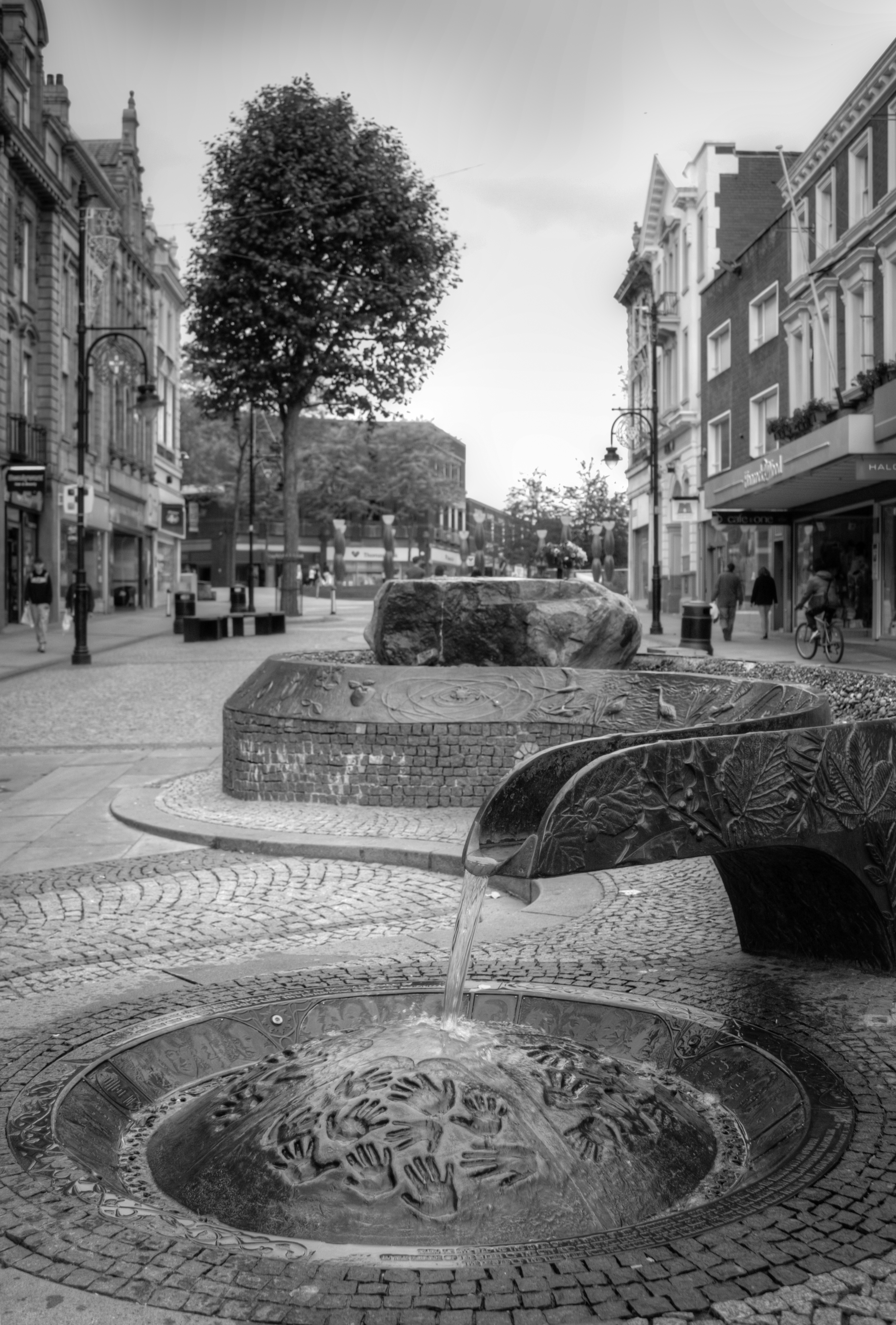
When I read that verse this week my mind went to a sculpture called The River of Life which runs down the main shopping street in Warrington. The sculpture was built by Warrington Council after two bombs were detonated by the IRA, killing 3 year old Johnathan Ball and 12 year old Tim Parry and injuring 56 others. It was the day before Mothering Sunday, March 20th, 1993.

The city council turned to a sculptor to discuss a memorial. Stephen Broadbent was the sculptor. He saw that the street was not just physically broken, but spiritually broken as well. He wanted to design something that would be “a symbol of renewal and faith in the power of the human spirit to triumph over adversity and to invest the future with hope.”

His inspiration was the image of the river of life in Revelation 22.
The angel showed me the river of the water of life, as clear as crystal, flowing out from the throne of God and of the Lamb down the middle of the great street of the city. On each side of the river stood the tree of life, bearing twelve crops of fruit, yielding its fruit every month. And the leaves of the tree are here for the healing of the nations.

And so it is. Now, flowing down that street is the River of Life  he made and on either side of the streaming water are trees, one for each month, each bearing fruits of the Spirit for the healing of the nations, for all times and seasons.

And so it is in Psalm 1 where the blessed are like a tree planted by streams of water bearing fruit in due season. I wonder that Stephen Broadbent himself is one of those trees, planted by the stream of tragedy and violence, leaving blessings of hope and healing through the season of trauma and grief.

I’ve seen photocards with these verses from Psalm 1. In them the stream is picturesque with sunlight reflecting from its gentle flow. The psalm doesn’t say the water is safe. 

The stream may be dangerous, fast flowing floodwater, a tidal wave, or deep or toxic. 

Or with a stretch of the imagination, the waters could be the waters that have to break for us to be born or baptised. 

Or the stream and the metaphor may be a metaphor for life.

Does the law of the Lord raise up people who delight in the law that there should be people by all the rough waters of life, that there should be lifesavers of healing, hope and blessing bearing fruit for all seasons of difficulty and danger?

It’s worth visiting that sculpture in Warrington. It’s on Bridge Street. It was always Bridge Street. The street hasn’t been renamed because of the sculpture and its intention to bridge the awful violence that tore people’s lives apart.

And here we are. The Bridges Group of Parishes – so called because of the bridges of the villages that make up the group of parishes. And the bridges are there to bridge the waterways that cut through the landscape.

We’ve reflected on Jesus’ position in relation to the crowds that streamed to him. We’ve reflected on the Psalmist’s position on those who delight in the law of the Lord.
We’ve reflected on the sculptor’s position in relation to the trauma of a community.
What about our own position?

Are we bridge builders and lifesavers? Do we delight in the law of the Lord, meditating on his law day and night? Are we blessed as agents of blessing, healing and hope? Or are we a curse on the poor, the stranger, the refugee, and all those vulnerable to losing their life at sea because we take our cues from the scornful, lingering in the way of sinners, taking the counsel of sinners?

Where are we as the river of life flows through our lives? Are we bridgebuilders offering healing where there has been division, hope where there has been despair? Are we like trees that bear the fruits of God’s Spirit, the fruits of love, joy, peace, forbearance, kindness, goodness, faithfulness, gentleness and self-control (against which no other law can stand) (Galatians 5:22f)? 

What is our position in relation to those Jesus blesses? Are we on their side, or are we on the side condemned by Jesus, with those who’ve grown rich at the expense of the poor, those who have stuffed themselves while so many go hungry, those who can afford to laugh while the rest of the world is in bits, those who walk the corridors of powers and still exclude, insult and reject others?

For as long as we delight in the law of the Lord, for as long as we seek to understand it, we will be on the side of those in the roughest of waters.

Seeing the wood for the trees – something for Palm Sunday

Here’s a sermon with donkeys, trees and their glad hosannas for two churches in the heart of Warwickshire countryside. We used Mark 11:1-11 and Philippians 2:5-11 as our readings.

March 24th 2024

The Cubbington Pear, European Tree of the Year 2015

They announced the winner of the European Tree of the Year this week. The winner is a Polish Beech called Heart of the Garden. It’s the third year in a row that a Polish tree has won. The UK Tree of the Year is a Sweet Chestnut in Acton Park in Wrexham. The Cubbington Pear won the award in 2015.

The Heart of the Garden took me all the way back to the tree at the heart of the Garden of Eden to the pomegranate tree we know as the Tree of Life where we made the choice of listening to one another, making our own decisions, breaking free and breaking bad in the same moment. In Holy Week we follow a carpenter to a cross made from a broken tree – a tree they broke to break Jesus. That tree is for us the Tree of Life. That’s the tree we gather round. It is the Tree of the Year all our years. It is where we meet God, hear him, and learn the practice of obedience in following him.

We can trace the roots of the tree broken for Jesus to the tree grown for us, the tree at the heart of the garden. Jesus’ journey to Jerusalem traces that route.

It begins with temptation. When Jesus told his followers that he must go to Jerusalem and will face suffering, Peter took him aside and rebuked him suggesting that there was an easier way of life for Jesus. Jesus dismissed this temptation of Peter in the same way he’d dismissed the temptations he faced in the wilderness. He used the same words to Peter as he had to the other tempter – “get behind me Satan”.

The journey to Jerusalem goes from the tree at the heart of the garden, all the way to the tree that was broken, bruised and cut for the crucifixion of the one they wanted to break, bruise and cut. Trees play their part all the way. Branches from palm trees cheer him on his way to the olives of the Garden of Gethsemane to the greatest of all tests of obedience as he faced up to his betrayal, arrest and murder. The journey to Jerusalem takes us from the first sense of human shame all the way to the final sense of divine glory, when, in the words of Isaiah, the mountains and hills will burst into song and the trees of the field will clap their hands.

The journey to Jerusalem goes from the wilderness of temptation to the heart of power, to the religious and political capital. Jesus moves from the edge, from the margins to the centre. Hosannas ring in his ears. Palms are waving, clapping their hands.

We left last week’s gospel with the promise that “Now is the judgement of this world; now the ruler of this world will be driven out”. (John 12:20-33) That is what the Hosannas are about. That’s the reason for the palm waving. That’s the point of the donkey.

Hosanna is a cry for help from those who need helping. It means “help, I pray”, or “save us, I pray”. It’s a cry as old as time, reverberating from the tree at the heart of the garden of Eden, that weeping pomegranate. It’s the sound of despair. But it’s also the sound of jubilation for those who realise that the one who is able to help and save is with them. They are seeing the ruler of this world being driven out. They have been the victims of those who have made them struggle, who have made them poor and who have made them suffer. They clap their hands. They wave their palms. Celebration is in the air. Their help is in the name of the one who comes riding a donkey.

How absurd.

How absurd to have a king on a donkey.

Donkeys are known as beasts of burden and carry those burdens with patient determination. This donkey carried the one who himself had burdened himself with the world and was bearing it with patient suffering. Those who waved their palms could see that. They could see in the absurdity a different sort of power – the power of humility which would drive out the ruler of this world.

They had a picture in their minds, drawn for them by Zechariah the prophet. Here’s what Zechariah envisaged:

Rejoice greatly, Daughter Zion! Shout, Daughter Jerusalem!
See your king comes to you, righteous and victorious,
lowly and riding on a donkey,
on a colt, the foal of a donkey.
I will take away the chariots from Ephraim
and the warhorses from Jerusalem,
and the battle bow will be broken.
He will proclaim peace to the nations.

Zechariah 9:9-10

You get the picture. It’s the one who rides the donkey against the riders of chariots and those who sit on their high horses – and the humble donkey wins. Jesus drew on the faith of the Psalms. He will have known Psalm 147 – where God’s delight is not in the strength of the horse, nor his pleasure in the speed of a runner. The Lord takes pleasure in those who hope in his steadfast love, like those whgo shout “Hosanna!”

Many rulers of this world will have come and gone in Jerusalem invading with their war horses. The people of Jerusalem will have been used to the sight of the chariots used by their Roman occupiers and overrulers. And, here on a donkey, is the peasant teacher who walks alongside the poor as their helper and deliverer, driving out the rulers of their world. The donkey highlights Jesus’ affrontery and the scorn he pours on those who use their power to exploit and oppress others.

We may think that the way our gospel ends this morning is a bit of an anticlimax. Mark says, Jesus went into Jerusalem. He went into the temple, looked around at everything, as it was already late and then went away again. But he comes back later in the week with his disciples. While they are awestruck by the magnificence of the Temple, particularly the wonderful stonework (Mark 13:1-2), Jesus is condemning the Temple and its rulers for turning the house of prayer for all nations into a den of thieves. Not one stone would be left standing on another as the rulers of that world would be driven out.

The rulers Jesus has in his sights are not those who run their affairs with love and compassion. He would have been delighted if he had found the temple was being run so that it was truly of place of prayer for all nations.

The rulers he wants to drive out are the same ones all those who shout “Hosanna” want out. Those who are self-serving, cruel, exploitative and oppressive. They are the tyrants and dictators – not just those in government, or with empires, but all those who abuse their power becoming bullies in the playground, tyrants in the workplace and violent abusers in their homes.

Jesus plodded into Jerusalem, at the same pace as those he walked alongside, their hosannas ringing in his ears. Just being on the back of the donkey was like a parody sketch through which Jesus poured scorn on the rulers of this world. It is an insult to them high and mighty and an assault on their fortifications and defences. Of course, they are going to fight back, and they did get their own back. They were able to turn the weapons of betrayal and the force of empire on Jesus, manipulating the crowd into calling for his crucifixion.

This is how hope arrives. It plods alongside the slowest, the weakest, the last and the least. It is as David to Goliath. It is an absurd way. It is the way of the cross. It is the way of love. It is the way the rulers of this world are driven out and the just and gentle rule of God begins. It is the way the “Hosannas” of desparation become the “Hosannas” of joyous celebration. Our help is in the name of the Lord (Psalm 124:8). The Lord is here. His spirit is with us.

The fight goes on – not on horseback, but on donkeyback. With our palms we join the trees of the field as they clap their hands and we sing our hosannas.

Our second reading, Philippians 2:5-11 explains how we believe the just and gentle rule of God begins:

In your relationships with one another, have the same mindset as Christ Jesus:

Who, being in very nature God,
    did not consider equality with God something to be used to his own advantage;

rather, he made himself nothing
    by taking the very nature of a servant,
    being made in human likeness.

And being found in appearance as a man,
    he humbled himself
    by becoming obedient to death—
        even death on a cross!

Therefore God exalted him to the highest place
    and gave him the name that is above every name,

that at the name of Jesus every knee should bow,
    in heaven and on earth and under the earth, and every tongue acknowledge that Jesus Christ is Lord,
    to the glory of God the Father.

Mark 11:1-11

When they were approaching Jerusalem, at Bethphage and Bethany, near the Mount of Olives, he sent two of his disciples and said to them, ‘Go into the village ahead of you, and immediately as you enter it, you will find there a colt that has never been ridden; untie it and bring it. If anyone says to you, “Why are you doing this?” just say this, “The Lord needs it and will send it back immediately.”’

They went away and found a cold tied near a door, outside in the street. As they were untying it, some of the bystanders said to them, ‘What are you doing, untying the colt?’ They told them what Jesus had said; and they allowed them to take it. Then they brought the colt to Jesus and threw their cloaks on it; and he sat on it. 

Many people spread their cloaks on the road, and others spread leafy branches that they had cut in the fields. Then those who went ahead and those who followed were shouting, ‘Hosanna! Blessed is the one who comes in the name of the Lord! Blessed is the coming kingdom of our ancestor David! Hosanna in the highest heaven!’

Then he entered Jerusalem and went into the temple; and when he had looked around at everything, as it was already late, he went out to Bethany with the twelve.

On Druids, Trees and Truth

Eiche und Basaltsäule, Joseph Beuys, Düsseldorf (1)
One of the 7000 Oaks inspired by artist Joseph Beuys with basalt stone
Friend Lewis asked me about “druids”. They are much maligned (is it, I wonder, mainly by the English?). They don’t understand their honourable history in ancient Celtic cultures where they were members of the professional class including religious leaders, legal authorities, lorekeepers, medical professionals and political advisors.

The modern word druid comes from the Latin druides, but behind that Latin word is Old Irish, Old Cornish and Middle Welsh words which hypothetically might be based on a proto-Celtic word reconstructed as druwids (plural is druwides). Druid is thought to come from the Celtic word for the oak tree, duir. A drewid is a “knower of oak trees”.

What led me to this clearance of understanding was a look at one of Joseph Beuys’s works (1982) which consisted of the planting of 7000 oak trees in Kassel in Germany. in conversation with Richard Demarco, Beuys said:

I think the tree is an element of regeneration which in itself is a concept of time. The oak is especially so because it is a slowly growing tree with a kind of really solid heart wood. It has always been a form of sculpture, a symbol for this planet ever since the Druids, who are called after the oak. Druid means oak. They used their oaks to define their holy places. I can see such a use for the future … The tree planting enterprise provides a very simple but radical possibility for this when we start with the seven thousand oaks.

Other words derived from this root (excuse pun) include the Old English treow from which we have tree, truce, truth, troth, tryst – what a vast array of fruit those words represent! And that leads me to the moment Jesus was hung from the remains of a felled tree and, with true love, excruciatingly transformed the Tree of Death to the Tree of Life.

Druid

PS You may be interested in a series of poems written by Jim Bridgman called The Tree Cycle, for example, this Nightmare of the Rood

>Watching trees

>
What about these words of Dee Hock?

True power is never used. If you use power you never really have it.

The words stand relatively unconnected in a box on page 140 of Birth of the Chaordic Age as a mini maxim.
Half an hour later I am confronted with Jotham’s Parable of the Trees from Judges 9 who uses his tree watching to reflect on the political power struggle which saw Abimelech wanting to snatch power. The trees refused to be made king. The olive tree, the fig tree and the vine didn’t want to give up the goodness of what they were producing. It was the bramble who accepted the invitation with the words “If in good faith you are anointing me king over you, then come and take refuge in my shade; but if not, let fire come out of the bramble and devour the cedars of Lebanon.”
I speak from bitter experience that brambles take over gardens. The invitation to seek shelter is an invitation to be throttled – and the threat of fire just clears the ground for the bramble to spread. (One test of the character of a man is to see how he treats those who disagree with him. If his only desire is to destroy those who disagree, then he is much like the bramble – plenty of good points, but no real substance for good.[from David Guzik])
So “Bramble King” is how Jotham thought of his brother. He was violent as was the rule of many of Israel’s kings. The experience of monarchy was not good. People looked back with nostalgia to a time when “there was no king in Israel, when all the people did what was right in their own eyes.” and I look forward to Dee Hock’s mini-maxim:

True power is never used. If you use power you never really have it.
and then I think of Robert Mugabe and the dictators who cause so much suffering because of their clinging to power. Is that what defines a dictator – “someone who clings to power”?