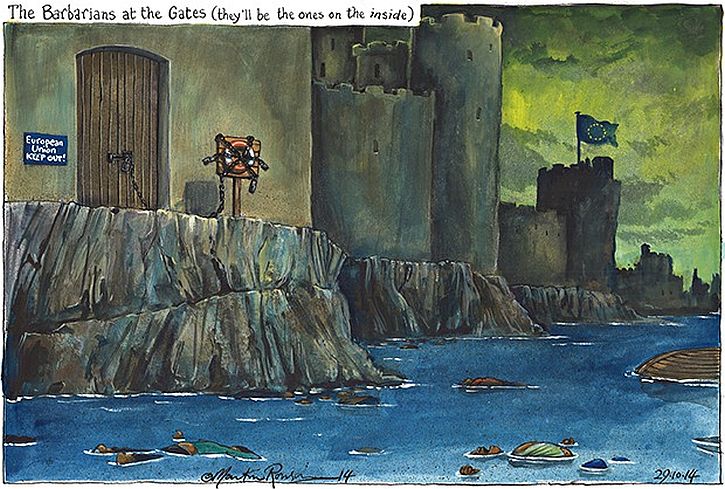
A few days ago I posted a piece about the photo of desperate migrants perched on top of the border fence that surrounds the Spanish enclave of Melilla on the north African coast. Now we learn that the British government has supported, and the EU justice and home affairs council has adopted a policy of leaving migrants to drown.
For the past year the Italian navy, with EU financial and logistical support, has operated a search-and-rescue operation called Mare Nostrum for migrants in danger of drowning in the Mediterranean which has saved the lives of an estimated 150,000 refugees. It is to be replaced with a much more limited EU ‘border protection’ operation codenamed Triton which will not conduct search-and-rescue missions. The justification given by both the UK government and the EU for this inhumane decision is that Mare Nostrum exercised a ‘pulling factor’, encouraging economic migrants to set sail for Europe.
In her beautiful blog, Maria Popova describes Reverend Victoria Stafford’s meditation in The Small Work in the Great Work (in the collection The Impossible Will Take a Little While: Perseverance and Hope in Troubled Times) as “gorgeous”. Stafford is “interested in what Seamus Heaney calls the meeting point of hope and history, where what has happened is met by what we make of it. What has happened is met midstream by people who are … spiritual beings and all that implies from creativity, imagination, crazy wisdom, passionate compassion, selfless courage, and radical reverence for life.” Here is how Heaney puts it in The Cure at Troy where hope and history rhyme:
Human beings suffer,
They torture one another,
They get hurt and get hard.
No poem or play or song
Can fully right a wrong
Inflicted and endured.
The innocent in gaols
Beat on their bars together.
A hunger-striker’s father
Stands in the graveyard dumb.
The police widow in veils
Faints at the funeral home.
History says, don’t hope
On this side of the grave.
But then, once in a lifetime
The longed-for tidal wave
Of justice can rise up,
And hope and history rhyme.
So hope for a great sea-change
On the far side of revenge.
Believe that further shore
Is reachable from here.
Believe in miracle
And cures and healing wells.
Popova frames her post with Dorothea Lange’s iconic photograph of Migrant Mother. The woman moved by Lange is possibly a Californian pea picker in the Great Depression. Perhaps Popova has been prompted to turn to this photo by Stafford’s anecdote:
“I have a friend who traffics in words. She is not a minister, but a psychiatrist in the health clinic at a prestigious women’s college. We were sitting once not long after a student she had known and counselled, had committed suicide… My friend, the doctor, the healer, held the loss very closely in those first few days, not unprofessionally, but deeply, fully – as you or I would have, had this been someone in our care.
At one point (with tears streaming down her face), she looked up in defiance (this is the only word for it) and spoke explicitly of her vocation, as if out of the ashes of that day she were renewing a vow or making a new covenant (and I think she was). She spoke explicitly of her vocation, and of yours and mine. She said, “You know I cannot save them. I am not here to save anybody or to save the world. All I can do – what I am called to do – is to plant myself at the gates of Hope. Sometimes they come in; sometimes they walk by. But I stand there every day and I call out till my lungs are sore with calling, and beckon and urge them toward beautiful life and love.”
Michael Sadgrove also claims the “gate” as the standpoint for Christian ministry. Considering Job in his book Wisdom and Ministry, Sadgrove asks about the piety required of those who are called to be friends and comforters to those who have to endure pain, and says that we don’t stand apart from suffering humanity, but face the world as it is. “We must often sit among the ahses where Job is, and must always go outside the gate to the place of the skull, where Jesus is.”
Opening the gate of Hope at the meeting point of hope and history begins with holding a moment (as in Lange’s photo) closely and deeply, and meeting that with all that we are. For me, this is a passionate rendition of all the pastoral cycle seeks to do in theological reflection and pastoral practice. The final word goes to Victoria Stafford: “Whatever our vocation, we stand, beckoning and calling, singing and shouting, planted at the gates of Hope.” There we see the world “as it is and as it could be; the place from which you glimpse not only struggle, but joy in the struggle” Dorothea Lange’s Migrant Mother is in the public domain.
Some people are just good at gathering people together. They call on people and the people come. This seems to be what leaders can do – or, rather, are those people who can gather us together our leaders? People gatherers have an attraction and an authority. Whether we call a meeting or throw a party, we are acting as people with authority, people able to call on others. Most people can grow that authority, usually by the attractive way that they gather people. Conversely, we have all been in gatherings which have been so carelessly organised that we have said “never again”. There’s usually a reason why “nobody came”.
Neighbours Table tells the story of a people gatherer. In an interview with Tammy Helfrich (available as podcast), Sarah Harmeyer talks about her recent life as a “people gatherer”. She adopts a word for the year. Word of the Year 2011 was “community” which brought a vision for inviting 500 people to her table during the year. At the point of the interview, she is nearing 1500 for the 3 year period on a budget of $75 per month. She started with an invitation to a “pot luck” delivered to her neighbours. Her father made a table to seat 20 – 91 came. She suggests that people are waiting to be invited, that whole neighbourhoods are waiting for such catalysts for change, for people to step forward.
Her “manners” can guide us all. “Plan ahead to be present with people”, develop a culture of mutual respect, interest and listening, introduce people to one another by saying what you love about them – all that makes for a good time gathering. So, pause for thought. Why do we call people together? Are they just instruments to our ambition, pawns in our little games? Are we prepared for them? What is our interest in their offering? Do we know them? Do we love them?
There is always a reason why “people come flocking”.
It’s a question that never crossed my mind when I turned up to a fancy dress party in plain clothes. Embarassing. It seems to be a question that never crossed the mind of the guest who was caught out at the wedding (Matthew 22:1-14).
He could have argued back. Jesus had, after all, told people not to worry about what to wear (Matthew 6:31), but there he was just tipping his head towards Eden where the boy and girl were unashamed by being in the all-together (Genesis 2:25). At the other bookend (Revelation 21:2) we are shown what we’ll look like when all-together we are got ready by God. “And I saw the holy city, the new Jerusalem, coming down out of heaven from God, prepared as a bride for her husband.”
There is a dressing down for those who worry about what they wear, and those who aren’t ready in time. Jesus reminds us that God clothes us. The guest who hadn’t dressed properly wasn’t clothed in righteousness.




 Grits and Grains
