The ins and outs of learning

It is important to recognize that mastering any of the disciplines requires effort on both the levels of understanding the principles and following the practices, It is tempting to think that just because one understands certain principles one has “learned” about the discipline. This is the familiar trap of confusing intellectual understanding with learning. Learning always involves new understanding and new behaviours, “thinking” and “doing”. This is the reason for distinguishing principles from practices. Both are vital.

Peter Senge, The Fifth Discipline p 384. This quote from Peter Senge (picked up from Friday mailing) emphasises the ins and outs of learning. We can indeed take in many things in terms of understanding, but there needs to be outcome in terms of disciplined practice, through which we learn more and better.

Big ain’t beautiful

Richard Beck, in Experimental Theology, quotes William James:

“I am against bigness and greatness in all their forms, and with the invisible molecular moral forces that work from individual to individual, stealing in through the crannies of the world like so many soft rootlets, or like the capillary oozing of water, and yet rending the hardest monuments of man’s pride, if you give them time. The bigger the unit you deal with, the hollower, the more brutal, the more mendacious is the life displayed. So I am against all big organizations as such, national ones first and foremost; against all big successes and big results; and in favor of the eternal forces of truth which always work in the individual and immediately unsuccessful way, under-dogs always, till history comes, after they are long dead, and puts them on top.” William James

Richard Beck’s blog is well worth following. He has helpfully organised his blog into series of posts. One of them is A Walk with William JamesRichard regards James as one who anticipated the leading ideas of the emergent church movement as well as the “greatest American psychologist”.

I am increasingly struck by the big significance of the small, and the tiny significance of the big. The large institutions are increasingly seen as disappointing. It is the tiniest interactions which constitute nature and these are becoming our trusted teachers.  This subversion was already realised in Jesus. His subjects included a mustard seed, a small child, a raven. His relationships were in the margins of the alienating big society.

In chaotic times

TU ES PETRUS!!!

I know that leaders today are faced with enormous challenges, most of them not of their own doing. As times grow more chaotic, as people question the meaning (and meaninglessness) of this life, people are clamouring for their leaders to save and rescue them…. People press their leaders to do anything to end the uncertainty, to make things better, to create stability. Even leaders who would never want to become dictators, those devoted to servant leadership, walk into this trap. They want to help, so they exert more control over the disorder. They try to create safety, to insulate people from the realities of change. They try to give answers to dilemnas that have no answers.

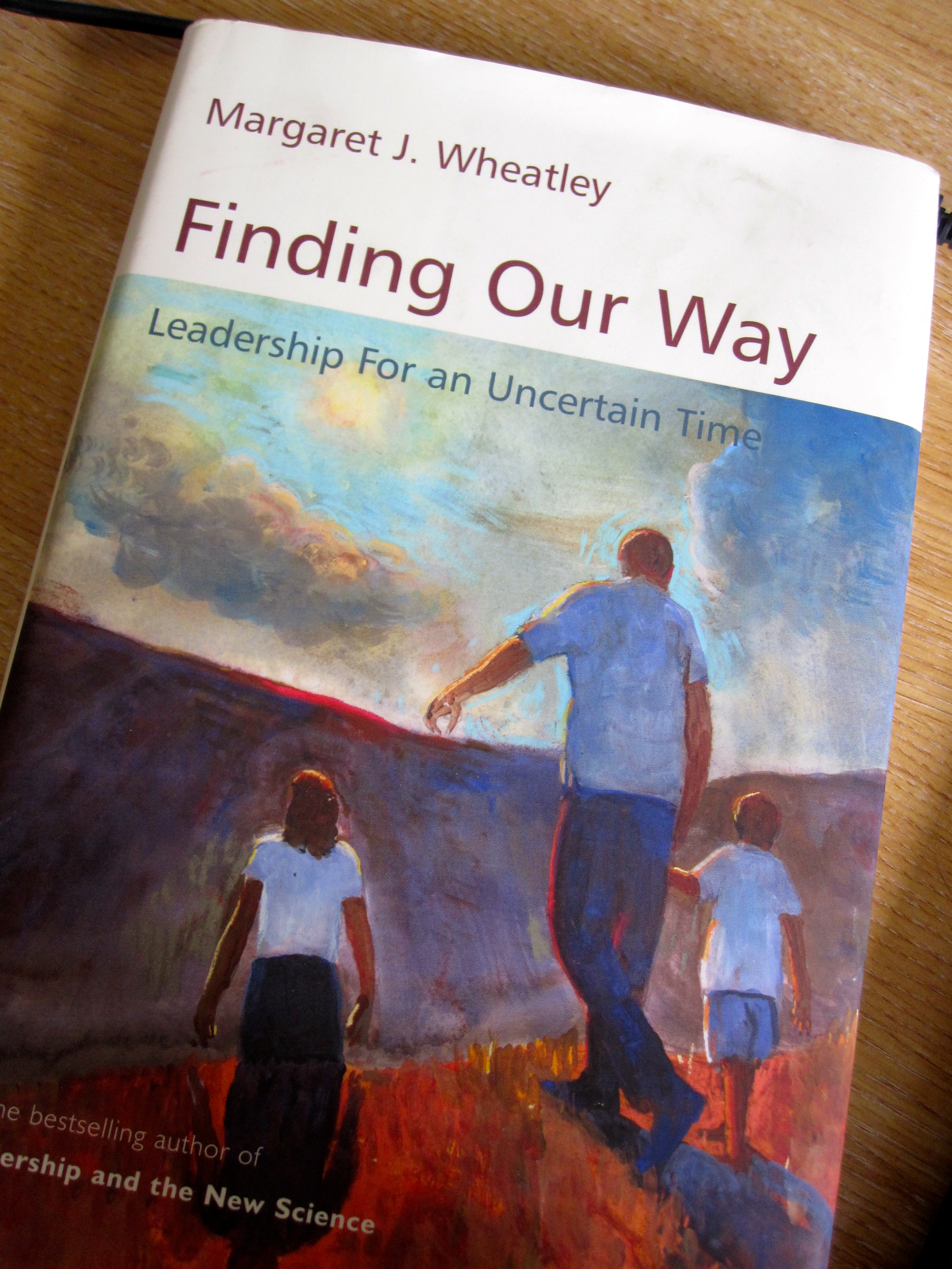
Today is the inauguration of Pope Francis’s papacy. We pray for him. This quote on the temptations and spirituality of leadership in times of chaos (all times) is from Meg Wheatley’s Finding our Way. It struck me as helpful on a day when many will be thinking through issues of leadership.

Frazzled institutions

NetWork

The photograph by Cea is Branching Morphogenesis, a walk-through installation by Jenny Sabin, consisting of 75,000 cable ties resembling neural net of the brain. This is a pattern and organising structure at the heart of our nature – and a far cry from institutional patterns highlighted by the likes of Virginia Woolf in an earlier post.

Diarmuid O’Murchu calls institutions “frazzled” in Adult FaithThe financial crisis of 2008 has reminded us that “banking institutions are more vulnerable than anybody had suspected”. O’Murchu’s observation that “all major institutions are in a state of identity crisis” reflects Dee Hock’s view of “organisations increasingly unable to achieve the purpose for which they were created, yet continuing to expand as they devour scarce resources, demean the human spirit and destroy the environment.” (Birth of the Chaordic Age, p 28). He lists:

  • Schools that can’t teach
  • universities far from universal
  • corporations that can neither cooperate or compete, only consolidate
  • unhealthy health-care systems
  • welfare systems in which no one fares well
  • farming systems that destroy soil and poison food
  • families far from familial
  • police that can’t enforce the law
  • judicial systems without justice
  • governments that can’t govern
  • economies that can’t economise

Hock’s comment on this is that “such universal, ever accelerated institutional failure suggests there is some deep, pervasive question we have not asked.”

One question I often bear in mind in relationships is “how big or small do I now feel?” Our usual answer is “small” in relation to institutional life. There’s not much we feel we can do except for the institution in which we walk tall and big ourselves up in relation to everyone else. We walk away, in increasing numbers, where we can.

For Hock, the problem is our “Industrial Age organisational concept” which is “a wrong concept of organisation and leadership based on a false metaphor with which we must deal. Until our consciousness of the relational aspect of the world and all life therein shall change, the problems that crush the young and make grown people cry will get progressively worse.”

For O’Murchu “all the major institutions we know today evolved as instruments for the implementation of patriarchal power. Many are beaking down and losing credibility, giving way to networks with a greater potential for collaboration and adult empowerment”. For O’Murchu institutions “inherently disempower” however democratic they may try to be. “No matter how democratic a hierarchical system is, it will fail to do justice to the aspirations of the people. People want to participate. They want to be involved; in a word, they want to exercise their adult creativity. And when that goal is jeopardised, it is then we need policing … the prevailing power – culturally, politically, religiously – feeds power. Only in a minimal and superficial way does it empower.”

Competition and control are the assumed guiding principles for institutions and our evolutionary history. But work done by micro-biologist Lynn Margulis suggests a paradigm shift to our thinking and our organisation. Margulis’s theory of symbiogenesis highlights an orientation for cooperation rather than competition.

Human imagination has been “domesticated” by institutions, according to O’Murchu, so that the “human being is seen primarily as a deviant creature whose behaviour has to be tightly controlled. Instead of being perceived as creative adults, whose long evolutionary history verifies … a heavy commitment to conviviality and collaboration, humans have been subjected to highly destructive imperial control.”

O’Murchu suggests that there are other “structural strategies” besides institutions with their “top-down hierarchical line of control, usually with clear distinctions between “us” (at the top) and “them” (at the base)”.

I suppose that our institutional framework has been shaped by the myth of The Fall. But there is a dangerous circularity to that assumption. The argument may be that the Fall accounts for human sinfulness which needs to be controlled (by institutions). But institutions (religious) account for the Fall. One depends on the other as is being increasingly recognised. The emperor/institution really is in the all together.

In some ways the church has been tarred with the same brush and there is decline in confidence and “bums on seats”. But then there is another more hopeful sense in which some Christians are behaving less like institutionalised “bums on seats” who are envisaging alternative structures for the sake of the least, last and lost.

Developing viable alternative structures seems vital (as well as inevitable) in a world in which  institutions have become so devalued. Alternative structures are already emerging in the form of networks but the context for that emergence is still governed by institutions who become ever more fearful and seem ever more remote from a (human) nature that is essentially cooperative, collaborative and convivial.


The Monday morning question

The whole globe is shook up, so what are you going to do when things are falling apart?

You’re either going to become more fundamentalist and try to hold things together, or you’re going to forsake the old ambitions and goals and live life as an experiment, making it up as you go along.

Perma Chödrön as quoted by Meg Wheatley in Finding our Way

Measurement by story

Measurement is part and parcel of the recent Olympic Games. The fastest, highest or most guarantees Gold. But measurement by number isn’t what makes life count.

I am enjoying Organic Community by Joseph Myers. He reminds us of the place of “story”. “Story is the universal measurement of life” and “reducing living organisms to a census count demeans the way we were created.”

Conversations #3

Myers reminds us that “life is not measured by the number of breaths we take, but by the number of moments that take our breath away.” He quotes Peter Block, from The Answer to How is Yes:

The quality of our experience is not measured by the seconds on the clock, but by the timelessness of our experience. We fool ourselves if we ask how long it will take before we know we are, become conscious, identify with our purpose, or remember our own history in  a more forgiving way.

The things that matter to us are measured by depth. Would you assess your humanity by its pace? When I view myself as a time-sensitive product, valued for what I produce, then I have made depth, extended thought, and the inward journey marginal indulgences.

But stories represent a problem for managers. Stories can’t be managed, but numbers can. Myers again: “Churches don’t become legendary in the community grapevine via reporting of numbers. They become legendary through the sharing of their story of mission within the community.”

The photo is from  “camera baba” aka Udit Kulshrastha 

Leaders in the new story

Leaders who live in the new story help us understand ourselves differently by the way they lead. They trust our humanness, they welcome the surprises we bring to them; they are curious about our differences; they delight in our inventiveness; they nurture us; they connect us. They trust that we can create wisely and well, that we seek the best interests of our organisation and our community, that we want to bring more good into the world.

… What we ask of the tellers of the new story is their voice and their courage. We do not need them to create a massive training programme, a global approach, a dramatic style. We only need them to speak to us when we are with them. we need them to break their silence and share their ideas of the world as they have come to know it.

Meg Wheatley in Finding our Way (p.30)

Thank you to friend Helen Scarisbrick for drawing this to my attention.

Lousy leaders

Dan Rockwell has posted a list on what makes lousy leaders.

Lousy leaders:

  1. Need to know more than others.
  2. Can’t explore for fear of being wrong.
  3. Won’t ask obvious questions for fear of looking dumb.
  4. Need their egos stroked.
  5. Wonder who’s out to get them.
  6. Fear high performers; they need the spotlight.
  7. Struggle to collaborate.
  8. Won’t change their minds.
  9. Feel isolated and alone.
  10. Sacrifice long-term success for short-term profits.

Lousy leaders can’t serve others because they serve themselves.

I call them “mis-leading”, and that is the point Vicki Davis makes in her list of 10 terrible traits of lousy leaders.