Liberation comes through community. Everyone who has been oppressed, excluded, impoverished knows that according to poet Danez Smith. Yet so much of our discourse is about the individual. Could it be that those who shape that discourse are those who already have their rewards, already feeling entitled to the cream?
Here’s what Danez Smith has to say in an interview with Kate Kellaway:
You don’t have the luxury of being an individual. To be black, queer or poor – to be an individual has always meant death for us. To be a woman alone is dangerous – we teach our daughters that, we teach black people that. Our liberation comes through community, organising, collectivising. Individuality has meant death. Individuality has meant being marooned. Individuality is a privilege, right? The only people who can think of themselves as separate from the other people who have made their lives possible are straight white dudes
On this beach sound and sand we lay ourselves to rest:
an annual punctuation, a colon and breathing space,
kindling and basking delighted by overlapping waves
of welcome: a silver thread in tiredness’ tapestry.
Tourists and turtles take their turns digging to cool sand
for new generation; young engineers make their marks
and build playful fortifications without calculation,
fear or hope of castles not withstanding nature’s storms.
Backed by wholesome sun I chase my shadow along the shore.
The load lightens. My trace disappears. Crabs sidle home.
A stranger nods a Merhaba in my direction looking out
another place and pace: life less dash or need for colon.
A far cry comes from the harbour, long silted and stranded
in history and imagination. “Phoenicia bound?”,
the ship’s master’s call to those piering their next purpose
and horizon, and those otherwise beached and bedraggled.
Luke, a passenger, packs a gospel for this new ark
with his two by twos, his hims and hers, his young and old,
his Jew and Greek, and Paul, his complementary pair embark,
Turks off Patara beach, where the sun shines after storms.
PS. References: Merhaba is the Turkish greeting “hello”.
Luke and Paul changed ships at Patara.
And so, with the tearful good-byes behind us, we were on our way. We made a straight run to Cos, the next day reached Rhodes, and then Patara. There we found a ship going direct to Phoenicia, got on board, and set sail. Cyprus came into view on our left, but was soon out of sight as we kept on course for Syria, and eventually docked in the port of Tyre. While the cargo was being unloaded, we looked up the local disciples and stayed with them seven days. (Acts 21:1ff)
There’s been so much pain over the last few weeks. I’m conscious of the temptation to steal the victims’ thunder – I wouldn’t want to do that. Stealing their thunder is like making them victims all over again. But all of us are touched by what has happened in London and Manchester (and other trauma beneath the media radar).
This is a poem by American poet Lydia Davis forged by inconsolable grief. It’s a cry for help from heart to head, particularly appropriate for times like these. The amazing resilience of those who lose so much, the bravery of those first responders prepared to run into troubles and the wishes and prayers of those who want to respond show head and heart work well together, but the heart must always call out “MORE”.
The poem, written in 2007, is called Head, Heart.
Heart weeps.
Head tries to help heart.
Head tells heart how it is, again.
You will lose the ones you love. They will all go. But even the earth will go someday.
Heart feels better, then.
But the words of head do not remain long in the ears of the heart.
Heart is so new to this.
I want them back, says heart.
Head is all heart has.
Help, head. Help heart.
PS Here’s a linked post I did in the wake of the Grenfell Tower fire
As we gear up to the General Election (which was never going to be called) we are entering manifesto season. I love the word manifesto, full of show and promise. I start the day with words from the Old Testament: the reading appointed for today has this:
“So now, O Israel, what does the Lord your God require of you? … The Lord set his heart in love on your ancestors alone and chose you, their descendants after them, out of all the peoples …
Circumcise, then, the foreskin of your heart, and do not be stubborn any longer. For the Lord your God is God of gods and Lord of lords, the great God, mighty and awesome, who is not partial and does not take a bribe, who executes justice for the orphan and that widow, and who loves the strangers, providing them with food and clothing. You shall also love the stranger, for you were strangers in the land of Egypt.”
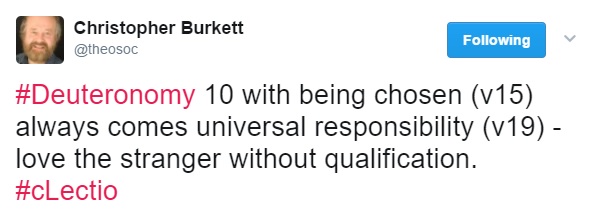
This is God’s manifesto – his show of promise which becomes the praise of his people. It contrasts with the meanness of some of the political manifestos which list what they can get away with, either for themselves or for the people, depending on your political point of view. My colleague, Christopher Burkett is helpful in his tweeted #cLectio reflection on this today:
We are all fearful of strangers. We worry about who will live next to us. Fear has always had the upper hand in our dealings with strangers. It is important for us to hear the voice from heaven commanding us to love strangers (with the unspoken implication, “do not let your hearts be anxious because of them”. Loving strangers, overcomes division, builds friendships and makes a fabric for society – and responds to the needful knocking on the door. There is great wisdom in the reminder that we were all once strangers (and some stranger still!) to one another who now count ourselves friends.
I was grateful to be reminded today of the Russian poet Yevgeny Yevtushenko. Yevtushenko died on April 1st 2017. Jeanette and I saw him perform his poetry in Sheffield’s Crucible Theatre in the 70’s. I well remember the way that he shuffled his feet as he dramatised a journey for one of his poems. Father Richard in one of his tweets, points us to Yevtushenko’s poem (Guardian Poem of the Week) in which he makes the point that “there are no boring people in this world”. In this poem he underlines our differences, that we are distinct from one another as planets are distinct from one another. In my words, “we are worlds apart”. That’s it. We are strangers to one another with very little common ground except that we are all stranger. This poem seems to embrace our stranger status, that though we are worlds apart, we can mean the world to one another. Here’s the poem (beautifully translated by Boris Dralyuk):
There are no boring people in this world.
Each fate is like the history of a planet.
And no two planets are alike at all.
Each is distinct – you simply can’t compare it.
If someone lived without attracting notice
and made a friend of their obscurity –
then their uniqueness was precisely this.
Their very plainness made them interesting.
Each person has a world that’s all their own.
Each of these worlds must have its finest moment
and each must have its hour of bitter torment –
and yet, to us, both hours remain unknown.
When people die, they do not die alone.
They die along with their first kiss, first combat.
They take away their first day in the snow …
All gone, all gone – there’s just no way to stop it.
There may be much that’s fated to remain,
but something – something leaves us all the same.
The rules are cruel, the game nightmarish –
it isn’t people but whole worlds that perish.
There are worlds of difference, but whole worlds to explore. But we’re not called to love strangers for our own self interest but for theirs. I hope that becomes manifest and manifesto.
You can see Yevtushenko performing his poetry here
Father Richard blogs as Education Priest at Quodcumque
The well known “The Kiss” (1907-08) by Gustav Klimt (in a garden, wrapped in gold)
I don’t count myself a “biblical scholar”. When I come to my daily reading from the Old Testament it is often as if I am reading the section for the first time. (Along with others I tend to tweet my naive responses with the #cLectio hashtag, here, here, here, here and here.) My current intrigue is with the Song of Songs, a tiny book of love poetry. And it is as if I am reading it for the first time. I guess it has always been a closed book to me – closed because of its reputation and the manner of its interpretation possibly as a consequence of its reputation. By reputation it is highly erotic and “saucy”. I’d prefer the description “absolutely delightful”. I wonder if a sense of embarrassment has led to its allegorical interpretations shared by synagogue and church which sees the poetry referring to the love of God for his people. Have such interpretations demeaned the text?
Some people will be surprised the Song of Songs is included in our scripture because there is no mention of God and the content is highly erotic. The Song of Songs is the title of the book. It is a superlative title indicating that this Song is very special. Colloquially we could say that this is the “mother and father of all song”. There are two speakers who are lovers. Later readers have named them Solomon (even David) and “the Shulammite” (someone from Jerusalem which translates as “the place of peace”). Allegorical interpreters have called one of the lovers “God” and the other “Israel” or “Church”. Personally I don’t see why we need to rush to their naming and I have preferred to leave them to themselves as two lovers. One of them, the maiden, has her confidantes. They are “daughters of Jerusalem”. They stand by. They have a view but no say. They stay as readers and celebrants. I have chosen to join them.
To me the couple are young lovers and with the Daughters of Jerusalem we are privileged to watch love building through them. My reading may have been influenced by Trevor Dennis (here is reason why we should reading him) who finds reason to call Adam and Eve children in his reading of Genesis. There are so many references to a garden in the Song of Songs that I couldn’t help going back to the Garden of Eden, to the boy and the girl we find in paradise. We have to be sorry the way they turned out (and the way they were turned out). I can’t help wondering whether The Song of Songs is dreaming a happy ending, building in love rather than falling in love.
In Imagining GodDennis imagines this “childs’ play”:
One hot afternoon Adam and Eve, unselfconsciously naked, sat on the bank of one of the rivers of Eden, dangling their feet in the water. Eve picked up a flat, round stone, stood up and flicked it in twelve graceful bounces right across to the other side.
‘Who taught you to do that?’ asked Adam.
‘God did.’
Adam turned towards God. ‘Did you really?’
‘Yes.’
‘Could you teach me?’
‘Of course. Watch.’
God stood up, chose a stone carefully, kissed it, curled his finger round it, and, with a movement of his wrist too quick to catch, sent it spinning downstream. It went almost as far as Adam and Eve could see, then swung round in a tight circle and came speeding towards them again, till with one last bounce it skipped back into God’s hand. It had hit the water two hundred times, and had left two hundred circles spreading and entwining themselves upon the surface. From the middle of each circle a fish leaped, somersaulted, and splashed back into the river.
‘Now you try!’ said God. Adam pushed him into the water. God came to the surface a few yards out from the bank. ‘That was level ten, by the way,’ he called. ‘Eve’s only at level two at the moment, aren’t you Eve?’ ‘You were showing off, God,’ said Eve. ‘You’ll be walking on the water next!’ ‘That’s level twenty,’ laughed God, and promptly disappeared beneath the surface.
So it was once in Eden. So it can be still. So it is, on rare and precious occasions. But Adam and Eve complicated matters. They grew up to think flicking stones child’s play. They turned in upon themselves, and God remained out of sight, beneath the surface. They did not sit with him on the bank any more. Now and then, realizing their loneliness and overcome with sudden longing, they would gaze out across the water and see the ripples he left behind. But these were soon gone, and the water would resume its customary smoothness, as if nothing had happened, as if he had never been there.
There are so many beautiful images in this Love Song of Love Songs. It is spring time, a time for building love’s nest. The references to spring signify love that is young, lovers for whom relationship is a novel and delicious mystery.
My beloved speaks and says to me:
“Arise, my love, my fair one,
and come away;
for now the winter is past,
the rain is over and gone.
The flowers appear on the earth;
the time of singing has come,
and the voice of the turtle-dove is heard in the land.
The fig tree puts forth its figs,
and the vines are in blossom;
they give fragrance.
Arise, my love, my fair one,
and come away.” Song of Songs 2:10-13
The song is soaked in pleasant images, images that are so sensual. They are images of body and bed, field and garden. The whole of creation seems to behind their love and a rich harvest is the outcome of their love. With the Daughters of Jerusalem and with the young lovers, we are allowed into a special world. For me, this is a creation story: the mother and father of so many love songs.
(And, of course, it reminded me of another garden, the strange meeting of two people there and the love that never goes cold between them.)
Mary stood weeping outside the tomb … As she wept, she bent over to look into the tomb; and she saw two angels in white, sitting where the body of Jesus had been lying, one at the head and the other at the feet. They said to her, “Woman, why are you weeping?” She said to them, “They have taken away my Lord, and I do not know where they have laid him.” When she had said this, she turned round and saw Jesus standing there, but she did not know that it was Jesus. Jesus said to her, “Woman, why are you weeping? For whom are you looking?” Supposing him to be the gardener, she said to him, “Sir, if you have carried him away, tell me where you have laid him, and I will take him away.” Jesus said to her, “Mary!” She turned and said to him in Hebrew “Rabbouni!” (which means Teacher). John 20:11-16
Love has created a world of its own – always has done, always will.
I have been thinking increasingly that the Psalter has fallen into the wrong hands – into my hands, and that, in my hands, those who Frantz Fanon referred to as The Wretched of the Earthhave been betrayed
The psalmists (I’m assuming many, or at least several) describe the wretchedness of their lives. Take the psalm appointed for today (March 31st), Psalm 102 as an example. The psalmist talks about her/his crying and distress. S/he isn’t just downhearted, but is smitten-down-hearted. Her enemies rage at her all day and every day and have ganged up on her to bully her. S/he is alone, hungry and thirsty. This is how s/he pours out the wretchedness of her situation:
1 Hear my prayer, O Lord; let my cry come to you. 2 Do not hide your face from me on the day of my distress. Incline your ear to me; answer me speedily on the day when I call.
3 For my days pass away like smoke, and my bones burn like a furnace. 4 My heart is stricken and withered like grass; I am too wasted to eat my bread. 5 Because of my loud groaning my bones cling to my skin. 6 I am like an owl of the wilderness, like a little owl of the waste places. 7 I lie awake; I am like a lonely bird on the housetop. 8 All day long my enemies taunt me; those who deride me use my name for a curse. 9 For I eat ashes like bread, and mingle tears with my drink, 10 because of your indignation and anger; for you have lifted me up and thrown me aside. 11 My days are like an evening shadow; I wither away like grass.
But this isn’t self-pity: the psalmist is just telling it like it is. There is no room for self-pity because the psalmist knows God and his history. He knows that he turns to the prayer of the destitute, that he hears the sighs of the prisoner. This is an uprising of prayer and outpouring of trust that her enemies will be short-lived while “the children of your servants shall continue, and their descendants shall be established in your sight”.
This is a prayer of the down-hearted and an act of defiance in the face of her enemies. It is but one page of a prayer book that comes from the hands of those who have fallen on hard times and belongs in their hands. I am sorry to have snatched it from them. I hope I don’t take their words from them, and that I might hear their lament and join their Amen.
This is how this prayer (Psalm 102) turns out, from hard pressed people to their God:
12 But you, O Lord, are enthroned for ever;
your name endures to all generations. 13 You will rise up and have compassion on Zion, for it is time to favour it; the appointed time has come. 14 For your servants hold its stones dear, and have pity on its dust. 15 The nations will fear the name of the Lord, and all the kings of the earth your glory. 16 For the Lord will build up Zion; he will appear in his glory. 17 He will regard the prayer of the destitute, and will not despise their prayer.
18 Let this be recorded for a generation to come, so that a people yet unborn may praise the Lord: 19 that he looked down from his holy height, from heaven the Lord looked at the earth, 20 to hear the groans of the prisoners, to set free those who were doomed to die; 21 so that the name of the Lord may be declared in Zion, and his praise in Jerusalem, 22 when peoples gather together, and kingdoms, to worship the Lord.
23 He has broken my strength in mid-course; he has shortened my days. 24 ‘O my God,’ I say, ‘do not take me away at the mid-point of my life, you whose years endure throughout all generations.’
25 Long ago you laid the foundation of the earth, and the heavens are the work of your hands. 26 They will perish, but you endure; they will all wear out like a garment. You change them like clothing, and they pass away; 27 but you are the same, and your years have no end. 28 The children of your servants shall live secure; their offspring shall be established in your presence
The image is from The Book of Martyrs, John Foxe, 1516-1587, Goodrich, Charles, 1790-1862.
This being human is a guest house.
Every morning a new arrival.
A joy, a depression, a meanness,
some momentary awareness comes
as an unexpected visitor.
Welcome and entertain them all!
Even if they’re a crowd of sorrows
who violently sweep your house
empty of its furniture,
still treat each guest honourably.
He may be clearing you out
for some new delight.
The dark thought, the shame, the malice,
meet them at the door laughing,
and invite them in.
Be grateful for whoever comes,
because each has been sent
as a guide from beyond.
I am grateful to Ivonprefontaine for reminding me about Rumi’s wonderful poem, The Guest House. It seems perfect for Lent in that it explores an important dimension of hospitality in a way that reminds me of Jesus’s temptations in the wilderness.
Rumi was a 13th century Persian poet. He was a Sunni Muslim, theologian and Sufi mystic. He was the “father” of the Whirling Dervishes (founded by his son, Sultan Walad).
The image of the poem is freely available through Pixabay
The Poor Man who Saved the City by Evelyn de Morgan (1901)
Like Qoheleth I am rather taken by the poor man in the city. It was a small city with only a few inhabitants. It was besieged but there was one man, a poor and wise man, who, by his wisdom delivered the city.
Not a lot of people know this man. He’s not someone I’ve ever noticed before, but he is there, highlighted in one of the less read books of the Old Testament, Ecclesiastes 9:14f. He doesn’t have a name. His story is told in not so many words:
There was a little city with few people in it. A great king came against it and besieged it, building great siegeworks against it. Now there was found in it a poor, wise man, and he by his wisdom delivered the city.
Like Qoheleth (the Teacher), I want to honour this man and the poor, wise men and women like him, who save their cities (our cities) from destruction by greed, speed and countless other destabilising and dehumanising forces. They are the salt of the earth, far removed from what we refer to as the typical “city gent”. We know he is not well-heeled and we know that he is care-worn (because his wisdom is forged from the attention and care he gives – and that is demanded of him in the challenge of just managing). These are the people we can turn to in times of trouble. They will hear us out, they will offer their wisdom. They become the heart (anagram of earth) of our communities and the springboards to trust and confidence.
But they are so often overlooked. This man reminds me of R.S.Thomas’s “friend”, Iago Prytherch – another man who would have gone unnoticed were it not for Thomas drawing him to our attention. Prytherch is down to earth, hard-working, more peasant than citizen, with an earthly wisdom. Thomas writes in Green Categories:
You never heard of Kant, did you Prytherch?
A strange man! What would he have said
Of your life here, free from the remote
War of antinomies: free also
From mind’s uncertainty faced with a world
Of its own making?
Here all is sure:
Things exist rooted in the flesh,
Stone, tree and flower. Even while you sleep
In your low room, the dark moor exerts
Its pressures on the timbers. Space and time
Are not the mathematics that your will
Imposes, but a green calendar
Your hearts observes; how else could you
Find your way home or know when to die
With the slow patience of the men who raised
This landmark in the moor’s deep tides?
His logic would have failed; your mind too.
Exposed suddenly to the cold wind
Of genius, faltered. Yet at night together
In your small garden, fenced from the wild moor’s
Constant aggression, you could have been at one
Sharing your faith over a star’s blue fire.
I don’t want to say that this man is Christ (because that might prevent us celebrating the ordinary people in ordinary places using their hard won wisdom for the welfare of the city), but I do want to say that man is Christ-like, and that Jesus too was poor and saves the city.
These are the people who are blessed. That is not an idle saying of Jesus (Luke 6:20). The blessing has substance and content, including wisdom that bears so much fruit. These are the people we hear praying in the Psalms. I think Isaiah is talking of a similar poor man in the city when he writes:
He will not cry or lift up his voice,
or make it heard in the street;
a bruised reed he will not break,
and a dimly burning wick he will not quench;
he will faithfully bring forth justice. (Isaiah 42:2f)
I want to remember that poor man and those men and women like him. Qoheleth writes, “No one remembered that poor man … the poor man’s wisdom is despised, and his words are not heeded.” He continues,
The quiet words of the wise are more to be heeded
than the shouting of a ruler among fools (Ecclesiastes 9:17)
But that is the world’s way – to be taken in by the vanities of the rich and powerful. We remember them (we name estates and prizes after them) and forget the poor (and the wisdom of their deep knowledge) – that’s if we ever notice them in the first place.


 I was grateful to be reminded today of the Russian poet
  There are worlds of difference, but whole worlds to explore. But we’re not called to love strangers for our own self interest but for theirs. I hope that becomes manifest and manifesto.
 I have been thinking increasingly that the Psalter has fallen into the wrong hands – into my hands, and that, in my hands, those who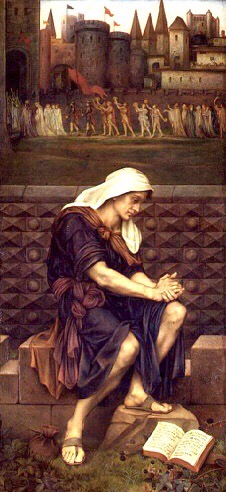
 Grits and Grains