A sermon for Easter 4A at St Alban’s Church, Offerton.
We were lucky enough to be able to go to the Yorkshire Sculpture Park in Barnsley last weekend.
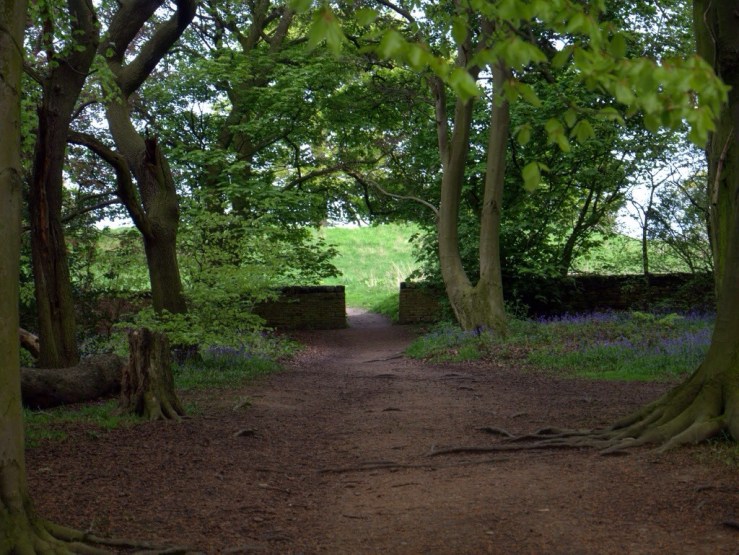
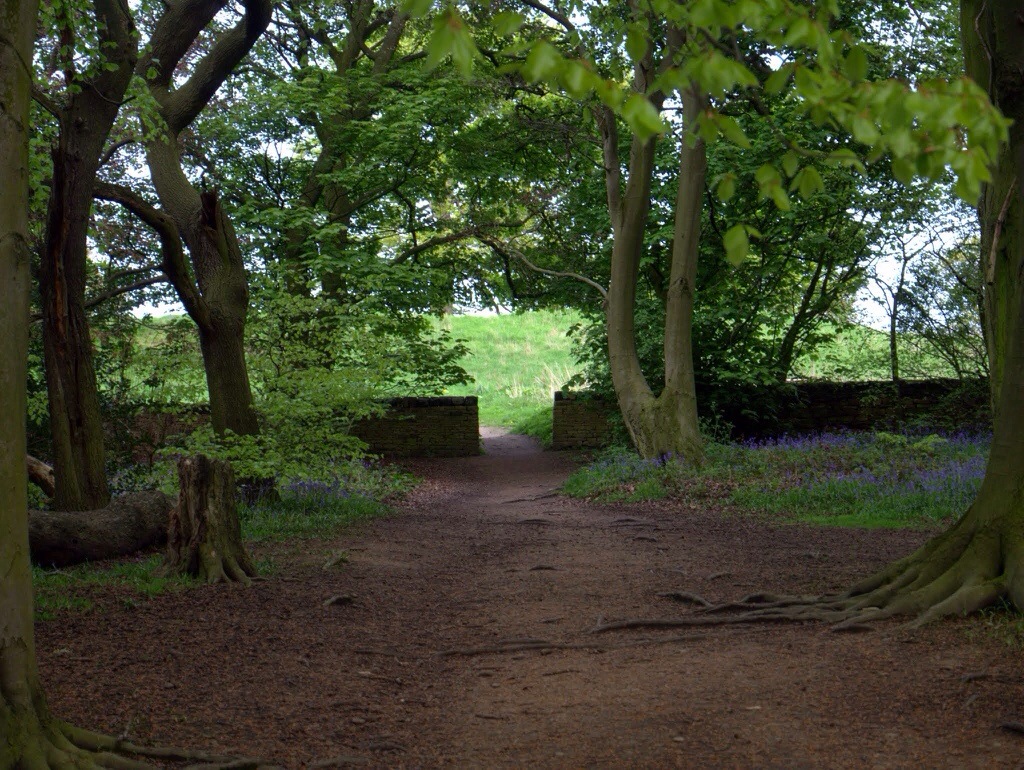
This is one of the photos I took. It does reflect the beauty of the landscape, at bluebell time. I thought it would help us to think about today’s gospel which is about openings and doorways.
There were a lot of sheep and lambs around at the Sculpture Park – in the pasture outside this walled and sheltered area. There is a gateway here for the sheep to find shelter if they need it – and I can think of many cold Yorkshire days when they would need the shelter of that stone wall.
Jesus talks about this gateway in our gospel reading (John 10:1-10). He talks about the sheep being sheltered, and the sheep finding pasture – the gateway is for their comings and goings, for their to-ing and fro-ing.
But it’s not quite an open gateway. An open gateway would be dangerous. There is a gate. Jesus says “I am the gate”, “I am the door”. Perhaps you can picture Jesus in that gateway in the photo. For me, I see him sat on the ground, sideways on, with his back to the gatepost, one leg bent up and one leg stretched along the ground, looking out for danger and looking in with care.
Today is known as Good Shepherd Sunday. This image of Jesus which John has given us in his gospel is what we celebrate and love as the Good Shepherd.
It is an image that captures our imagination. For example, there is a Hospice in Chester called The Hospice of the Good Shepherd – a name which may have appealed to its founders because of their faith that Jesus guards the door in and out of life, and the promise that if we go through Jesus Christ, our Lord we enter into life that is fulfilling, complete and in which we want for nothing.
And that is how we say our prayers isn’t it? Our prayer to God is “through Jesus Christ, our Lord” …..
Jesus is the door, the gate. He is the way, the truth and the life…….. If we let him.
This next image is of the famous painting by Holman Hunt called the Light of the World. The painting is in the Manchester Art Gallery.
This is a painting about another door – the door is the door to our lives, the door to our soul. It is a long time since that door has been opened. Look at all the weeds that have grown round the door.
The painting is a reminder of what Jesus said. “Behold I stand at the door and knock. If you hear me call and open the door, I’ll come right in and sit down to supper with you.”
He knocks and waits. The door has no handle on the outside. There is no way in for the light of the world until the door is opened from the inside.
Are we going to open up?
We have been talked into a fearful way of life in which we lock our homes away from others.
It is a long time since we dared to leave our back door open. We’ve put some extra bolts on as well – and alarms. And there’s a code for getting in, and a code for getting out. We triple lock things.
But do we lock ourselves away as well?
Are we too busy to respond to our neighbours when they are in trouble? Sometimes we’d rather not know. We don’t want strangers knocking on the door. We don’t want people selling us things. We don’t want political canvassers – and we don’t want religious callers. No thank you. That door is going to stay closed, and if we hear anyone knocking we are going to pretend that we’re not in.
Jesus stands at the door and knocks.
Where there was once openings there is now just brick walls, dead ends, no go areas.
But that has always been the case, back to the day when Adam hid himself in the garden, back to the day of resurrection when the disciples locked themselves in because they were afraid of who might come looking for them. Jesus stood at those doors and knocked, though that time couldn’t wait for them to open up for him.
Where there was once openings there is now just brick walls, dead ends, no go areas. And that has always been the case.
But where there was just dead ends, brick walls and no chance, there is every chance, possibility and new openings. And that has always been the case as well.
Fists that are clenched are being opened. Minds that are closed are being opened. Hearts that have hardened are being softened. And it is happening all the time. We are amazed when we see it happening, aren’t we?
Yesterday, I was just pulling out from a parking space in Ellesmere Port when someone cut in to the space in front of me. I thought he’d come in tight – and then drove off. Then I saw the driver of the car run to the corner where I was turning, signalling me to pull over. He told me that he had damaged my car. He needn’t have gone to that trouble. He used that moment well. I told him that I appreciated what he had done.
These are the moments to write home about. These are the openings that we have in our lives. These are moments of grace and opportunity.
I was amazed.
Similar amazement is written all over our first reading (Acts 2:42-47) because of the devotion and fellowship of those who followed the apostles teaching. All that they managed to do, the way they shared everything, their generosity of heart amazed everyone. They had the goodwill of all the people.
There may well have been a lot of comings and goings in our lives, and it is understandable that many people become less trusting, even bitter ……. as a result.
But, it doesn’t have to be like that. There is a way out. That way out is offered by Jesus as the door, as the Good Shepherd.
Jan Richardson offers a way of blessing for this day. She says:
Press your hand to your heart.
Rest it over that place in your chest that has grown closed and tight, where the rust, with its talent for making decay look artful, has bitten into what you once held dear.
Breathe deep. Press on the knot and feel how it begins to give way, turning upon the hinge of your heart.
Notice how it opens wide and wider still as you exhale, spilling you out into a realm where you never dreamed to go, but cannot now imagine living this life without.
Why be our own doorkeepers and safekeepers when Jesus Christ offers himself as our gateway? As the Psalmist says, “The Lord will watch over your going out and your coming in, from this time on and for evermore.” (Psalm 121:8)
Through Jesus Christ we have amazing grace. Through Jesus Christ we have new openings, all the time and any time.





 Posted with Blogsy
 Grits and Grains