When the song of the angels is stilled

This poem has a lot to say as we get back to work after Christmas, and as we put the decorations away at 12th Night.

David Herbert's avatarGrits and Grains

“When the song of the angels is stilled,
When the star in the sky is gone,
When the kings and princes are home,
When the shepherds are back with their flock,
The work of Christmas begins:
To find the lost,
To heal the broken,
To feed the hungry,
To release the prisoner,
To rebuild the nations,
To bring peace among people,
To make music in the heart.”

Howard Thurman

View original post

My name is ….. A reflection for the New Year

Just when I’ve tidied my desk (my concession to the New Year) I’m shown Paul Smith’s desk in an exhibition at the Design Museum in London called My name is Paul Smith. I’m happy that my desk is now tidier than Paul’s.

Paul Smith makes the point that his desk represents his mind. (And my empty desk?). Paul is surrounded by colour, fabrics, toys and many things. They are resources that stir his imagination. They are his findings from his searches and research. This resourcefulness has been immensely productive, as demonstrated in the exhibition.

Paul pays tribute to his wife, Pauline, for the way that she taught him to notice things. Noticing things doesn’t come naturally. It needs practice. So, a New year resolution: notice more. I may have a clear desk, but I do have a mind in which I can store a host of findings. I’ll have to do a lot more research (aka asking questions) to increase that store. And then there’s the question of what I do with those findings. They may not be as colourful or iconic as …..

Nicodemus

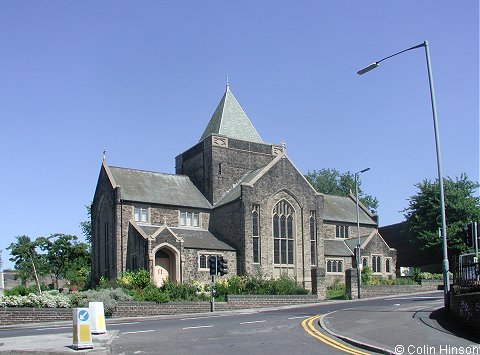
St Michael and All Angels - West Kirby
St Michael’s, West Kirby by Arthur John Picton

Fun at West Kirby with Nicodemus as the focus for the gospel reading – he comes to Jesus by night (John 3:1-17). Is that to hide himself? Does it describe his “unknowing” – which Jesus exposes? Does it describe his anxiety?

Does John attach any significance to his name – which means “victory of the people” (as does “Nicholas/Nichola”) with the passage ending with the words about Jesus’s coming not being to condemn the world, but to save it – the victory of the people?

Nicodemus is a shadowy figure this early in John’s gospel. He crops up again – John 7:45-51. Here he defends Jesus while still being very much part of the ruling council. He stands on his own when he says: “Our law does not judge people without first giving them a hearing to find out what they are doing, does it?” To which his fellow councillors react, replying: “Surely you are not also from Galilee, are you?”

By the time Nicodemus makes his third appearance – John 19:38-42 – he is no longer associated with the rulers, but does come with Joseph of Arimathea (who is a secret disciple because of his fear) to take Jesus’s dead body to prepare it for burial.

I’d say that that was quite a journey John describes of the prestigious Nicodemus – from meeting Jesus in darkness, to being in two minds while keeping his old party membership – to his new identity of being with Jesus in his death and resurrection.

The Myrrhbearers from Fr Stephen’s blog

Nicodemus is one of the myrrhbearers celebrated in the Sunday of the Myrrhbearers in the Orthodox tradition on the 3rd Sunday of Easter. He and Joseph wrapped Jesus’ body with myrrh before burial. The other myrrhbearers – Mary Magdalene, Mary (wife of Cleopas), Joanna, Salome and Susanna – all brought myrrh to anoint Jesus’s body after his burial.

A story that begins in night and ends with the new morning of resurrection is a telling way of explaining the possibility of being born again. It’s a telling story for Lent – for Lent comes from the old English for “lengthening days”. One day,  “there will be no more night” (Revelation 22:5), but in the mean time we live in the restlessness, anxiety, secrecy of the night – for some a time of great fear and violence – as we see in this clip from Libya.

St Aidan’s Day

Today is the feast day of St Aidan. Aidan has a special place in my heart because I have such fond memories of my time as a curate at St Aidan’s Church – part of Sheffield Manor Parish. I remember my first Sunday there. It wasn’t in church, but on a sponsored walk with members of the local probation hostel. Forty years on I remember the wonderful people I met on Norfolk Park, Claywood flats, Skye Edge, City Road, Manor and Manor Park.
Aidan was an Irish monk at a monatery in Iona. King Oswald was committed to restoring Christianity to the region. Oswald first sent a bishop named Corman for this task. He failed to make any headway, saying that Northumbrians were too stubborn to be converted. Aidan was then sent. Apparently he criticised the methods used by Corman. I wonder what Corman did wrong. We get a clue from the way the Aidan is reported to have gone about his task. Aidan did it slowly. He walked. He spoke politely to the people he met. One legend reports that the king gave Aidan a horse so that he wouldn’t have to walk. This undermined Aidan’s methods and he gave the horse to a beggar. Without the horse, Aidan could talk to people on their own level, and walk at their own pace. So, he slowly brought Christianity to the Northumbrian communities.

Lessons for us?

  • Some methods of evangelism don’t work – and they never have.
  • Level with people
  • Slow down – be patient – take time

The Collect for St Aidan’s Day emphasises Aidan’s personal qualities:

Everlasting God,
you sent the gentle bishop Aidan
to proclaim the gospel in this land:
grant us to live as he taught
in simplicity, humility and love for the poor;
through Jesus Christ.

And why do I have such fond memories of St Aidan’s Sheffield? That’s because of the patience, humility and love of the person – John Jacob whose responsibility it was to train me as a curate. From that moment I have realised the importance of time. Learning, training and change all take time. They have to be timed well with gentleness, simplicity, humility and love.

I remember so many. They all had a part in my growing up. They include, in no particular order, Tom Collins, Betty and Geoff Frost, Jean Kemp, Eileen and Eva Goring, Margaret and Richard Gabbitas, Margery Allen, Eileen Pickering, Sidney Dyson, Stan Simpson, Richard Sissons, Ernest and Jean Clayton, Jean and Joanne Sainz, Doris Pennington, Janet Cobb, Harry Cox, John and Jean Jameson, Kev Windle, Andy Marshall, Mark Franey, Jeanette Ashton, Jane Mercer, Hilda Horton, George Gunson, Nora Coward, the Sambrook sisters (Ebb and Flo), Anne Asher, Betty Super, Dennis Garlick, Fred Kelk, Mark Mohammed, Barry Allen, Walter Green, Rosie Green. There were my colleagues. Besides John there was Ian Cameron, Jim Moore (who showed me such kindness), Joe Lister, Ray Draper and John Wood. There are many others whose names I can’t remember but whose lives I do. They will never have known the effect they had on me – together and as individuals.

Little David

> Thinking about David …. God seems to overlook qualifications and eligibility. Today’s psalm (89) refers to how David was chosen to be king of Israel. “I have set a youth above the mighty; I have raised a young man over the people.” God’s man, Samuel was sent to Jesse’s family to anoint the one indicated. The first in line was bruought in – and Samuel gets told “Do not consider his appearance or his height, for I have rejected him. The Lord does not look at the things people look at.” (1 Sam 16). Seven of Jesse’s sons were introduced to Samuel, but it was the last and youngest in the presentation line who was the one Samuel anointed. This seems to be the way with God. He prefers the small, the last and the least. He overlooks qualifications and eligibility. Centuries later Paul rejoices in his weaknesses because he hears God: “My grace is sufficient for you, for my power is made perfect in weakness.” (2 Cor 12:9)

There were not many people who put money on David beating Goliath – boy against giant. But there are a lot of people who have been made to look small by the world who believe that their victory is assured because their God is one who overlooks qualifications and eligibility and has a preference for the lost, last and least.

Belbin is better known for his theories about team role preferences. His theories are also applicable in terms of recruitment. He too is prepared to overlook qualifications and eligibility. These things look backwards and eligibility does not equate to suitability. Looking at suitability is forward looking to what a person can become.

So those are eligible and suitable are an ideal fit but may be short stayers.
Those who are eligible but unsuitable are a poor fit and problems occur.
Those who are barely eligible and unsuitable are total misfits and become leavers.
Those who are barely eligible but suitable are a surprise fit and become long stayers.

Now, I only have limited experience of recruitment but I can safely say that both David and Paul come into the category of “barely eligible but suitable” – with the right sort of help. And that’s how Goliath got his comeuppance.

Quentin Crisp

>

I didn’t know till tonight that Sting’s Englishman in New York was a celebration of Quentin Crisp. Englishman in New York was the title of tonight’s moving ITV sequel to The Naked Civil Servant about Quentin Crisp’s life in New York. Crisp, played again by John Hurt, comes across as a man of great integrity. As a homosexual “who wore make up in London in the 30’s” he was always an outsider – and despised. His commitment to “being himself”, together with his wit, made him a celebrity figure in New York where he was in great demand as a public speaker.

In a question and answer session at his swansong at a gay club in Tampa, Florida, he comes up with a real pearl of wisdom:

Neither look forward where there is doubt, nor backward where there is regret. Look inward and ask yourself not if there is anything out in the world that you want and had better grab quickly before nightfall, but whether there is anything inside you that you have not yet unpacked.

The quote was prefaced with remarks about the privilege of being the scorned outsider – not as something to be avoided but as something to be embraced. As a privileged insider I wonder how wise his advice is:

In an expanding universe, time is on the side of the outcast. Those who once inhabited the suburbs of human contempt find that without changing their address they eventually live in the metropolis.

I am sure that the wisdom of wise outsiders like Quentin Crisp have helped many people on the outside to “be themselves” instead of selling themselves short.

As Sting writes:

It takes a man to suffer ignorance and smile,
Be yourself no matter what they say.

The Winton Train


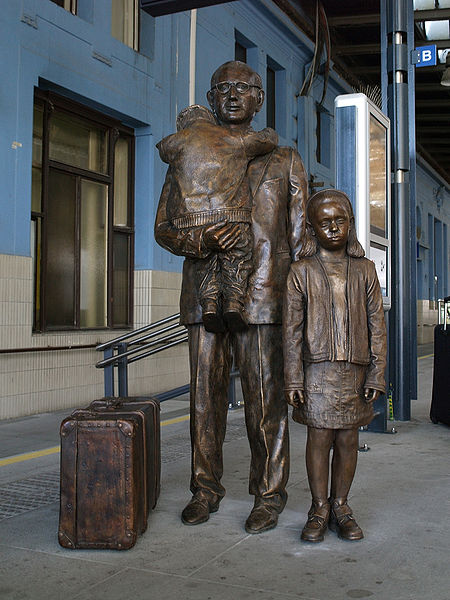
Wow. The Winton Train arrives at Liverpool Street Station today – with passengers rescued from Prague 70 years ago – the train will be met by the person who masterminded the rescue – Nicholas Winton (pictured). Nicholas Winton is 100 years old.


Altogether he managed to rescue 669 children transporting them by train from Prague to Lon don. Most of them were Jewish children who otherwise would have become victims of the holocaust. They have become known as the Winton Children – and that family of 669 has now become a family of 5000. This was part of the Kindertransport rescue mission which began a few days after Kristallnacht (1938) when some British Jewish leaders petitioned the Prime Minister, Neville Chamberlain, to accept unaccompanied Jewish children from Europe to protect them from Nazism. Six million Jews were killed in the holocaust. A quarter of them were children.

Dagmar Simova is one of the Winton Children on the train. Her response to the question of what it felt like to be once again being on a train from Prague is on the Winton Train Project’s blog: “My mother, father and grandfather came to the station with me. We all wept. This time my husband and daughter came to see me off. When we waved, suddenly it struck me. I was looking at them, but again I saw those three.”

Nicholas Winton never mentioned anything about this. It only became known 50 years later when his wife, Elizabeth, came across some papers when she was cleaning out their attic.

People like Nicholas Winton are honoured in a memorial park in Prague called the Orchard of Saviours. It celebrates all who helped Jewish children at great cost to themselves. Four types of apple trees have been planted and the refurbished fountain has been named after Sir Nicholas Winton.

The Winton Train Project hopes to despatch another Winton Train with young people and their artworks inspired by goodness bound for other European cities, and that it become a tradition to commemorate the resilient determination of people to believe in goodness and actively take part in a common future.

God of many breasts

> 
In the news last week was a man who has fathered a child aged 75 and a woman who has given birth – aged 70 (that’s the Mum, not Benjamin Button). Her name is
Raji Deva Lohan – and it’s her first child!But that’s nothing compared to the story from Genesis 17 in our worship this week. Abram was 99. His wife Sarai was regarded (and ?despised) as barren, and they suddenly expect their first child. Not just one – but millions of them! It changes their whole life and identity. Abram becomes Abraham (meaning father of many nations) and Sarai becomes Sarah (meaning “princess” – better than being despised any day!) Together they become known as the father and mother of nations which include Jews, Christians and Muslims (see, we really are brothers and sisters).

Kate Huey’s posts are always worth a read. This week she puts together the opinion of experts who reckon that the Abraham and Sarah stories were written at the time of the Exile in the 6th century BC – when the deported Jews sat down “by the rivers of Babylon and wept when they remembered Zion”. They were so desparate they couldn’t even bring themselves to sing the songs of their homeland. They were powerless. This powerlessness is the backdrop to the Genesis story in which the reader is asked to look back and is given a future tense for their lives – hope and direction.

Reading betwen the lines – OK they were all powerless. So was Abram and Sarai. Try as they might they couldn’t have a baby. Yet at 99 – why 99? – presumably to emphasise just how old and knackered they were – they get their baby/babies. Trust God to do the business – and that gave them their future (and us ours).

Kate Huey refers to the name of God in the story – El-Shaddai. Usually translated as “God Almighty” – in other words “all-conquering” there is an alternative which is God of the mountains – and yet again (according to Valerie Bridgeman Davis) “God of many breasts”. Now even if that is not a correct translation it really is worth playing around with because it contrasts the fertility and generosity of God with the barrenness and powerlessness of human nature for Abram, Sarai, the exiled and all those who can’t feel “at home” in their world.

Barbara Brown Taylor’s sermon on this text, “The Late Bloomer,” makes Abraham and Sarah feel like people we know, who find it hard to believe in the promise or the future. “To live by it, day after day, to see it in the night sky and hear it in your name and see it again in your lover’s eyes. It is a hard thing, to believe in a promise with no power to make it come true. Everything is in the future tense. And yet. What better way to live than in the grip of a promise, and a divine one at that?”

Barbara Brown Taylor reflects that living in the meantime calls us “to live reverently, deliberately, and fully awake: that is what it means to live in the promise, where the wait itself is as rich as its end. All it takes are some regular reminders, because as long as the promise is renewed, the promise is alive, as vivid as a rainbow, as real as the million stars overhead” (“The Late Bloomer,”in Gospel Medicine).