Ox-faced Luke: a poem for St Luke’s Day

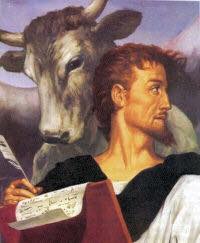
44231259_10217343419320451_8457308505865453568_nOx-faced Luke,
his gospel yoked
to that load bearing
beast of burden
ploughing on
through life’s muddied field

Ox-bowed Luke,
his gospel bulging
muscle of sacrifice
for the lost, the poor
and stranger still
their inheritance of earth


Luke, author of the third gospel, is often symbolised by a winged ox, one of the “four living creatures” of Ezekiel 1 (and Revelation 4). The ox represents domesticated animals. Symbols for the other evangelists are: (m)an(gel) for Matthew, lion for Mark and eagle for John.


I need to go to Specksavers

My poetweet this morning responds to a reading of Genesis 3

It’s also the serpent
that opens the eyes of the blind.
And when they saw they sewed,
dressing their nakedness,
hiding their very selves
behind blinds of honesty
from one another,
from God, forever,
till another one with love
opens the eyes of the blind.

Since the dawn of time we have been wanting to help one another to see. “Now, can you see?”, we ask. “Why can’t you see?”, we accuse. I am really grateful for those who have opened my own eyes, for those who have coloured my life with love, those who have helped me to be more open and more confident. I am not so grateful for those who have been more serpentine, those who have insinuated shame into my life.

How can I help others to see? What if I am not careful in the way that I am? What if all I did was bring shame and destroy self-confidence? What if I am serpent like in my feedback and suggestion? What if all I achieved was to force people back into their shell? What if I poisoned their view of the world and themselves?

The serpent said to the woman, ‘You will not die; for God knows that when you eat of it your eyes will be opened, and you will be like God, knowing good and evil.’ So when the woman saw [through the eyes of the serpent] that the tree was good for food, and that it was a delight for the eyes, and that the tree was to be desired to make one wise, she took of its fruit and ate. Genesis 3

How can I help others to see unless someone with love opens my eyes? Until then, I am a blind guide, even blind to the damage I do to the eyes of others.

Will we put our hands together to pray?

3455167464_f04814b6a6_b

Every morning I, David, pray with Jews,
my brothers, my sisters. Their scripture
fallen into my hands, fills my mind,
names me. I take their prayers,
the longing of their psalms,
I hear their pain, share their dreams,
my amen I join to theirs.

And I regret every morning
I can’t pray with more distant relatives,
my brothers, my sisters, children of Hagar.
A step too far. What are their longings,
what are their dreams?
I pray, that as I pray, they pray,
with me, for me, amen.


The photo is by mrehan, found at https://www.flickr.com/photos/mrehan00/3455167464

First Steps

The path of the righteous is like the light of dawn
which shines brighter and brighter until full day.
Proverbs 4:18

Who knows where first steps lead?
We feel our way through death’s vale,
beyond the pale to dark corners,
blind alleys, a way hardly taken,
through dark nights of the soul.
This is the path of the righteous,
the path of Missio Dei,
the path of light to dawn.

Leadership Styles and a Political Divide

I’ve just been rereading this book. It is so full of wisdom and good sense for leadership.

David Herbert's avatarGrits and Grains

lamdin

Sometimes you hear bells ringing all the while through reading a book. There was so many chimes in Finding Your Leadership Styleby Keith Lamdin – so many “just so” moments”, so many reminders of other reading – and I so agreed with the direction of Keith Lamdin’s travel.

Two women staffing a train tea trolley lead Lamdin’s book. While passengers on a delayed train were getting upset about missing their connections these “trolley assistants read the emotional climate of the passengers on the train and knew that they needed to stay calm”. They led in that moment offering “something different from those more familiar teachings about leadership, vision and motivation”. Their example demands a second look at “leadership” and suggests that leadership is for all types, leadership is not something special and that all of us have natural ability to lead others – though some make better leaders than others. Lamdin writes:

“leadership…

View original post 1,227 more words

Shoulders, Atlas and Earth Day

earth-158678_960_720If you had to choose a poem for Earth Day what would it be? From my limited collection of poetry I have chosen Shoulders by Naomi Shihab Nye. It reminded me of Atlas and his burden – I share the popular misconception that he shoulders the earth (rather than the celestial spheres). Naomi Shihab Nye shoulders hope in her poetry. She says that her poems often begin with the voices of her neighbours, “always inventive and surprising”.

Shoulders

A man crosses the street in rain,
stepping gently, looking two times north and south,
because his son is asleep on his shoulder.

No car must splash him.
no car drive too near to his shadow.

This man carries the world’s most sensitive cargo
but he’s not marked.
Nowhere does his jacket say FRAGILE,
HANDLE WITH CARE.

His ear fills up with breathing.
He hears the hum of a boy’s dream deep inside him.

We’re not going to be able
to live in this world
if we’re not willing to do what he’s doing
with one another.

The road will only be wide.
The rain will never stop falling.

this poem is from Red Suitcase

The Negative Spaces We Forget

I didn’t know what “negative space” was until I joined an art class and discovered just how important negative space is. Negative space is the space that surrounds an object in an image. Negative space helps to define the boundaries of positive space and brings balance to a composition.

We highlight what we do. In conversations we talk about what we do, showing some things, hiding others. In our work meetings we report on what we are doing. But what is going on in the negative spaces? Do we get asked to share what we are conscious of not doing? What are the things that lie in the shadow of those things we highlight? What about those things we don’t have time for, or can’t find time for? What happens when we scrutinise the composition of our negative space?

When I think of my own negative space I am conscious of the thinking, the theology, the sharing I could be doing but can’t because of a mixture of my laziness and my preoccupation with other things. I also become conscious of the people I have forgotten and who have receded into the shadows, the neighbours I should know, the circumstances I should understand and empathise with.

It is not a pretty picture. Like many in pastoral ministry I am sure that I failed to take account of negative space. It was the people in front of me who got my attention – those who could talk, those who could demand a hearing. It was the people who were privileged enough, well enough to walk the same streets as me. The assumption was made that if you didn’t see someone they were OK. So we judged how well bereaved were coping from what we saw – the evidence before our eyes, sometimes forgetting that the very reason we don’t see some people is because they are hiding (or being hidden), because they are not well enough to be “out”, because they don’t want to be a burden or because they are shamed by a society that only seems to know positive space.

We forget that positive space is a privileged space, a space for those who are able to stand proud. Negative space, on the other hand, is a much larger space – a pit of not knowing, ignored and forgotten by those who don’t occupy such space. In the dazzle of positive space it is easy to forget God’s light shines in darkness. It is easy to forget that there is much love in that negative space.

The image of The Bomb, is by Israeli artist Noma Bar

Praying simply

A poor life this, if full of care,
We have no time to stand and stare.

These are the closing lines of W H Davies’s so simple poem, Leisure.

I bet I’m not the only one to be brought up sharp by this. Could this be a Lenten discipline: to take time?

Mary Oliver’s simple lines in Praying might help us to take time in the everyday – just to wonder and wander in prayer. Prayer doesn’t have to be difficult.

It doesn’t have to be
the blue iris, it could be
weeds in a vacant lot, or a few
small stones; just
pay attention, then patch

a few words together and don’t try
to make them elaborate, this isn’t
a contest but the doorway

into thanks, and a silence in which
another voice may speak.

Photo credit: Vilseskogen


Punctuating the night

Waking in the middle of the night,
say, midway between lying and rising,
just then, is not always curse and cue
for raking old worries to no effect.

just sometimes we awake with a blessing,
precious memories shine our consciousness:
not one, but two lights beam in darkness,
a colon before rest.

where do they come from? they travel far
but arrive fresh. they head straight for me
because only I will know the pair they are.
they come for me, a blessing, a colon before rest.

both were recalls of what was barely
registered at the time of their birth.
one a scholar defining remembrance of Him:
the other, of trouble taken to meet

a paedophile prisoner released
from his sentence. the one the very point
of the other, remembering a man lost
in the darkness of our collective sleep.

After the colon comes the sense, the blessing.
There are some things only we will know,
only alight when they come to see us,
treasure to take us to rest of night.

Some power lines as powerful as can be

electrical-power-lines (1)

Sometimes what comes out in conversation takes our breath away doesn’t it? Conversations are wonderful ways of learning and realising stuff deep within our experience.

At a recent workshop on power leaders in ministry were sharing empowering stories and exploring ways of empowering others. What emerged was a radical question, very simply expressed: don’t we want everyone to be as powerful as they can be?

There is, of course:

  1. a huge “as long as”,
  2. and a qualification who the “we” is who so want us all to be powerful as can be
  3. as well as a health warning.

The health warning is that power can be so dangerous and all of our perceptions of power are coloured by our experiences and the extent to which we have been overpowered or empowered.

The “we”, of course, is not everyone. There are those who want to protect their “superpower” status and they depend on belittling and demeaning behaviours to manipulate dependence and fear in others. They have a vested interest – and they often are vested, dressed up in uniform – in a status quo in which they are favoured. To be part of the band of “we” we need to ask the question about how we can be disarming – to unilaterally disarm as an initial step to deescalate unhealthy power dynamics.

The “as long as” of the question “don’t we want everyone to be as powerful as they can be?” is as long as it is the right sort of power. We know what the wrong sort of power looks and feels like. It either makes us feel big (aka arrogant) or small – either way it is dehumanising. Our workshop conversation had begun with a consideration of a typology of power developed by French and Raven back in 1959. They identified five (later expanded to six) bases of power. Those bases are of two sorts. The first sort is the power that is handed on with authority, hierarchically and is based on position. The second sort is the power that is given by “followers”. Followers turn to people who they believe are competent (“experts”) and to people they like or respect (“referent”). Those we turn to may have positional power, or they may not.

Power

What we wish for when we want everyone to be as powerful as they can be is:

  1. for them to be freed from oppressive power, and
  2. for us to help one another into habits (not vests!) and disciplines in which virtues grow to the extent that we inspire confidence in one another

This is a tall order. We are all broken power brokers and we all come to the conversation with temptations to, such as, protect our position, make ourselves look big/clever, win. We can only help one another. This is a community endeavour in which we can help one another uncover our abuses of power and re-member those excluded by our executive powers.

NB Spoken by a white middle class university educated priest with well reinforced positional power but convinced that the communities I care for should be as powerful as they can be and eternally grateful for those communities which have been empowering and made this life worth more that it otherwise would have been.