Overcommitment
To allow oneself to be carried away by a multitude of conflicting concerns, to surrender to too many demands, to commit oneself to too many projects, to want to help everyone in everything is to succumb to violence. More than that, it is cooperation in violence. The frenzy of the activist neutralises his work for peace. It destroys his own inner capacity for peace. It destroys the fruitfulness of his own work, because it kills the root of inner wisdom which makes work fruitful.
Thomas Merton in Confessions of a Guilty Bystander
Great Orme Outlook

Crossing a path on Palm Sunday
 |
| It’s only a donkey! There was no horsepower to Jesus’ entry to Jerusalem. Photo from the World Bank Photo Collection |
In his excellent book Barefoot Disciple, Stephen Cherry reminds us that we have misunderstood Jesus’ “triumphal” entry into Jerusalem and suggests that we should not be celebrating a triumphal entry on Palm Sunday but a “humble entry”. That is what Matthew makes of it. Matthew cuts the “triumphant and victorious” reference of Zechariah’s prophecy and simply says, “Look your king is coming to you, humble, and mounted on a donkey.” (21:5). The crowd wanted a triumphal entry of a Saviour to please them. Jesus’ humble entry led to a humble end. He refused to play to the crowd (his last temptation?) who expected him to turn the tables on their occupiers, and then they turned the tables on him.
Like many Christians I joined the Palm Sunday procession yesterday. I was at Chester Cathedral. We went into the city. I have seen many processions, including many I dare not and could not cross. They were triumphal processions. They were pompous processions. Yesterday several people crossed our path. This was an unpretentious procession. This was a procession you could touch (and the children loved petting the donkey!) I appreciated the soft edge of our procession and the hospitality of the ground that was given to all who passed by. If that’s the way of the cross, that’s the way to go.
How Jesus entered Jerusalem challenges our rather grand entrances. Don’t we like to wade in? Don’t we like to look big? Don’t we try to impress? I followed the humble procession yesterday. I’m not so sure how much I fit with my other interventions, my entries into conversations, rooms and situations. There’s a way to go: a way that is far more compassionate.
Stephen Cherry blogs at Another Angle

The Bigger Picture
 |
| Photo of Kilham “tunnel” with permission. http://www.yocc.co.uk |
David Hockney certainly provides the Bigger Picture at the Royal Academy of Arts. Increasingly he has rejected the viewfinder of the camera. The viewfinder of his most recent work is his own eyes and the imagination of his mind’s eye.
What Hockney sees is amazing the rest of us who haven’t practiced the art of seeing. The colours he sees in a field, a tree trunk or a forest floor are not far-fetched but are already hinted at in the subject. Many of the subjects are from his own homeland of East Yorkshire, including “the tunnel” near Kilham. The tunnel is an ordinary farm track with trees, hedgerow and tractor track, with the tunnel being formed by the trees that overarch the track.
It is a track which most of would take for granted, which we would pass by without noticing it. But Hockney treats us to his own views which he lays out on canvases that fill the room. Each view is different. He steps to one side and then another to give himself yet another point of view. He steps forward and he steps backwards. He sees it in the morning light and the evening light, when wet and when dry, in spring through to winter. He sees it in relaxed mood and when stressed and tired. There is the one scene, but so many views. There is one pair of eyes, but so many perspectives. There is the partiality of personal insight but still such wonder. Even Hockney “only sees dimly”, because that is the human condition (1 Cor 13).
There is only so much that can go into one exhibition room. The exhibition is a sell out, even though it is open till midnight on some evenings. The rooms are crowded with people who have come to see. We are given a bigger picture which we see with our own eyes. Excitedly, many take the time to try to share what they see but it is each to their own. There is the one scene, and through one pair of eyes so many views. There is one room and so many pairs of eyes, each drawing their own conclusions.
Realising the many perspectives gives us the bigger picture. Is this the prescription that helps us see better? It is, so long as we can reconcile our views. In any room full of people there is a whole variety of views. But no bigger picture emerges if those views can’t be reconciled to each other. If our views are diametrically opposed to each other we become uncomfortable and we don’t know where to look.

Changing the order of things
It is a privilege to be supporting newly ordained ministers: a group of people in short-term posts on their way to taking on posts of greater responsibility. They are a people in transition who manage remarkably well to avoid being anxious about what might or might not happen to them. They are going through the appointment process, which is also, of course, often a disappointment process. The process of appointment and disappointment is a confusing one. There is not always an apparent justice.
I have always been intrigued by the element of surprise in (dis)appointments and the more exciting appointments I have been involved with have had an element of surprise. Ruth was overwhelmingly surprised when she was appointed churchwarden. Jack was surprised when he wasn’t, though to his credit, he came to terms with his disappointment with great grace.
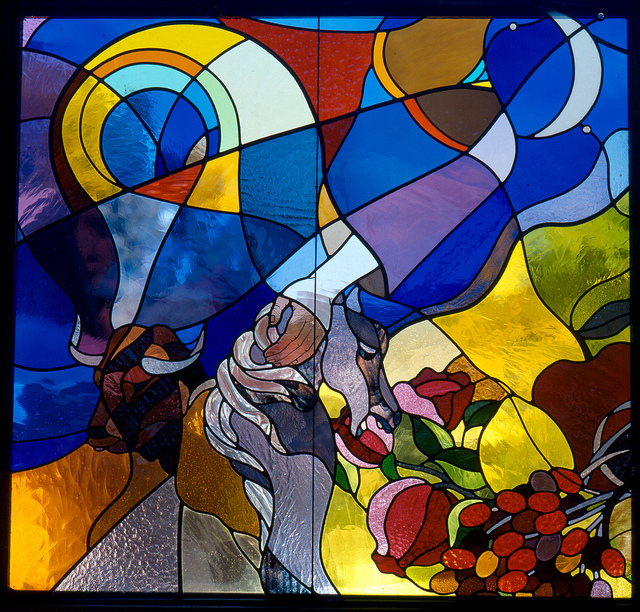
Ordinarily, there should be justice in appointments, and succession planning should follow well understood procedures. But there needs to be processes of disruption. I have been reading the story of Jacob’s blessing of Joseph’s two sons Manasseh and Ephraim (Genesis 48). They were born in that order and should, by rights, have been blessed in that order. Jacob himself “stole” his father’s blessing from his older twin Esau. Of Jacob’s twelve sons, Joseph was the last in line, inspiring murderous resentment amongst his brothers. (The stained glass pictured above shows Joseph’s blessing). Disappointments abound in the Bible. The choice of David by the prophet Samuel was a surprise to David’s father. David was not the first-born, but the last-born – and still so young. Each of his older brothers was presented to Samuel. Each was dis-appointed as Samuel turned the line of succession on its head (1 Samuel 16:1-13).
The New Testament takes up the theme. Everything is in the wrong order. Even the birth of Jesus is in the wrong place. The wise ones went for Jerusalem and finished up nine miles wide of the mark. (Matthew 2). Jesus, himself set the cat among the pigeons by describing the disappointment process. He said “The last will be first, and the first will be last” (Matthew 20:16) before being challenged by the Mum who claimed her two sons had the right to the best seats in the house (Matthew 20:20-24).
All these stories are a reminder that there has to be room for manoeuvre and that there have to be processes of disruption. Prayer before appointments is an invitation for the Holy Spirit to confirm or disrupt the natural order of things. Sometimes the order of things has to change if things are going to change. The story of Manasseh and Ephraim, (or is it Ephraim and Manasseh?) is a reminder of that. It represents the hope of a new order, in which those whose appointment comes as a surprise live for the sake of others and not for themselves. That is why the order is changed.
A new order is one in which all those who come last in things come first – a great disappointing for some.
The stained glass is by Maria Stolz of Renaissance Glassworks Howard Lake, MN 55349
Here is another post on the theme of disappointment and leadership.

Measuring sympathy
 I have come across a lot of recipes recently where ingredients are measured in cups. This is frustratingly imprecise to someone who has to follow recipes line by line. I bought the measures, only to discover that they deliver a chilli which knocks your socks off. I still don’t know the cup size.
Measurements are part of everyday behaviour. I was disturbed yesterday by someone saying “I haven’t got a lot of sympathy for …” It’s as if we have a cup-board possession with a measure of sympathy. Put differently, only being able to spare a pinch of sympathy indicates the meanness of our disposition and behaviour.
How do we measure sympathy? Sometimes sympathy is measured in tea cups. “Tea and sympathy” never amounts to much and describes a limited attention of a duty call. I suggest that there is a more effective simple formula:
sympathy = knowledge x patience
Sympathy grows as we grow in understanding of the other point of view, the other’s position and all the systems that make their life what it is. Then that sympathy is magnified by the gift of patience. Personally I’ve not got a lot of sympathy for those who say they haven’t got a lot of sympathy for … More fool me.


More like the voice of angels
I am not sure why angel voices are those of women or of boys when the named angels are Michael, Raphael and Gabriel. But if I am not very much mistaken, the voice of the Webb Sisters is absolutely heavenly as it bears the gravelly voice of Leonard Cohen to the heights of beauty. For me this voice of the angel from John Tavener’s Eternity’s Sunrise sounds like it’s from the very heart of heaven. I wonder if this is how angels sound. They seem to have all the time in the world.Friends Christopher Burkett and Jayne Shepherd have shared this story illustrating the power of words – surely the touch of an angel. (I wonder why Church of England bishops can’t sound and look like this).
For the record, the Webb Sisters sing (and pray) on Leonard Cohen’s new album Old Ideas. With Raphael (angel of healing) they sing Come Healing.
O gather up the brokenness
and bring it to me now
the fragrance of those promises
you never dared to vow
The splinters that you carry
the cross you left behind
come healing of the body
come healing of the mind
And let the heavens hear it
the penitential hymn
come healing of the spirit
come healing of the limb
Behold the gates of mercy
in arbitrary space
and none of us deserving
the cruelty of the grace
O solitude of longing
where love haas been confined
come healing of the body
come healing of the mind
O see the darkness yielding
that tore the light apart
come healing of the reason
come healing of the heart
O troubled dust concealing
an undivided love
the heart beneath is teaching
to the broken heart above
O let the ehavens falter
and let the earth proclaim:
come healing of the Altar
come healing of the name
O longing of the branches
to lift the little bud
o longing of the arteries
to purify the blood
And let the heavens hear it
the penitential hymn
come healing of the spirit
come healing of the limb

Reflections
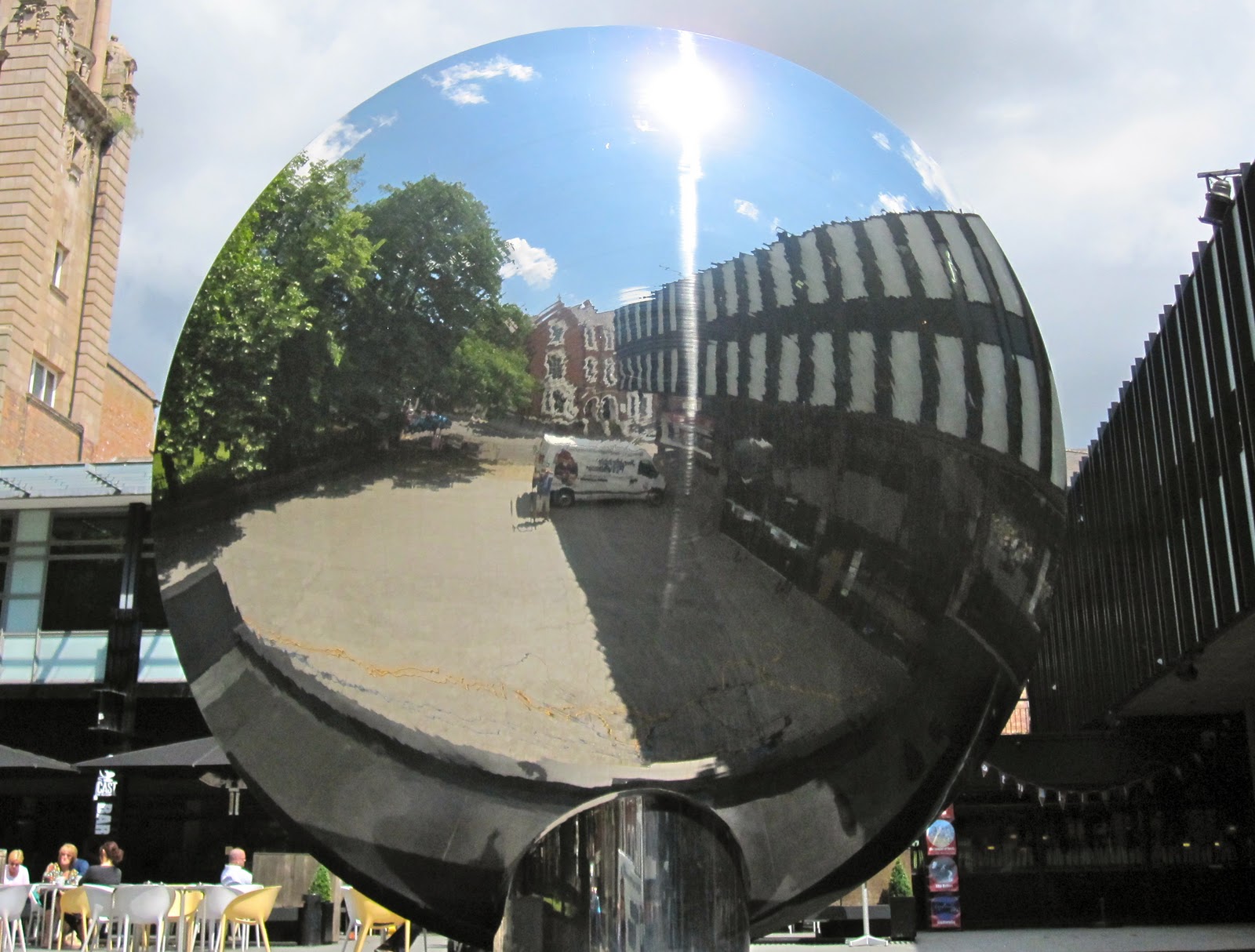 |
| Anish Kapoor Sky Light at Nottingham |
Alan Smith & Peter Shaw provide some helpful advice about the importance of reflection in The Reflective Leader. They remind us that the “greatest sea changes that have come about in human history have been rooted in reflection”.
They list six principles:
- Record first impressions, thoughts and reflections systematically, particularly when we are new to a situation.
- Reflect when things are going well. I suppose that we are not defensive at that point.
- Prepare for times of reflection. We need as much data and information as possible (there’s never too much information!) including comments and feedback from others.
- Ask questions. Curiosity is essential for reflection.
- Seek out those who are gifted at reflection, then nurture this gift in them, then tell others about them to encourage a culture of reflection.
- Reflect regularly. It’s hard work but gets easier with practice.
 |
| Reflecting on the Bridgewater Canal near Warrington |
My response:
- Go easy.
- Shower longer.
- Use feedback.
- Use ripples.
- Welcome surprise.
- Be prepared to change – all the time.

And the award for the best …. is

Now is the time of many retrospectives including Charlie Booker’s Words of the Year 2011. I imagine the awards being announced. Best newcomer: “Merkozy”, with the word trailing its expensive gown onto the stage to accept the award and thanking their producers, the euro crisis, and all those who have used the word. Word of the Year is, apparently, “OCCUPY”. Many of us would agree with that, and with the accompanying nomination of Giles Fraser for the Twurch of England’s Priest of the Year. Mercifully there is no award ceremony. Imagine trying to get Occupy off the stage.
 |
| Janine caters for all tastes at Hollymere |
We have our own Herbert Awards, which reflect a local viewpoint. Community of the Year is awarded to Hollymere for developing a community of care and promoting independent living for those who would otherwise be heavily dependant and cut off from others. Hollymere represents a new design for living for older people, with its own “high street” open to the wider community, community rooms, restaurant and gym. Designers, carers and residents should come to the stage together to receive this award.Our prize for Butcher of our world doesn’t go to some toppled tyrant, but to our local butchers, Drury’s, who bring life, custom, humour and service (as well as some quality fresh food) to our local parade of shops.
In the sports category, Andy Murray has provided many moments when it has been hard to tear ourselves away from the set (!). There is only one team ever up for nomination: Leicester City. This year the only prize they win is Most Disappointing.
Our Concert of the Year was Paul Simon at the Manchester Apollo, though Take That take it for Extravaganza of the Year. Earworm is a word that took my fancy this year, and although I have been introduced to some good new (to me) music, such as Noah and the Whale, John Martyn, P J Harvey, the Earworm Prize goes to Fleet Foxes‘ Helplessness Blues.
Nominations for Film of the Year are disappointingly few. Once again we failed to deliver on our intention to get out more, which for us means going to the cinema. Yet we have seen some outstanding films, including The King’s Speech, Black Swan, The Inbetweeners, We Need to Talk about Kevin, Hugo and The Girl with the Dragon Tattoo. For us there wasn’t anything to choose between them. We enjoyed them all, though not sure enjoyment is the word to use in relation to Kevin.
 While everyone was watching Arab Springwatch, we had our own springwatch, which began with the discovery of a dunnock’s nest in the back garden, and then a robin’s nest in the bush at the front of the house. We kept an eye on the hatchlings and fledglings and felt personally responsible when they flew their nests (on the same day).
Theological Find of the Year is awarded to Paula Gooder for sharing her research findings that ancient Hebrew cosmology shows a longstanding theological enterprise to bring God down to earth, and to Ivan Illich and his conspiracy “theory”.
 Most Creative Moment was putting together a series of photos for Ginger’s Day Out (in Llandudno) for children at Christ Church School, Ellesmere Port. There’s a book inside everyone – or, so they say. I think I’ve found mine!
Blogging Moment of the Year was getting feedback from Vic Goddard, Headteacher of Passmores Academy, the school featured in Channel 4’s Educating Essex for a post I wrote in response to that series.
There are joint winners of the prize for Most Helpful Intervention in my Thinking about Leadership. Heather Gold helped me to understand the importance of giving in her instructions how to be a tummler. Meg Wheatley is helping me to understand that we have to change our mind about leadership and organisation. Dee Hock led me to her, and also wrote of what he learned about organisation and leadership from the ground beneath his feet:
Billions upon billions of self-organising interactions are occurring second by second in the square yard of soil, each inter-connecing, relating, creating,and shaping self and others. Every particle is inseparable interacting and relating to others, and they still to others, unto the remote reaches of the universe and beyond – beyond knowing – but not beyond awareness, respect and love. The mystery of it all is overwhelmingly beautiful. Birth of the Chaordic Age. page 288.
 Comedy of the Year goes to Rhod Gilbert for his routine about the tooth brush. There were many other contenders.
I am going to give my Mum the Lifetime Achievement Award. You have to be frail to qualify for lifetime achievement awards. She is now frail enough and now is more naturally retrospective. I have been surprised by some of the things she has got up to. For example, going into her city centre on her own at 3 in the morning to look for someone addicted to heroin on behalf of her worried parents (and finding her). She has also helped me understand that the delivery of a child isn’t a once in a lifetime event, but a lifetime’s work.


