>Jubilee

>Morning Prayer today included the wonderful reading from Leviticus 25 outlining the teaching on Jubilee.

It’s green – recognisnng the rights of the land – every 7th year was to be a sabbath of complete rest for the land – a time for the land to sigh.

After 7 lots of 7 years – ie the year after the 49th, the 50th – “and you shall proclaim liberty throughout the land to all its inhabitants”. All capital transactions were to use the Jubilee as its basis. So if land was sold it was sold until the next Jubilee year with the land returning then to its original owner. The price for the sale was to be linked to the number of crops.

How amazing is that! In our country we talk about ‘old money’ and ‘new money’. We talk about the ‘landed gentry’ who are the beneficiaries of a capital system which knows of no Jubilee.

Is it surprising that there is no reference in the Bible to the Jubilee principle being put into practice? Of course it isn’t. Because in this world of ours people like to accumulate power (and property). We shouldn’t be surprised that vested interests prefer the status quo. The consequence is that inequality, oppression and poverty become systemic, and people become alienated. It also means there can never be Jubilee, because that is when liberty is procalimed throughout the land to all its inhabitants.

(This picture was taken by Jeanette)

I live in a village community which would be transformed by the Jubilee principle. Inheritance (particularly land) is an enormous issue within families and grievances stretch generations back. Fault lines are embedded in the fabric of community life. It’s not stereotypes that divide communities such as ours. It’s not race, gender or age – though they do paly a part. It’s who snubbed who three generations back, and which side people founght on in the war that counts (the Civil War I mean!)I suspect that when hurts are deeply embedded in the fabric of a community most people don’t even realise that they are there.

The Church is able to offer a breathing space – a place to untangle the past and space to take on enterprise with fresh partners and renewed relationships. The political realignment of the Jubilee principle may not be feasible but the life of the Church (the mission of God) show that the fault lines aren’t inevitable, and that alienation and division are short-lived – certainly less than 50 years. This sounds very idealistic doesn’t it? Why’s that?

>Finding Happiness

>It was good to hear Christopher Jamison on R4 this morning. He is Abbot of Worth Abbey and has written a book called Finding Happiness.
He says definitions of what happiness is are hard to find, but most boil down to being about “feeling good”. Life isn’t like that though because we have good days and bad days – as well as sickness and suffering. He made the point that happiness is about knowing good and doing good.
He also referred to good worship being an experience of the imagination of God.

>Desks against the wall

>It is not good for man to work alone – especially when the desk is piled high with paperwork (see Genesis). Friend Simon led an excellent session on delegation yesterday on our leadership programme – going through the continuum of leadership styles – tell, sell, consult and share and sharing the grid of confidence and competence.

One phrase that keeps cropping up in relation to delegation is “letting go“. It’s a funny expression but indicates the difficulties of delegation and that it involves grief.

Just wondering.

Just wondering whether better words might be “letting in” – then delegation becomes an issue of hospitality, celebration and fun.

It also gives a eucharistic reference to delegation – as this icon by Rublev of the Trinity shows. God is letting/inviting us in in the ultimate act of delegation and self-giving. His mission/work is placed in our hands and on our lips as he trusts us with his work. He doesn’t “let go” in the sense of leaving us to it but “lets in” as he promises constant companionship (bread sharing).
“Letting in” sounds as if it could be so much more fun than “letting go”. It sounds as if there is more room for celebration – and more chance of continuing relationship. There is nothing worse than letting go of something important and not knowing what on earth has happened.

So what are we saying when we have our desks against the wall? The Lord does indeed prepare a table before us, and that table often looks very like a desk of paperwork. How hospitable are we with our work? Shall we let people in? Shall we keep it to ourselves?

Politics

Politics is not just a tiresome consequence of human shortcomings, it is an ongoing conversation about how to bring out and empower the ocean of different gifts and talents in a community. It is not about the limited money in people’s pockets, it is about the limitless potential in their hearts and minds and souls and bodies. It is about how to engage all the energy that is about, and how to discern and embody that which constitutes the goodl life. It may not always be happy, beautiful, or rich, but if a community can express such a notion of politics, it can experience a goodness that other communities, with their impoverished politics, can only envy.
Sam Wells: God’s Companions (2006) p169

>Pause for Reflection

>
This picture is from Estaticist’s photostream and is from Butchart Gardens on Vancouver Island called Pause for Reflection.
Sam Wells refers to the way sherpas in the Himalayas will suddenly stop their climbing, put down their equipment and rest – as if waiting for shomething or somebody. This causes great consternation to westerners. “Why do you do that?” The sherpas’ reply is “We have travelled a long way; we are waiting for our souls to catch up with our bodies.”
This seems to represent an essential spiritual discipline – and we westerners need to learn that though we have moved on so fast, and been through so much change, we haven’t always given our souls time to catch up. It is the same principle as the sabbath – a regular time, once a week for us to catch up with ourselves. And for the same reason, we need family holidays and celebrations to allow ourselves to catch up with one another and to realise that we have missed each other in all the busyness.
Sometimes though, our soul is never going to catch up with us. We can wait until the snow melts, but our soul is never going to find us. Being lost like that signals the need for us to retreat – with retreat being another essential spiritual discipline, Retreating far enough helps us regain soul and and the location of what we value most. The story of the Prodigal Son is the classic tale of the retreat of a man who finds all that he ever wanted and all that he ever needed.

>Folly and Wealth

>
Jim Janknegt‘s picture of the Rich Fool describes two economies. The economy of the rich fool shows the grim reality of the rich fool who decided to build bigger barns and to take life easier. He is on his own, surrounded by “stuff” with the lights turned down – presumably saving money. Neighbours live in a smaller house. They are bathed in light as they gather round the table enjoying company of each other. Jesus’s parable, Jim’s picture, and the credit crunch underline the folly of materialistic capitalism. We’ve been led to believe that we should follow the lead of those with style – celebrity lifestyle – with the likes of HEAT magazine. From this picture we seem to have a lot to learn from those who haven’t succeeded in the worldly economic sense – those who value people more than things – those who look out for others instead of just looking out for themselves.
Rev Tim Hastie Smith, speaking at the Headmasters’ and Headmistresses’ Conference referred to the “prophetic duty” of schools to challenge lives “dedicated to the acquisition of more things”. He said the next generation will learn to make do with less only if it is introduced to a different sort of wealth.

Bonnie Combe is a woman who lost her husband in a plane crash in Alaska. During her journey through grief, a friend asked her, “Did your husband enrich your life?” “Why, of course,” she answered. The friend came back to her with something that changed her life, “Well then — what are you going to do with those riches?” That statement became the ground of her recovery. [Told on ABC Nightline, 7/21/99 during a discussion of the John F. Kennedy Jr. plane crash]

Savings

Leo Tolstoy tells the story of a rich man who was never satisfied. Tolstoy tells wonderful stories. He told a story of a man who always wanted more and he heard of a wonderful chance to get more land. For 1,000 rubles he could have all that he could walk around in a day, but he had to make it back to the starting point by the end of the day or he would lose everything that he invested. He arose early and set out. He walked on and on thinking that he could get just a little more land if he kept going on, but he went so far that he realized that he must walk very fast if he was going to get back to the starting point and claim the land. As the sun went lower in the sky, he quickened his pace. He began to run. He came within sight of the starting place and so he exerted his last energies plunging over the finish line, falling to the ground, dead. His servant took a spade and dug a grave. He made is just long enough and just wide enough and buried him. Do you know the title of Leo Tolstoy’s story? “How much land does a man need?” And he ends the story with this line: “six feet from his head to his heels was all that man needed”
a Lindy Black Sermon Nugget

>Angels

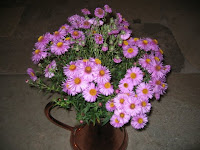
> Friend Owen (aged 4) wants to believe in angels. well, today is the Feast of St Michael and All Angels – and michaelmas daisies have come on cue. Owen asks some wonderful questions – as most children do.

Here’s my response:
How would we know God’s love if there weren’t angels? They are God’s messengers and the bridge between heaven and earth. (Next job – explain to Owen about heaven!!!!) There is a lovely book called Angels written by Jane Williams (wife of the Archbishop) which has some lovely pictures and thoughts in it. It is written for adults.

Angels don’t have wings! That’s how the artist explains their journey from earth to heaven – and back again. Nor are they generally recognisable – only by those who are prepared to acknowledge an angel when they see one. Owen will recognise an angel more by what they say and how they make him feel. In the Bible they usually start by saying “Do not be afraid”. Oh yes – they are alive – and they come in all colours, shapes and sizes – men, women and children.