For crying out loud, what do you want me to do for you?

A sermon for the Last Sunday after Trinity (Year B) encouraging us to join Bartimaeus in his loud prayer that helps him see. The readings for the Last Sunday after Trinity (B) are Jeremiah 31:7-9 and Mark 10:46-end.

October 27th 2024

Here’s the question. “What do you want me to do for you?” This is the question Jesus asked Bartimaeus. It’s exactly the same question he asked the two disciples who approached him in last week’s gospel. The sons of Zebedee, James and John, came forward to Jesus, saying: “we want you to do for us whatever we ask of you”, to which Jesus replied: “What is it you want me to do for you?”

It’s a question any helper might ask. “What is it you want me to do for you?” It might well be a question you imagine Jesus asking you. As you settle down in prayer you might imagine Jesus asking you, “What do you want me to do for you?” Our prayer may specifically answer that question as we lay open the heart of our concerns to God.

Not that we expect God to do all we ask. Remember James and John. They wanted Jesus to do for them wherever they asked, but what they asked for was so wide of the mark that there was no way Jesus was going to do it for them. They asked to sit either side of Jesus in his glory – there was no way Jesus was going to save the seats for them. As it turned out the gospel shows us in the crucifixion scene that those to the left and right of Jesus “in his glory” are those disgraced by society, those shamed and ashamed – all three of them convicted criminals.

But sometimes our prayers are answered. Sometimes what we ask to be done is done, as in the case of Bartimaeus. 

The beginning of his prayer is shouted out and is heard above the noise of the crowd. Often our prayer is a cry, and sometimes we cry out loud, as Bartimaeus does here: ‘Jesus, Son of David, have mercy on me!’ He goes against the crowd who mercilessly tried to shut him up. But he carried on shouting, ‘Son of David, have mercy on me!’ Jesus heard his prayer. He couldn’t help hearing him: he was shouting so loud. 

Mercifully Jesus called him to him asking that question. “What do you want me to do for you?” The blind man replied, “My teacher, let me see again”. Jesus recognises the faith of the blind man in what the blind man has called him. He’s called him “Jesus”, “Son of David” and “Teacher”. According to Mark, Bartimaeus has seen in Jesus what the disciples have so far not seen. He’s the one who’s seen. It’s the disciples who are blind. When we call anyone “Teacher” we’re already trusting them to show us the way. Jesus responds to such faith, insight and trust. To the blind man he says “your faith has made you well”. Jesus had helped him see again – and Mark leaves us with this spectacle of Jesus journeying to Jerusalem with this beggar by his side. We don’t very often see the procession into Jerusalem that way, do we? But that is the way Mark paints the picture.

We can’t get away from the blind in our worship. Our other reading is also about the blind and the lame. They are what’s left of Judah after generations of suffering at the hands of the babylonian empire six centuries before Christ. Babylon invaded Judah three times that century and occupied her for 50 years. Judah was ruined. There was very little left. So much had been destroyed – Jerusalem, the temple – everything that gave them a national identity was gone. And most of the people had gone as well – killed or deported. Those who were left lived with the humiliation of being beaten. They were refugees scattered far and wide.

This scripture from Jeremiah has been treasured because of the vision Jeremiah has for these people and the words he has for them – the blind, the lame and those scattered to the four corners of the earth. These are traumatised people. They are survivors of devastating disaster. Some of you will know what it is to be traumatised by what’s happened to you. You may have lost someone or you may have suffered a life-changing injury. The news these days is full of reports of whole communities destroyed and traumatised by war in Gaza, Beirut, Lebanon. We look into their faces. There are no words. We often frame our speechlessness with those very words. “There are no words”, we say.

Traumatic shock leaves us reeling disrupting our normal mental processes because we can’t work out what is happening to us. The mind shuts down and the memory of the traumatic events become fragmented. The wounds are unspeakable. There are no words. The mind automatically shuts down feelings and turns off human responses locking violent experiences away in a form of self-protection which often means we never get to understand our pain, our loss, our grief. Trauma disrupts the trust we have – whether that is in God, in others or in the future. The future we had in mind is simply no longer there – and many traumatised people are left feeling that there is no future. “I see no future.”

This is the context for Jeremiah. He is part of a people traumatised by events. They have lost everything. There are no words. They have no vision for the future apart from their ongoing pain. But Jeremiah gives them words. They’re words given to him by God. Jeremiah shares his vision. Our reading comes from a part of the book of Jeremiah which is known as “the Book of Comfort”. God through Jeremiah is restoring their faith and renewing their hope. They have a vision for the future. Jeremiah is helping them see again.

Our readings are related. In both people are being helped to see again. That’s the one thing Bartimaeus asks of Jesus in today’s gospel. “I want to see again.” In our Old Testament reading Jeremiah helps the whole people to see themselves again, something like the people they had always been.

I suggested that you might use Jesus’ question in your prayer. Imagine Jesus asking you, “What do you want me to do for you?” After all you’ve been through, whatever that is, what will your answer be? What will you ask for?

Remember that Jesus asked that question to James and John as well as to Bartimaeus. He wasn’t interested in answering James and John’s request for status and privilege. Jesus will never answer our thirst for power, wealth or prestige. It’s no good praying over our lottery ticket. He only answers the beggar’s prayer.

Our readings are related to inspire the church to join the beggar in his prayer (not James and John in theirs).
Do we turn to Christ to help us see – to help us see differently,
to help us see ourselves differently,
to help us see our neighbours differently,
to help us see strangers differently,
to help us see our enemies differently,
to help us see the future differently,
to help us see our past differently?

Anais Nin wrote: “We don’t see things as they are, we see things as we are.” Maybe we’ve grown old. Maybe we are jaded, tired, cynical. Maybe ….

Lord Jesus, help us to see.
Help us see the way you see so that we may follow you that way.

I don’t know who the man born blind is either, but idly speculating …

Who is the man born blind? Who do you think he is? How do you picture him? When Jesus went looking for him (John 9:35), after he had been thrown out, who did he ask for? Did he have a name?

John leaves him anonymous. He may be Bartimaeus but if it is John has stripped him of his name. Anyway, Bartimaeus is another man who is blind in Mark’s gospel – it’s the other one (also nameless) that Jesus uses spit on to help him see (Mark 8:22-26).

Even if it is Bartimaeus the meaning is unclear, for if Bartimaeus is an Aramaic name his name means “unclean”, but if it is a Greek name his name means “honoured”. He certainly isn’t unclean in the eyes of Jesus and John. In fact he is a man whose blindness is accompanied by other gifts – a kind of biblical sage who is such a contrast to the able-bodied disciples.

Is he then, the model disciple?

We guess the identity of the “beloved disciple”. There are theories – could be John, Peter, Lazarus – but there’s no settled answer.

It might be that John has deliberately anonymised both of them, the man born blind and the beloved disciple.

Who is the beloved disciple? My suggestion is that the beloved disciple is whoever has his or her head on the bosom of Jesus (John 13:23), so that he/she can hear the whispered will of God, so that he/she can feel how the heart of Jesus ticks.

And similarly I wonder, is the man born blind the one who comes to see? – was blind, but now s/he sees – not through their own efforts, experience, wisdom or learning but through the gift and creation of God.

I don’t know whether you ever call rain “spit”. Our dog always pokes her nose out of the door warily to check whether it is spitting. Even if it is just spitting she turns tail and heads back in.

The rain is the spit on the earth, and the making of mud. It was from the mud that the Lord God formed humanity to become a living being (Genesis 2:7) and it was with the mud and a rub of the eyes by the lord both of light and darkness that the man born blind could see (John 9:6).

But is this just about the one man born blind? Is it about all those who “come to see”? And is the man born blind a new Adam? Is the man born blind the beloved disciple?

Just speculating. Who do you think he is?

Touching rock

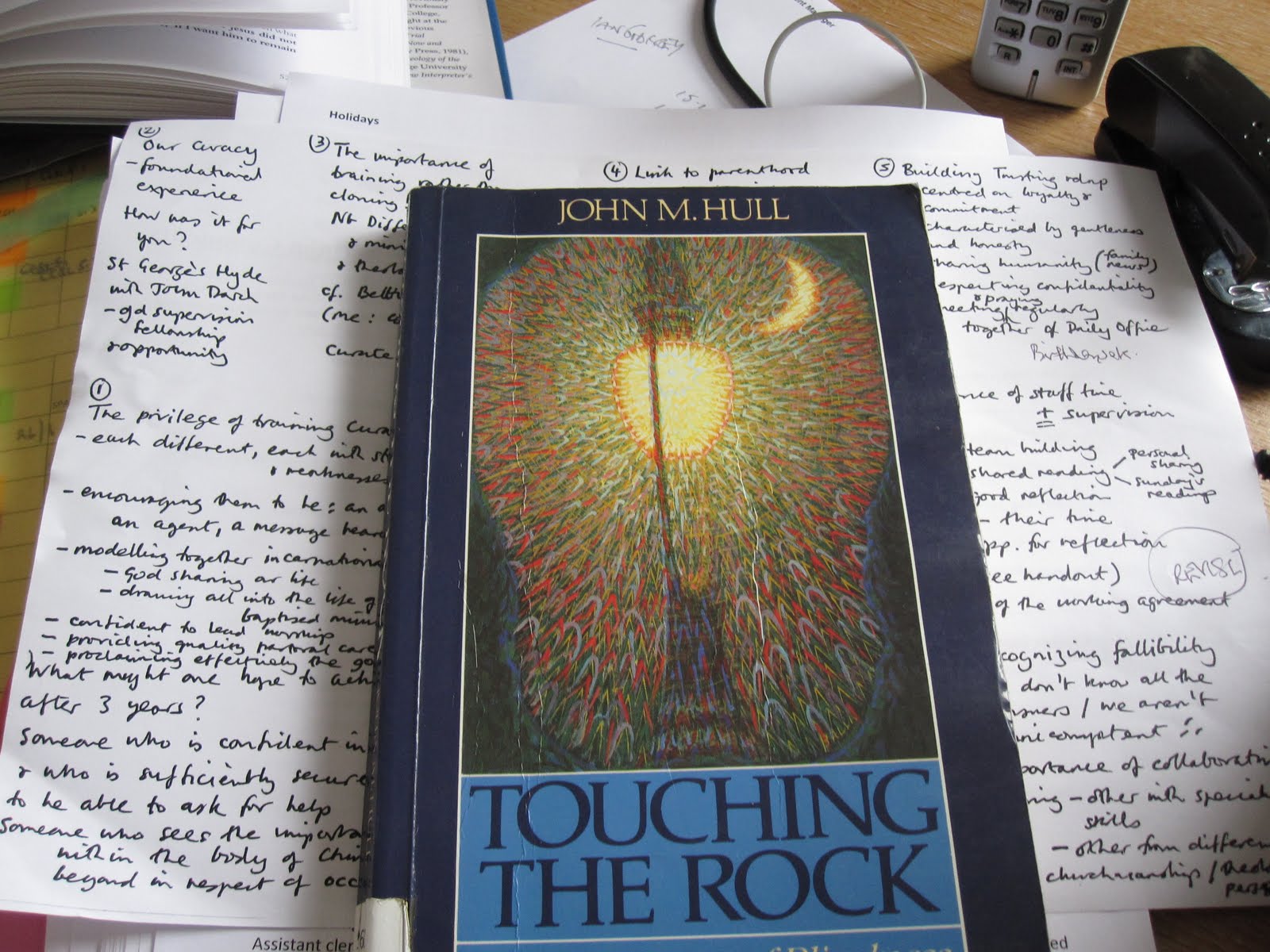
This is from an earlier post I wrote after reading John Hull‘s incredibly moving and honest account of the onset of his blindness, Touching the Rock. He refers to the “thousands of tiny accidental happenings” which led him along the path to blindness. According to Hull, faith transforms such accidental happenings into the “signs of our destiny” by “retrovidence” rather than “providence”.

He describes his stumbling on the altar at Iona Abbey during his stay there in 1986, through which he became a WBS a “whole-body-seer”. Here he sees things for himself, sees through his blindness, and discovers how he can see things through. His seeing is full of feeling and emotion as he touches the rock.

Altar at the Iona abbey
Altar at Iona photo by Calypso Orchid

“After several nights, I discovered the main altar. I had been told about this, and I easily recognised it from the description. It was a single block of marble. Finding one corner, I ran my fingers along the edge, only to find that I could not reach the other. I worked my way along the front and was amazed at its size. The front was carved with hard, cold letters. They stood out baldly, but I could not be bothered reading. The top was as smooth as silk, but how far back did it go? I stretched my arms out over it but could not reach the back. This was incredible. It must have a back somewhere. Pushing myself upon to it, my feet hanging out over the front, I could reach the back. I did this again and again, measuring it with my body, till at last I began to have some idea of its proportions. It was bigger than me and much older. There were several places on the polished surface which were marked with a long, rather irregular indentations, not cracks, but imperfections of some kind. Could it have been dropped? These marks felt like the result of impact. The contrast between the rough depressions and the huge polished areas was extra ordinary. Here was the work of people, grinding this thing, smoothing it to an almost greasy, slightly dusty finish which went slippery when I licked it. Here were these abrasions, something more primitive, the naked heart of the rock.” (P 163).

As a post-script, he writes: “God is many and yet one, and in God there are many worlds yet one. God does not abolish darkness; God is the Lord of both light and darkness. If in God’s light we see light, then in God’s darkness we see darkness. If a journey into light is a journey into God, then a journey into darkness is a journey into God. That is why I go on journeying, not through, but into.” (p165)

>supervision

>

Interesting discussion on supervision at yesterday’s training session for those who are going to be “supervising ministers” for newly ordained clergy.

Peter Chantry offered insights from his experience as he looks forward to welcoming a new curate to his Nantwich parish. They safeguard space each week for a supervision session. One hour every Thursday morning. That is impressive. One of the impressive aspects of his presentation – besides his low-tech mind-map handout – was his emphasis on the quality of the relationship and the way that he is obviously facilitating a collaborative/community approach to formation. There is evidently a care-full building of trust for the relationship “centred on loyalty and commitment, characterised by gentleness and honesty, sharing humanity, respecting confidentiality, meeting & praying regularly.” Good stuff.

It begged the question from friend Julian of what supervision is for. Or, what does successful supervision look like?

I wonder. We spend so much time talking about supervision, insisting that it is a good thing – but what is it for? Is it about “seeing things for ourselves”, “seeing through things” (where there were blind spots), and “seeing things through” (sustainability)?

I have been reading John Hull‘s incredibly moving and honest account of the onset of his blindness, Touching the Rock. He refers to the “thousands of tiny accidental happenings” which led him along the path to blindness. According to Hull faith transforms such accidental happenings into the “signs of our destiny”, by “retrovidence” rather than “providence”.

He describes his stumbling on the altar at Iona Abbey during his stay there in 1986, through which he became a WBS a “whole-body-seer”. Here he sees things for himself, sees through his blindness, and discovers how he can see things through. His seeing is full of feeling and emotion as he touches the rock.

Altar at the Iona abbey
Altar at Iona
photo by Calypso Orchid

“After several nights, I discovered the main altar. I had been told about this, and I easily recognised it from the description. It was a single block of marble. Finding one corner, I ran my fingers along the edge, only to find that I could not reach the other. I worked my way along the front and was amazed at its size. The front was carved with hard, cold letters. They stood out baldly, but I could not be bothered reading. The top was as smooth as silk, but how far back did it go? I stretched my arms out over it but could not reach the back. This was incredible. It must have a back somewhere. Pushing myself upon to it, my feet hanging out over the front, I could reach the back. I did this again and again, measuring it with my body, till at last I began to have some idea of its proportions. It was bigger than me and much older. There were several places on the polished surface which were marked with a long, rather irregular indentations, not cracks, but imperfections of some kind. Could it have been dropped? These marks felt like the result of impact. The contrast between the rough depressions and the huge polished areas was extra ordinary. Here was the work of people, grinding this thing, smoothing it to an almost greasy, slightly dusty finish which went slippery when I licked it. Here were these abrasions, something more primitive, the naked heart of the rock.” (P 163).

As a post-script, he writes: “God is many and yet one, and in God there are many worlds yet one. God does not abolish darkness; God is the Lord of both light and darkness. If in God’s light we see light, then in God’s darkness we see darkness. If a journey into light is a journey into God, then a journey into darkness is a journey into God. That is why I go on journeying, not through, but into.” (p165)

PS Simon Marsh has a different slant on this and has an interesting post on teaching the world to listen – with a video of profoundly deaf musician Dame Evelyn Glennie.