Going Home After Christmas – another way

Here is a sermon for Epiphany, about getting home after Christmas — about what it means to return to ordinary life once the magic of Christmas has done its work.
(Readings: Isaiah 60:1–6; Matthew 2:1–12)


This morning I want to take up the star of wonder
and see how far we have come this Christmas,
exploring the way to the manger,
and how on earth we get home.

Our readings cover many miles —
the miles in the reading from Isaiah,
the miles nations will come
to the light of the glory of God,
the miles rulers will travel
to the brightness of the dawn
of a new day, a new time, a new year.

The miles the children of Israel will travel:
sons coming from afar,
daughters carried on the hip.

The miles wealth will cross the seas,
and the camels… the camels —
from Midian and Ephah,
even from Sheba,
bearing gold and incense,
proclaiming the praise of the Lord
when he comes.

And in the gospel for today
there are the Magi from the east —
the Magi who believe in the magic of life,
who follow the star of wonder,
always wondering what kind of magic
can turn hatred into love
and a world at war into a world at peace.

Our readings cover miles of wonder.

The magic the travellers trusted
was not illusion or trickery,
but the stubborn hope
that the world could be other than it is.

It is a hope as old as time.
It is God’s hope we join.

The Magi are ones who travelled so far,
going first one way,
and then finding a better way.

First they went the usual way,
the old way, the well-trodden wrong way.
They found themselves in Jerusalem,
in the twisted streets of the medina,
the religious capital,
the political and social capital.

Everyone said they would find
what they were looking for there,
because that’s where we always expect God to be —
close to influence, respectability, and control.

There’s no doubt that Google Maps
had led them to a king.
But Herod wasn’t who they were looking for.

There was no magic in his palace —
just the same old rules,
the same old rule of oppression,
ruling out the magic
of the least, the lost, and the last.

They stayed awhile — long enough
for the priests and lawyers
to consult the ancient books of magic,
the scriptures that had forgotten
just how dangerous they really are,
to remind themselves
that the place of magic
is the smallest of places,
never Jerusalem.

They’d got it so wrong.

Nine miles wide, one theologian says —
the distance between Jerusalem and Bethlehem,
the distance between power and promise,
the distance between knowing the words
and recognising the child.

Nine miles on, they saw the star
stop over the place where Jesus was.
Overwhelming joy brought them to their knees.

They bowed from their lofty heights.
They opened up their gifts —
all their power and glory:
their gold, their frankincense, their myrrh.

Gifts laden with meaning —
the gold of their wealth,
the incense of their power,
the myrrh of their mortality.

They handed them all over.

They do not leave Bethlehem lightly.

They have loved this place.
They have loved the silence,
the smallness,
the nearness of God in a child.

They have lingered long enough
to be changed by what they have seen.

And then they went home another way,
considerably lighter.

We are in the same room as the Magi.
We are with them in Bethlehem.
We too have travelled far this Christmas.
We too have knelt at the place of wonder.

But no one can stay in Bethlehem.
It was too dangerous for Joseph, Mary, and Jesus.
They had to flee from Herod’s terror
and his slaughter of the innocent.

Nor could the Magi stay.
They had to return to their own country.

They had two choices.
They could go back the way they came —
through Jerusalem,
through Herod,
through the centres of religious, social, and political power.

Or they could take the road less travelled.
They chose to follow their dream,
to heed the warning,
to go home another way —
refusing the way of fear and exclusion,
the way that protects power
by crushing the vulnerable.

And nor can we stay at the manger.
Christmas does not ask us to linger,
but to return.

There are just twelve days of Christmas,
and we are nearly at the end of them.
The road home opens before us.

We go back to the same people,
the same work,
the same complications and demands —
just as the Magi did.

The question is not whether we go home,
but how we go home.

Will we go back the way we came —
shaped by fear, habit, and power?
Or will we go home another way —
refusing fear,
trusting the stubborn magic of love,
seeing God not in the centres of control
but in the smallest of places,
among the least, the last, and the lost?

Home calls us —
the place that knows us,
the place we know,
the place whose joys and wounds
we carry in our bones.

The Magi return to their own country —
to their villages,
their households,
their responsibilities and loves.

They go back to the same world,
but not by the same road.

And so do we.

We go home
not because Bethlehem has nothing left to give,
but because it has given us enough.

Enough light
to see differently.
Enough love
to travel lighter.
Enough hope
to believe the world can be other than it is.

That is the road less taken —
and it is the way
into a new year of grace.
God on the night shift

We’ve stayed up!
We’ve stayed awake
to make this night,
this night above all nights, holy.

And we’ve sung praise to this holy night.
Perhaps for the first time tonight in this church
have we sung congregationally the lovely carol, Cantique de Noel.

Noel is a word from Anglo-Norman French. It means birthday.
So when we sing Noel, we are singing a birthday song to the world –
a new beginning sung into the night.

This holy night we see God
as light, forever a-light in our darkness,
a light in our fears, aloneness and confusion.
Tonight we see night as the time God acts.
God’s creation begins in darkness.
That’s our Genesis.
The Exodus began in the dark.
The resurrection begins “while it was still dark”.
God works the night shift.

Tonight we see God –
the very nature of God,
seen and worshipped
as the smallest,
the most vulnerable of life.
This is how we see God,
in a stable, in the busyness
of a crowd of people, in a state
preoccupied by the presence of enemy power.

We see God in that darkness,
and we begin to love the name of that baby,
Jesus, the one who saves us
by joining our darkness with the lightness of love.
As night follows day, he is with us
in the darkness of hurt and disappointment,
rejection, betrayal, the loss of loved ones,
the anxiety of making ends meet,
in a world of war, and a world in flight –
he is with us, our boy, Emmanuel.

Grace doesn’t come with a sword
to overcome the darkness with a spectacular blow.
Instead God illuminates the darkness
with everlasting companionship.

And in this new light, we see ourselves again
as the very image of God.
This holy night, God appears small,
and that smallness reveals what God is always like.
The manger isn’t camouflage, it is revelation.
The manger is our mirror image.
We are made in the image of God,
not born to be high and mighty, first and foremost,
but born into smallness – humble at heart.

And this is the best possible light,
this night, to see one another.
Even though we are in the dark
God helps us see his work begin in smallness,
even with the least, the last and the lost.
God imagines us all worth visiting,
all worth illuminating, all worth saving.

And perhaps, finally,
this holy night invites us
not only to consider how we see God,
or how we see ourselves,
or how we see one another –
but how God sees us.

God does not look for the impressive,
the sorted, the strong.
God looks with delight
upon those awake in the night,
those keeping watch,
those doing their best to get through.

This is the light God shines upon us:
not a searching light,
not a judging light,
but a warming one.
A light that says,
You are worth visiting.
You are worth staying with.
You are worth saving.

This holy night,
God sees us as beloved.
And that is blessing enough
to carry us back into the dark,
Unafraid.
Good night.

Wherever is Jesus? Where in the world is Jesus? Where on earth is he? Questions for the search team

A reflection on the loss of Jesus for the first Sunday of Christmas (year C). The gospel is from Luke 2:41-end when Joseph and Mary lost Jesus.

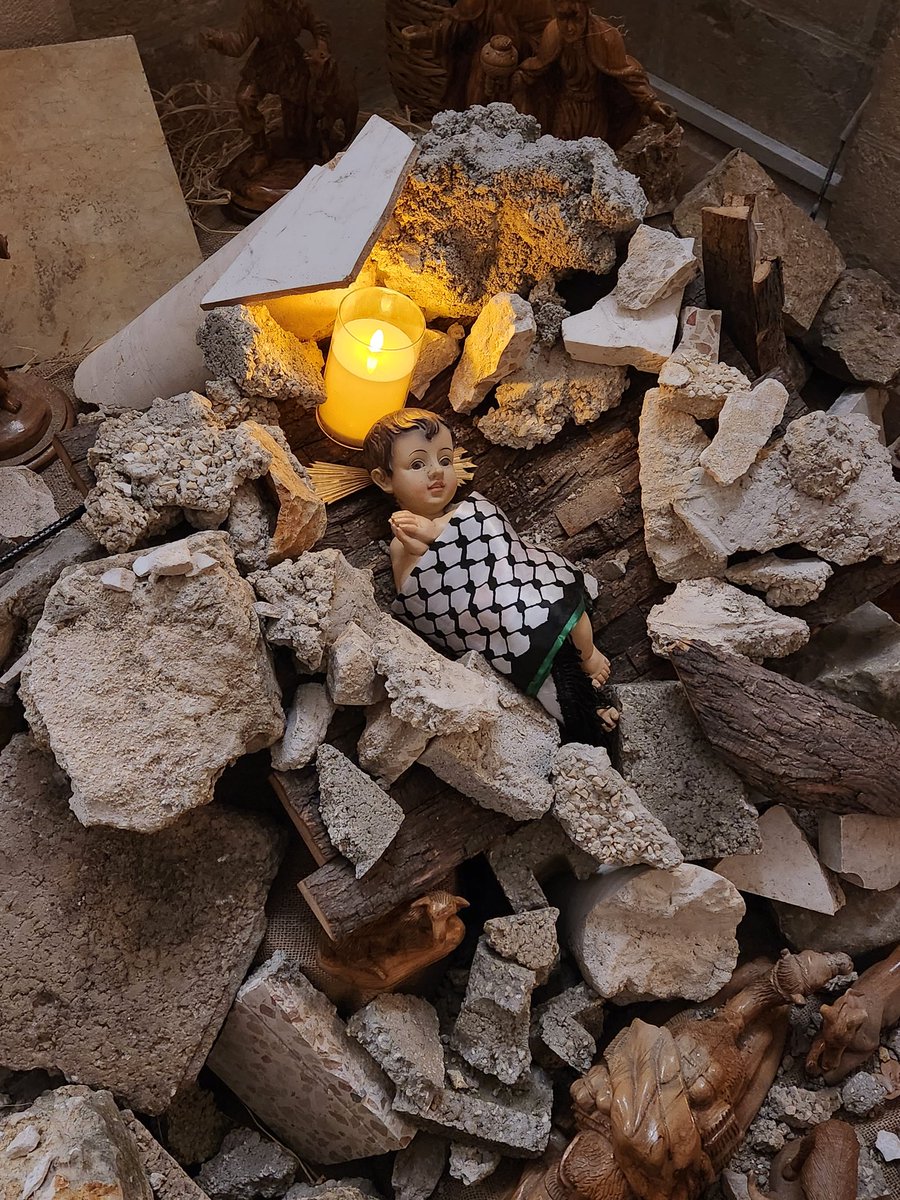
Crèche, December 2023, Evangelical Lutheran Christmas Church, Bethlehem. Photo: Munther Isaac

Today is the 1st Sunday of Christmas. Christmas is far from over as we revel in its meaning for us. Tradition has given us the 12 days of Christmas. Today is the 5th day.

What did my love give me on the 5th day? I’m sure someone will sing the answer.

What’s that all about? Maybe we can guess the significance of the 4 calling birds, the 3 French hens, the 2 turtle doves, and the partridge in the pear tree. Can we?

But what are those 5 gold rings, the four calling birds, the three French hens, the two turtle doves and the partridge in a pear tree?

We see the five rings flying on the Olympic flags, bringing separated nations to play games to bring the world together. Five gold rings, each one representing a continent, all of them representing the whole world. On this 5th day of Christmas, has my true love given me the whole world?

On this 5th day of Christmas our true love gives us this story of Jesus staying behind in Jerusalem and the worry he caused. It leaves us with the question “where in the world is Jesus?” “Where on earth is he?”

This story isn’t told in the other gospels. Luke uses the story to transition from the story of Jesus’ birth to the bigger story of Jesus’ ministry. Instead of staying with his parents for their journey home to Nazareth from the temple festival in Jerusalem Jesus stays behind.

The story gives us Jesus’ first words and they’re the words I suggest we focus on this morning – just in case we lose Jesus and struggle to find him.

We can perhaps all relate to the panic of losing someone in the crowd – so we can relate to what Mary and Joseph must have felt when they realised that Jesus was no longer with them. They thought he was walking back with their relatives or friends but he wasn’t to be found amongst them. They had to go back to Jerusalem to search for him. After three days they found him in the temple courts, among the teachers, listening to them and asking questions.

Remember, this is the beginning of Luke’s gospel. What’s at the beginning of the gospel should remind us of what’s at the end and fulfilment of the gospel, and vice versa. In the end there is another walk – from Jerusalem to Emmaus. Two people walking along the road, talking together about what had happened  – and joined by a third person who turns out to be Jesus. At the beginning of the gospel there were two walking together only because one had separated himself from them. In the fulfilment of the gospel there are three only because one had joined the two.

This is the gospel of Jesus being found in the gospel of the lost and found.

In both stories it takes three days to find Jesus, and three days is a hell of a long time to have lost someone. It was in the breaking of the bread that Jesus had become known to the two disciples in Emmaus. Subsequently he is found in his speech of just four words: “Peace be with you” (24:36) and recognised in his wounds. And this is where Jesus has been found in the church ever since: in the breaking of bread, wherever the greetings of peace are heard, and in the wounds he bravely bears These are the places to look for Jesus. This is where we find Jesus.

Now, that’s a lot to say about the end of his life, particularly as it’s the fifth day of Christmas and we’ve still got the nativity set up in our homes and minds. But already at Christmas we have a birth as well as a death and resurrection. One draws attention to the other in Luke’s telling of them.

Back to the beginning with Mary and Joseph being cross with Jesus. “Son, why have you treated us like this?” And Jesus’s reply to them, “Why were you searching for me? Didn’t you know I had to be in my Father’s house?” These are Jesus’ first words in the gospel of Luke. “Didn’t you know I had to be in my Father’s house?” But they didn’t know what he was saying to them.

This is the question I hope stays with us on this 5th day of Christmas, as we leave one secular year behind and are about to enter another – with fresh resolution to find Jesus wherever he may be – with a commitment to finding him and following him.
Where do we find Jesus?
Where do we find Jesus when we’ve lost him?
Where do we find Jesus when he’s stayed behind?
Why does he stay behind rather than going with us?

Mary and Joseph didn’t understand Jesus’ question. Luke tells us they didn’t understand what he was saying to them. Translators have struggled to capture Jesus’ meaning and have offered an alternative in the footnotes of the NIV – Did you not know I had to be about my Father’s business? But they thought he was in the family business – carpenters for the poor families of Nazareth – Joseph & Son.

But we don’t read the question “did you not know I had to be about my Father’s business? “. We read “Didn’t you know I had to be in my Father’s house?” The question is important because it is a question about where in the world Jesus can be found.

The translation in my Father’s house doesn’t quite seem right. Firstly it suggests the place Jesus can be found is so limited, and secondly it suggests Jesus can be found in a building and that leads us to churchianity rather than Christianity – with church buildings and the institution of church being the place to find Jesus when we know there are so many who love Jesus who’ve not joined a church.

Does this work as a question of Jesus for all his followers, for those who’ve lost him and those looking for him? “Did you not know you’d find me in what my Father is building?” Or, “did you not know you’d find me in whatever my Father is building?” Is that the guiding question? Is that the question to guide our search? As we build our resolution for the New Year, is that the clue to intensify our search for Jesus in what his father, our father, is building?

A couple of chapters further on in Luke’s gospel we come to what is called The Nazareth Manifesto when Jesus read in the synagogue in Nazareth from Isaiah the words, “The Spirit of the Lord is upon me to bring good news to the poor. He has sent me to proclaim release to the captives and recovery of sight to the blind, to let the oppressed go free.” He commented afterwards, “Today this scripture has been fulfilled in your hearing.”

The word manifesto  means showing. Here is Jesus showing what he is about. He is about his father’s business. He is in whatever his father is building. It is on that building site we will find him.

They’ve built a shrine for Jesus in Bethlehem. It shows baby Jesus lying in a pile of rubble in the devastation of his people while Mary, Joseph, the shepherds, the wise men and ourselves search for him. It’s on the side of the altar at Bethlehem’s Lutheran Church. The pastor there, Munther Isaac, a prominent Palestinian peacemaker says that he wants the world to know that is what Christmas looks like in Palestine these days.

Where in the world is Jesus? Where on earth is he? These questions going through the minds of Mary and Joseph go through our minds too.

This is where to find Jesus, in the devastation, wherever there is oppression and suffering, captivity and blindness. 

He’s in the news – in the good news for the poor.
He’s in the sharing of bread.
He’s in the making of peace.
He’s among the wounded.
That is where to find him.

We need look no further.

Discovering consolation with Simeon and Anna

The weekend of Holocaust Memorial Day is the day we celebrate The Presentation of Christ in the Temple. Here’s what I prepared for a small worship gathering in a Warwickshire village.

Presentation of Christ in the Temple – January 28th 2024

I don’t know how many of you watch films, TV or read books. Charles Darwin read novels to relax. But he had one requirement. The book had to have a happy ending. If it didn’t he would fling it furiously on the fire.

So says Polish poet Wislawa Szymborska in her poem called Consolation.

The poem continues:

Roaming in his mind over so many times and places
looking back on all the extinct species,
such triumphs of strong over weak,
so many tests of survival,
sooner or later all in vain,
that at least in fiction
and its micro-scale
he had a right to expect a happy ending.

I don’t know what you make of evolutionary theory, whether you agree with it or not, but I suppose that our usual viewpoint is that of the “survivor” and the “strong” and “fit”. The theory is about the “fittest” surviving. The theory is very good news for the strong as they continually score triumphs over the weak, but it’s very bad news for the forever beaten, weakened to extinction. The logic of natural selection and survival of the fittest was behind the Nazi death camps – their catastrophe we remember this weekend in Holocaust Memorial Day.

Seeing life like that, it is understandable that Darwin looked for happy endings when he read to relax.

Our gospel this morning is about the search for happy endings. Simeon, we are told, was “righteous and devout” and was “looking forward to the consolation of Israel”. His consolation was to take the child Jesus in his arms and to find in him the hope of salvation, “a light for revelation to the Gentiles” and for glory to the people Israel.

The old lady in the gospel story, Anna, started speaking about the child “to all who were looking for the redemption of Jerusalem” – in other words, those looking for consolation because of the state of Jerusalem.

The poet continues her poem by listing all sorts of happy endings. Here they are, some of them:

And so, necessarily: sunrays behind a cloud,
lovers together again, kin reconciled,
doubts dissolved, faith rewarded,
fortunes recovered, treasures dug up.
Neighbours regret their mulishness,
good names restored, greed put to shame,
old maids married to respectable ministers,
schemers expelled to the other hemisphere,
forgers of documents cast down the stairs,
seducers of virgins hurrying to altars
orphans taken in, widows embraced,
pride humbled, wounds mended,
prodigal sons invited to the table,
the cup of bitterness poured into the sea,
tissues wet with tears of reconciliation,
universal singing and music-making,
and the puppy Fido,
lost already in the first chapter,
let him run home again
and bark joyfully.

We’re here, not just because we are survivors. We may have survived many plots and lived through many twists and turns but it is because we love our neighbours as we love ourselves that we are here. Together we stand. We know those who are going through hell. We know those who are hanging on by a thread. We know those who are beaten, rejected and weakened by those who are stronger, wealthier and better connected. We know the plight of the poor, the refugee. We know the victims of hate crimes. We know people who aren’t allowed to be themselves. We cry for the children killed in war, for the families who go hungry. We’re here for them, to worship the God who brings consolation.

Nicholas Winton saved the lives of many Jewish children. His life is featured in the film One Life now showing in cinemas.

We all understand that fiction is fiction and that too often there are no happy endings. There is too much tragedy and that grieves us so. We live in the world where the strong rule over the weak, and where the weak, if they survive at all, continue to suffer. If only there could be a happy ending to all the unhappy endings.

And so we pray – for those who are poor, those who are sick, those in prison, those who are vulnerable. In our prayers we are looking for consolation for those for whom we pray. We are with Simeon whose eyes were fixed on the consolation of Israel, and we are with Anna in her conversations with those looking for the redemption of Jerusalem. We are with them looking for the happy ending for all those who have been wronged and for all those suffering in the state of things today.

We will do all in our power to help those who need our help. We will fight for better lives, happier endings. We gather our energies to make sure that the vulnerable do survive. We know they deserve their happy-ever-after and we will do all in our power to stop those who don’t care for the way it ends for them, the heartless beasts, the wolves, the tyrants.

Israel was suffering from heartless beasts. They were prey to wolves. Tyrants ruled them. They had a history of exile, persecution, oppression – a vast accumulation of trauma and tragedy. Simeon felt that. Anna felt that. And all those Anna spoke amongst felt that. That is why they were looking for the redemption of Jerusalem – a very different ending to the ignominious end which seemed to be their destiny.

Simeon knows there is a happy ending. He has seen it with his own eyes. He has held it in his arms. He has embraced the ending which will see many “fall” and many “raised”. The poor will be blessed. They will rise up. The beasts will be slain. This is the consolation of weak, occupied, isolated Israel. The consolation of Israel is the survival of the least, the last and the lost. The consolation of Israel is the humiliation of the beastly strong. The consolation of Israel is the child. The consolation of Israel is the vulnerability God takes to heart.

Not everyone knows that the Christmas season is a 40 day season in the liturgical year, just like Advent was and Lent is. The Christmas story ends with the presentation of Jesus in the temple. There is a Feast on February 2nd to celebrate this ending. That is the 40th day which churches keep on the Sunday before feb 2nd if they don’t keep weekday festivals. Our gospel reading is the reading for that 40th day.

There are many twists and turns in the Christmas story. There is the danger Mary is in by getting pregnant outside of marriage, there is the discomfort of the journey, there not being any room for them in Bethlehem, the threat to Jesus’ life from Herod, having to take flight to Egypt as refugees. All this is part of the story, let alone the battle between light and dark. There is a happy ending. Simeon finds the consolation Israel was searching for and Anna names their redeemer.

Musicals were playing in the background when I was finishing this sermon. The earworm was Love changes everything. It is love that changes everything. It is love that gives Charles Darwin and ourselves a happy ending. The happy ending is not the survival of the fittest. 

The happy ending is the unhappy ending for the villains (often the fittest, strongest, riches and most powerful). The happy ending is the survival of the people God loves – those so easily lost and so often last and least.

Luke 2:22-40
When the time came for their purification according to the law of Moses, they brought him up to Jerusalem to present him to the Lord (as it is written in the law of the Lord, ‘Every firstborn male shall be designated as holy to the Lord”), and they offered a sacrifice according to what is stated in the law of the Lord, ‘a pair of turtle-doves or two young pigeons.’

Now there was a man in Jerusalem whose name was Simeon; this man was righteous and devout, looking forward to the consolation of Israel, and the Holy Spirit rested on him. It had been revealed to him by the Holy Spirit that he would not see death before he had seen the Lord’s Messiah. Guided by the Spirit, Simeon came into the temple; and when the parents brought in the child Jesus, to do for him what was customary under the law, Simeon took him in his arms and praised God, saying,
“Master, now you are dismissing your servant in peace,
according to your word;
for my eyes have seen your salvation,
which you have prepared in the presence of all peoples,
a light for revelation to the Gentiles
and for glory to your people Israel.’

And the child’s father and mother were amazed at what was being said about him. Then Simeon blessed them and said to his mother Mary, ‘This child is destined for the falling and the rising of many in Israel, and to be a sign that will be opposed so the inner thoughts of many will be revealed – and a sword will pierce your own heart too.’

There was also a prophet, Anna the daughter of Phanuel, of the tribe of Asher. She was of a great age, having lived with her husband for seven years after her marriage, and then as a widow to the age of eighty-four. She never left the temple but worshipped there with fasting and prayer night and day. At that moment she came, and began to praise God and to speak about the child to all who were looking for the redemption of Jerusalem.

When they had finished everything required by the law of the Lord, they returned to Galilee, to their own town of Nazareth. The child grew and became strong, filled with wisdom; and the favour of God was upon him.

Darkness needs light: a reflection on the coming of holy night

I assume that everyone’s feeling tired by midnight on Christmas Eve. Midnight is not the time to be preaching long and hard. Here’s my offering for a group of churches in rural Warwickshire.

Wherever we look in the story of Jesus’ birth there is darkness. 

Matthew’s gospel begins with Mary’s disgrace and how Joseph saved her from being cast out by marrying her. Then we’re told that the Magi’s search triggers the slaughter of the innocents by Herod – he killed all the children in Bethlehem and around who were under two years old! Then Mary and Joseph become refugees to escape Herod’s slaughter.

Luke’s gospel begins with the darkness of Joseph and Mary being forced to make the long journey from Nazareth to Bethlehem by order of the Roman emperor -just to be counted – just to become numbers in the machine of a foreign empire. 

John’s gospel begins with the life which was to be the light of all people, the light that shines in darkness.

Darkness is never far from us. It’s within us – all those dark thoughts, and it’s all around us. On this night of darkness we celebrate how the light comes to us, how the light comes to us as love (all vulnerable), how the night becomes holy – thanks be to God.

I wrote this for tonight.

One light,
so much darkness. If truth be told
what Christmas needs
is the longest of nights, 
the shortest of days,
and the time when people
are at their coldest
and meanest.

For truth to be told
darkness needs light
for the night to find its way to day,
for those who walk
through the dark night of the soul
lost in a cloud of unknowing
frightened in the valley
of the shadows of death.

If truth be told
darkness lies
in the distance between us,
what  we do to one another in war,
rape, rubble, ruin in Gaza and Kyiv.
It rides the nightmares
of suffering, anxiety, despair.
It’s the cost of living.

The data of darkness
is hidden in official secrets
and personal shame,
in the blindness of prejudices
in the lies of truth twisters
in the scheming of profiteers
in the denial of freedoms
in the erections of borders

that divide darkness
from darkness, hiding the terror
from which so many flee.
It’s in their denial. Yes,
there is no room.
It’s in their small boats
not built for the darkness
of the deep and stormy sea.

If truth be told, it’s told in numbers:
in the homeless numbers,
the foodbank users,
the choosers choosing 
heating or eating,
the children killed in war.
It‘s in the numbers of those
who are just numbers.

It’s the middle of the night,
when even the clocks
put their hands together
in time to pray.
They pray for first light
to end the night, a baby flame
in the frame of shame,
and then they pray us awake

and in the darkness, see,
shimmering and flickering
in the world which,
if truth be told,
has no room for Light,
where the only place
to rest his head lay
in the love of a mother

and the kindness of a stranger 
in the inn the light came in,
casting shadows with halos,
our light never dying.
With the angel band backing,
all hallelujah singing,
watching shepherds 
dance the night away.

Joy to the world. Happy Christmas.

© David Herbert 2023

Christmas and the cost of living

This poem was inspired by a small and mighty Christmas cards designed by a friend.

Christmas and the cost of living

Why do we make
Christmas so big
when joy’s so short,
innocence lost,
when baby’s squeezed
in a one star place?

Why do we make
Christmas so big
when the word,
from the beginning
was just a whisper
kissed of God?

Why do we make
Christmas so big
when we hang the tree,
lynch the light and
tinsel tight tie
the hostage angel?

Do we there nail
our hope that in
Advent edgeway
such baby-talk
may faithful grow
mercy, love, peace?

©David Herbert

The First Photograph – a poem for these sort of times

The First Photograph

When Aylan Kurdi’s photo splashed across the waves,
it was a scoop, a spotlight on refugees, a beacon of hope
for better treatment, more welcome ways. It became
Sea Prayer for parents casting their children to sea in light vessels.
But nothing changed. It was a false dawn. Children keep drowning.
Here in Bethlehem, lives are poor, government weak.

A concrete cordon of wall dominates, not for our security mind,
but as shutter and blind to lives despised. We are occupied
by those whose minds pre-occupied by counting our threat,
known by numbers, never names. Our lives are poor,
our movement restricted, often imprisoned for raising flag,
hand or stone, getting by with our whittled olive tourist trade.

When reporters came from way out east, that was our moment,
that Aylan Kurdi flash. Three came. They’d heard our plight.
and noted our views, their reports were carried in paper news.
Their attraction, they said, was a star, a pin prick in a night sky,
inspiration for their camera and that first photograph, a baby
captured, strangely focused, fast exposed as a flash of light.

That was the image of us. It sold and sold. going world-wide,
framed, kissed and even enshrined, the light of the world,
while we still in darkness lie. There was a child, a shot in the dark.
Because of that aperture in this little Goliath walled town
where streets stay dark and soldiers still count their enemy,
we picture endurance in that light relief, that blink of an eye,
that pin prick in the night.

©David Herbert

Links to Khaled Hosseini’s Sea Prayer and the photo of Aylan Kurdi’s body

Nativity – He Qi

He Qi is a Chinese artist who spent the years of the Cultural Revolution painting pictures of Mao Tse Tung in the day time as an alternative to forced labour, and in the evening painting pictures of the Madonna inspired by his fascination with Raphael’s Madonna and Child.

He Qi’s Nativity is typical of his work in terms of colour and vibrancy. His painting resembles stained glass and always feel they have an element of fun. In this picture you can see the sheep virtually dancing in response to the angels. Listening is an important element of this piece. Of course, the sheep stand for all those who know the Lord as their shepherd.

The light in this Nativity comes from heaven and is far more intense than the light any of us can hold. The light Joseph holds is dim compared to the light that Mary holds. – but then Joseph is fading from the picture with his work well and faithfully done.

Mary is pictured in the pink. Normally Mary is dressed in blue, but here He Qi picks up pink as a symbol of marriage and shows Mary as the archetype of the church who holds and treasures Jesus. Jesus is offering a red apple to Mary and the church. This is a reference to the Garden of Eden signifying Jesus as a new Adam and Mary and the church as a new Eve. This is new creation.

The apple is blood red to indicate the nature of God’s offering. Is there also an ambiguity in the shape of the apple? Is it also heart shaped to indicate that this is the new heart promised by God to his disheartened people (Ezekiel 36)?

This is the Nativity. Christus natus est. This is Christmas. Happy Christmas.

A Pearl from Dietrich Bonhoeffer

dafjas9u8aenm4b
Dietrich Bonhoeffer’s statue is one of ten to modern martyrs, unveiled in July 1998, which stand above the west entrance to Westminster Abbey. The sculptor was Tim Crawley.

On this day, 1945, Dietrich Bonhoeffer was martyred – aged 39. His life, teaching and death are constant reminders of the cost of discipleship and the need for political engagement. Here is one of his pearls:

God travels wonderful ways with human beings, but he does not comply with the views and opinions of people. God does not go the way that people want to prescribe for him; rather, his way is beyond all comprehension, free and self-determined beyond all proof.

Where reason is indignant, where our nature rebels, where our piety anxiously keeps us away: that is precisely where God loves to be. There he confounds the reason of the reasonable; there he aggravates our nature, our piety—that is where he wants to be, and no one can keep him from it.

Only the humble believe him and rejoice that God is so free and so marvelous that he does wonders where people despair, that he takes what is little and lowly and makes it marvelous. And that is the wonder of all wonders, that God loves the lowly…. God is not ashamed of the lowliness of human beings. God marches right in.

He chooses people as his instruments and performs his wonders where one would least expect them. God is near to lowliness; he loves the lost, the neglected, the unseemly, the excluded, the weak and broken.

Dietrich Bonhoeffer, God is in the Manger: Reflections on Advent and Christmas

Opening the community chest

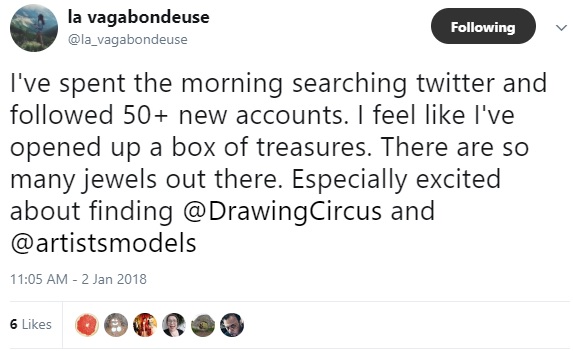
la vagabondeuse

I love that tweet @la_vagabondeuse and know the feeling of opening up a box of treasures. There are so many jewels out there. Of course, this has more to do with la_vagabondeuse’s willingness to open her ears and heart to others. Twitter is just the means to that end – one of many social media and other means.

I spent an hour and a half reading through my Twitter feed this morning. Call it a birthday indulgence if you like, but I know it is something I should be doing more of (listening, that is). There are whole boxes of treasure and so many jewels. Here’s some of what dazzled me this morning:

  • John Sutherland’s robust response @policecommander to Daily Mail’s lazy front page report on the nation being hooked on happy pills
  • the recall by Michelle Eyre @MichelleDEyre of the 9th day of Christmas, her true love’s gift of “nine ladies dancing” and her thanksgiving for the nine fruits of the Holy Spirit
  • some lines from Hafiz relayed by Ramblings @ramblingsloa: “Ever since happiness heard your name, it’s been running through the streets trying to find you.”
  • a beautiful image of Naomi and Ruth shared by Jacqueline Durban @radicalhoneybee together with a simply three word sentence: “Love made rock”
  • a 50 second video @HSBC_UK with hashtag #togetherwethrive shared by Michael Sadgrove @sadgrovem in praise of the word “together” in the spirit of Bonhoeffer

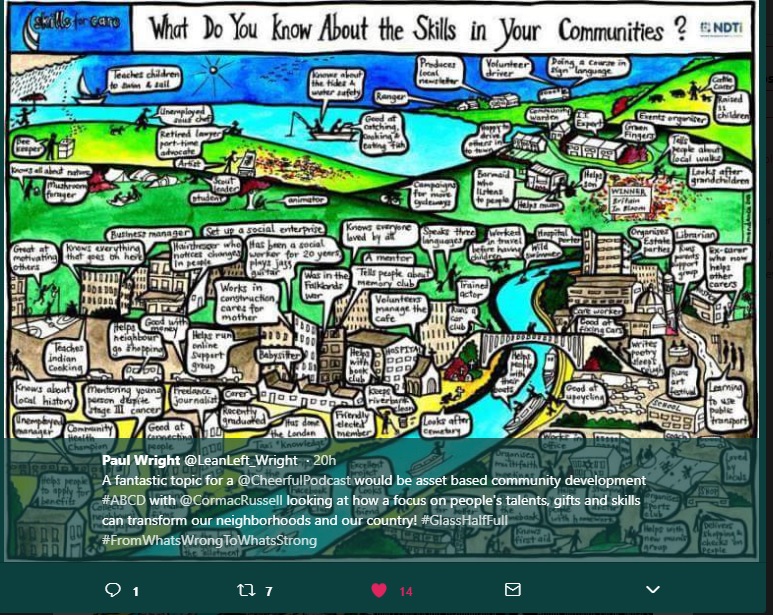
I do realise that Twitter is a preserve of the chattering classes, but it is one way of listening to others. We can choose our newsfeed and who we listen to. I choose the twitterati who have their ear to the ground, the ones who are sensitive to the rumblings of down to earth living (over, for example, the Daily Mail and its presumption of daily fail). And I discover, through that listening, the huge amount of treasure in the community chest – treasure graphically portrayed in another tweet from Paul Wright @LeanLeft_Wright this morning.ABCD

This shows the energy bubbling under the surface of community making the point that community develops through the appreciation of its members. You have to live there to know that. It is about opening our ears to hear the voices of others, and opening our hearts to the passion of others and celebrating the community bounty – the treasures and jewels of the community chest, just like la vagabondeuse is trying to do. This is loving the voice of our neighbour and discovering our commonwealth. Put technically this is “asset based community development”. But for those who live there, it is simply the love that makes the rock on which community builds (to paraphrase @radicalhoneybee).