Giving

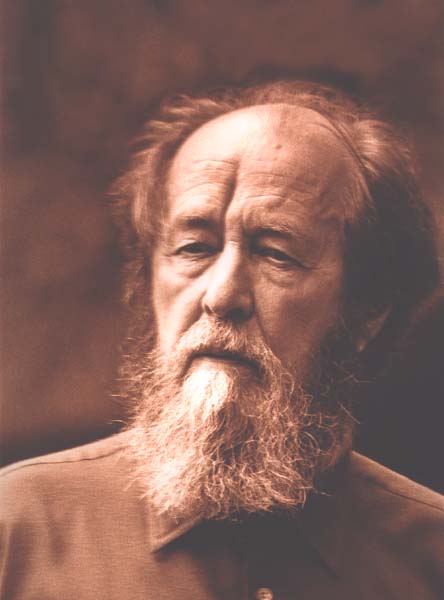
>Miroslav Volf refers to a story written by Alexander Solzhenitsyn in his book Free of Charge. That’s Solzhenitsyn’s picture.

In the story Matryona’s House an old woman “never tried to acquire things for herself. She wouldn’t struggle to buy things which would mean more to her than life itself. All her life she never tried to dress smartly in the kind of clothes which embellish cripples and disguise evildoers.” As the story unfolds she is misunderstood and abandoned, even by her husband. Six of her children die but she carries on giving.

“We all lived beside her”, Solzhenitsyn put in mouth of one of her fellow villagers, “and never understood that she was the righteous one without whom, according to the proverb, no village can stand. Nor any city. Nor our whole land.”

Volf comments a gift is an “event between people. Gifts serve “to create, nourish or re-create” social bonds.

I don’t think I am a good giver. According to Volf “ungracious and reluctant givers inspect the causes of a need and dole out the benefits in proportion to its legitimacy.” He refers to Nathan the Wise , a play by Lessing written in 1779, in which Sultan Saladin enlists a beggar to be his treasurer. The Sultan wanted to end begging by ensuring that beggars could afford not to beg. He wanted a beggar as his treasurer “because only a beggar knows how to give to beggars appropriately”. Of his previous treasurer Saladin said:”He gave so ungraciously when he gave; first inquired so vehemently into the situation of the receiver; never satisfied that he wa slacking, also wanted to know the cause of the lack, in order to measure the cause stingily against the offering.”

I wonder whether Christian teaching about giving has helped. Most sermons seem to be about persuading worshippers to hand over their cash to keep the show on the road. On the drain/radiator test, this sounds more like a drain and a far cry from God giving life to the world. (radiator!)

Feeding the Church


As Christians we gather at the table and remember what Jesus did with bread on that hillside. The words used by Matthew here are familiar from the Last Supper account and from our own celebration of the Eucharist as well: the verbs–take, bless, break and give–are simple but powerful, and apply to our lives just as they apply to the bread we share with one another and with the world. In fact, this work of the church goes on in every age and every wilderness. Thomas Long writes: “the church is always in the desert, the place where it cannot rely upon its own resources, which are few. The church is hungry itself and is surrounded by a world of deep cravings….” 

from Kate Huey with reference to the Feeding of the 5000
Picture is by Eularia Clarke

>Blessing

>It is easy to believe we are ‘cursed’ – naturally, not supernaturally, I mean.

The media messages pick on our personal, social and institutional points of vulnerability. All these voices leave us with a deep sense of unease.

If we feel cursed ourselves the likelihood is that we will curse others.
However, if we know we are blessed the likelihood is that we will bless others. I know how much I curse others, and I know how much I bless others – and can draw my own conclusion that I haven’t been doing enough listening to the voices that call me blessed. I know I am not alone in finding it hard to accept blessing and to treasure the blessings people give.

Blessing comes from the Latin word “benediction” meaning “speaking well”. Jesus has a warning for us when too many speak well of us (Luke 6:26) that means we might have become too powerful, boastful and corruptible – but all of us need to be affirmed.

Nouwen points out that this is the way to “a sense of well-being and true belonging” and was moved by the blessing given to a 13 year old at his bar-mitzvah by his parents: “Son, whatever will happen to you in your life, whether you will have success or not, become important or not, will be healthy or not, always remember how much your mother and I love you.”

For Nouwen, prayer is about listening to that voice of blessing – to hear with the “ear of faith” the persistent voice of love saying “You are my beloved child – on you my favour rests.”

The blessings are there for us to receive.

“the blessings of the poor who stop us on the road, the blessings of the blossoming trees and fresh flowers that tell us about new life, the blessings of music, painting sculpture, and architecture – all of that – but most of all the blessings that come to us through words of gratitude, encouragement, affection and love. These many blessings do not have to be invented. They are there, surrounding us on all sides. But we have to be present to them and receive them. They don’t force themselves on us. They are gentle reminders of that beautiful, strong, but hidden voice of the one who calls us by name and speaks good things about us.”

>The Information Age

>Listening to friend Carol’s presentation yesterday made me realise how church is tied down by the industrial age. Perception of church is stil very much building based and the church building boom seems to have been part and parcel of the industrial development of the 19th century. Often funded by industrialists churches were places to be seen and seemed to cement people’s place in society.
We have hastily moved from being an industrial society to being an information society, and is it the nature of information which has had such an effect on society and how we organise ourselves into social networks. Yet while factories have closed (and communities coped far better that they thought) our church buildings remain and remain furnished with the trappings (and pews) of the mindset of the industrial age.
According to Gregory Bateson “information is a difference that makes a difference”. Dee Hock makes these points:

Unlike finite physical resources, information multiplies by transfer and is not depleted by use.
Information is a miser of energy. It can endlessly replicate, move ubiquitously at the speed of light, and massively condense in minute space …
Information breeds. When one bit of information is combined with another, the result is new information. It will become the slave and property of noone. Efforts to make information conform to archaic notions of scarcity, ownership and finite physical quantity – concepts that grew out of the agricultural and industrialised age – merely lock humankind into old, mental boxes of constraint and exploitation.
Information is ethically neutral.
Products, services, and organisations in which the value of the mental content begins to dwarf the value of the physical content require wise people of deep understanding.

Dee Hock writes this:

Thinking about a society based on information and one based on physicality requires radically different perspective and consciousness. However, we prefer too often to ignore the fundmental differences nd carry over into the Chaordic Age of managing information, ideas and values, concepts and assumptions that proved useful in the mechanised Industrial Age of machine crafting, the age of managing things; concepts such as ownership, scarcity, spearability, quantifiable measurement, statistical economics, mathematical monetarism, hierarchical structuralism, and command-and-control management.
The birth of the Chaordic Age alls into question virtually every concept of societal organisation, management, and conduct on which we have come to rely. Clinging too rigorously to old concepts, dismissing new concepts too lightly, protecting old forms that resulted from those concepts too fiercely, imposing those forms on a changing society too resolutely, are a certain path to failure.

Hospitable Space

> Turkish people were able to gather together to watch their team in the Euro finals because one of them had started a facebook to see how many Turkish people there were around in the north-east. Facebook, ebay, youtube are typical self-organising communities in our networking society. They don’t need community workers or developers. They don’t need leaders or rulers either. Facebook has over 75 million members with 250,000 joining every day.
On the other hand, membership of many other communities are in sharp decline. Membership of churches, voluntary groups, political parties all report falling memberships. Some cynically say that people are avoiding commitment – or are they avoiding commitment they are not willing to give. Or, are people leaving things where there are rules and regulations – where they are feeling they are being organised by somebody else?
What does this say to people who want to see the development of community?
The size of membership of Facebook indicates that I am not alone in wanting to develop community and belong to community. But I operate in an institution (because the Church of England operates as an institution)and as part of “leadership” implement initiatives which create frustration when the “followers” don’t respond. Myself and others who have been hide-bound by institutional community need to learn is that communities which flourish are those which are self-organising, and which are movements rather than institutions.
Isn’t this what the early church looked like to St Luke? He describes members meeting in one another’s houses, sharing everything. He underlines how fast the community was growing.
What Facebook offers is a space for people to move into. Maybe that is what the art of living is – providing spaces of hospitality in which people can belong and grow – which reminds me – I must go and lock the church. Oh dear!
This is what the Rhett Smith has to say on the subject:

Basically, people are organizing themselves in powerful ways that thwart the traditional means of organization through leaders in authoritative, hierarchical positions. No longer do people need to go through an institution to achieve their end goal. Many churches already know this, and still, so many other don’t. Those who recognize the shift will be in positions to harness the unbelievable creative power of a church community. Those who don’t will find themselves struggling to carry out the vision for their church community.

>Dee Hock

> A soul-friend discovered, and the launch of a new book prize – Jogger’s Read of the Year with the top prize going to Dee Hock’s “Birth of the Cahordic Age” discovered by me 10 years after its publication.

Dee Hock describes his relationship to insitutions – and it rings an eight bell quarter peel in my mind. he writes of his teenage rebellion:

“My rebellion was persistent, stubborn, at times stupid refusal to accept orthodox ideas, be persuaded by authoritarian means, or seek acceptance by conformity.”

He asks: “what is this chasm between how institutions profess to function and how they actually do; between what they claim to do for people and what they actualy do to them?” (p37) Among them: schools that can’t teach, unhealthy health-care systems, welfare systems in which no one fares well, farming systems that destroy soil and poison food. (p28)

I could ask in similar vein why it is that the church which is supposed to offer life in all its fullness induces such boredom and is seen as a “turn off” instead of a “turn on”, and why it is that the good news of salvation has to be cloaked in disguise in order not to frighten people off (according
to my reading of a recent PCC discussion on our parish magazine.