A reflection on Psalm 1 and Luke 6:17-26 for two small congregations in a group of parishes in vacancy.
The 3rd Sunday before Lent – Year C
In last week’s gospel (Luke 5:1-11) crowds surrounded Jesus so much that to find space for himself Jesus needed to get into a boat on the lake as crowds gathered around Him to hear His teachings.
We have another crowd in today’s gospel (Luke 6:17-26). There’s a large crowd of his disciples (including the twelve he called “apostles”), and “a great number of people from all over Judea, from Jerusalem, from the coastal region around Tyre and Sidon” who had come to hear him and be healed of their diseases.
In the context of safeguarding we need to note that Luke has underlined where Jesus was in relation to the crowd. He is not “high up”, over others.
In the boat on the lake he would have been lower than his hearers.
And in today’s gospel Luke paints a different picture to Matthew’s Sermon on the Mount. Luke has them all on a level place – Jesus on the level with all the people.
In this, and so many other ways, Luke is wanting to show how Jesus stands in relation to others – never overbearing, never patronising, always side by side – as typified by walking incognito with disciples to Emmaus.
There is no distance between Jesus and the people. He was there with them, eye to eye, shoulder to shoulder, side by side, valuing relationship over hierarchy.
That’s the position you’re hoping to fill, isn’t it? You’re hoping for a priest who will ask your permission to come alongside, as your helper. It’s probably also the position we long to be ourselves, alongside others with others alongside us.
None of us are ever safe when people look down on us, and nobody is safe from us as long we look down on them. Jesus’ physical positioning in relation to others guarantees safety. He is the good shepherd.
That’s how Jesus positioned himself, alongside us, always on the side of those he blesses. What is our position? Where do we stand?
The psalmist points to those who take a very different position. They “walk in the counsel of the wicked”, “linger in the way of sinners” and join “the assembly of the scornful”. They’re condemned. They won’t stand the judgement of the law of the Lord or stand in the “congregation of the righteous”.
There is another way. That is the way of Jesus and all those who delight in the law of the Lord, meditating on his law day and night. They’re the ones blessed and the psalmist sees them like trees “planted by streams of water, bearing fruit in due season”.
There is a clear choice: the way of the wicked, or the way of the Lord. It’s either blessings or curse.
I had to go to a two column format to get our two readings on one sheet of paper. But in so doing I have shown the pairings:
Blessed are all you who are poor, but woe to you who are rich
Blessed are you who hunger now, but woe to you who are well fed now
Blessed are you who weep now, but woe to you who laugh now
Blessed are you when people hate you, exclude you and insult you, and woe to you when everyone speaks well of you

This is the law of the Lord. This is Jesus’ teaching. This is the law of the Lord according to Luke who has already given us Mary’s song celebrating the ways of God in scattering the proud, toppling rulers from their thrones, raising the humble and humiliated, filling the hungry with good things and sending the rich empty away. This is the law of the Lord. (Luke 1:46-53).
This is the law of the Lord brought to us by Luke who has already told us how Jesus preached in the synagogue about the law of the Lord being good news for the poor: freedom for prisoners, recovery of sight for the blind and liberation for the oppressed. (Luke 4:18-19).
This is the law of the Lord our scriptures describe as blessed. This is the law that delights the blessed but which the wicked, the sinners and the scornful scorn. This is the law that those who are blessed think on day and night, according to Psalm 1.
They are like a tree planted by streams of water, bearing fruit in due season, with leaves that do not wither.
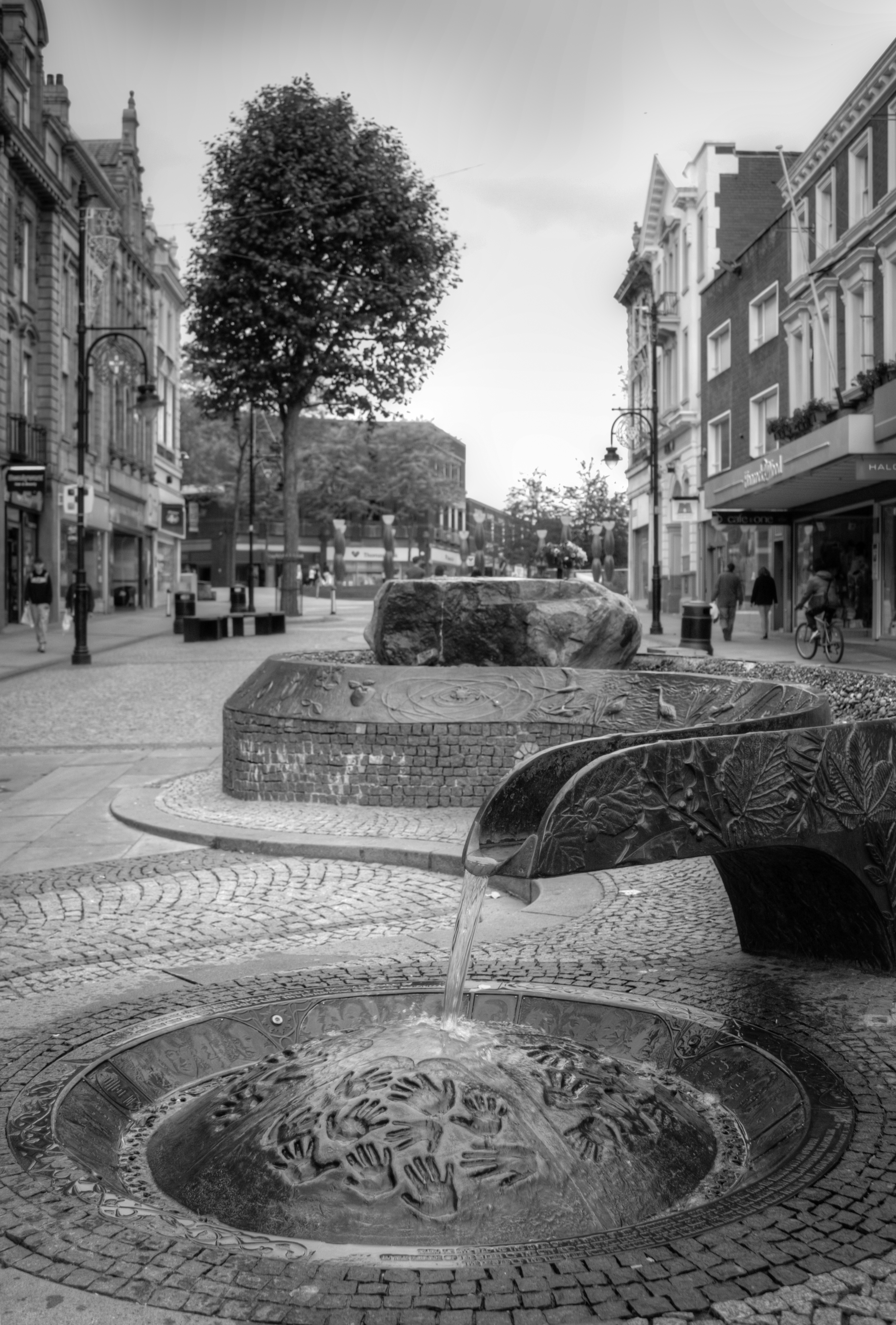
When I read that verse this week my mind went to a sculpture called The River of Life which runs down the main shopping street in Warrington. The sculpture was built by Warrington Council after two bombs were detonated by the IRA, killing 3 year old Johnathan Ball and 12 year old Tim Parry and injuring 56 others. It was the day before Mothering Sunday, March 20th, 1993.
The city council turned to a sculptor to discuss a memorial. Stephen Broadbent was the sculptor. He saw that the street was not just physically broken, but spiritually broken as well. He wanted to design something that would be “a symbol of renewal and faith in the power of the human spirit to triumph over adversity and to invest the future with hope.”
His inspiration was the image of the river of life in Revelation 22.
The angel showed me the river of the water of life, as clear as crystal, flowing out from the throne of God and of the Lamb down the middle of the great street of the city. On each side of the river stood the tree of life, bearing twelve crops of fruit, yielding its fruit every month. And the leaves of the tree are here for the healing of the nations.
And so it is. Now, flowing down that street is the River of Life he made and on either side of the streaming water are trees, one for each month, each bearing fruits of the Spirit for the healing of the nations, for all times and seasons.
And so it is in Psalm 1 where the blessed are like a tree planted by streams of water bearing fruit in due season. I wonder that Stephen Broadbent himself is one of those trees, planted by the stream of tragedy and violence, leaving blessings of hope and healing through the season of trauma and grief.
I’ve seen photocards with these verses from Psalm 1. In them the stream is picturesque with sunlight reflecting from its gentle flow. The psalm doesn’t say the water is safe.
The stream may be dangerous, fast flowing floodwater, a tidal wave, or deep or toxic.
Or with a stretch of the imagination, the waters could be the waters that have to break for us to be born or baptised.
Or the stream and the metaphor may be a metaphor for life.
Does the law of the Lord raise up people who delight in the law that there should be people by all the rough waters of life, that there should be lifesavers of healing, hope and blessing bearing fruit for all seasons of difficulty and danger?
It’s worth visiting that sculpture in Warrington. It’s on Bridge Street. It was always Bridge Street. The street hasn’t been renamed because of the sculpture and its intention to bridge the awful violence that tore people’s lives apart.

And here we are. The Bridges Group of Parishes – so called because of the bridges of the villages that make up the group of parishes. And the bridges are there to bridge the waterways that cut through the landscape.
We’ve reflected on Jesus’ position in relation to the crowds that streamed to him. We’ve reflected on the Psalmist’s position on those who delight in the law of the Lord.
We’ve reflected on the sculptor’s position in relation to the trauma of a community.
What about our own position?
Are we bridge builders and lifesavers? Do we delight in the law of the Lord, meditating on his law day and night? Are we blessed as agents of blessing, healing and hope? Or are we a curse on the poor, the stranger, the refugee, and all those vulnerable to losing their life at sea because we take our cues from the scornful, lingering in the way of sinners, taking the counsel of sinners?
Where are we as the river of life flows through our lives? Are we bridgebuilders offering healing where there has been division, hope where there has been despair? Are we like trees that bear the fruits of God’s Spirit, the fruits of love, joy, peace, forbearance, kindness, goodness, faithfulness, gentleness and self-control (against which no other law can stand) (Galatians 5:22f)?
What is our position in relation to those Jesus blesses? Are we on their side, or are we on the side condemned by Jesus, with those who’ve grown rich at the expense of the poor, those who have stuffed themselves while so many go hungry, those who can afford to laugh while the rest of the world is in bits, those who walk the corridors of powers and still exclude, insult and reject others?
For as long as we delight in the law of the Lord, for as long as we seek to understand it, we will be on the side of those in the roughest of waters.

 Grits and Grains