Luke’s Last Surprise: One Condemned Man Joining Another as the First in Paradise

This Sunday marks the end of the Christian year.
Next Sunday we hop on the next liturgical cycle of readings – it will be Year A.
Each year focuses on a particular gospel. Next year it will be Matthew’s. This year it has been Luke’s.

When I began this preaching year, I wondered what Luke would offer us.
I wondered how he might inspire us, challenge us, lead us.
And now, at the end of the year, I find myself saying one thing above all: WOW.
Luke has surprised us. Luke has stretched us.
Luke has shown us the kingdom of God in places we would never have thought to look.

This Sunday is a WOW moment,
a hinge on which we hang our wonder,
before the new year opens again.
Next week we begin again,
not from cold, not from scratch,
but already warmed by hope,
already knowing what God’s kingdom looks like
in the dominion of darkness.

We will return to the manger
knowing now what Luke has shown us all year –
that God’s kingdom begins with the smallest,
with the least, with the last instead of the first,
in a vulnerable baby held by exhausted parents
on the edges of empire.

These are the readings (Colossians 1:11-20 and Luke 23:33-43) that crown our year.
And this is where Luke has been leading us all along:
not to a palace, but to the place of the skull,
Not to a gold throne, but to a wooden cross.
A king.
A sign nailed above his head.
And a thief beside him.
That’s the gospel picture.
That’s where Luke brings us when the year ends and we crown Christ our King.

Our other reading, from Colossians, may seem difficult at first –
until we recognise it as a hymn.
A hymn praising the God who rescues us from the dominion of darkness,
who strengthens us with endurance,
who qualifies us for the kingdom of his beloved Son –
the kingdom of light,
the kingdom where Christ is King.

Luke paints the scene.
It is the “dominion of darkness” (to use the phrase from Colossians).
The place is the place of the skull,
Death Row in the Dominion of Darkness:
there is the smell of death
and the overpowering smell
of cruelty, injustice and wrongdoing.
There are three crosses.
One is for Jesus, the others for two criminals crucified either side of him.

Luke gives them very different voices.
One sneers – placing him with those who mock, jeer and insult Jesus.
“He saved others, let him save himself if he is who he says he is.”
(In other words, he isn’t who he says he is.)
“Aren’t you the Messiah? Save yourself and us!”

The other criminal rebukes him, saying the two of them deserve their punishment.
Then he protests Jesus’ innocence. “This man has done nothing wrong.”
And in that moment he is just right.
He is right to defend the defenceless
against the forces which have conspired against Jesus.
“This man has done nothing wrong,”
and yet he is facing the same sentence, only worse,
because insult is added to injury.

Then he turns to Jesus.
“Jesus, remember me when you come into your kingdom”

This criminal is the first to defend Jesus publicly.
He is the first to take his stand with Jesus.
And Luke wants us to see him.
This figure.
This last, least, condemned man
who becomes the first to declare Jesus innocent
and the first to receive a royal promise.

He is the last person in the world you’d expect
to be the first to defend Jesus –
(we are led to believe that there is no honour amongst thieves),
but here he is in the picture of paradise – alongside Jesus.
The last becomes the first in paradise,
that kingdom of love –
a relationship, not a place.

And here – right here – you can almost see it happen:

And perhaps this is Luke’s final surprise for us:
that the first to enter paradise with the King is not a saint or a scholar or a faithful disciple,
but a criminal who can offer Jesus nothing but honesty and trust.

He offers no record of virtue.
No proof of goodness.
No last-minute achievements.
He can’t even lift his hands in prayer.
All he can do is speak the truth —
about himself, about Jesus, about the kingdom.
And Jesus takes that truth, that tiny seed of faith,
and makes it bloom.

“Today you will be with me in paradise.”

And that paradise begins there,
in the dominion of darkness,
with a king crowned not with gold but with thorns,
and a wrongdoer who sees more clearly than anyone else.

The only crown Jesus could ever wear is a crown of thorns.
They’re the thorns of scorn, the barbs of bitterness.
They’re our failures, our wounds, our complicity,
our inability to rule even ourselves.

But the kingdom Luke has been showing us week after week
is a kingdom where the last come first,
the lost are found
and where the crucified King gathers in his arms
those the world’s unjust powers condemn.

This is the WOW moment.
Everything has led to this,
when the thorns begin to flower.
This is what Luke is intent on showing us.

His sequel, Acts,becomes the story
of the cross in bloom.
The frightened disciples become bold and generous.
The failures become witnesses.
A crippled beggar stands up and walks.
An Ethiopian outsider becomes the first fully Gentile convert.
A persecutor becomes an apostle.
Prisoners sing hymns; jailers are baptised;
enemies share bread.

Again and again the thorns flower.
Again and again the barren places bear fruit.
Again and again the last become first.

This is where the King of Love leads us:
into a rule of life that puts the last first
and sees thorns flower with grace.

All year long Luke has shown us a kingdom that grows in unlikely places,
and now at the last,
he shows us the unlikeliest place of all,
the place of the skull, Death Row.
Yet even here, if we look through Luke’s eyes,
Something ]begins to bloom.

At the place of the Skull grows the tree of life.
The crown of thorns flowers with grace.
The King of Love
and the convicted criminal
become the first couple in the new creation –
the first to walk the way of mercy,
the first to step into the garden of God’s future.

This is how the Christian year ends:
not with worldly triumph,
but with this strange, saving beauty –
a King who makes the last first,
who turns a place of execution into a place of promise,
who opens paradise to the least likely of all.

This is the kingdom of God and the gentle thorn-crowned rule of Jesus.

Luke 23:33-43

When they came to the place called the Skull, they crucified him there, along with the criminals – one on his right, the other on his left. Jesus said, ‘Father, forgive them, for they do not know what they are doing.’ And they divided up his clothes by casting lots.

The people stood watching, and the rulers even sneered at him. They said, ‘He saved others; let him save himself if he is God’s Messiah, the Chosen One.’

The soldiers also came up and mocked him. They offered him wine vinegar and said, ‘If you are the king of the Jews, save yourself.’

There was a written notice above him, which read: this is the king of the jews.

One of the criminals who hung there hurled insults at him: ‘Aren’t you the Messiah? Save yourself and us!’

But the other criminal rebuked him. ‘Don’t you fear God,’ he said, ‘since you are under the same sentence? We are punished justly, for we are getting what our deeds deserve. But this man has done nothing wrong.’

Then he said, ‘Jesus, remember me when you come into your kingdom.’

Jesus answered him, ‘Truly I tell you, today you will be with me in paradise.’

Wherever is Jesus? Where in the world is Jesus? Where on earth is he? Questions for the search team

A reflection on the loss of Jesus for the first Sunday of Christmas (year C). The gospel is from Luke 2:41-end when Joseph and Mary lost Jesus.

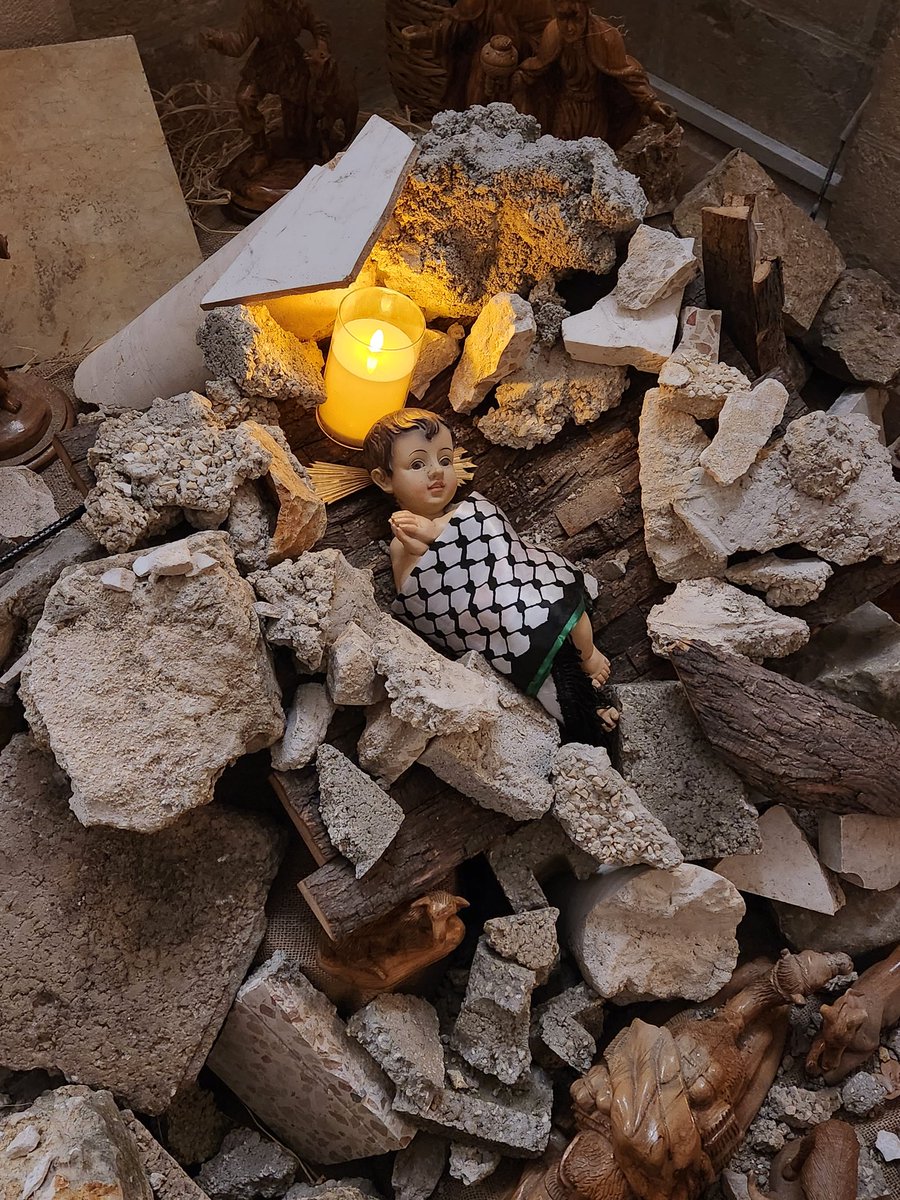
Crèche, December 2023, Evangelical Lutheran Christmas Church, Bethlehem. Photo: Munther Isaac

Today is the 1st Sunday of Christmas. Christmas is far from over as we revel in its meaning for us. Tradition has given us the 12 days of Christmas. Today is the 5th day.

What did my love give me on the 5th day? I’m sure someone will sing the answer.

What’s that all about? Maybe we can guess the significance of the 4 calling birds, the 3 French hens, the 2 turtle doves, and the partridge in the pear tree. Can we?

But what are those 5 gold rings, the four calling birds, the three French hens, the two turtle doves and the partridge in a pear tree?

We see the five rings flying on the Olympic flags, bringing separated nations to play games to bring the world together. Five gold rings, each one representing a continent, all of them representing the whole world. On this 5th day of Christmas, has my true love given me the whole world?

On this 5th day of Christmas our true love gives us this story of Jesus staying behind in Jerusalem and the worry he caused. It leaves us with the question “where in the world is Jesus?” “Where on earth is he?”

This story isn’t told in the other gospels. Luke uses the story to transition from the story of Jesus’ birth to the bigger story of Jesus’ ministry. Instead of staying with his parents for their journey home to Nazareth from the temple festival in Jerusalem Jesus stays behind.

The story gives us Jesus’ first words and they’re the words I suggest we focus on this morning – just in case we lose Jesus and struggle to find him.

We can perhaps all relate to the panic of losing someone in the crowd – so we can relate to what Mary and Joseph must have felt when they realised that Jesus was no longer with them. They thought he was walking back with their relatives or friends but he wasn’t to be found amongst them. They had to go back to Jerusalem to search for him. After three days they found him in the temple courts, among the teachers, listening to them and asking questions.

Remember, this is the beginning of Luke’s gospel. What’s at the beginning of the gospel should remind us of what’s at the end and fulfilment of the gospel, and vice versa. In the end there is another walk – from Jerusalem to Emmaus. Two people walking along the road, talking together about what had happened  – and joined by a third person who turns out to be Jesus. At the beginning of the gospel there were two walking together only because one had separated himself from them. In the fulfilment of the gospel there are three only because one had joined the two.

This is the gospel of Jesus being found in the gospel of the lost and found.

In both stories it takes three days to find Jesus, and three days is a hell of a long time to have lost someone. It was in the breaking of the bread that Jesus had become known to the two disciples in Emmaus. Subsequently he is found in his speech of just four words: “Peace be with you” (24:36) and recognised in his wounds. And this is where Jesus has been found in the church ever since: in the breaking of bread, wherever the greetings of peace are heard, and in the wounds he bravely bears These are the places to look for Jesus. This is where we find Jesus.

Now, that’s a lot to say about the end of his life, particularly as it’s the fifth day of Christmas and we’ve still got the nativity set up in our homes and minds. But already at Christmas we have a birth as well as a death and resurrection. One draws attention to the other in Luke’s telling of them.

Back to the beginning with Mary and Joseph being cross with Jesus. “Son, why have you treated us like this?” And Jesus’s reply to them, “Why were you searching for me? Didn’t you know I had to be in my Father’s house?” These are Jesus’ first words in the gospel of Luke. “Didn’t you know I had to be in my Father’s house?” But they didn’t know what he was saying to them.

This is the question I hope stays with us on this 5th day of Christmas, as we leave one secular year behind and are about to enter another – with fresh resolution to find Jesus wherever he may be – with a commitment to finding him and following him.
Where do we find Jesus?
Where do we find Jesus when we’ve lost him?
Where do we find Jesus when he’s stayed behind?
Why does he stay behind rather than going with us?

Mary and Joseph didn’t understand Jesus’ question. Luke tells us they didn’t understand what he was saying to them. Translators have struggled to capture Jesus’ meaning and have offered an alternative in the footnotes of the NIV – Did you not know I had to be about my Father’s business? But they thought he was in the family business – carpenters for the poor families of Nazareth – Joseph & Son.

But we don’t read the question “did you not know I had to be about my Father’s business? “. We read “Didn’t you know I had to be in my Father’s house?” The question is important because it is a question about where in the world Jesus can be found.

The translation in my Father’s house doesn’t quite seem right. Firstly it suggests the place Jesus can be found is so limited, and secondly it suggests Jesus can be found in a building and that leads us to churchianity rather than Christianity – with church buildings and the institution of church being the place to find Jesus when we know there are so many who love Jesus who’ve not joined a church.

Does this work as a question of Jesus for all his followers, for those who’ve lost him and those looking for him? “Did you not know you’d find me in what my Father is building?” Or, “did you not know you’d find me in whatever my Father is building?” Is that the guiding question? Is that the question to guide our search? As we build our resolution for the New Year, is that the clue to intensify our search for Jesus in what his father, our father, is building?

A couple of chapters further on in Luke’s gospel we come to what is called The Nazareth Manifesto when Jesus read in the synagogue in Nazareth from Isaiah the words, “The Spirit of the Lord is upon me to bring good news to the poor. He has sent me to proclaim release to the captives and recovery of sight to the blind, to let the oppressed go free.” He commented afterwards, “Today this scripture has been fulfilled in your hearing.”

The word manifesto  means showing. Here is Jesus showing what he is about. He is about his father’s business. He is in whatever his father is building. It is on that building site we will find him.

They’ve built a shrine for Jesus in Bethlehem. It shows baby Jesus lying in a pile of rubble in the devastation of his people while Mary, Joseph, the shepherds, the wise men and ourselves search for him. It’s on the side of the altar at Bethlehem’s Lutheran Church. The pastor there, Munther Isaac, a prominent Palestinian peacemaker says that he wants the world to know that is what Christmas looks like in Palestine these days.

Where in the world is Jesus? Where on earth is he? These questions going through the minds of Mary and Joseph go through our minds too.

This is where to find Jesus, in the devastation, wherever there is oppression and suffering, captivity and blindness. 

He’s in the news – in the good news for the poor.
He’s in the sharing of bread.
He’s in the making of peace.
He’s among the wounded.
That is where to find him.

We need look no further.

A resolution: notes for a sermon for the 2nd Sunday of Christmas

Notes for a sermon for January 5th 2014 at St Alban’s, OffertonJohn 1:1-18

Note: this is the first time some of the congregation will have seen each other this new year.
Ask about resolutions made? (And broken) Find some out.
And ask for people to pray for each other that they might keep their resolve.

Mine is to “notice more” and to “welcome each day”.

It’s never too late to make a resolution.
We don’t reserve resolutions for New Year’s Eve do we?
Making resolutions is an everyday activity. Each year has its critical moments during which we make resolutions. (And we should be helping each other to keep those resolutions for as long as they need to be kept).

I have been wondering what a congregational resolution might look like.

Many of our resolutions are money oriented aren’t they, like “making ends meet”. I am sure that many of you make such resolutions, and I am sure that many of your PCC resolutions are along those lines. You might also have resolutions in place regarding your GAP goals. And you need to help each other to keep those resolutions.

I am wondering whether we would like to make a fresh resolution in the light of this morning’s gospel. The resolution is “let’s see”. Can I explain?

John’s gospel begins in a way that none of the others do.

John doesn’t introduce the themes of his gospel with reference to the nativity of Jesus. Instead, John sets the scene (no pun) by referring to darkness and light.
His point is that the world and our times are overwhelmed in darkness and that Jesus is the light that shines in that darkness.
The light helps us to see even when we are living through dark times.
That’s how John sets the scene for his gospel.
The darkness is so dark that some can’t even see the darkness.
God causes his light to shine in that darkness. That’s the good news.

Having introduced that theme John then goes on to provide examples of specific instances when the light did shine in the darkness, when people saw and realised, when the penny dropped.

That’s why I suggest that a good resolution for you as a congregation is “LET’S SEE” – and I hope that you will pray for one another that you may keep that resolution and that you may help one another to see.

John’s gospel is littered with invitations to come and see.

He said to two of John the Baptist’s disciples, “Come and see”.
You can almost hear them talking to one another, “shall we?”, “shalln’t we?” finally resolving “yes, let’s see.” (1:39)

Philip found Nathanael and urged him to “come and see”.
“Come and see what we have found”. He had found him about whom Moses and the prophets wrote, Jesus, son of Joseph from Nazareth”. (1:46)

And then there was the woman Jesus met at the well at Samaria. She went to the city and called out “come and see a man who told me everything I have ever done! He cannot be the Messiah, can he?” And they left the city with the resolution to go and see. (4:29)

The disciples that Jesus loves (the beloved disciples), according to John, are the ones who accept the invitation – the ones who come to see him as the light, the resurrection and the life.

Our gospel for this morning mentions “seeing”, or, “not seeing” – because of the darkness.

 The word became flesh and dwelt among us, and we have beheld/seen his glory. (1:14)

 No one has ever seen God. It is God the only Son, who is close to the Father’s heart, who has made him known. (1:18)

 No one had seen God. But Jesus has made him known. We can see God in and through Jesus because he is the very image of God – he is the spit of his father. In Jesus we have the opportunity to see God.

Do you fancy making a resolution this morning to go alongside those others you have made in your lives?
Do you want to see?
In dark times in your relationships, in dark times in your work, in dark times in your families, in dark times in your faith, in dark times as a congregation, in dark times in your health, do you want to see?
At times when you feel trapped, do you want to see a way forward?

We try to cover our darkness don’t we?
We make up a face that hides the cracks.
We give the impression that we know where we’re going.
We smile and present a brave face to the world.
We hide our dark thoughts.
We pretend we are all sunshine and light.

But this does not help us to SEE. We hide our darkness by using artificial light.

If we hide our darkness, if we pretend everything is hunky-dory we are not going to see the true light which God causes to shine among us, through Jesus, through his saints and through one another.
(If we think everything is hunky-dory, we see nothing. We are blind fools).
We have to be honest about our dark times and our dark thoughts.

A lady I know, Jan Richardson, has recently lost her husband.
He died after what should have been fairly routine surgery at the beginning of December.
She is an artist who keeps a blog called the Painted Prayerbook.
Most weeks she produces an image to accompany the Sunday readings and writes a blessing which she posts on her blog.

I’m going to read her latest blessing, written for Epiphany, written in the light (or, rather, the darkness) of her husband’s death, and written in the light of herself being blessed through those who shared their darkness “by entering into days of waiting and nights of long vigil.” It begins with the words that reflect that darkness. “This blessing hardly knows what to say …” It is called:

This Brightness That You Bear
A Blessing for My Family

This blessing
hardly knows what to say,
speechless as it is
not simply
from grief
but from the gratitude
that has come with it—

the thankfulness that sits
among the sorrow
and can barely begin
to tell you
what it means
not to be alone.

This blessing
knows the distances
you crossed
in person
in prayer
to enter into
days of waiting,
nights of long vigil.

It knows the paths
you traveled
to be here
in the dark.

Even in the shadows
this blessing
sees more than it can say
and has simply
come to show you
the light
that you have given

not to return it
to you
not to reflect it
back to you
but only to ask you
to open your eyes
and see
the grace of it,
the gift that shinesin this brightness
that you bear.

Let’s see.

Is that a resolution you want to make in the light of John’s gospel and in the light of Jesus?
Is that something you want to help others do?
Is that something you want to resolve to do as a church and congregation?
Is this a blessing you want to bear in your lives for those who share the darkness with us?

Shall we help one another to see? Is that a resolution worth keeping?

And the award for the best …. is

Occupy London

Now is the time of many retrospectives including Charlie Booker’s Words of the Year 2011. I imagine the awards being announced. Best newcomer: “Merkozy”, with the word trailing its expensive gown onto the stage to accept the award and thanking their producers, the euro crisis, and all those who have used the word. Word of the Year is, apparently, “OCCUPY”. Many of us would agree with that, and with the accompanying nomination of Giles Fraser for the Twurch of England’s Priest of the Year. Mercifully there is no award ceremony. Imagine trying to get Occupy off the stage.

Janine caters for all tastes at
Hollymere

 We have our own Herbert Awards, which reflect a local viewpoint. Community of the Year is awarded to Hollymere for developing a community of care and promoting independent living for those who would otherwise be heavily dependant and cut off from others. Hollymere represents a new design for living for older people, with its own “high street” open to the wider community, community rooms, restaurant and gym. Designers, carers and residents should come to the stage together to receive this award.Our prize for Butcher of our world doesn’t go to some toppled tyrant, but to our local butchers, Drury’s, who bring life, custom, humour and service (as well as some quality fresh food) to our local parade of shops.

In the sports category, Andy Murray has provided many moments when it has been hard to tear ourselves away from the set (!). There is only one team ever up for nomination: Leicester City. This year the only prize they win is Most Disappointing.

Our Concert of the Year was Paul Simon at the Manchester Apollo, though Take That take it for Extravaganza of the Year. Earworm is a word that took my fancy this year, and although I have been introduced to some good new (to me) music, such as Noah and the Whale, John Martyn, P J Harvey, the Earworm Prize goes to Fleet Foxes‘ Helplessness Blues.

Nominations for Film of the Year are disappointingly few. Once again we failed to deliver on our intention to get out more, which for us means going to the cinema. Yet we have seen some outstanding films, including The King’s SpeechBlack Swan, The InbetweenersWe Need to Talk about KevinHugo and The Girl with the Dragon Tattoo. For us there wasn’t anything to choose between them. We enjoyed them all, though not sure enjoyment is the word to use in relation to Kevin.

dunnock's nestWhile everyone was watching Arab Springwatch, we had our own springwatch, which began with the discovery of a dunnock’s nest in the back garden, and then a robin’s nest in the bush at the front of the house. We kept an eye on the hatchlings and fledglings and felt personally responsible when they flew their nests (on the same day).

Theological Find of the Year is awarded to Paula Gooder for sharing her research findings that ancient Hebrew cosmology shows a longstanding theological enterprise to bring God down to earth, and to Ivan Illich and his conspiracy “theory”.

Ginger posing for photoMost Creative Moment was putting together a series of photos for Ginger’s Day Out (in Llandudno) for children at Christ Church School, Ellesmere Port. There’s a book inside everyone – or, so they say. I think I’ve found mine!

Blogging Moment of the Year was getting feedback from Vic Goddard, Headteacher of Passmores Academy, the school featured in Channel 4’s Educating Essex for a post I wrote in response to that series.

There are joint winners of the prize for Most Helpful Intervention in my Thinking about Leadership. Heather Gold helped me to understand the importance of giving in her instructions how to be a tummler. Meg Wheatley is helping me to understand that we have to change our mind about leadership and organisation. Dee Hock led me to her, and also wrote of what he learned about organisation and leadership from the ground beneath his feet:

Billions upon billions of self-organising interactions are occurring second by second in the square yard of soil, each inter-connecing, relating, creating,and shaping self and others. Every particle is inseparable interacting and relating to others, and they still to others, unto the remote reaches of the universe and beyond – beyond knowing – but not beyond awareness, respect and love. The mystery of it all is overwhelmingly beautiful. Birth of the Chaordic Age. page 288.

IMG_0019Comedy of the Year goes to Rhod Gilbert for his routine about the tooth brush. There were many other contenders.

I am going to give my Mum the Lifetime Achievement Award. You have to be frail to qualify for lifetime achievement awards. She is now frail enough and now is more naturally retrospective. I have been surprised by some of the things she has got up to. For example, going into her city centre on her own at 3 in the morning to look for someone addicted to heroin on behalf of her worried parents (and finding her). She has also helped me understand that the delivery of a child isn’t a once in a lifetime event, but a lifetime’s work.

>Capricorny

>Another decade. Another year – and for me another birthday (that’s quite a collection now. I wonder whether the combination of birthday and New Year is very helpful to the Capricorn mentality. New Year is a time for resolution and for looking forward to times ahead. It comes after the difficult days between Christmas and New Year which are days of lethargy. Capricorns, apparently love to climb mountains (the mountain goat) – and where none exist one will be created. Life can be lived under our own effort too much – maybe we take oursleves too seriously as a result.
So here’s a resolution to go alongside all the others I have failed with – to focus on the grace of God and his love, and to remember that if there are any mountains to be climbed I don’t go alone. That could make it a birthday to remember – a turning point.

>New Year

> It was an Edinburgh New Year for us with our son and partner. It was good to relax with them – though it wasn’t so relaxing at the Princes Street party. What was moving was New Year’s Day at St John’s Church where we were all invited to confess/dispose of our shame of ’08. Everyone had something to dispose of in the liturgical waste basket – which was then set alight (I bet the Church Council hadn’t discussed that!) and did its dance as the most perfectly formed flame – then drenched in water (?baptism) – and the consequential smoke rising in prayer for a new beginning.

We sang words from Desmond Tutu.

We prayed:

Come Father,
Come Mother,
Come Lord Jesus
Come Holy Spirit of God
Give us for our hallowing
thoughts that pass into prayer
Prayer that passes into love,
and love that passes into action.

And we prayed:

May the blessed sun shine on us and warm each heart till it glows like a great fire, so that strangers and friends may come in and warm themselves. May the light shine out from our eyes, like a candle set in the windows of a house, and may the risen Lord bless us and bless us kindly.

But most of all, we were quiet – enjoying this public space of Edinburgh into which some people had had the care to invite us.