The Genesis of Gentleness and the Gentleness of Genesis

Read gently my friend.

Facebook friend, Josh Askwith, has just heard the book of Genesis read straight through. What struck him was not the violence, nor the intrigue, nor the strangeness. It was something else. He posted this:

“I was struck by how gently it ends.”

And that’s got me thinking. Gently. That is not the adjective most people reach for when describing the Old Testament.

His comment landed on top of a conversation I had recently with someone who confessed that she “struggles” with the Old Testament. She is not alone. Many Christians speak of it as though it were a necessary preface to the real story — darker, harsher, spiritually inferior. The implication is often unspoken but clear: the Old Testament is something Jesus saves us from.

I wonder how much of that instinct has been formed not simply by careful reading, but by centuries of misreading — by a habit of exaggerating the discontinuity between Old and New, of distancing Jesus from his Jewish roots, of quietly rendering Israel’s scriptures obsolete. When we treat the Old Testament as primitive or problematic, are we inheriting interpretative habits shaped, at least in part, by anti-Jewish assumptions?

And then Genesis ends — not with thunder, but with tenderness.

Joseph forgives his brothers. Revenge is refused. Fear is met with reassurance. “You meant it for harm,” he says, “but God meant it for good.” The story closes not in triumph but in trust — a coffin in Egypt, waiting for promise. It is strangely, stubbornly gentle.

But the gentleness is not softness. It is shaped by a deeper pattern running all the way through the book.

Near the end, in Genesis 48, we are given an image that feels almost like a summary of everything that has gone before. Jacob — old now, frail, nearing death — is brought Joseph’s two sons to bless. Manasseh, the firstborn, is positioned at Jacob’s right hand. Ephraim, the younger, at his left. Everything is arranged according to custom, according to entitlement, according to the straight lines of inheritance – so that Manasseh will be blessed first and Ephraim last. That is the way of the world.

But then Jacob crosses his hands.

The right hand rests on the younger boy. The left on the elder.

Joseph tries to correct him. It must be a mistake. But Jacob refuses. The crossing is deliberate.
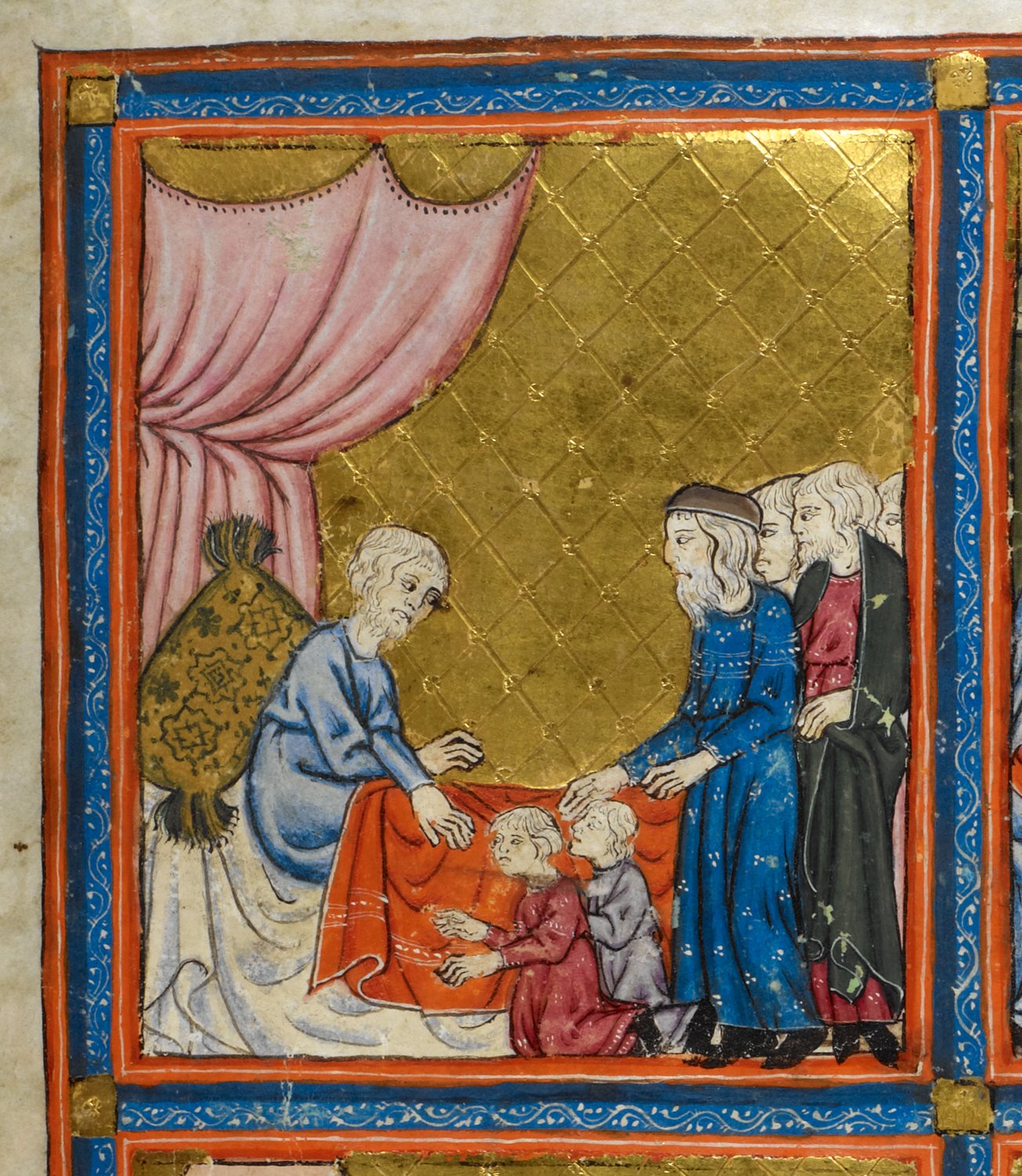
Jacob Blessing Ephraim and Manasseh, miniature on vellum from the Golden Haggadah, Catalonia, early 14th century, at the British Library, London

It is hard not to smile at the irony. The name Jacob is bound up with grasping and twisting — the heel-grabber, the supplanter. The one who once twisted his way into stealing a blessing from his brother Esau, now twists his own arms to give one. The old twister twists again — but this time not to steal, not to secure advantage for himself, but to bend the future toward the overlooked.

Genesis has been rehearsing this pattern from the beginning. Abel over Cain. Isaac over Ishmael. Jacob over Esau. Joseph over his brothers. And now Ephraim over Manasseh.

This is not randomness. It is theology.

God’s blessing does not run along the straight lines of primacy, status, or expectation. It bends. It crosses. It interrupts the obvious.

For those who are first, secure, established, this is unsettling. For those who are second, small, despised, or displaced, it is life.

Read this way, Genesis is not primitive folklore. It is dangerous scripture.

It belongs to the Torah — to a people who would know slavery, exile, homelessness; who would know what it is to be second best. It is instruction for living under empire. It is a memory bank for those whose lives do not follow the straight lines of power. Again and again it whispers: the story is not over when you are overlooked. The blessing may yet cross in your direction.

No wonder such texts can be domesticated. If the Old Testament can be caricatured as angry, obsolete, or morally inferior, its critique of hierarchy is neutralised. If it is reduced to a foil for a gentler New Testament, its radical edge is blunted.

But Jesus does not stand over against this story. He stands within it.

When he speaks of the last being first and the first last, he is not inventing a new moral universe. He is speaking Torah-deep truth. When Mary sings of the proud scattered and the lowly lifted, she is echoing the long music of Israel. When the kingdom is announced as good news to the poor, it is not a departure from Genesis but its flowering.

The rule of the kingdom of God crosses old hierarchies. It must – if the second best, the left out and despised are to find favour.

That does not mean the first are hated or the strong despised. The point is not revenge. The crossing of hands is not retaliation; it is freedom. God is not bound by our ranking systems. Blessing is not the private property of the powerful.

Perhaps that is why Genesis ends gently. Because beneath its betrayals and famines and rivalries runs a deeper current of mercy — a God who keeps bending history toward life.

A God who crosses his hands.

And for those who have lived too long on the left side of the room – left behind, left out – that is not merely interesting theology. It is hope. It is radical gentleness.

This week’s clection: a community gathered round a hashtag

JobTo make some of us who say Morning Prayer on our own accountable, we gather our thoughts using Twitter #cLectio – some are now using Facebook too. It is a company I find helpful. I look forward to our daily posts, some of which are quite challenging. Hashtag cLectio was the brainchild of friend and colleague @theosoc Christopher Burkett. #cLectio stands for the (Revised) Common Lectionary – that’s the “c”, see? The lectionary lists readings for worship for each day of the year.  (There’s an app for daily prayer using the lectionary readings.)

Posts are often our first thoughts, sometimes our only thoughts, and other times they’re more thoughtful. Anyone can join in, either daily or occasional. At the moment we are reading through the book of Job. This is an amazing piece of ancient literature which is a sustained reflection on suffering, faith and friendship: questions which remain contemporary through the ages.

In this week’s clection we’ve been gobsmacked by Job’s friend, Eliphaz. Alan Jewell, @VicarAlan, scoffed: “With friends like Eliphaz ….” while Christopher complained “Eliphaz really gets to me, I so dislike what he says”. Eliphaz’s windy words and miserable comfort have made us reflect on what we say and how we respond to suffering and grief – thoughts made more urgent with events at Grenfell Tower and Finsbury Park.

We’re not meant to like Eliphaz and his words warn us off from being a friend like him. My “clection of the day” yesterday arose from some of Eliphaz’s words from the appointed reading, Job 15.

Your sin prompts your mouth;
you adopt the tongue of the crafty.
Your own mouth condemns you, not mine;
your own lips testify against you.

How very dare he? In fact, it’s these windy, wounding words that condemns Eliphaz to the readers’ ridicule. But there is a truth in what Eliphaz says. Our “sin” does prompt our mouths and we do utter our attitudes. We have a proverb that says that eyes are the windows of the soul. But if we speak from the heart what we say is also a reflection of our heart and soul.

So I got to pray:

Job15

And I remembered the question raised by Malcolm Guite in a poem from his Singing Bowl:

What if every word we say
Never ends or fades away,
Gathers volume gathers weigh,
Drums and dins us with dismay
Surges on some dreadful day
When we cannot get away
Whelms us till we drown?

What if not a word is lost,
What if every word we cast
Cruel, cunning, cold, accurst,
Every word we cut and paste
Echoes to us from the past
Fares and finds us first and last
Haunts and hunts us down?

What if every murmuration,
Every otiose oration
Every oath and imprecation,
Insidious insinuation,
Every blogger’s aberration,
Every facebook fabrication
Every twittered titivation,
Unexamined asservation
Idiotic iteration,
Every facile explanation,
Drags us to the ground?

What if each polite evasion
Every word of defamation,
Insults made by implication,
Querulous prevarication,
Compromise in convocation,
Propaganda for the nation
False or flattering peruasion,
Blackmail and manipulation
Simulated desparation
Grows to such reverberation
That it shakes our own foundation,
Shakes and brings us down?

Better that some words be lost,
Better that they should not last,
Tongues of fire and violence.
O Word through whom the world is blessed,
Word in whom all words are graced,
Do not bring us to the test,
Give our clamant voices rest,
And the rest is silence.

I am so grateful for the #cLectio community.

The Mother and Father of all Song: The Song of Songs

the_kiss_-_gustav_klimt_-_google_cultural_institute
The well known “The Kiss” (1907-08) by Gustav Klimt (in a garden, wrapped in gold)

I don’t count myself a “biblical scholar”. When I come to my daily reading from the Old Testament it is often as if I am reading the section for the first time. (Along with others I tend to tweet my naive responses with the #cLectio hashtag, here, here, here, here and here.) My current intrigue is with the Song of Songs, a tiny book of love poetry. And it is as if I am reading it for the first time. I guess it has always been a closed book to me – closed because of its reputation and the manner of its interpretation possibly as a consequence of its reputation. By reputation it is highly erotic and “saucy”. I’d prefer the description “absolutely delightful”. I wonder if a sense of embarrassment has led to its allegorical interpretations shared by synagogue and church which sees the poetry referring to the love of God for his people. Have such interpretations demeaned the text?

Some people will be surprised the Song of Songs is included in our scripture because there is no mention of God and the content is highly erotic. The Song of Songs is the title of the book. It is a superlative title indicating that this Song is very special. Colloquially we could say that this is the “mother and father of all song”. There are two speakers who are lovers. Later readers have named them Solomon (even David) and “the Shulammite” (someone from Jerusalem which translates as “the place of peace”). Allegorical interpreters have called one of the lovers “God” and the other “Israel” or “Church”. Personally I don’t see why we need to rush to their naming and I have preferred to leave them to themselves as two lovers. One of them, the maiden, has her confidantes. They are “daughters of Jerusalem”. They stand by. They have a view but no say. They stay as readers and celebrants. I have chosen to join them.

To me the couple are young lovers and with the Daughters of Jerusalem we are privileged to watch love building through them. My reading may have been influenced by Trevor Dennis (here is reason why we should reading him) who finds reason to call Adam and Eve children in his reading of Genesis. There are so many references to a garden in the Song of Songs that I couldn’t help going back to the Garden of Eden, to the boy and the girl we find in paradise. We have to be sorry the way they turned out (and the way they were turned out). I can’t help wondering whether The Song of Songs is dreaming a happy ending, building in love rather than falling in love.

In Imagining God Dennis imagines this “childs’ play”:

One hot afternoon Adam and Eve, unselfconsciously naked, sat on the bank of one of the rivers of Eden, dangling their feet in the water. Eve picked up a flat, round stone, stood up and flicked it in twelve graceful bounces right across to the other side.

‘Who taught you to do that?’ asked Adam.
‘God did.’
Adam turned towards God. ‘Did you really?’
‘Yes.’
‘Could you teach me?’
‘Of course. Watch.’

God stood up, chose a stone carefully, kissed it, curled his finger round it, and, with a movement of his wrist too quick to catch, sent it spinning downstream. It went almost as far as Adam and Eve could see, then swung round in a tight circle and came speeding towards them again, till with one last bounce it skipped back into God’s hand. It had hit the water two hundred times, and had left two hundred circles spreading and entwining themselves upon the surface. From the middle of each circle a fish leaped, somersaulted, and splashed back into the river.

‘Now you try!’ said God. Adam pushed him into the water. God came to the surface a few yards out from the bank. ‘That was level ten, by the way,’ he called. ‘Eve’s only at level two at the moment, aren’t you Eve?’ ‘You were showing off, God,’ said Eve. ‘You’ll be walking on the water next!’ ‘That’s level twenty,’ laughed God, and promptly disappeared beneath the surface.

So it was once in Eden. So it can be still. So it is, on rare and precious occasions. But Adam and Eve complicated matters. They grew up to think flicking stones child’s play. They turned in upon themselves, and God remained out of sight, beneath the surface. They did not sit with him on the bank any more. Now and then, realizing their loneliness and overcome with sudden longing, they would gaze out across the water and see the ripples he left behind. But these were soon gone, and the water would resume its customary smoothness, as if nothing had happened, as if he had never been there.

There are so many beautiful images in this Love Song of Love Songs. It is spring time, a time for building love’s nest. The references to spring signify love that is young, lovers for whom relationship is a novel and delicious mystery.

My beloved speaks and says to me:
“Arise, my love, my fair one,
and come away;
for now the winter is past,
the rain is over and gone.
The flowers appear on the earth;
the time of singing has come,
and the voice of the turtle-dove is heard in the land.
The fig tree puts forth its figs,
and the vines are in blossom;
they give fragrance.
Arise, my love, my fair one,
and come away.”
Song of Songs 2:10-13

The song is soaked in pleasant images, images that are so sensual. They are images of body and bed, field and garden. The whole of creation seems to behind their love and a rich harvest is the outcome of their love. With the Daughters of Jerusalem and with the young lovers, we are allowed into a special world. For me, this is a creation story: the mother and father of so many love songs.

(And, of course, it reminded me of another garden, the strange meeting of two people there and the love that never goes cold between them.)

Mary stood weeping outside the tomb … As she wept, she bent over to look into the tomb; and she saw two angels in white, sitting where the body of Jesus had been lying, one at the head and the other at the feet. They said to her, “Woman, why are you weeping?” She said to them, “They have taken away my Lord, and I do not know where they have laid him.” When she had said this, she turned round and saw Jesus standing there, but she did not know that it was Jesus. Jesus said to her, “Woman, why are you weeping? For whom are you looking?” Supposing him to be the gardener, she said to him, “Sir, if you have carried him away, tell me where you have laid him, and I will take him away.” Jesus said to her, “Mary!” She turned and said to him in Hebrew “Rabbouni!” (which means Teacher).                           John 20:11-16

Love has created a world of its own – always has done, always will.

The text of the Song of Songs is laid out here.